If you are an artist, a collective, or a small community group trying to get a few thousand dollars for a project, this is how to apply for a small arts grant: confirm you are eligible, define the project, build a budget you can defend, write a short narrative, then submit a compact packet before a hard deadline. Expect 15 to 25 hours of work, most of it thinking rather than typing.
The people who win small grants are rarely the best-known names in the room. Panels reward a clear project, a believable budget, and an applicant who knows exactly what the money pays for.
Table of Contents
What You Need
Most small arts grants ask for the same handful of materials. Gathering them before you start writing saves hours later, because the narrative and the budget reference the same facts.
Start with eligibility. It is the cheapest thing to check and the fastest way to waste a month. Most funders ask whether you are an individual, a project with a fiscal sponsor, an LLC, or a registered nonprofit, and whether you live or work in a specific area.
| How you apply | What funders usually need | Common snag |
|---|---|---|
| Individual artist | Work samples, CV, project statement, personal budget | No organizational history, so the project has to carry the case |
| Unincorporated collective | Membership list, group statement, proof of past activity | Many nonprofit-only calls exclude you outright |
| LLC | Business registration, project plan, budget | Arts funders rarely fund for-profit entities |
| 501(c)(3) nonprofit | Determination letter, EIN, board list, IRS Form 990 | Start-up groups often have no Form 990 yet |
| Fiscally sponsored project | Sponsor agreement, sponsor EIN, project budget | Sponsor fees eat into a small award |
Have these ready before you write anything:
- Project basics. What the project is, when it happens, where, who takes part, and how many people are involved.
- Work samples. Three to five pieces that match the medium of the project, not just your favorites.
- A short bio and CV. One paragraph of bio, then a one-page CV with exhibitions, residencies, commissions, and prior awards.
- Real cost numbers. Quotes for fabrication, materials, space rental, sound, or printing. Estimates beat guesses.
- Administrative details. Legal name, address, email, phone, tax status, EIN if you have one.
- Support letters. One or two from a venue partner, collaborator, teacher, or community partner who can vouch for the work.
If you have no nonprofit status, do not stop here. A fiscal sponsor is a nonprofit that agrees to receive the money on your behalf and handle the paperwork, usually for a fee in the range of three to fifteen percent of the award. Ask about it early so the fee is in your budget rather than a surprise after the award.
Step-by-Step: How to Apply for a Small Arts Grant
Read the Grant Announcement and Confirm Eligibility
The announcement is not a formality. It tells you the funding purpose, who may apply, which costs are eligible, geographic limits, the award amount, the deadline, and the required attachments.
Read the eligibility line first, then the expenses section, then the deadline. If anything is unclear, email the grant manager listed on the page and ask a specific question. Applicants on forums repeat this constantly: reading the actual guidelines or asking the funder directly resolves more uncertainty than any general advice article.
Watch for the funding model too. Some opportunities are first-come, first-served and deplete before the deadline, while others are reviewed on a fixed cycle. If the announcement says funds may run out, treat the date as a soft one and submit within a week of it opening.
Define the Project and Its Public Benefit
A broad idea cannot be scored. Turn it into a project with dates, a location, an audience, and an outcome.
The vague version reads: “a community-based performance series exploring identity and belonging.” The specific version reads: “three free evening performances for about 120 people at a rented community hall, followed by a facilitated discussion with local youth workers.” The second one can be budgeted, scheduled, and judged.
Panels are usually also looking for public benefit. Who attends, who benefits, why this matters here, and what is different after the project ends. A neighborhood arts group that can point to a real audience and a real partner has an easier time than a project that only describes itself in art terms.
Build a Realistic Project Budget
The budget is often the highest-weighted part of the review, and it is where inexperienced applications fall apart. It should look like what the project actually costs, not what you hope to receive.
| Line item | Example | Why it belongs here |
|---|---|---|
| Materials and fabrication | 1200 | Quoted from the fabricator, not guessed |
| Space rental | 450 | Hall, gallery, or green room, three evenings |
| Artist fees | 1200 | Paid to performers and collaborators |
| Accessibility and promotion | 300 | Interpreters, printing, captioned video |
| Administrative or indirect cost | 200 | Portion of your own overhead |
| In-kind contribution | 500 | Your own labor or donated equipment, counted only if asked |
| Total requested | 3350 | Cash from the funder, plus any required match |
If the funder requires a match, treat cash match and in-kind match differently. Cash match means money you actually have. In-kind means donated space, equipment, or your own unpaid hours, and many funders cap how much of it counts. State the match clearly and keep it plausible, because reviewers check.
Keep the request proportional to the project. Asking for ten thousand dollars for a two-day workshop reads as a plan that has not been thought through, while asking for a precise, modest number reads as one that has.
Prepare the Narrative and Supporting Materials
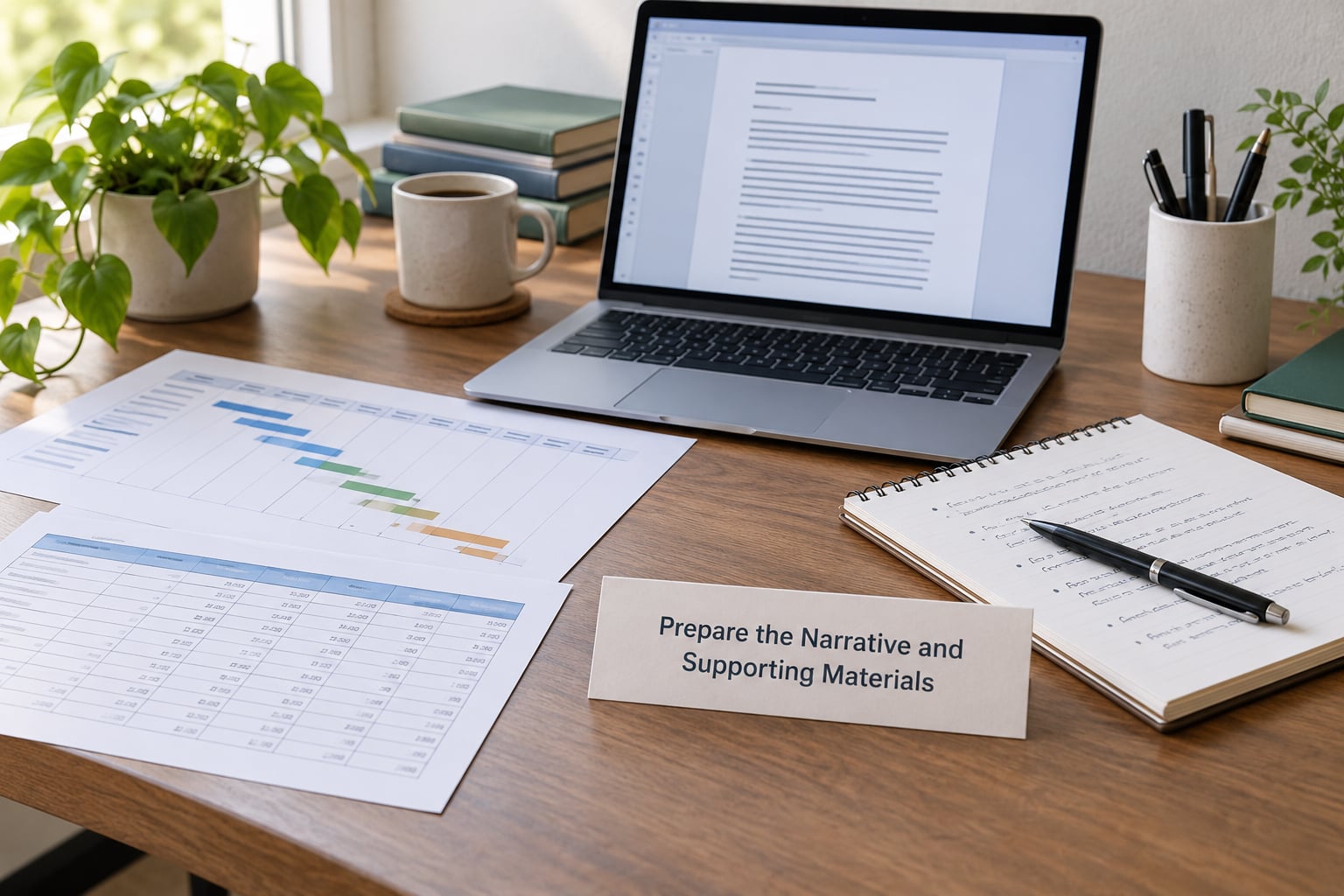
Most small arts grant applications want the same core documents: a project statement, an artist or organization bio, a CV, work samples, a timeline, a budget, and any required letters of support. Prepare them once, cleanly, and reuse the unchanged parts across applications.
The project statement is usually 500 to 1,000 words and follows a simple order: what you are making, who it is for, why it matters here, how it will happen, and what the audience will experience or walk away with. Write in the active voice, use strong verbs, and say “will” instead of “may” or “hopes to.”
Reviewers often say the same thing about failed applications: they simply could not understand the project. Concrete beats evocative every time.
Revise for Clarity and Funder Fit
Set the draft down for a day, then read it against the published criteria rather than your own intentions. Go through this checklist:
- Does each answer address the question as written, in the number of words or characters allowed?
- Could a reviewer who has never met you describe the project after one read?
- Did you remove claims you cannot support, such as reach numbers or partnerships nobody confirmed?
- Are the budget totals correct, and does the total in the narrative match the spreadsheet?
- Did you name dates, quantities, and partners where you could?
- Does someone outside the project understand it after reading it aloud to you?
Read the narrative out loud once. Sentences that trip you are the ones a tired panel will skip.
Submit Before the Deadline and Save Confirmation
Most portals want an account, a saved draft, and attachments with clean file names. Name files the way the guidelines ask, usually something like Lastname_ProjectName_Budget.pdf, and keep the same naming pattern across the packet.
Before you hit submit, confirm every required field is filled. Required fields often sit at the bottom of long forms, and a missing one silently voids the application.
Save the confirmation page, the receipt, or a screenshot of the submission screen with the date. If the portal gives you a reference number, put it in your calendar with the expected decision date. Then keep the whole packet in a folder so the reporting stage is easier later.
Follow Up and Plan for the Decision
Log every application in one spreadsheet: funder, deadline, amount requested, date submitted, decision date, and result. It takes two minutes and it stops you from applying twice or missing a follow-up.
If a funder asks for clarification, answer the actual question in one or two sentences and get it back quickly. Some funders will not consider a late clarification, which is unfair and common.
If you are declined, ask for one specific piece of feedback. Reviewers often cannot explain a panel decision, but a grants officer frequently will, and the answer is usually about clarity, cost realism, or fit with the funder’s priorities rather than the quality of the work.
Have a second project in mind. Rejection is common at this level, and the same material reshaped around a slightly different project often succeeds the next time.
Common Mistakes and How to Fix Them
- Applying to a funder whose priorities do not match the work. Fix: read the funding priorities section and the list of past recipients before anything else. If your project is not similar, move on.
- Writing a project description full of mood and no facts. Fix: for every sentence about meaning, add one about dates, numbers, people, or place.
- Submitting a budget built from a template. Fix: get at least two real quotes and rebuild the numbers from zero before submitting.
- Missing documents that were listed as required. Fix: use the checklist in the announcement and tick each item off before submitting.
- Ignoring the expenses the funder does not cover. Fix: read the eligible and ineligible costs sections carefully. Overspending on ineligible items is an easy way to be disqualified after award.
- Skipping the proofread. Fix: print the narrative, read it on paper, and have one other person read it once.
- Sending everything at the deadline hour. Fix: submit two to three days early. Portals slow down on the final day, and you lose the ability to fix a failed upload.
- Hiding gaps in your track record. Fix: be straightforward about a new group or a first project, and lean on partners, letters, and prior activity instead. Vagueness reads worse than a straightforward beginner.
Two habits cover most of these. Write one reusable master document per material, so each new application takes an afternoon instead of a week. And apply selectively: five well-matched applications usually beat thirty scattered ones.
Frequently Asked Questions
Do I need a 501(c)(3) to apply for a small arts grant?
No. Many small arts grants are open to individual artists, informal collectives and unincorporated groups, but each call states its own rules. Some funders fund only registered nonprofits and want a determination letter plus an EIN. If you have no nonprofit status, fiscal sponsorship is the usual route, and many artists apply successfully that way.
Can an LLC get grant money?
Sometimes, but rarely. Most arts funders award money to individuals, nonprofits or fiscally sponsored projects, and some foundations will not fund any for-profit entity at all. An LLC also cannot receive tax-deductible contributions. Ask the funder in writing before you build a budget around an LLC, because the answer changes the entire plan.
What is fiscal sponsorship?
Fiscal sponsorship lets a nonprofit organization receive and administer money raised for your project, under an agreement covering fees, responsibilities and exit terms. Sponsor fees commonly fall somewhere between three and fifteen percent of the award, so build that line into your budget. Model A and Model C agreements differ mainly in how the money arrives.
Can I use ChatGPT to write a grant application?
You can use it to tighten or restructure language you have already written, but the facts, numbers and commitments must be yours. Many funders now ask about AI assistance, and reviewers recognize a statement with no real detail in it. Read every line aloud, rewrite anything you would not say to a panel, and keep control of your budget figures.
Do you ever pay back a grant?
Normally no, because a grant is not a loan. You do commit to spending the money only on approved budget lines and to reporting on the outcome. The exceptions are funds conditioned on a match you failed to raise, and unspent restricted funds, which some funders require you to return.
How long does it take to hear back on an arts grant application?
Allow six to twelve weeks for most city and foundation small grants, and sometimes three months from deadline to decision. The announcement should state its own timeline, and that is the figure to trust over anything posted in a forum. If the deadline has passed and nothing is posted, email the grants office rather than guessing.
Conclusion
Pick one opportunity that fits your project and read the eligibility line before you fall in love with it. Confirm you qualify, define the project in specific terms, build the budget from real quotes, and reuse a set of clean supporting documents.
Then email the grant manager with your one real question, revise against the published criteria, and submit a few days early. That sequence is the whole process, and it works for a first-time applicant with no track record just as well as it does for an established group.