
A career change resume is not a lie dressed up in new words. It is the same working history, reorganized so a hiring manager in a different industry can see proof of your value within a few seconds. Knowing how to write a resume for a career change means naming the destination role, translating what you already did into results, and presenting it in a format that does not pretend your gaps or your unconventional path are something to hide.
Most people get stuck at the summary paragraph, rewriting the same three sentences for weeks. That is usually because they start from job titles instead of from accomplishments. Start from what you can prove, and the rest falls into place. This guide walks through the whole process in nine steps, with examples you can adapt tonight.
Budget two to three evenings for the first draft and about fifteen minutes per application after that. Difficulty is moderate; the hard part is honest reframing, not formatting.
Table of Contents
- What You Need Before You Draft
- Step-by-Step: How to Write a Resume for a Career Change
- Step 1: Choose a Target Role and Research the Job
- Step 2: Pick a Simple, Appropriate Resume Format
- Step 3: Write a Summary That Bridges Both Careers
- Step 4: Translate Experience Into Transferable Evidence
- Step 5: Build a Skills Section That Matches the New Field
- Step 6: Address Employment Gaps, Industry Gaps and Career Breaks
- Step 7: Tailor the Resume for Every Important Application
- Step 8: Proofread, Format, and Get Feedback
- Step 9: Catch the Mistakes That Cost Interviews
- Common Mistakes and How to Fix Them
- Frequently Asked Questions
- What if I have no experience in the new field?
- How do you explain a career change on a resume?
- How long should a career-change resume be?
- Should I include an employment gap on my resume?
- What transferable skills should I list for a new career?
- How do I tailor a resume to a specific job without rewriting it every time?
What You Need Before You Draft
Gather this material before you open a blank document. It saves a lot of backtracking.
- One target role, ideally one job title you would happily be doing two years from now, plus a second and third as backups.
- Three to five saved job descriptions for that target role, from different employers, so you can see what repeats.
- Your full responsibility list for every role in the last ten to fifteen years, including the unglamorous parts.
- Numbers: revenue handled, headcount supervised, volume processed, turnaround time, error rate, retention percentage, budget size, event attendance, wait times, whatever applies to your field.
- Education and credentials, plus any training, certificates or licenses you hold, with the year and the issuing body.
- Exact dates for every position, including months, so you can spot gaps on your own timeline.
- Contact details: full name, city and state, email, phone number, and a LinkedIn URL that matches the resume.
- A transferable skills list written in plain language, ten to fifteen items, not yet dressed up for any industry.
- Tools and systems you have used: project trackers, spreadsheets, CRM platforms, scheduling software, design tools, language skills.
On length: a career-change resume is usually one page if you have under ten years of experience, and two pages if you have more, plus a gap story that needs room. Some industries and countries expect two pages as the default for experienced people, others still treat one page as the rule. When you are unsure, match the convention of the companies you are applying to.
Read a few strong resumes in your target field before you write. Job seekers on Reddit’s r/resumes and r/careerguidance threads frequently point out that the fastest way to fix a weak draft is to copy the structure of a resume that already works in that industry, not the one you had before.
Step-by-Step: How to Write a Resume for a Career Change
Step 1: Choose a Target Role and Research the Job
Pick one realistic target role, then break three job descriptions into columns: duties that repeat, qualifications that repeat, tools named, and the industry language they use. Save the words they use. A posting for a warehouse shift lead talks about cycle counts and slotting accuracy; if you are aiming at operations coordination, those same terms belong on your resume.
Then sort every requirement into two piles. Requirements in the first pile need direct evidence, and if you lack it you either fill the gap with a project, a certificate, or a course, or you accept that this posting is a stretch. Requirements in the second pile can be met with transferable evidence, and those are where your old experience does the work.
You will know this step worked when you can name the top five requirements in the posting and point to a specific line on your draft for each one.
Step 2: Pick a Simple, Appropriate Resume Format
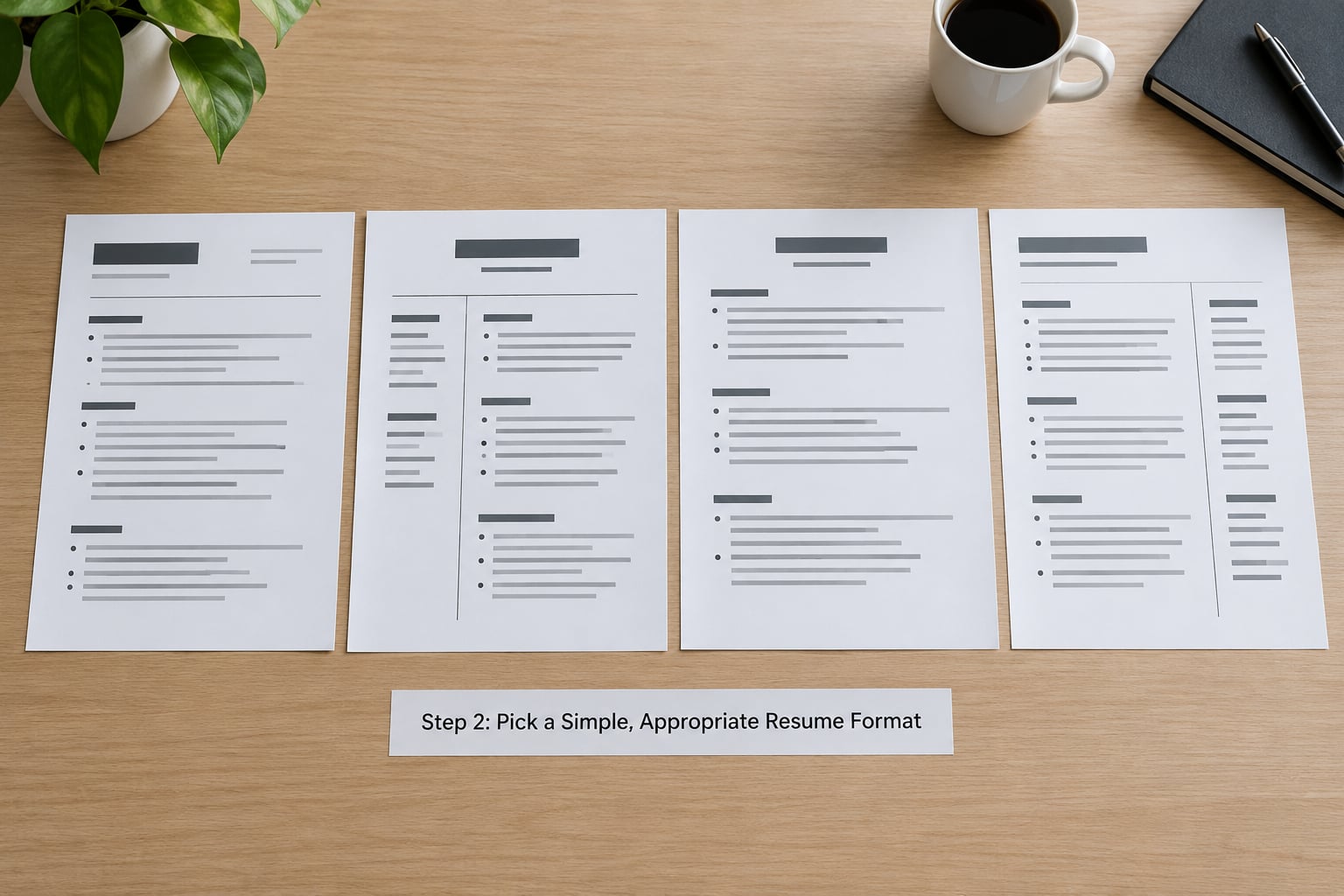
Chronological, functional, or hybrid: here is the honest comparison. Most career changers land on hybrid, and a skills-only resume is the one most recruiters distrust.
| Format | How it is ordered | Best for | Watch out for |
|---|---|---|---|
| Chronological | Most recent job first | Continuous history in one field, and most government and corporate applications | Exposes a career break immediately, since the date column cannot hide anything |
| Functional (skills only) | Skills grouped first, employers listed briefly underneath | Almost nobody, and rarely a good idea | Many recruiters read it as job hopping or an attempt to obscure a short history |
| Hybrid (combination) | Brief relevant experience section, then a skills section that leads with the transferable stuff | Most career changers, including people with varied or non-linear work histories | Needs tight editing so the experience section does not swallow the page |
Hybrid wins because it tells the truth and still leads with relevance. You show dates and employers honestly, then organize your skills and your most relevant bullets so the transferable work appears first. Recruiters on r/resumes say over and over that the format matters far less than whether the first third of the page speaks the target industry’s language.
Reverse-chronological is the standard for both chronological and hybrid layouts, with the possible exception of government applications, where some agencies ask for reverse order by relevance instead. Check the posting.
Step 3: Write a Summary That Bridges Both Careers
Three or four sentences: where you are now, where you are going, the two or three strengths that travel with you, and one number that proves it. Write it last, after the bullets, because the evidence comes first.
A career changer moving from event production into client services might write: “Nightlife and events manager with six years running live programming for audiences averaging 400 per night. Now moving into customer success, bringing six years of de-escalation under pressure, vendor negotiation, and repeat-guest retention work. Cut no-show rates 22% through prepaid ticketing and follow-up scheduling. Comfortable with Salesforce, and used to hitting service targets on nights when everything went wrong.”
The same formula works for readers who come from a different background. Someone moving from nonprofit program coordination into corporate training might write: “Program coordinator with eight years designing youth workshops across six community sites. Moving into corporate learning and development, bringing curriculum design, facilitation, and grant-funded budget management. Built a volunteer bench of 40 facilitators across three states. Comfortable with adult learning styles and LMS platforms.”
Both summaries name two worlds, three transferable strengths, and one measurable result. Notice that neither one leads with identity or with the reason for the switch. You can absolutely mention your community or your motivations where they are genuinely relevant, especially in an LGBTQ+ community organization, a Pride event team, or a role where lived experience is part of the work, but it should never be the only thing on the page. Hiring managers want to know what you will do on day one.
Step 4: Translate Experience Into Transferable Evidence

Duties describe what you were near. Results describe what changed because you were there. Rewrite every bullet in the shape of action verb, context, result, using a number whenever one honestly exists.
Weak: “Responsible for handling customer complaints and resolving issues.”
Strong: “De-escalated 60-plus angry guests a month during sold-out events, resolving 94% on first contact and cutting refund requests by a third.”
Same job, same person, completely different signal. The second version is usable in customer success, guest relations, support operations, and account management, because the result travels and the industry label does not.
If you cannot find a number, use scale instead: team size, budget, number of locations, number of accounts, weekly volume, deadline pressure, span of control. Scale is a real number too.
Step 5: Build a Skills Section That Matches the New Field
Group skills under evidence-based headings rather than a generic list. Headings like “Program and Project Operations”, “Customer Communication”, and “Tools” tell a reader where to look, and they let you place the target industry’s vocabulary in the section where it belongs.
Under each heading, include hard skills, named tools, interpersonal abilities, and industry knowledge separately. Someone coming from military to civilian work might list “Scheduling and roster management” rather than “organization skills”, and name the specific systems they used.
Map each requirement from the target posting back to somewhere real: a job, a volunteer role, a course, a degree project, or something you built for yourself. If a requirement has no home anywhere, that is an upskilling decision, not a resume writing decision.
Step 6: Address Employment Gaps, Industry Gaps and Career Breaks
Never hide a gap by faking an end date. Recruiters check, and a false chronology reads as deception rather than privacy. Instead, address it in one neutral line and move on.
Some phrasing that works: “Parental leave, two years” or “Career break, caregiving”. For a health-related absence, “Extended medical leave, 18 months, returned to full-time work”. For freelancing, list it as work with dates and clients. For a period with no activity, use “Personal and family commitments” and give the months.
A gap of six months or less usually needs no mention at all. Longer gaps want one line. Two years or more deserves a line plus something that shows you are still active: freelance work, volunteer work, a course, caring for a family member, or a relevant certification.
People in r/careerguidance raise the same worry repeatedly, that a gap reads as a red flag. It can, if you leave it unexplained. One honest sentence removes most of the weight, and over-explaining it in the summary puts the focus on the wrong thing.
Step 7: Tailor the Resume for Every Important Application
Keep one master resume. For each serious application, run the same fifteen-minute routine: rewrite the summary’s target-role sentence, reorder the skills section so the top three headings match the posting’s top three requirements, swap two or three bullets for closer matches, mirror the posting’s exact terminology where it is accurate, and reorder the education and credentials section to match what they emphasize.
Use the focus keyword exactly as people search it when it fits naturally, here that means writing a resume for a career change and naming it as your goal once in the summary and once in a closing note, rather than repeating it in every heading.
Keyword stuffing is the fastest way to look like spam to both a recruiter and a screening tool. If a phrase does not describe something you actually did, leave it out.
Step 8: Proofread, Format, and Get Feedback
Name the file like this: Firstname_Lastname_CareerChange_Resume.pdf. A sloppy filename costs nothing, but a generic one like resume_final_v3_REAL.pdf looks careless before anyone opens it.
Keep margins around one inch, use one readable font at a normal size, and make sure dates and contact details are consistent from top to bottom. Avoid columns, text boxes, and graphics, because many applicant tracking systems parse them badly or not at all. Save as PDF unless the posting asks for a Word document, and build the file so that selecting and copying your text gives you clean, readable sentences.
Then edit twice. The first pass is for content, cutting anything that does not support the target role. The second pass is for typos, spacing, and dates. After that, send the file to one person who actually works in the field you are targeting and ask one question: what did you assume about me that is not on the page?
Step 9: Catch the Mistakes That Cost Interviews
Before you send, read for six problems: a job title list with no results anywhere, a summary that describes duties instead of value, a skills section made of words like “hardworking” and “team player”, a cover story of jobs that never connect to the target role, unexplained date gaps, and the same paragraphs pasted into every application. Fix what you find, then send.
Common Mistakes and How to Fix Them
Rebranding yourself into a lie. Listing a title you never held, or claiming years of experience you do not have, gets you found out during the first interview and sometimes reported. Fix: describe what you did using accurate titles and the language of the target industry, not invented labels.
Keeping unrelated early jobs at the expense of relevance. Fifteen-year-old work history crowds out the bullets that matter. Fix: go back roughly ten years for most fields, and keep earlier roles only when they show genuine progress or explain a long gap.
Listing generic transferable skills. “Adaptable, dependable, team-oriented” tells a reader nothing. Fix: replace each adjective with a behavior plus a result, such as “led a six-person team through a venue remodel with no lost operating days”.
Hiding a gap by editing the dates. Fix: one neutral line, with a truthful activity attached when the gap is long.
Refusing to quantify anything. Fix: numbers, then scale, then a named project. If nothing applies, say what you did instead of how often you did it.
Pasting the job description back at the employer. Mirror their requirements only where they match your real history. Copying sentences reads as filler, and a screening tool will not reward it.
Trusting a skills-only format to hide an uneven history. It does not hide it, it just makes people suspicious. Fix: use a hybrid layout.
A few situations need different handling.
- Changing fields at 45 or 55. Lead with results and length of impact, not years of schooling. Two pages is usually fine. Do not list every job from two decades back.
- Coming back after a long absence. Rebuild the most recent section first with anything paid, freelance, or volunteer, then move backwards.
- Building a portfolio while working a bridge job. List the bridge role for the income and stability, and give two or three bullets to the portfolio projects so the resume is not only about survival work.
- Applying while still employed. Use a functional-style skills summary that does not announce your availability, and put your notice period in the cover letter.
- Feeling overqualified for an entry-level role. Do not argue seniority in the resume. Emphasize the part of the job you actually want and the specific reason you are choosing it.
- Coming from a trade, the military, or hands-on work. Translate supervision, safety, scheduling and equipment into office vocabulary without pretending the experience was office-based.
Frequently Asked Questions
What if I have no experience in the new field?
Lead with adjacent evidence. Name the tasks in the new posting that you have already done somewhere else, and write those bullets with results. Add proof for the rest: a relevant certificate, a portfolio project, a short-term course, volunteer work, or an internship in the field. Recruiters hiring at the entry level are usually buying a specific skill plus the confidence to use it, and both can be evidenced outside a job title.
How do you explain a career change on a resume?
In two or three sentences in the summary, and more fully in the cover letter. Name where you are coming from, the role you want, the reason that moves you, and the specific strength that carries over. Keep it forward-looking and concrete. A confident factual line reads far better than a long apology or an anecdote about a bad day at your last job.
How long should a career-change resume be?
One page is the safe default under roughly ten years of experience, and two pages is normal for longer careers, especially when the history is varied or includes a gap that needs a line of explanation. Never cut relevant accomplishments to hit a page count. If you land on two pages with no filler, two pages is fine for most private sector and many nonprofit roles.
Should I include an employment gap on my resume?
Yes, with honest dates and one neutral line, because an unexplained hole invites the reader to imagine the worst. Six months or shorter rarely needs a mention. Longer gaps get one line, and gaps of two years or more should be paired with something real and current such as freelance work, volunteering, caregiving, or a completed course.
What transferable skills should I list for a new career?
List skills that travel: managing people, budgets, schedules, customers, projects, deadlines and vendors, plus the tools you used and the industries you understand. Write each one as a behavior with a result rather than a bare adjective. The strongest version pulls its wording from the target job description, using their terms for things you genuinely did.
How do I tailor a resume to a specific job without rewriting it every time?
Keep one master version and adjust a fixed set of parts: the target-role line in the summary, the order of the skills headings, two or three bullets, and the terminology you use for matching duties. Spend about fifteen minutes per serious application. That is usually enough to raise your match without producing a document that reads as assembled in a hurry.
Start tonight by writing your ten most relevant accomplishments, each with a number or a scale, in a plain list with no formatting. That list is the raw material for everything else, and it takes about forty minutes. Once it exists, the summary and the skills section follow quickly, and the resume takes shape on its own.