
How to change your name after marriage in the US comes down to one question: does your marriage certificate already show the name you want to use? If it does, no court is involved. You take a certified copy to the Social Security Administration, then to the DMV, then to your bank, employer and passport office. If it does not, because you are combining surnames or inventing a new one, you petition your local court for an order first and use that order everywhere instead.
Most people finish the administrative route in two to six months. The court route adds weeks to months, mostly waiting. The single biggest cause of rejected applications is a mismatch between records, so the order you update first matters: Social Security, then your driver’s license, then everything downstream.
Two things worth saying up front. US law does not require anyone to change a name when they marry, so keeping, hyphenating, blending, or replacing a surname is entirely your call. And same-sex and trans couples should know that the route through marriage certificates is not designed with them in mind in many states, which is why the court petition gets real attention below.
This is general information about a process that varies by state and county and changes from time to time. Your state’s court self-help center and county clerk will have the current forms and fee schedule.
Table of Contents
- What You Need
- Step-by-Step: How to Change Your Name After Marriage
- 1. Choose and confirm your new legal name
- 2. Get certified copies of your marriage certificate
- 3. Prepare and file your court petition
- 4. Complete the hearing and receive the final order
- 5. Update Social Security and driver’s license records first
- 6. Update the remaining accounts and records
- Common Mistakes
- Frequently Asked Questions
- Does getting married automatically change your legal name in the US?
- Do I need to change the name on my birth certificate after marriage?
- Can I use a hyphenated, blended, or completely different last name?
- How much does it cost to change your name after marriage, and can a hearing be waived?
- What should I do if an old name still appears on my tax, bank, or employment records?
- How long after marriage should I start the name change process?
- Start with Your State’s Rules
What You Need
The exact process varies by state, so the list below is what you will usually need rather than a guarantee for your county. Some states handle a marriage-based name change entirely through the DMV, some require a court order for nearly every change, and a few sit in between.
- A valid marriage certificate or license. Most agencies want a certified copy, not the decorative one your officiant handed you. Some will accept a marriage verification letter from the county clerk instead.
- Proof of your current identity. A current driver’s license, state ID, or passport is what ties your present name to the record you are updating.
- The intended new name, written out. Decide whether you are taking a spouse’s surname, hyphenating, blending two names into one, using a maiden name as a middle name, or starting fresh.
- Petition forms, if a court order is required. Most state court systems publish a standard packet, often called a petition for change of name.
- A filing fee. The amount is set by the court and waived in many counties on request if you cannot afford it.
- State-specific extras. Publication in a newspaper, a waiting period, a background check, or a hearing even when nobody objects.
It helps to separate two routes clearly. If your marriage certificate carries your new name, you are on the administrative route: Social Security, DMV, passport, then everyone else. If your certificate does not carry it, you need a court-ordered name change, and that order becomes the proof you use for every record afterward.
That distinction matters for LGBTQ+ couples specifically. Where same-sex marriage was once the only path to a shared name, some states still route everything through a petition, and in a handful of jurisdictions a marriage that was not legally recognized can leave a couple needing a full court petition on the merits rather than a marriage-based change.
Step-by-Step: How to Change Your Name After Marriage
The sequence runs from choosing the name to confirming that the change is reflected everywhere. Marriage itself does not update a single record, and state rules control the court portion.
1. Choose and confirm your new legal name
Start by writing down your intended name in the exact format you want on your documents, then check it against the format your state requires before you file anything. Courts and agencies care about spelling, spacing, and punctuation, and a petition that says Smith-Jones when your license says Smith Jones creates friction for years.
Think about how the name interacts with the rest of your life before committing. It shows up on professional licenses, employer records, bank accounts, insurance policies, a passport, and any international travel bookings, so people who hold immigration petitions or applications in progress should check how a name change interacts with those filings before starting.
Family naming traditions are worth a conversation too, particularly when both partners are changing, when one partner’s surname carries baggage the family wants to leave behind, or when you are blending rather than replacing. Couples on r/TwoXChromosomes describe the process itself as unremarkable and the paperwork load as the real burden, and that is the part to plan for.
2. Get certified copies of your marriage certificate
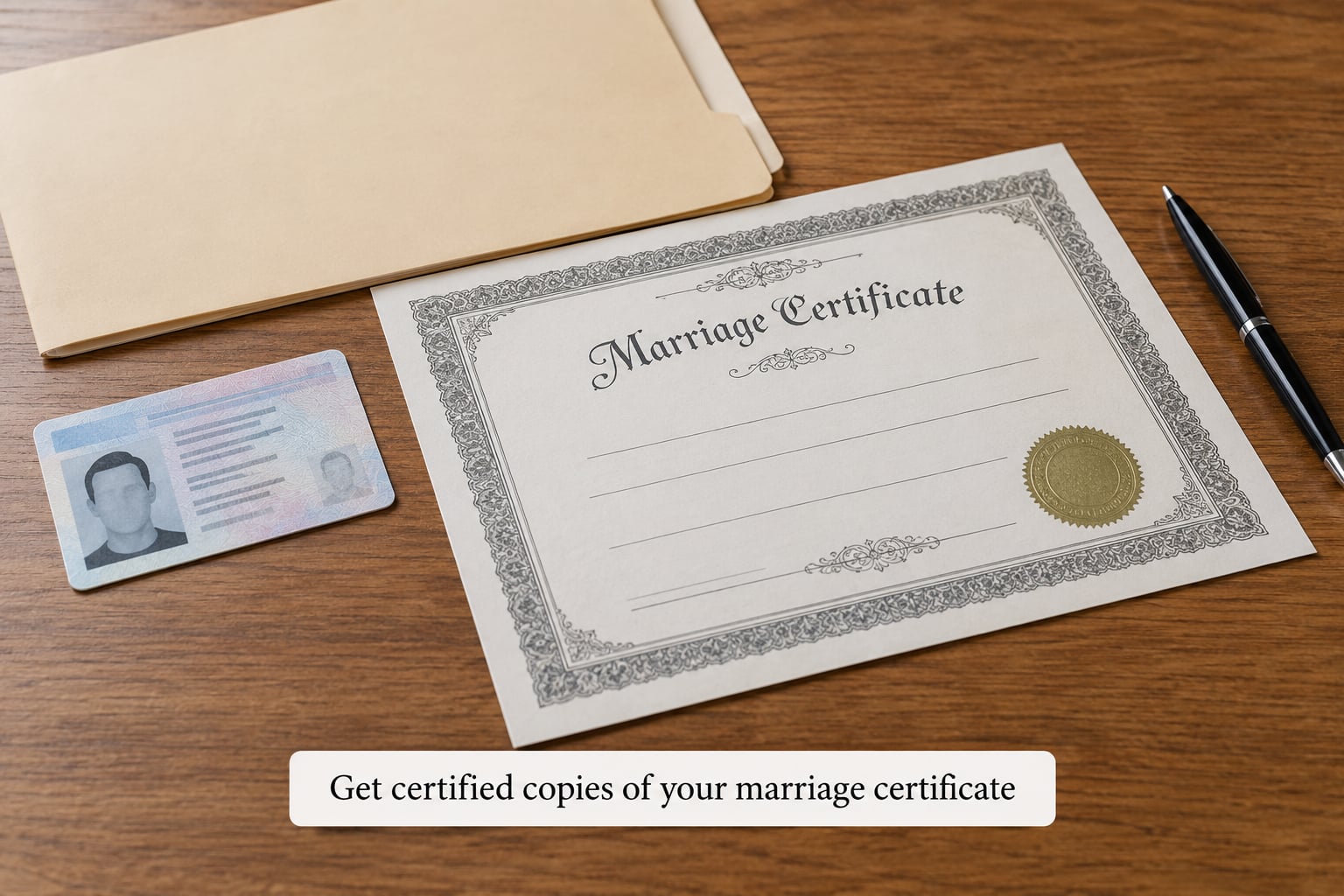
Order certified copies from the vital-records office or county clerk in the county where the license was filed, not from the wedding website and not from the copy your officiant signed. A certified copy carries a raised seal or registrar’s stamp, and courts and federal agencies routinely reject photocopies, printouts, and apps that only scan the document.
Order more than one. Every agency wants its own original or certified copy, and people regularly discover this after their first submission has already been mailed. Three to five copies is a sensible number for a couple updating banks, an insurer, an employer, and a passport application at the same time.
Allow a few weeks from the wedding date. The certificate has to be recorded and then certified, and the office that issues it is usually the one with a backlog right after summer wedding season. If it is delayed or unavailable, ask the clerk whether a marriage verification letter will work in the interim, and check whether your state requires filing in the county where you currently live if you married somewhere else.
3. Prepare and file your court petition
You need a court petition when your certificate does not already carry the new name, or when your state requires an order for any name change. Filing means submitting a petition in the court for the county where you live, with the forms that court provides, the required signature, and the filing fee.
The petition asks the court to change your name from your current legal name to your intended one, and it states why. A marriage certificate is strong supporting evidence, and in states that allow a marriage-based petition it is often the core of the case, but marriage alone is not the decision everywhere. Some states let a judge approve the change because two people married; others require the petitioner to state a reason beyond the marriage.
Expect a few moving parts. Some courts require the petition to be published in a local newspaper or posted at the courthouse. Some check for outstanding judgments, unpaid taxes, or an active bankruptcy, which can delay or block the petition. Filing a waiver of appearance can remove you from an in-person hearing in some counties, and asking about a fee waiver at the same time as you file costs nothing.
4. Complete the hearing and receive the final order
Most name-change petitions are uncontested, so the hearing is short and nobody opposes you. After filing you may wait weeks for a date, and some courts set the hearing well after filing rather than at the first available slot.
At the hearing, a judge confirms your identity, asks why you want the change, and asks whether the name is for any improper purpose. Bring the certified marriage certificate and your photo ID. Some counties now allow a video appearance, which matters a great deal if you work full time, travel, or live far from the courthouse, and a growing number of courts will resolve uncontested petitions on the paperwork alone.
Before you leave, read the final order carefully. Check that the former name and the new name are spelled exactly as they should be. Then order several certified copies of the signed order, because that document replaces the marriage certificate as your proof for the rest of the process, and you will need copies for Social Security, the DMV, the passport, and your bank.
5. Update Social Security and driver’s license records first
Update your Social Security record first, then your driver’s license or state ID. Most agencies check the Social Security Administration’s record to confirm who you are, and the DMV will not issue a license that disagrees with it.
The Social Security Administration does this at no charge, and there are two routes. You can apply in person at a local office by appointment, or online through your my Social Security account if you have one and your state is participating. Either way, the form is Form SS-5, and an original or certified copy of your marriage certificate or court order goes with it. You will receive a new card by mail, and your Social Security number itself does not change.
Timing is where people get burned. Many agencies advise waiting about 30 days after the wedding or the court order before applying, because the federal databases that the agency relies on for automated verification lag behind newly recorded marriages. Apply too early and the system cannot find your record, which produces a rejection and a rescheduled appointment. Federal procedures and forms do change, so check the current requirements on the agency’s own site before you file.
Then take the letter you receive confirming the Social Security update to the DMV, along with your current license, the certified proof of your name change, and whatever proof of residency your state requires. If you want a REAL ID-compliant card rather than a standard one, treat that as the moment to do it, since you will be presenting the documents once. If the records still do not match when you arrive, do not argue at the counter; go home, confirm the Social Security record, and book again.
6. Update the remaining accounts and records
Work down this list in order, because later organizations often check earlier ones. Expect the passport to be the slowest item and the banks to be the most awkward.
- Passport and travel. Renewals use Form DS-82, first-time and in-person applications use Form DS-11, and Form DS-5504 covers correcting a recently issued passport. Book any international travel well ahead, because a ticket bought under your old name will not match a new passport.
- Employer and payroll. Give HR the court order or certificate and a written request, and ask specifically about the legal name on payroll, the W-2, and your benefits. Insurers and retirement plans often ask for the marriage certificate again as dependent verification weeks later, so send a copy rather than making them ask.
- Banks, credit unions, lenders, and investments. A mismatch here can freeze a transfer or delay a mortgage application. Ask each institution what documentation it needs and keep a copy of everything you submit.
- Credit bureaus and utilities. A name change does not affect your credit score, and you do not need to notify the bureaus, but lenders you already have may need updating.
- Voter registration, vehicle registration, insurance policies, professional and state licenses, schools, subscriptions, and professional memberships. Each has its own form and its own fee, and several have deadlines.
- Online accounts. Changing your username or email is not a legal name change and does nothing for your records. It is also a security risk when a service asks for your legal name and you have already changed it elsewhere, so update the real records first.
Common Mistakes
The mistakes below are all avoidable, and most of them cost weeks rather than money.
- Depending on the marriage certificate alone when your state wants an order. Read your state’s self-help page before ordering anything. If a court order is required, going straight to the DMV wastes a trip and a fee.
- Filing in the wrong county. Venue is usually the county where you live now, not where the wedding happened. A filing from the wrong county can be rejected outright.
- Using former names that do not match your records. Every former name you have used, including maiden and prior married names, usually belongs on the petition. Leaving one out causes questions at the hearing.
- Not getting certified copies of the final order. A photocopy will not satisfy the DMV or the passport office. Order certified copies the day you get the signed order.
- Updating your driver’s license before Social Security. The DMV checks the federal record, and going out of order is the most common reason a visit ends without a new card.
- Applying to Social Security too soon. Database sync lag after a wedding causes rejections. Wait roughly 30 days.
- Overlooking immigration consequences. Anyone with a pending immigration matter should take advice before changing their name, because a legal name change can require updating filings and evidence.
- Not keeping proof of each update. Save every confirmation, receipt, and certified copy. When a mismatch surfaces months later, that file is what fixes it.
Plan the timeline rather than the paperwork. Do not book international travel in the first few months, tell your employer early, and check whether your state requires a waiting period before you can file at all.
Frequently Asked Questions
Does getting married automatically change your legal name in the US?
No. Marriage is a legal status, not a name change. Until you update each agency record separately, your legal name stays the same one you had before the wedding. A marriage certificate can serve as proof for those updates, and it already contains the new name in some states, but it does not change any record on its own.
Do I need to change the name on my birth certificate after marriage?
Usually not. Most people never touch the birth certificate, because it serves as an identity document rather than a current record. Some people request an amended certificate for records or genealogy purposes, and the rules on whether that is even allowed vary by state. Check your state’s vital-records office before assuming you can change it.
Can I use a hyphenated, blended, or completely different last name?
Yes, all three are allowed. Taking a spouse’s surname, hyphenating, blending both surnames into one, or adopting an unrelated name are all legitimate choices. A simple change that matches your marriage certificate can usually be done administratively. Blending or inventing a surname usually requires a court order, because your certificate will not carry it.
How much does it cost to change your name after marriage, and can a hearing be waived?
Court filing fees, certified copy fees, and replacement ID fees vary by state and county, and they change over time. Many counties waive the filing fee if you ask, and a number of courts resolve uncontested name changes without an in-person hearing. The Social Security Administration charges nothing for a replacement card.
What should I do if an old name still appears on my tax, bank, or employment records?
Contact the organization and send the same proof you used everywhere else, such as a certified court order or marriage certificate, plus your new identification. If the problem is with your tax records, correct it with the Internal Revenue Service. Keep a copy of every submission, because stale records usually surface again months later.
How long after marriage should I start the name change process?
Start as soon as you have your certified copy of the recorded marriage certificate, which usually arrives a few weeks after the wedding. If you are applying to the Social Security Administration, many agencies recommend waiting about 30 days first so federal records sync properly. Starting earlier than that is the most common cause of a rejected application.
Start with Your State’s Rules
Three actions move this forward: confirm the exact new name you want, order certified copies of your marriage certificate, and read the name-change procedure in the state and county where you live. That last step decides whether you are looking at a stack of forms or a court date.
Once you have a final order, read it twice and make sure the former and new names are spelled correctly, then use that same document consistently as you work through Social Security, the DMV, your passport, and every account after it. Rules differ by state and shift from year to year, so confirm the current requirements with your county clerk or court self-help center before you file. Updated for 2026.