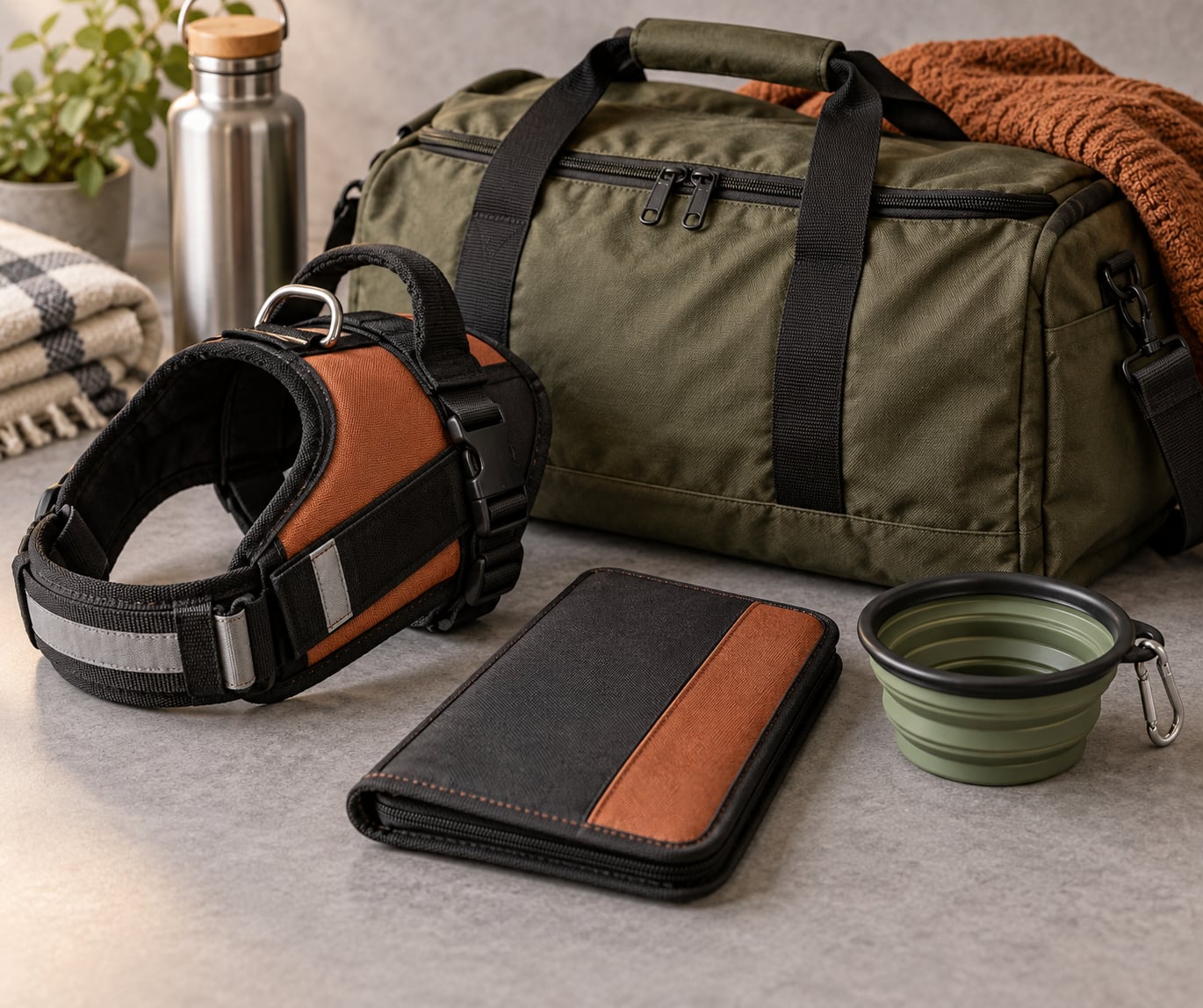
Learning how to travel with a service dog comes down to three things: your dog is individually trained to perform tasks for your disability, every provider on your route has its own paperwork rules, and you have a plan for the day something breaks. The federal protections are real and strong in the United States. So is the paperwork. Most denied boarding happens because a form was missing, a deadline slipped, or someone confused a service dog with an emotional support animal.
This guide covers flying, hotels, rideshare, rail and cruise, plus what to do when a flight gets cancelled at 2 a.m. and your dog is the reason you cannot board the replacement. It runs about half an hour to read and a week to prepare properly.
Table of Contents
What You Need
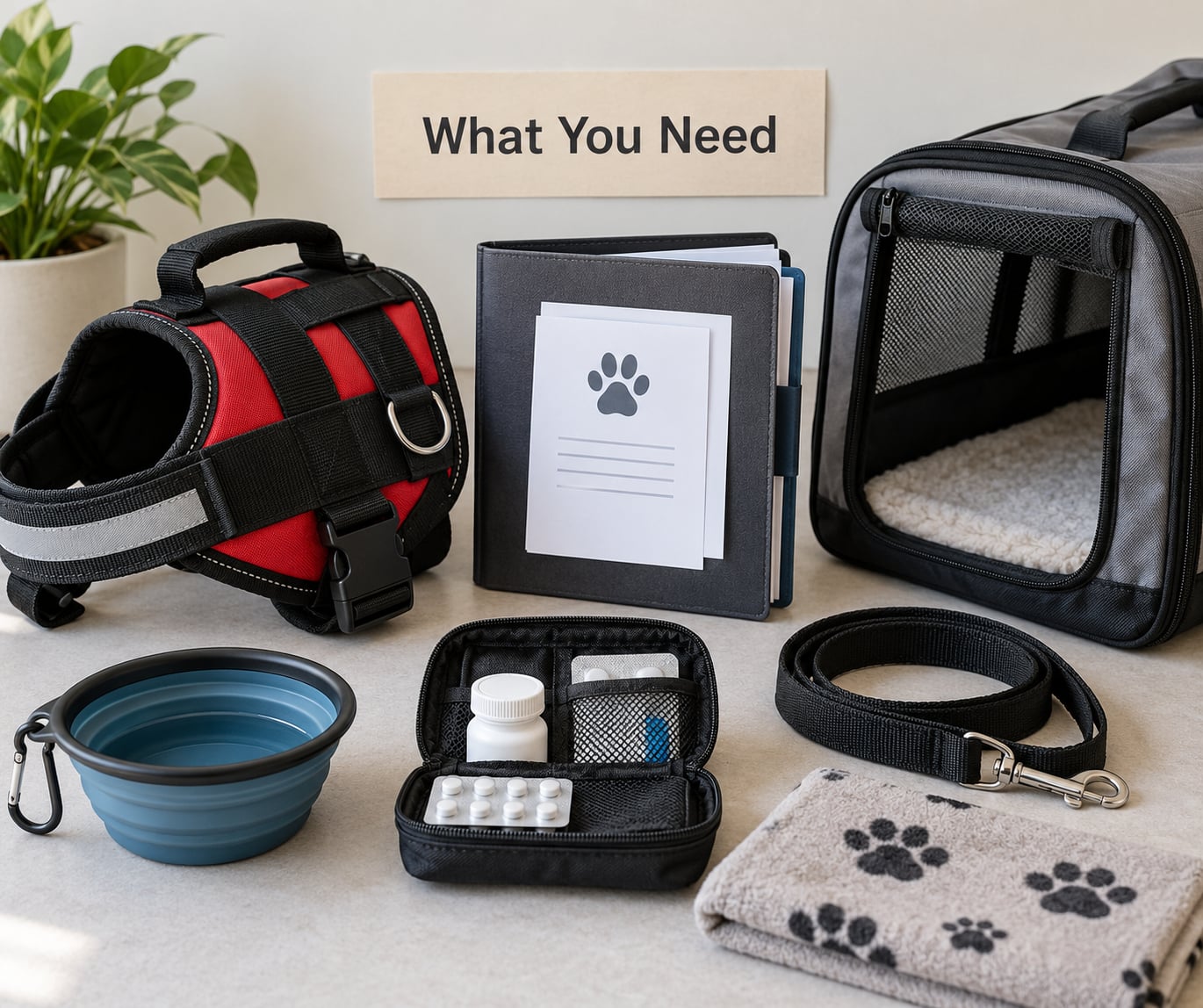
Before you book anything, gather four categories of things: the paperwork that proves your dog’s status, the gear that keeps them comfortable, the training that keeps them calm, and the advance notice that providers require.
Paperwork
The core document for U.S. flights is the U.S. DOT Service Animal Air Transportation Form. Airlines have been asking for it at least 48 hours before departure, and most require it before you arrive at the airport rather than at the gate. Print two copies. Phone batteries die, and airport Wi-Fi is not reliable.
Alongside that form, carry the airline’s own service animal form if it asks for one, a current veterinary health form, your dog’s vaccination record, and a rabies certificate. If any flight segment runs eight hours or longer, airlines may also ask handlers to complete a relief attestation form explaining how the dog will handle elimination during that stretch.
Identification and gear
Two forms of ID matter. The first is the documentation above. The second is on your dog: a harness with a service animal patch or tag, plus a backup tag on the collar or a microchip registered with a current contact number. Handlers on Reddit forums say the harness patch is often the first thing a gate agent looks at.
Pack a collapsible water bowl, a long tether for bathroom breaks that still keeps the dog under your control, waste bags, pee pads, any prescribed medication with a few extra days’ supply, a blanket or mat that smells like home, and a printed folder of everything. Skip the carrier if your dog is too large for one. Crates and kennels are never required for a service dog, and airlines may not charge you for the animal.
Training and temperament
The Air Carrier Access Act lets an airline refuse a service animal that is out of control, not housebroken, or barking, growling or moving through the cabin unbidden. Practise before you go. A well-trained service dog should be able to hold its bathroom needs for the length of a flight, settle on command, and stay out of aisles and exits.
Advance planning
Some providers want notice before you arrive. Amtrak asks for at least 48 hours’ notice for animals that travel in a special space. Cruise lines generally ask for forms and sometimes a fee for service animals too large for the cabin. Ask every one of them in writing and save the reply.
Step-by-Step: How to Travel With a Service Dog
Confirm That Your Dog Is a Service Animal
Only dogs qualify under the ADA definition, and the standard is task training, not diagnosis paperwork. A service dog is individually trained to perform tasks that directly help a person with a disability. Guide dogs, hearing and alert dogs, psychiatric service dogs, seizure response dogs, mobility assistance dogs and sensory signal dogs all fit. Cats, rabbits and miniature horses are not covered by the ADA’s service animal definition, though airlines may accept them under their own policies.
What does not qualify is an animal whose presence is purely comforting. Emotional support animals lost in-cabin airline protections when the DOT rule changed in 2021, and they now travel as ordinary pets with pet fees, carrier rules and weight limits. Therapy animals working in a hospital or a classroom are a third category with no public-access rights at all.
When staff ask, you can answer two questions only: “Is this a service animal?” and “What tasks does it perform?” The ADA National Network publishes that staff may ask those and nothing else, and handlers can decline to show a doctor or diagnosis letter. Anything beyond those two questions is not a question you have to answer.
Check the Rules for Every Part of the Trip
Learning how to travel with a service dog means checking each provider separately, because the rules are genuinely different across them. United asks for no documentation for domestic flights with service dogs. Delta asks for a veterinary health form and an immunization record. Other major carriers publish their own pages describing forms, submission addresses, seating and accessibility desk contacts.
Read the airline’s current page rather than trusting a blog post or a forum answer, including this one, because these policies get revised. Then check the rail operator, the hotel, the cruise line, the rideshare platform and the destination country’s import rules. International entry is its own process with microchip and health certificate rules that have nothing to do with the ADA.
Gather Identification and Support Documents
Assemble one folder, physical and digital, that you can hand over without explaining it twice. Contents: the DOT Service Animal Air Transportation Form, the airline’s own form if required, the veterinary health form, the rabies vaccination certificate, the microchip registration details, and contact information for your veterinarian and for yourself.
Put the vet’s phone number on the top sheet. If your dog is unwell on the day, someone will want to call someone, and being unreachable in a terminal is a bad place to learn that.
If your dog is still in training, tell the airline in advance and ask how they classify the animal in writing. Policies differ, and a dog that is not yet accepted as a service animal may be handled under pet rules instead.
Build a Travel Kit and Practice Before Departure
Run a dress rehearsal a week before departure. Put on the harness your dog will wear, pack the bag, load the car, drive somewhere unfamiliar, and time the whole thing. Dogs read your stress, and a dog that has practised the routine once will settle faster when the day is unusual.
Feed lightly before the airport and stick to your dog’s normal food. A full stomach plus engine noise is a combination that ends badly. Bring enough food and water for the trip plus several hours of delay, and keep it where you can reach it without leaving your seat.
Desensitise to the specific stressors you know about. Low-flying aircraft, engine noise, crowds, unfamiliar flooring, and long periods without relief. Short positive sessions beat one long stressful one, and veterinary behaviourists are worth a consult if your dog panics around crowds.
Travel, Check In, and Ask for Assistance
At the airport, go to the accessibility desk or the special services counter instead of the general line. Tell the agent you are travelling with a service animal and hand them the folder. Ask them to note your file number and confirm which seat assignment works with your dog.
Then this: you and your service animal are screened together by a walk-through metal detector. You may walk through together, or you may lead the animal through separately. You are not required to go through a private screening booth and be separated, and asking for one is a request you can decline. Harnesses, collars and tags go through the X-ray machine with your other belongings; the dog walks with you.
At the gate, ask the agent to confirm they have your file before boarding starts. Board early with the pre-boarding group when the airline offers it, and settle your dog on the cabin floor or in your lap. Airlines may not block the middle seat unless the dog is too large or the safety team requires it. One service animal per passenger is the usual limit.
Know the animal relief area before you need it. Ask a flight attendant on the way in, and use a layover bathroom when the connection is long enough.
Handle Hotels, Rideshares, and Sightseeing
Hotels are covered by the ADA in the United States, which means they may not charge a pet fee for a service animal or refuse you access because of a no-pets policy. You may be asked for documentation if the animal is not obvious, and they may not ask about your disability beyond what a service animal policy allows.
Rideshare and taxi drivers are treated differently from hotels. Drivers are generally permitted to refuse, and platforms vary on whether a driver may do so. Treat every pickup like an airport gate conversation: explain the tasks at the window before the car arrives, and keep a backup number ready. Rail and public transit usually ask for advance notice; Amtrak’s window is 48 hours for animals traveling in a designated space.
For sightseeing, check ahead whether the attraction allows service animals in every part of the visit. Kitchens, operating rooms, some religious settings and home-based private businesses are among the few places access can legitimately be limited.
Prepare for Delays and Unexpected Problems
Every trip plan has a version B. Build one before you leave: an alternative route, a hotel that will take service animals at any hour, a boarding kennel arrangement you would only use in a real emergency, and enough of your dog’s medication for several extra days.
If a flight is cancelled, contact the airline’s accessibility desk rather than the general queue and ask specifically about boarding the rebooked flight with your dog. If you are denied at the gate, stay calm, ask for the airline’s Complaint Resolution Official before you leave the airport, note the flight number and the agent’s name, and follow up in writing once you are home. You can also file a complaint with the U.S. DOT Aviation Consumer Protection Division.
If your dog becomes overwhelmed, restless, or starts barking, get the flight attendant’s attention early. Handlers consistently say behaviour, not paperwork, is what determines whether a dog stays on board.
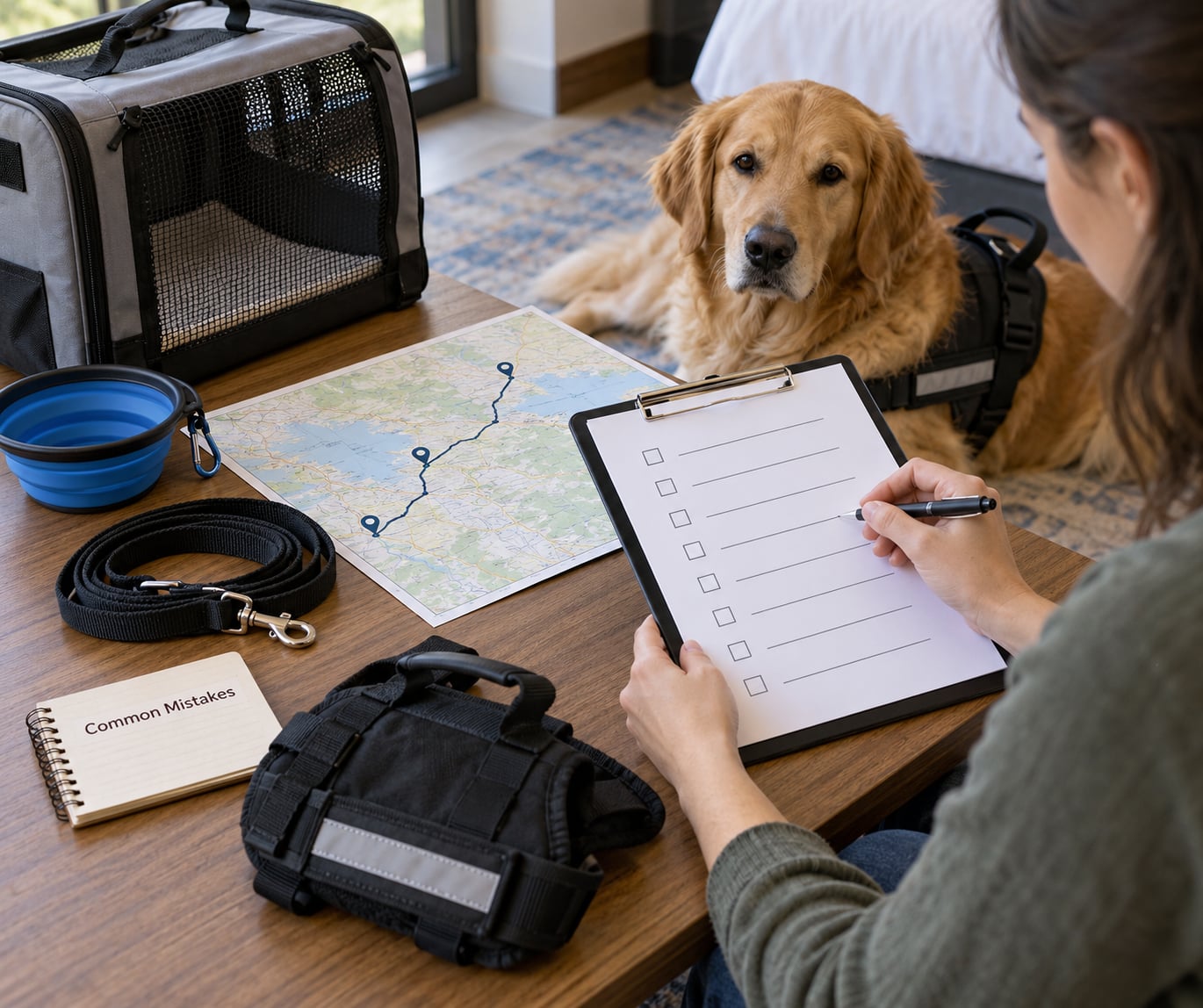
Common Mistakes
Using emotional support language. “My dog supports me emotionally” triggers pet rules, pet fees and carrier requirements. Say service animal and name the tasks instead.
Filing paperwork at the airport on the day of the flight. The 48-hour window exists so the airline can staff the flight properly. Late forms are the single most common reason a handler hears a “no” at the counter.
Treating the dog like a pet. No carrier, no kennel, no pet fee, no pet allowance, and no limit of one small animal per handler. If someone offers you pet rules, ask to have the accessibility desk correct the record.
Overpacking and under-preparing. A forty-pound bag of “just in case” items slows you down at every step. Pack for the actual flight length plus delays, and rehearse the trip once before departure day.
Skipping the backup plan. Assume something will go wrong and decide in advance what you do about it, because a 1 a.m. rebooking is the worst possible time to improvise.
Assuming the airline verifies training. It usually does not. It looks at the harness patch, the paperwork and the dog’s behaviour in the cabin, which means the harness is not optional.
Dropping the harness at the hotel or the rental car. Keep the dog in the harness whenever it is in public. It is your fastest, least exhausting explanation.
Frequently Asked Questions
Can service dogs sit on your lap on a plane?
Yes, many handlers do exactly that, and the Air Carrier Access Act allows it. The dog must fit in the cabin space in front of you, on the floor or on your lap, and must not block the aisle or an exit. Airlines may not charge you for the dog or count it toward your carry-on allowance. If your dog is too large for the space under the seat in front of you, ask the accessibility desk about a wider seat or extra legroom rather than arriving and hoping.
How does a dog go through TSA?
You and your service animal are screened by a walk-through metal detector. You may walk through together, or you may lead the animal through separately. Harnesses, collars and tags go through the X-ray machine with your checked items, while the dog stays with you. You do not have to be separated into a private screening room, and you may decline that request.
Do service dogs get a free seat on a plane?
The dog does not take a seat of its own and you are not charged a fee for it. Airlines may block the middle seat next to you only if the dog is too large to sit safely on the floor or in your lap, or if the flight crew determines safety requires it. What you pay is your own ticket, plus any fee the airline charges for a larger seat if you request one.
Can you bring a large service dog, such as a 70 lb dog, on a plane?
Size is judged against the space under the seat in front of you, and there is no federal weight limit. A dog that cannot fit there, or that blocks the aisle or an exit, can be refused. Discuss the measurements with the airline’s accessibility desk before booking and ask about a seat that gives your dog more room. Buying a pet seat or having the dog travel in the hold is not something you should be asked to accept.
Do hotels charge for service dogs?
In the United States, a hotel may not charge a pet fee or refuse you access because of a no-pets policy when you are travelling with a service animal. Staff may ask whether the dog is a service animal and, if it is not obvious, may ask for documentation. They may not ask about your disability beyond that. Outside the U.S., rules differ, so check local law before booking.
Conclusion
Start by confirming your dog’s status honestly: individually trained tasks, described in one sentence you can say out loud without hesitating. Then check each provider’s current rules yourself, because they differ and they change, and file anything they ask for at least 48 hours before departure. Finally, write the backup plan while you are calm, because a cancelled flight will not wait for you to think.
Traveling with a service dog is a logistics problem more than a legal one. The rights are on your side. Preparation is what makes the day boring, which is exactly the outcome you want.