Here is the short version, because it surprises most people: the AIDS Memorial Quilt was made by hand, one panel at a time, by friends and family of people who had died of AIDS. Each panel measures three feet by six feet, the footprint of a grave, and carries a name. Nearly fifty thousand of them were sewn, catalogued and stitched into blocks that were then hung on the National Mall in Washington, D.C., in 1987. Almost none of them are quilts in the technical sense. They are keepsakes, arguments and grief turned into fabric.
What follows is how that actually worked: where the idea came from, what goes onto a panel, who makes one, how thousands of them were organised into something displayable, and where the collection lives now. If you are here because someone you loved is named on the Quilt, skip to the section on materials and the one on finding a name.
Table of Contents
- What Was the AIDS Memorial Quilt?
- How the AIDS Memorial Quilt Project Began
- How the AIDS Memorial Quilt Was Made
- What Materials Were Used in a Quilt Panel?
- Who Made the Panels?
- How Were the Individual Panels Assembled?
- How Did the Quilt Become a Public Memorial?
- What Stories Did the Panels Tell?
- How Did the Quilt Change Over Time?
- Why Is the AIDS Memorial Quilt Important Today?
- Frequently Asked Questions
- Conclusion
What Was the AIDS Memorial Quilt?
The AIDS Memorial Quilt is the largest community art project in the world, begun in San Francisco in 1987 by Cleve Jones and the NAMES Project Foundation. It is a collection of roughly 48,000 to 50,000 handmade panels commemorating people who died of AIDS, along with an archive of the written records that came with them.
It is also a living memorial rather than a finished monument. New panels have continued to be added for decades, and the Quilt travels, is exhibited, and is now permanently stewarded by the National AIDS Memorial. The name count keeps moving, which is why different sources give different figures: an academic reference lists 94,000 names, while the National AIDS Memorial and current museum descriptions report more than 110,000 people commemorated.
What separates it from a war memorial or a plaque is scale and material. A name on stone is carved once by an institution. A name on a quilt panel is chosen, decorated and handed over by a grieving person, and it carries their handwriting, their photographs, sometimes their relative’s actual wedding ring.
| Year | What happened |
|---|---|
| 1985 | Cleve Jones helps organise a candlelight march in San Francisco for Harvey Milk and Mayor George Moscone. Marchers tape the names of friends who died of AIDS onto cardboard placards on the old Federal Building, and from across the street the placards read like patchwork. |
| 1986-87 | Jones and Joseph Durant begin planning a permanent memorial. The NAMES Project Foundation is incorporated in San Francisco. |
| 1987 | The first panels are sewn. Jones makes his own first panel for his friend Marvin Feldman. |
| October 1987 | The first public display: 1,920 panels laid out on the National Mall during the National March on Washington for Lesbian and Gay Rights. |
| Late 1980s-1990s | The Quilt expands, tours the country and the world, and an estimated 14 million people see it in person. |
| 2007 | The Call My Name initiative, run with CNN, deliberately seeks panels for people who had been missing from the archive, including women and people of colour. |
| Present day | Permanent stewardship sits with the National AIDS Memorial. Digitised panel maker records are available through the Library of Congress. |
How the AIDS Memorial Quilt Project Began
The idea came out of a protest. On the night of Harvey Milk and George Moscone’s deaths in November 1985, marchers walked through San Francisco with candles and cardboard signs naming the friends they had lost to AIDS. The signs were taped in rows across the facade of the old Federal Building.
Jones, who helped organise the march, looked at that wall from the street and saw something the organisers had not intended: a patchwork quilt, hung in the open air, made out of grief and improvisation. The moral argument followed from there. AIDS deaths were being hidden because the people who died were gay men, and often drag queens, intravenous drug users and hemophiliacs — groups a frightened public had been taught to treat as disposable. A memorial on cardboard could be torn down. A Quilt made of tens of thousands of named squares was harder to dismiss.
Jones spent the next couple of years turning that observation into an institution. With Joseph Durant and others, he set up the NAMES Project Foundation, which took its name from the practice of calling out the names of the dead. The early goal was deliberately practical: collect panels from every state and from outside the country, then show the growing Quilt on the National Mall where politicians and camera crews could not look away.
One early instruction shaped everything after it. Panel makers were told to keep the materials durable, because the Quilt was built to be handled, folded, carried on airplanes and hung again and again. Nothing was meant to stay in a box.
How the AIDS Memorial Quilt Was Made
Understanding how the AIDS Memorial Quilt was made comes down to five steps that repeat roughly fifty thousand times. Someone chose a person to remember, gathered fabric and keepsakes, built a panel three feet by six feet, wrote the name and a short biography on the panel, and mailed the finished work to the NAMES Project. Staff then catalogued it, gave it a number, and grouped it into a quilt block for display.
How to make an AIDS Memorial Quilt panel
- Choose the person. A panel is always for a named individual. Most makers pick a partner, brother, friend or parent, and several people occasionally make one panel together.
- Gather the materials. This is where most of the emotion goes. Collect fabric, clothing, letters, photographs, jewellery, keys, anything that belonged to them.
- Get the size right. Three feet by six feet, which matches the average human grave. Panels that came in another size were trimmed or set aside, so measure before you stitch.
- Construct it. Sew the fabric, appliqué, embroider, patch or simply fasten the keepsakes under a top layer. Most panels skip batting and are finished at the edge rather than quilted in three layers.
- Write the name and story. The name goes on the panel, along with dates and as much biography as the maker wants to give. That written record is catalogued separately and is often what people are looking for decades later.
- Send it in. The panel goes to the NAMES Project, where it is inspected, numbered, indexed by name and block number, and stored until it can be joined into a block.
The order matters less than you might think. Plenty of panels were assembled long after the person died, sometimes years later, and the making itself functioned as a private grief ritual rather than a hurried act of mourning.
One practical detail catches people: durability. Official guidance from the period asked for materials that could survive handling and light, because the finished Quilt was folded, trucked, hung and refolded for three decades.
What Materials Were Used in a Quilt Panel?
A panel could be almost anything. The one rule was the size and the name; everything else was up to the person holding the needle. Photographic prints were the most common element, followed by lettering and appliqué, then the harder-to-categorise objects that give panels their weight and their particular gravity.
| Material | What it contributed |
|---|---|
| Cotton, denim, felt, dress fabric, leather | The structure, and often a piece of clothing the person actually wore. |
| Photographs | The face, which is what turns a name into a person in a crowd of panels. |
| Handwriting and lettering | The maker’s own hand, sometimes repeated many times across the panel. |
| Wedding rings, jewellery, keys | A life measured in objects, attached rather than drawn. |
| Letters, notes, tickets, theatre stubs | Evidence of an ordinary life rather than a summary of an illness. |
| Cremation ashes | Included on some panels, which is not a symbolic flourish but a literal burial. |
| Thread, embroidery, appliqué | Surface work that carries the maker’s hand and time. |
Because the materials were ordinary, the cost of participation was almost nothing. Someone who could sew could make a panel, and someone who could not sew could cut fabric, photograph a photograph and staple it down. That accessibility is a large part of why the project grew to fifty thousand panels rather than a few hundred.
It also explains why most panels are not quilts. Traditional quilting means three layers — top, batting, backing — stitched together in a repeating pattern. Most Quilt panels have two layers or none, no batting, and no pattern. In construction they resemble the Victorian crazy quilts of the 1880s, which sewed irregular scraps onto a base with visible, deliberately wandering stitching. That tradition of sentimental mixed-media assemblage was, in effect, closer to what panel makers were doing than to pieced bed quilts.
Who Made the Panels?
The panels were made by mourners. Friends, partners, siblings and parents were the typical makers, and they were almost never professional artists. The skill level in the collection is enormous and uneven, and that unevenness is part of the record.
Panels also came from people living with HIV/AIDS who were making their own in advance, sometimes alongside a partner, which turns the panel from a eulogy into a statement of intent. And panels were made collectively: local chapters of the NAMES Project ran sewing nights where a dozen people worked on a dozen squares and talked about who they had lost. Metro New York Quilters, one example, produced about 500 of roughly 25,000 panels in one stage of the project’s growth.
That group model is the reason the Quilt was affordable to build. Groups shared machines, bought fabric in bulk, and distributed the emotional labour of remembering several dozen people across a room.
The archive also records who was missing. For most of the Quilt’s first two decades, the people represented were overwhelmingly gay men, and largely white gay men, while the epidemic was killing Black, Latino, Indigenous and injection-drug-using communities at high rates. Activists inside and outside the project kept pointing this out. The Call My Name initiative in 2007 was one direct response, deliberately soliciting panels for people who had fewer than 400 representatives among the earlier tens of thousands.
How Were the Individual Panels Assembled?
Three words get used loosely and it matters which one you mean. A panel is a single three-by-six square made by one person or group. A block is a group of panels, typically eight, assembled and framed as a unit for transport and display. A section is a much larger running expanse of the Quilt, made up of many blocks, which is the portion that travels.
| Term | What it is | Typical size |
|---|---|---|
| Panel | One memorial square, made by friends or family | 3 ft by 6 ft |
| Block | Panels joined and framed for handling | About eight panels |
| Section | A run of blocks, the unit that travels and is displayed | Dozens of blocks |
The NAMES Project handled incoming panels as mail, which meant hundreds of packages arriving with no other information. Staff opened them, recorded the name, dates and biography submitted by the maker, assigned the panel a block number, and filed the written record separately from the fabric. That indexing is what makes a fifty-thousand-panel archive searchable at all: a researcher can look up a name, or work outward from a block number, without unpacking anything.
Blocks were built so the Quilt could be moved. A single panel is floppy and easily torn; backed, bordered and framed into a block, it can be stacked, shipped and hung without a seam splitting. The whole collection was eventually estimated at more than 720,000 square feet and around 54 tons, which is a useful reminder of how physically serious the project became.
How Did the Quilt Become a Public Memorial?
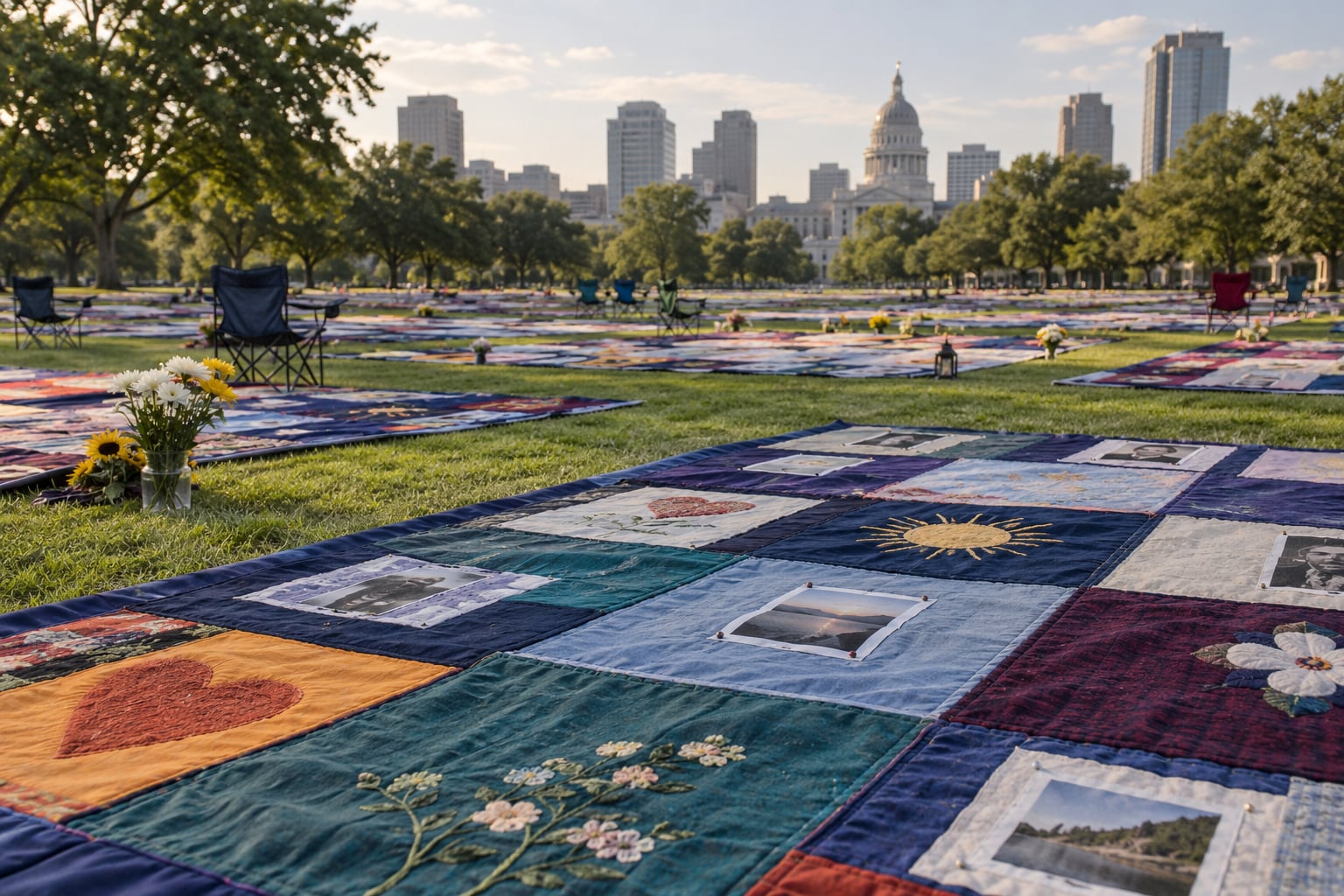
The first public showing happened on the National Mall in Washington, D.C., in October 1987, during the National March on Washington for Lesbian and Gay Rights. About 1,920 panels were displayed that first time, which sounds small and was not: the layout covered the lawn in a grid the press photographed from above, and the visual of that many names at once was the argument.
The display worked because of the crowd, not the panels. People walked into a field of fabric, found a name, and stopped walking. That reaction is the whole mechanism the project was designed around, and it repeated for years as the Quilt toured. The Quilt has been shown at major marches, at the Smithsonian’s National Museum of American History, and in public spaces including a long-running installation in an airport terminal, where travellers moved past it without any framing at all.
Visibility produced money and politics as a side effect. Displays were paired with fundraising for AIDS service organisations, which at the time were operating with almost no public funding and were being pressured by a public that preferred the epidemic to disappear. The Quilt made the scale of the deaths impossible to argue with, and estimates put the total in-person audience across its touring years at around 14 million.
The slogan attached to the project made the same point in one line: not all battles are fought with a sword.
What Stories Did the Panels Tell?
What a panel carries depends entirely on who made it, so there is no typical panel. But certain patterns show up repeatedly across the archive, and they say more about the epidemic than about quilting.
Panels often name a role rather than a job title. A great many commemorate people who worked in bars, dance halls, theatres, restaurants and hair salons, because those were the social centres of a community being emptied out. A panel that shows a work badge or a key says something about where a life was spent that a biography alone would not.
Many panels address the illness directly, using patches, medical imagery or deliberately rough stitching to mark a body that was being taken apart by opportunistic infections while the person’s public life continued. Others keep the medical language out entirely and instead record ordinary time: a marriage, a birthday, a garden, a car, a stretch of years in a city.
Where makers added a written biography, the archive becomes something closer to an oral history project than an art collection. Those documents routinely include the person’s work, their family, where they lived, who they were with, and what the maker wants remembered. Digital panel maker records of this kind are now held and made available through the Library of Congress, which is how many families find a panel maker’s own words decades after the fabric was made.
There is a smaller set of panels that disrupt the picture, and they are worth noticing. Some were made for people whose deaths came from haemophilia treatment or contaminated injection equipment rather than from sexual transmission, and some remember people who were not part of the community the Quilt is most often read as representing.
How Did the Quilt Change Over Time?
The Quilt grew in three directions at once: more panels, more international material, and a different relationship with the disease. The early years of the project were defined by an accelerating death toll, and the panels were a running record of a community in emergency. As effective antiretroviral treatment arrived in the mid-1990s and the death rate fell sharply, the meaning of contributing shifted from immediate lament to commemoration of a much longer history of loss.
International sections followed, including locally organised Quilt projects in countries such as Australia that started with a few dozen panels and now maintain their own block collections. The American Quilt’s structure, with its block numbers and searchable records, was widely copied rather than centralised.
The critique about representation also shaped later phases. Campaigners argued that a memorial dominated by one demographic could actively misrepresent the epidemic, and initiatives such as Call My Name in 2007 pushed deliberately for panels naming women, people of colour and people who died of drug use and haemophilia-related blood products. Adding those names was not a marketing exercise; it was a correction.
Physically, the Quilt moved from a travelling exhibition object to a managed archive. Sections were photographed and digitised, records were indexed, and the collection passed into permanent stewardship with the National AIDS Memorial. The practical consequence is the most common frustration people raise today: the Quilt is no longer one object you can walk up to, and finding a specific panel usually means working through the digital records rather than looking at cloth.
Why Is the AIDS Memorial Quilt Important Today?
The main reason is that the epidemic is still easy to make invisible. Most people reading this were not alive during the years when AIDS was the leading cause of death for American men under forty, and no one now dies of AIDS in the United States without a readily available treatment that works. That success is exactly why the history needs a physical anchor.
The Quilt does a few things nothing else does as well. It names people individually at a scale that statistics cannot, which is the only reliable corrective to treating an epidemic as an abstraction. It documents how a community organised without permission, from kitchen tables and church basements, and it preserves a grief vocabulary that most of us were never taught.
For anyone who lost someone to AIDS, the practical value is concrete rather than sentimental. A panel can still be made, the archive can still be searched, and the written record of a person can still be found. The people who search for it say the same thing repeatedly: what they want is not the big historical object, they want their person back.
That search is also the clearest argument for taking the archive seriously. A name that cannot be found is a small erasure, repeated thousands of times, and the cost of fixing it is indexing work and access.
Frequently Asked Questions
What size is an AIDS Memorial Quilt panel?
Each panel is three feet by six feet, which is roughly the footprint of a human grave and the reason the Quilt reads at human scale rather than as a giant artwork. Panels arriving in other dimensions were generally trimmed or set aside. The format was fixed from the start so that any two panels, made by strangers in different states, could be assembled into the same quilt block.
How to make an AIDS quilt panel?
Choose one person to remember, gather fabric and keepsakes, and build a panel three feet by six feet. Most makers sew, applique or patch, though plenty of panels simply fasten photographs and objects under a top layer, and most skip batting. Write the name and a short biography on the panel, then send it to the NAMES Project, which numbers it, files the written record, and groups it into a block for display.
How many names are on the AIDS Memorial Quilt?
The figure depends on the source and the year. An academic reference cites 94,000 names, while the National AIDS Memorial and current museum descriptions report more than 110,000 people commemorated, against roughly 48,000 to 50,000 panels. Some panels carry several names, so the name count is always higher than the panel count.
Do they still make and add panels to the AIDS Quilt?
Yes. New panels continue to be made and added, and the collection is now under permanent stewardship of the National AIDS Memorial rather than run only as a travelling show. People contribute for losses that predate the Quilt, including relatives who died in the earliest years before a panel could be made. Written panel maker records are also available in digitised form through the Library of Congress.
Where is the AIDS Memorial Quilt kept now?
The collection is held and permanently stewarded by the National AIDS Memorial, with sections appearing in public exhibitions, including a long-running installation in an international airport terminal. Most of the Quilt is not on permanent open display. People looking for a specific person generally work through digitised records rather than expecting to browse the cloth directly.
Why is the AIDS Quilt not really a quilt?
Traditional quilting means three layers, top, batting and backing, worked into a repeating pattern. Most AIDS Memorial Quilt panels use two layers or none, have no batting, and are not pieced into a pattern. The construction resembles the Victorian crazy quilts of the 1880s, which sewed irregular scraps and sentimental objects onto a base with wandering visible stitching.
Conclusion
The making of the AIDS Memorial Quilt reduces to a repeated sequence: pick a name, build a three-by-six-foot panel out of whatever the person’s life left behind, write the name and a short story on it, mail it to the NAMES Project, and let staff catalogue it into a numbered block for public display. Done roughly fifty thousand times by grieving friends, partners and families, that sequence produced the largest community art project in the world.
If you want to do more than read about it, start with the person rather than the project. Choose one life, find out what objects belonged to it, and make the panel yourself. And if a relative of yours is already on the Quilt, the written panel maker records are searchable by name and block number, which is usually where people start.