
Yes, you can rent an apartment with no credit history. Most landlords do not require a credit score, they require evidence that you will pay the rent on time, so a file with nothing in it just means you have to supply that evidence somewhere else: income, a guarantor, a larger deposit, or rental references. This guide walks through the whole process in order, from checking your credit file to signing the lease.
The part that trips people up is that most advice out there is written for bad credit, which is a different problem. Someone with a 560 has a file full of data that reads badly. Someone with no credit history has no data at all, and screeners treat that as unknown risk rather than proven risk.
Budget about two to three weeks for a first apartment search, and expect to write several applications before something lands. Rules vary by state and city, so check what screening is legal where you live.
Table of Contents
- What You Need
- Step-by-Step: How to Rent an Apartment With No Credit History
- 1. Check whether you have a credit file or a credit freeze
- 2. Set a realistic budget and prepare cash for upfront costs
- 3. Look for landlords and buildings that accept alternative screening
- 4. Build an application that shows reliability without a long credit history
- 5. Ask clear questions and verify the landlord before paying
- 6. Sign only after reviewing the lease and move-in terms
- Common Mistakes
- Frequently Asked Questions
- Can I rent an apartment with no credit history?
- What is the difference between no credit history and bad credit?
- Do landlords always run a credit check?
- Can paying the rent in advance replace a credit check?
- How can I prove that I will pay rent on time?
- Is a co-signer enough to rent an apartment without credit history?
- Conclusion
What You Need
Before you contact a single landlord, get these items together. An incomplete application is the fastest way to get quietly passed over.
- Government photo ID. A driver license, state ID, or passport. International applicants may need a passport plus immigration documentation.
- Proof of income for the last 60 days. Recent pay stubs, an employer verification letter, or bank statements if you are paid irregularly.
- Rental references. A current or past landlord’s name, phone number, and email, plus proof you paid on time if you have it.
- Cash or a plan for upfront costs. Application fees, a security deposit, and usually first and last month’s rent due before move-in.
- Your credit reports. Free reports from the three bureaus, so you know what a screener will see before they see it.
- A short written statement. A few sentences explaining the gap and what you will do about it. You would be surprised how often this is the thing that decides the application.
Step-by-Step: How to Rent an Apartment With No Credit History
1. Check whether you have a credit file or a credit freeze
Pull your free reports from all three bureaus and read them line by line. Look for a freeze or a security freeze flag first, because a frozen file reads as empty to a screening vendor even if you have years of on-time payments sitting underneath.
Then sort yourself into one of three buckets. A no file means no accounts ever appeared. A thin file means one or two accounts, usually a card with a low limit or a short history. Bad credit means accounts exist and something went wrong, such as a collection or a late payment. The last two get scored and ranked. The first one gets described as insufficient data, which is a different thing entirely, and some software treats it as an automatic decline.
While you have the reports open, dispute anything that is wrong. A wrong address from a few years ago, a card that was closed after you paid it off, a debt that belongs to someone else with a similar name. Fixing those takes days and removes an objection that a landlord would otherwise never argue about.
2. Set a realistic budget and prepare cash for upfront costs
Add up everything that lands before your first paycheck arrives: application fees, the security deposit, first month’s rent, last month’s rent, prorated rent if you move in mid-month, renters insurance, and moving costs. In many markets that total runs to two or three months of rent before you own a single fork.
Many landlords will also ask for a larger deposit when they cannot read a score, or for a partial month extra held as an applied deposit. Whether that comes back to you at move-out depends entirely on how the lease and local law define it, so get the exact treatment written into the lease before you hand over money.
Paying rent in advance does not buy you a pass on lawful screening. It makes you less risky, which is different, and a landlord still has the right to run credit and background checks on every named applicant as long as they apply the same standard to everyone.
3. Look for landlords and buildings that accept alternative screening
Large professional apartment complexes will essentially always run a credit check as part of the application. Experienced landlords tend to screen employment, income, and rental history carefully and explain any co-signer requirement up front, so budget your effort accordingly.
Independent owners of one to four unit buildings, small local management companies, and owners renting out a spare room are far more likely to weigh income and references instead of a number. Student housing often waives the credit check entirely because the average student has none, while subsidized and income-restricted programs run their own eligibility rules that have nothing to do with credit.
The tradeoff is honest: flexibility costs you time. A listing that advertises no credit check may also mean less screening, a higher monthly rate, or a landlord who wants more cash up front. Ask before you apply.
4. Build an application that shows reliability without a long credit history
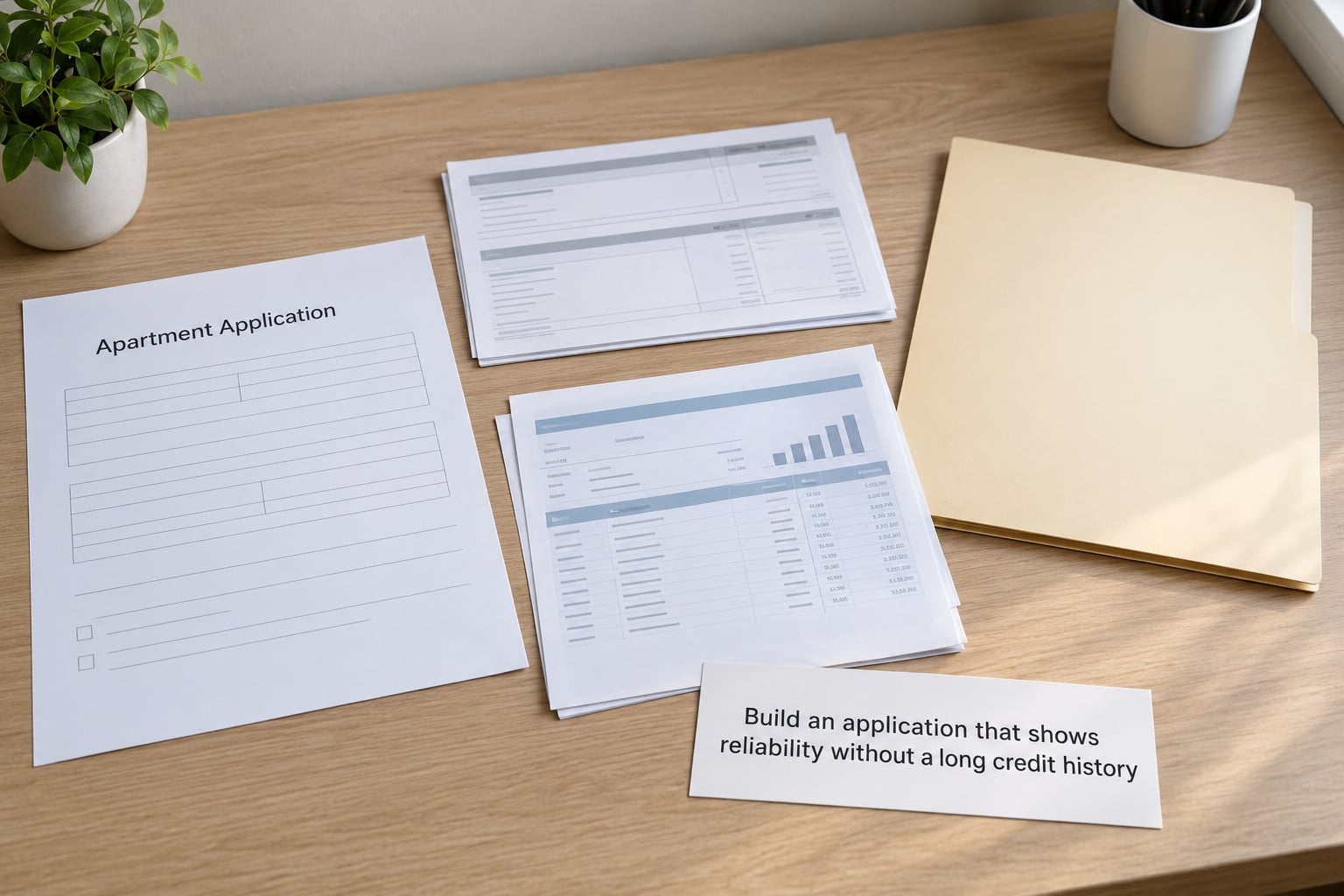
Your job is to replace the missing score with data a human can verify. Aim for documented gross income of 2.5 to 3 times your monthly rent, which is the rule of thumb most screeners apply.
If you freelance or drive for a platform, pay stubs do not exist. Build the case from 1099 forms, 12 months of bank statements showing regular deposits from identifiable clients, an invoice history, a signed contractor agreement, or a written statement from a client confirming your rate and hours. Add a savings balance that covers your deposit and a few months of rent, and a screenshot showing the funds are genuinely yours rather than borrowed the same week.
References carry weight. Ask a previous landlord, an employer, or a professor for a short letter confirming you paid on time and did not damage the property. Text them the wording you want so they are not drafting from scratch.
If someone will co-sign, treat it as a real legal exposure, not a favor. Decide whether you are willing to owe the rent if they stop paying. What a landlord does with a guarantor’s credit is simple: they run the same check on them, and their score carries the application.
5. Ask clear questions and verify the landlord before paying
Before you fill anything out, ask what the screening criteria are, what the application fee covers, whether the fee is refunded if you are denied, whether the deposit tier depends on credit, what the cancellation policy looks like, and whether you can see the screening standards the property uses.
A script helps: I am just starting to build a credit file, so I would like to understand how your applications are screened before I submit mine. That sentence changes the conversation from a request for mercy into a request for information.
Verify the landlord before money moves. Confirm the unit actually exists, see the building in person or through a live video tour, match the landlord’s name against the property record or business listing, and never send a deposit through wire transfer, gift card, or a payment app to someone you have not met. Legitimate landlords will happily let you tour first.
6. Sign only after reviewing the lease and move-in terms

Do the walkthrough on your own phone, video, with the clock visible. Photograph every existing mark, scratch, stain, and dent before anything gets moved in, and email the set to the landlord the same day so the timestamps are theirs too.
Then read the lease rather than skimming it. Confirm the rent amount and due date, the deposit amount and the conditions for getting it back, which utilities are included, what happens if someone leaves early, whether the screening fee is refundable, and whether the landlord can enter without notice.
Ask about rent reporting while you are at it. Some property management companies report on-time rent to the credit bureaus, which turns this apartment into the thing that fixes your next application. Getting it in writing costs nothing now.
When a landlord asks for extra money beyond the standard deposit, write down exactly what it is called and whether it is refundable. State rules on deposit tiers vary, and score-based deposit differences are treated as routine in some states and restricted in others. Your landlord’s answer and your state’s rules may not agree, so ask.
Common Mistakes
- Paying for multiple credit reports. Reports are free from the bureaus. Fix your file instead of buying the same information repeatedly.
- Sending sensitive documents before you have seen the property. Wait until you have toured or done a live video walkthrough and confirmed the landlord is who they claim to be.
- Counting on prepaid rent to replace screening. Money reduces perceived risk, it does not remove a lawful check.
- Skipping the lease read. People get burned by deposit terms and early-termination clauses, not by the application fee.
- Worrying about inquiries. Most rental screening is a hard inquiry that can affect your score briefly, which is worth knowing, but avoiding it is not worth a month of extra searching.
- Including a co-applicant who is a risk. On a joint lease every named applicant is screened, and a weak file can drag down a strong one.
Prevention is mostly preparation: one clean set of documents, a written explanation ready to paste into an application, and a list of references you have already asked permission to contact. Do that once and every application after it takes an evening instead of a week.
Frequently Asked Questions
Can I rent an apartment with no credit history?
Yes. Landlords need evidence you will pay, not a specific score. If you show documented income of roughly 2.5 to 3 times monthly rent, offer a guarantor or a larger deposit, and supply solid references, most independent landlords will consider you. Large apartment complexes screen more strictly, so target smaller buildings, roommate situations, and student housing where the score matters less.
What is the difference between no credit history and bad credit?
No credit history means no accounts ever appeared on your report, so there is no score to calculate and a screener sees insufficient data. Bad credit means accounts exist and something went wrong, such as collections, charge-offs, or late payments. Screening software treats these differently, and plenty of bad-credit applicants get approved on income and deposits alone while no-file applicants get declined automatically.
Do landlords always run a credit check?
Most do, but not all. Independent landlords, owners of small buildings, university-affiliated housing, and some subsidized programs either skip the credit check or replace it with income verification and identity checks. A listing promising no credit check still carries risk, so tour the property and verify the landlord before paying anything. Screening rules vary by state and local law.
Can paying the rent in advance replace a credit check?
No. Offering extra cash lowers the financial risk a landlord sees, but it does not remove their right to screen applicants, and screening criteria must apply the same way to everyone. Many landlords will accept prepaid rent or a larger deposit as an additional factor rather than a substitute. Get any extra amount described in writing, including whether it is credited toward rent or held as a refundable deposit.
How can I prove that I will pay rent on time?
Show a pattern, not a promise. Past landlords can confirm on-time payments, a consistent job or client list supports steady income, and bank statements show money arriving and covering the same bills each month. Aim for documented gross income of 2.5 to 3 times the monthly rent. If you freelance, use 1099 forms, 12 months of bank statements, invoices, and a client verification letter instead of pay stubs.
Is a co-signer enough to rent an apartment without credit history?
Usually, yes. A co-signer with steady income and clean credit carries most applications, because the landlord screens them exactly like any other applicant and their profile becomes the deciding factor. Read the lease carefully first, since you may be jointly and severally liable for missed rent even after your co-signer moves out. Make sure they understand that exposure in writing before they sign.
Conclusion
Start with the boring part. Pull your free credit reports, confirm whether you have a no file, a thin file, or an actual score, and clear out any errors while you are there. Then build a real budget for deposits, fees, and insurance, and put together one clean application packet you can reuse.
With that in hand, approach independent landlords and smaller buildings first, lead with your income and references, and be ready to discuss a guarantor or a larger deposit. Ask about rent reporting before you sign, because that lease could fix the credit problem for your next apartment. Updated for 2026.