Learning how to throw a house party in a small apartment comes down to three things: a guest limit your floor plan can actually hold, food and drinks people can manage while standing, and a stated end time. Prep takes about two hours on the day plus twenty minutes the night before, and the difficulty is moderate — mostly the kind where the plan does the work for you.
A house party in a one-bedroom or studio isn’t a scaled-down version of a big house party. It’s a different format: shorter, standing-heavy, spread across more than one surface, with the volume turned down and the exits kept clear. Get those four things right and the night feels generous rather than cramped.
Table of Contents
- What You Need
- Step-by-Step
- Common Mistakes
- Frequently Asked Questions
- How many people can I invite to a small apartment party?
- How can I make a small apartment feel less crowded?
- What is a good amount of food and drinks for a small house party?
- How loud should music be in an apartment?
- How do I keep guests from blocking exits or damaging furniture?
- What is the easiest way to clean up after a small apartment party?
- Conclusion
What You Need
You need far less than a house party usually calls for, because the constraint is space, not supply. Settle these decisions before anyone arrives, and the evening runs itself.
- A guest number, written down. A real number, not “anyone who can come.” Decide it before you send invitations, because adding people later is what turns a comfortable evening into a crush.
- A floor plan on paper. Sketch your common area and mark where people will stand, sit, eat, and set down coats. Circles on paper, spaced roughly an arm’s length apart, tell you more than squinting at the room.
- Seating for about half your list. Every stool, folding chair, ottoman, floor cushion, and the two spare chairs you borrowed. Half-seating is the sweet spot — it lets conversation happen without creating a bottleneck.
- Self-serve food that needs no plate. Handheld items like sliders, skewers, fruit, pastries, crackers with cheese, and one pasta or taco item if you want real food. Nothing that requires a plate, a knife, or standing at the counter to assemble.
- Two drink stations, not one. One in the kitchen, one on a side table or the bar cart. People stop moving when the drink table is across the room, and that stop is where the noise happens.
- Ice, in more than one container. A cooler or insulated tub in the kitchen and a smaller bowl at the other station. Ice in one place becomes a bottleneck and a puddle.
- A portable speaker and a playlist. One speaker you can position, not three you can’t. Build the playlist in advance so you’re not touching a phone all night.
- Lighting you can dim. Lamps instead of overhead fluorescents, plus one warm or colored source. Overhead lighting is what makes a small room look like a waiting area.
- Ventilation. Crack a window an inch, run the exhaust fan during the food portion, and open the door briefly during arrivals to move stale air. Warm, crowded rooms get stuffy fast.
- Cleaning supplies staged in advance. Trash bags in a bin near the door, a recycling bag beside it, spare towels, and a stack of paper towels in the kitchen.
- A check on your lease and building rules. Some leases restrict gatherings, some buildings set quiet hours, and a doorman or superintendent may need a heads-up. Two minutes reading beats a formal complaint.
- Valuables put away. Jewelry, laptops, cameras, documents, and anything breakable on a high shelf or in a closed drawer, before the first guest arrives rather than after.
Step-by-Step
Here is the order that works, from the decision to the reset. Each step explains what to do, why it matters in a small space, and how you know it’s working.
How to Throw a House Party in a Small Apartment: Set a Guest Limit First
Cap your list by floor area and circulation, not by how many people you’d like to see. A rough rule of thumb is one person per 10 square feet of usable common area — the space where people actually stand and move — and then subtract a few, because coats, bags, and drinks take up floor space that never appears in your square footage.
In a furnished studio with a small kitchen, that math usually lands somewhere around 8 to 12 people for a comfortable evening. A one-bedroom with a separate living room handles 12 to 16. A two-bedroom or a place with a balcony or shared courtyard can push toward 18 to 20 for a stand-up mixer, where guests circulate instead of sitting. Plenty of hosts in studios settle on a personal ceiling closer to 15 and entertain in smaller groups most of the year.
Ask yourself two extra questions. Will anyone dance? Dancing needs roughly double the floor space of standing and talking, so drop your number by a third if the playlist says dance music. Will people stay seated in clusters? Seating spreads bodies out, which helps you go slightly higher, provided every seat has a path to the door.
You’ll know the limit is right when you can walk from the door to the kitchen to the bathroom without squeezing sideways past anyone. Test it yourself the day before: stand at your planned headcount in your planned arrangement and try it.
Create Zones Instead of Crowding One Room
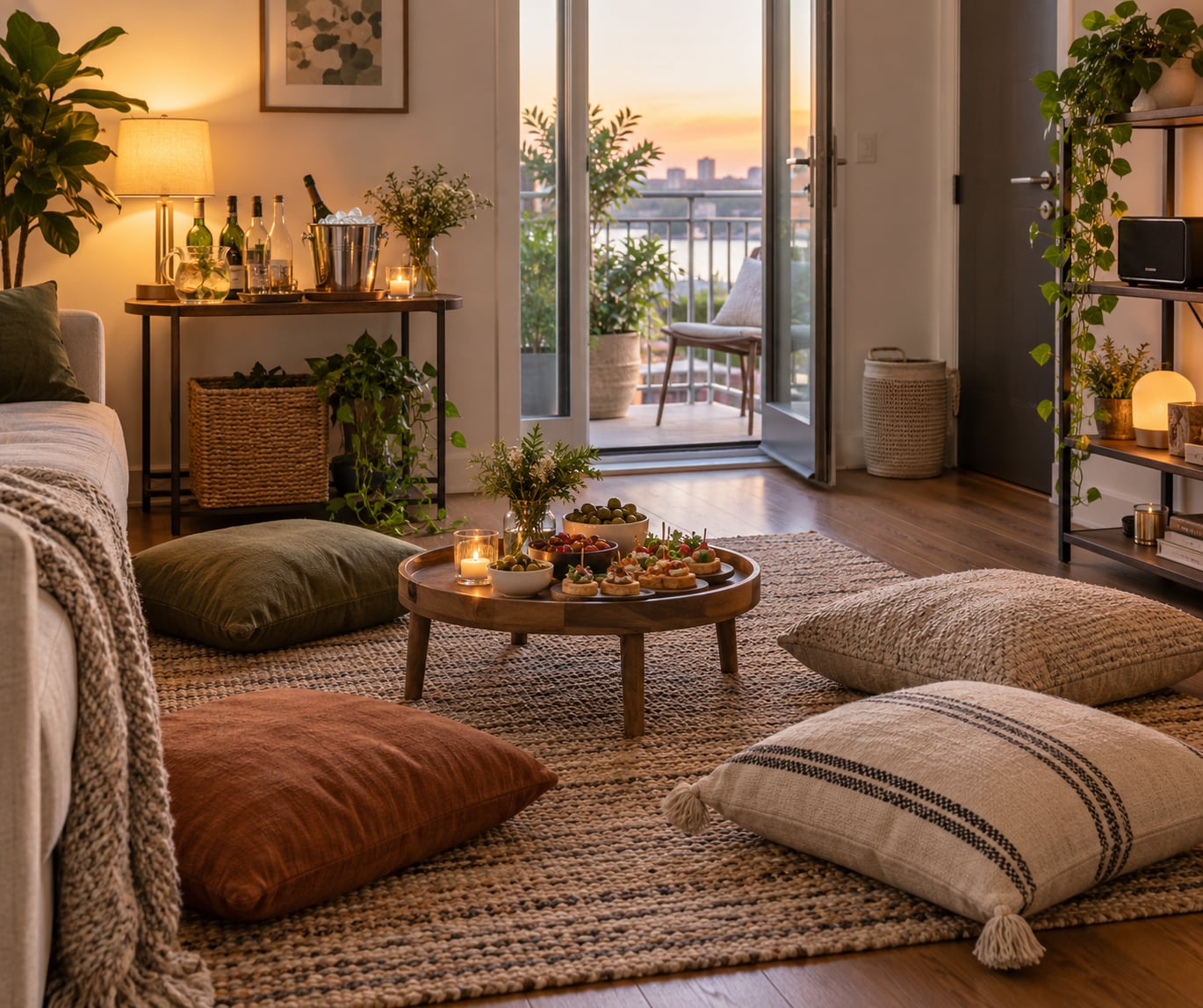
Give each activity its own spot so guests move instead of gathering in a knot in the middle. Four zones cover almost everything: a welcome spot by the door, a conversation zone with seating, a food zone near the kitchen, and a drink zone on a side table or bar cart away from the food.
Add a fifth for coats and bags — a bedroom corner, the back of a closet, or a folding rack by the entry — so bags don’t end up on chairs you need for seating. It sounds small, but free chair space is the difference between a room that works and a room where two people stand.
You can define zones for almost nothing. Push a lamp into a corner to make a conversation nook, drape a blanket or a sheet over a shelf to hide clutter, lay the rug where you want people to stand, or set a scented candle or diffuser — skip candles if your room is tight or your building bans them. A mirror on a wall you can see when you walk in makes the room read bigger than it is.
Keep doorways, the path to the bathroom, and the path to the exit clear of furniture. Not negotiatingly clear — actually clear. Check it once an hour.
Prepare Food and Drinks With Minimal Mess
Choose food people can eat with one hand while standing, and put it where the kitchen traffic is heaviest. A counter-height table or a folding table in the living room works better than a crowded kitchen counter, because it pulls people out of the one-room bottleneck.
Skip anything that needs a knife, a heat source, or a plate to assemble. Good options: sliders and mini sandwiches, cheese and crackers, marinated olives, deviled eggs, sliced fruit, pastries, spring rolls, or one tray of something warm held over by a crockpot on a separate surface. For dietary variety, keep one clearly labeled plant-based main and one clearly labeled no-dairy or no-gluten item, and put small cards next to them. One menu never suits every guest, so labeling does more work than asking people repeatedly.
For drinks, station them. Put out glassware, ice, and a corkscrew or opener where guests can serve themselves without you. Use markers on the bottles to identify anything unfamiliar, and put a bottle of water and a bottle of soda in the same sightline as the alcohol, not in a separate fridge corner. People who never see water drink less of it.
Skip red wine if the room is tight and you’re nervous — pale drinks and clear cocktails show fewer stains on a light rug and a pale sofa. Use coasters, and put a few paper towels within reach of the second drink station.
Set the Music, Lighting and Atmosphere
Use one speaker you can move, place it away from the shared walls, and set a ceiling you can defend. A portable speaker on a shelf or a small stand works better than a speaker on the floor behind the couch, which sends bass straight through the floor and up into the apartment above.
Build the playlist before the party, roughly two hours of music for a three-hour evening. Start with something mid-energy so the early arrivals can talk, add more energy in the middle, and taper in the last half hour — a playlist that peaks at midnight makes leaving feel like an insult.
Test the level before guests arrive. Stand in your hallway with the door closed and play the loudest track. If you can clearly make out the lyrics from the hall, it’s too loud. Do the same test upstairs and downstairs if the building allows it.
For lighting, kill the overhead and use two or three warm sources at different heights. Lamps on side tables beat ceiling lights in a small room every time. Keep one dimmable or colored light so people can lower the brightness later.
Check In With Neighbors and Protect the Building
Give the people directly above, below, and next to you a heads-up before the party, not after. In dense housing, that’s the difference between a friendly evening and an unpleasant relationship — and it costs you five minutes.
Rules vary by lease, building and city, so check yours rather than guessing. Look for language about gatherings, quiet hours, and nuisance behavior, and check whether your building has posted hours. If there’s a doorman or superintendent, a quick word costs nothing and shows respect for their job. A greeting downstairs also buys you patience if someone does call the non-emergency line.
Then send a note or knock. Keep it short and give them your number, which turns a future complaint into a text message to you instead:
“Hi, I’m having a small get-together at my apartment on Saturday from 7 to 11 p.m. — about a dozen people, nothing loud, and we’ll be done by 11. If anything is too much, please text me at (555-0142) and I’ll turn it down. Thanks for living next door.”
Invite rather than warn when you can. Several hosts say that inviting a neighbor in for ten minutes defuses the whole situation, and it costs you one drink.
A few more building basics: secure your valuables, keep keys in a designated bowl or a hook by the door so nobody handles a stranger’s keys, and pick an end time now — put it in the invitation, not just in your head.
Clean Up Without Turning the Night Into Another Project
Put a trash bag and a recycling bag in a bin near the front door before the party starts, and a second bag in the kitchen. When the bin is full and within three steps of the exit, people use it. When it’s in a closet, they don’t.
Do small resets during the party instead of one big cleanup at the end. Every hour or so: empty a drink ice tub, wipe a sticky counter, restock the ice, and check that nobody is blocking the hallway. Ten minutes spread across three hours is much lighter than a forty-minute session at midnight.
At the wind-down, shift the music down and dim the lights so the room tells people it’s time. Offer the door, your car keys, and the rideshare line — hosting well includes helping people get home safely. If anyone is heading out, walk them to the stairwell or lobby; a shared entrance is a noise problem too.
The final reset takes about thirty minutes: bag the trash, empty and rinse anything in the sink, wipe sticky surfaces, sweep visible crumbs, run the bathroom once, replace the soap, and reset the furniture. Then walk your own route past the shared walls and stop when the sun comes up.
Common Mistakes
Almost every small-apartment party problem has a quick fix, and most of them show up an hour in.
- Overpacking the guest list. The fix: pick a number that leaves circulation room, send the invite with a start and end time, and invite a few more people to text than you’ve capacity for, then text them the no gently.
- Blocking the exits. Coats on the hallway floor, bags by the door, a chair in front of the route to the kitchen. The fix: designate a coat spot in the first ten minutes, before it becomes a pile.
- Putting all drinks in one area. The fix: a second station away from the food, with its own ice and its own trash bag.
- Harsh overhead lighting. The fix: lamps at two or three heights, overhead off or on dim, one warm source low in the room.
- Music too loud for the walls. The fix: move the speaker off the shared wall, keep it off the floor, set a level you can still hold a conversation over, and retest from your hallway.
- Skipping ventilation. A packed room heats up fast and a warm room means open windows and louder voices. The fix: crack a window early, run the exhaust fan, and cool the room before peak time instead of during it.
- No plan for trash. The fix: pre-bagged bin near the door, one in the kitchen, and a can beside the drink station.
- Skipping the neighbor heads-up. The fix: knock or text the units above, below, and beside you with your end time and your number.
A few final tips that pay off more than any decoration. Tell people when the party ends in the invitation itself, because that is the least awkward version of the question. Have one person you trust help with the door and the cleanup so you aren’t doing both while hosting. And if a neighbor does complain, answer with kindness and adjust: move the speaker, close the window, or end the evening early. One adjusted night is worth more than a lecture.
Frequently Asked Questions
How many people can I invite to a small apartment party?
Most small apartments comfortably hold one person per 10 square feet of usable common area, then a few fewer once you account for coats, bags and drinks. That usually means 8 to 12 people in a furnished studio and 12 to 16 in a one-bedroom. Cut that number by a third if people will dance, and test your number the day before by standing in the room in your planned layout and walking from the door to the kitchen to the bathroom without squeezing past anyone.
How can I make a small apartment feel less crowded?
Give each activity its own zone instead of letting everyone gather in the middle: a welcome spot by the door, a conversation corner with seating, food near the kitchen, drinks on a separate table, and one dedicated corner for coats and bags. Push a lamp into a corner and use warm lighting instead of overheads, put a mirror where you see it walking in, and free up chair space so the room reads as intentional rather than packed.
What is a good amount of food and drinks for a small house party?
Plan roughly three substantial handheld items per guest plus a couple of light nibbles, and serve drinks in a self-serve setup so you are not pouring all night. Keep one clearly labeled plant-based main and one clearly labeled option for guests avoiding dairy or gluten, rather than trying to build a menu that suits everyone. Two drink stations with their own ice prevent both a bottleneck and a puddle on your floor.
How loud should music be in an apartment?
The useful test is not a number on a speaker dial. Before guests arrive, play your loudest track, close the door, and stand in your hallway. If you can make out lyrics clearly, the music is too loud for shared walls. Keep the speaker off the floor and away from the party wall, and you should still be able to hold a conversation without raising your voice across the room.
How do I keep guests from blocking exits or damaging furniture?
Give coats and bags a home in the first ten minutes, usually a bedroom corner or a folding rack by the entry, so they never end up in the hallway or on your chairs. Walk your door-to-kitchen-to-bathroom route once an hour and move whatever drifted into it. Put breakables and valuables away before anyone arrives, and take anything fragile off open surfaces where people set down drinks.
What is the easiest way to clean up after a small apartment party?
Stage the cleanup before the party: a bin with pre-bagged trash and recycling near the front door, a second bag in the kitchen, and paper towels within reach of the drink station. During the party, do ten-minute resets rather than saving everything for midnight. The final pass takes about half an hour — bag trash, rinse the sink, wipe sticky counters, sweep crumbs, reset the bathroom, and restore furniture.
Conclusion
Before you open the door, run this checklist once: your guest number is written down and matches your floor plan, two or three zones are set, the doorways and bathroom route are clear, self-serve food and two drink stations are stocked, the hallway sound test passed, and the trash bin is beside the exit. Get to throw a house party in a small apartment right and the space stops being the limitation.