
How to keep volunteers coming back comes down to how the experience feels each time people show up: clear expectations, a role that makes sense, a schedule that respects their life, and visible proof the hours mattered. Fix those four things and most teams see repeat participation climb inside a couple of quarters. Updated for 2026.
Most volunteer programs don’t lose people at the recruitment stage. They lose them right after the first shift, when a volunteer who signed up enthusiastic discovers nobody told them what to do and the next opportunity was a vague group text three weeks later. The nine steps below attack that drop-off in order, and each one is cheap enough for a four-person volunteer team with no budget.
You do not need software to do this. A shared spreadsheet of names and dates, a one-page role description, and a fixed rhythm of short messages will carry you most of the way.
Table of Contents
- What You Need
- How to Keep Volunteers Coming Back Step by Step
- 1. Make the First Experience Worth Returning To
- 2. Give Volunteers a Clear and Meaningful Role
- 3. Make Scheduling and Reminders Easy
- 4. Communicate Before and After Every Shift
- 5. Ask for Feedback and Act on It
- 6. Recognize Contributions in Ways Volunteers Value
- 7. Create Progression and Belonging
- 8. Follow Up When Someone Stops Returning
- 9. Measure What Helps People Return
- Common Mistakes
- Frequently Asked Questions
- How do you thank volunteers in a way that feels genuine?
- What are the most common reasons volunteers quit?
- How often should I follow up with volunteers?
- How do I handle inconsistent attendance without shaming anyone?
- How do I bring back a volunteer who stopped coming?
- What can we do about volunteer burnout?
- Conclusion
What You Need
Before changing anything, gather five things. Without them you’ll be guessing at why people lapse.
- A list of who actually came back. Even a spreadsheet with names, roles and last date works. Write down who returned within 90 days and who did not.
- A written description of each role. One page: what the shift involves, roughly how long, who to ask for help, and what a good shift looks like.
- One feedback channel. A message thread, a short form, or a five-minute conversation at the end of a shift. Pick one and use it the same way every time.
- Recognition materials. Thank-you notes, certificates, a group chat where you can name people publicly. These cost nothing and get used constantly.
- A repeat-participation measure. Decide before you start how you’ll count a returning volunteer so the numbers stay honest over time.
How to Keep Volunteers Coming Back Step by Step
1. Make the First Experience Worth Returning To

The first shift decides whether there is a second shift. Put together a folder or a single printed sheet with the day’s plan, the location, who to look for, safety basics, and the date and time of the next opportunity.
Walk the volunteer through the space, introduce them to two or three people by name, and give them one genuinely useful job for that first session rather than a pile of filing. Finish by asking directly: “Do you want another date on the calendar before you leave?” People who leave without a date on the calendar are the ones you lose.
You will know it worked when your second shift has more returning names than new ones. Most retention guides start right here, because every later step is easier when the first visit already felt organized.
2. Give Volunteers a Clear and Meaningful Role
Vague roles are the quietest retention killer. A volunteer who shows up not knowing what they are supposed to do spends the shift anxious and stops coming back without telling you why.
Write one page per role: the specific tasks, the realistic time commitment, who decides what, and which parts of the mission the role connects to. Say plainly which decisions the volunteer can make alone and which need approval. That clarity does not restrict people, it frees them.
Ask each volunteer during their first month what part of the work they found most and least useful, then adjust. A role description nobody has reviewed in a year is a guess.
3. Make Scheduling and Reminders Easy
Scheduling is where small organizations lose the most hours and the most people. Offer self-scheduling where you can, publish the open slots in one place, and make swapping or passing a shift a one-message process with no guilt attached.
Send one reminder the day before. A short nudge to the group message the evening before is the single cheapest change most small teams can make, and it cuts no-shows noticeably without any extra budget.
Volunteers with narrow availability often disengage because saying no feels like a rejection. Tell them the no is welcome and easy, and they will say yes again next month.
4. Communicate Before and After Every Shift
Send short pre-shift instructions: where to be, what to bring, who to find, what changed since last time. If plans change on the day, say so early and give people a way to opt out without a conversation.
The post-shift message matters just as much. Ten days later, tell the team what happened because of the shift. That habit alone changes how many people put their name down for the next one.
5. Ask for Feedback and Act on It
Survey questions that work: What made this shift easier or harder than last time? Was anything missing at the start? What should we stop doing? What would you like to try next? Keep it to four questions and send it within 48 hours, while the memory is fresh.
The acting is the part most programs skip. Collect three responses, pick one thing you can genuinely change, change it, then tell everyone what changed and why. Coordinators who close that loop are the ones whose volunteers keep answering honestly, because the last round of feedback visibly went somewhere.
6. Recognize Contributions in Ways Volunteers Value
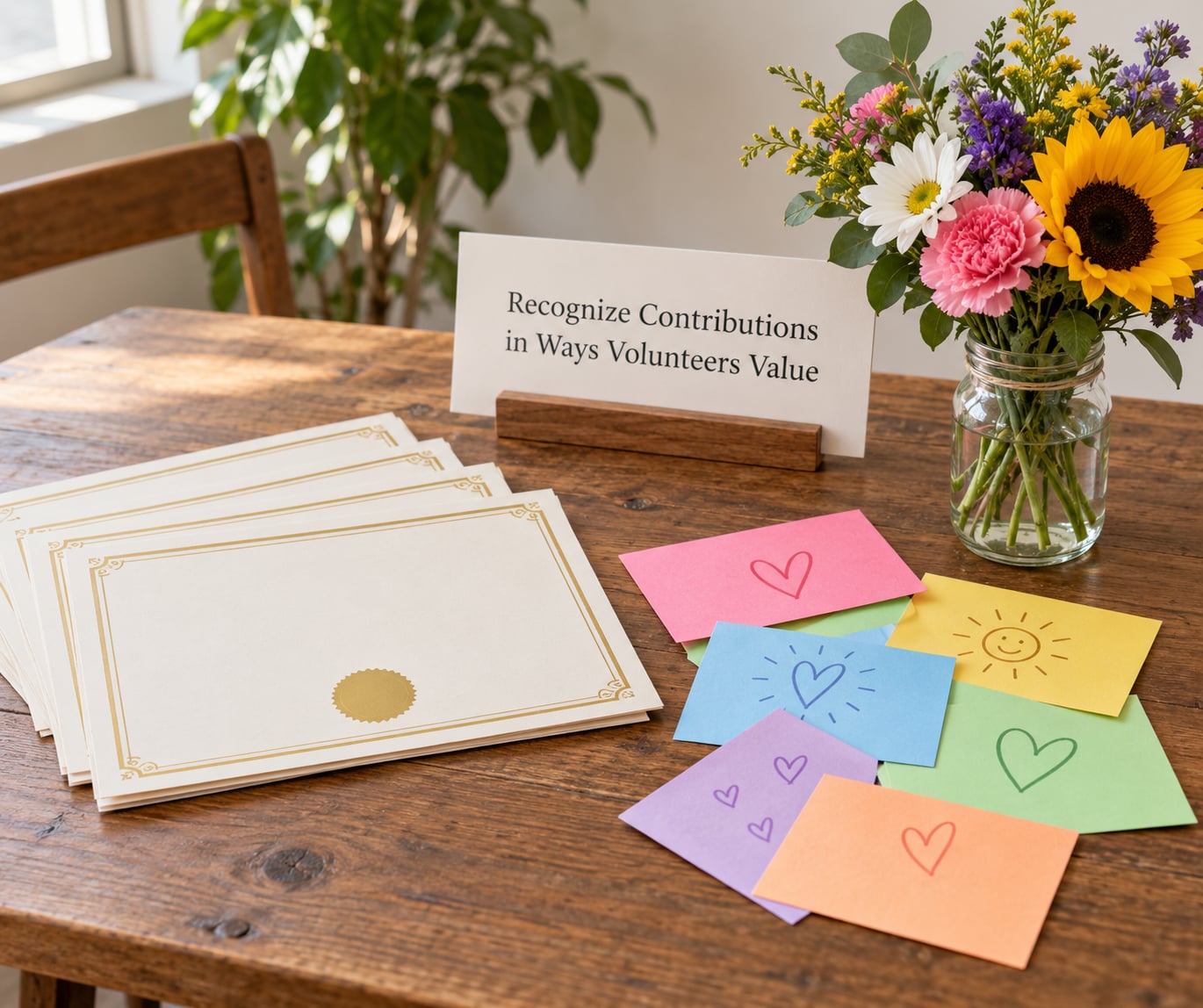
Generic mass emails get dismissed. Thanking someone in a way that fits them gets remembered.
- A handwritten note naming something specific they actually did.
- A public mention in the group chat or newsletter, with permission first.
- A certificate at milestones, six months, one year, after a big event.
- A reference letter, written properly, with dates and hours they can use.
- The perk they asked for, like a front-row seat or access to a project they liked.
- Being trusted with something harder, which most volunteers value more than any gift.
Keep a record of what you have given each person so recognition stays varied and nobody receives the same mug twice.
7. Create Progression and Belonging
Volunteers who only ever do entry-level tasks leave once they have learned them. Give people somewhere to go: pair each new volunteer with a buddy, invite them to a monthly gathering, open a committee or working group they can join, and lay out what a lead role involves and how someone asks for it.
Belonging is not decoration. A volunteer who feels out of place or on the outside of an in-group simply stops coming, and rarely says why. Watch for who stands slightly apart during a shift and introduce them to someone on purpose.
In community organizations, this matters more than most coordinators expect. If part of your community does not feel represented in your volunteer line-up, fix that before you look for a retention trick.
8. Follow Up When Someone Stops Returning
Silence after a lapse is where relationships get lost. Send one personal message, not a mass one. Something like: “You helped with the Saturday distribution in March and we have missed you. Nothing is wrong and nothing is expected of you. If the schedule or the role no longer fits, tell me and we’ll find something that does. If you’d like to try again, here are three dates.”
No pressure, one message, real options. Then let the person reply on their own timeline and stop following up after a second attempt.
A repeat participation rate in the low-to-mid range is common for teams that were not tracking it at all. Treat your own number as a starting point to improve, not a verdict on your program.
9. Measure What Helps People Return
Pick a simple definition and stick to it. Repeat participation rate is volunteers who returned for at least one more shift within 90 days, divided by everyone who completed a first shift, multiplied by 100.
With a cohort of 100 first-time volunteers, if 64 came back for a second shift within 90 days, your repeat participation rate is 64%. Track it by quarter and by role type, since event volunteers and recurring shift volunteers will not produce comparable numbers.
Pair it with the questions from step five. A rate tells you a change happened; the survey tells you which change.
Common Mistakes
Most retention problems trace back to one of these, and each has a plain fix.
- Vague roles. Volunteers arrive unsure what to do. Fix: the one-page role description from What You Need, reviewed once a year.
- Slow communication. Plans change and people hear about it late, so they stop trusting the schedule. Fix: a same-day message whenever something changes, even if the change is small.
- Delayed thanks. A thank-you three weeks late lands as an afterthought. Fix: same week, named, specific.
- Promising flexibility you can’t deliver. You say people can come and go, then get annoyed when coverage fails. Fix: offer a fixed set of shift options with a simple swap message, and hold to it.
- Treating volunteers as interchangeable labor. Roles rotate without warning and nobody knows anyone. Fix: keep names stable on roles and pair new people with a buddy.
- Changing plans without explanation. A cancelled program with no note reads as indifference. Fix: tell people what happened even when there is nothing to ask of them.
The reasons underneath those mistakes usually fall into a short list: nobody explained the shift, the timing never fit real life, the hours produced nothing visible, feedback went nowhere, thanks never came, there was no second role once they got good at the first one, or they felt outside the group. Match the reason to the fix and the pattern stops repeating.
Frequently Asked Questions
How do you thank volunteers in a way that feels genuine?
Thank people quickly, specifically and by name. A note that mentions the specific thing they did, sent the same week, lands better than a mass email sent a month later. Mix the format: handwritten cards for milestone moments, public mentions in your group chat for regular contributors, and a properly written reference letter when someone is job hunting. Keep a record so recognition stays varied.
What are the most common reasons volunteers quit?
The usual reasons are unclear expectations, a schedule that does not fit real life, no recognition, no visible impact, feedback that is collected and ignored, feeling outside the social group, and burnout from scope creeping toward paid work. In practice most lapses are a combination of two: a person who did not feel needed, and a person who felt overwhelmed. Ask at the point of lapse, because the reason is usually different from what you would guess.
How often should I follow up with volunteers?
Once a week before and once after a shift is plenty, and more than that starts to feel like pressure. Send a day-before reminder, a short note the following week, and a personal message only when someone has missed two scheduled shifts. Volunteers who get asked for feedback should expect one check-in every quarter. Consistent beats frequent.
How do I handle inconsistent attendance without shaming anyone?
Set the expectation once, early and plainly, then respond to the pattern quietly. Ask about barriers before consequences: schedule, transport, health, caring responsibilities. Offer a lower-commitment option such as a monthly event or a remote task. If a person has missed repeatedly, a short note saying the role is open if they want it keeps the door open without pressure.
How do I bring back a volunteer who stopped coming?
Send one personal message that assumes nothing is wrong. Name something specific they did, say what the team missed, and offer a smaller or different role if the old one no longer fits. Give three concrete dates rather than an open invitation. If they do not reply after a second message, leave it there and keep the door open through normal group updates.
What can we do about volunteer burnout?
Reduce scope before you add support. Set a maximum number of hours per month, rotate the most draining tasks, and end shifts with a clean finish rather than an unfinished task. Watch for signs: skipping the good parts, arriving late, dread in the messages. Someone showing those signs usually wants permission to do less, so offer a lighter role before they decide to leave.
Conclusion
Start with the first experience. Fix your next shift so that a new volunteer leaves knowing exactly what to do and already holding a date for the one after it. Then send a short update ten days later telling the team what their hours produced.
From there, keep the promise small and keep it on time: one day-before reminder every week, one personal message when someone has been quiet too long, one visible change when a volunteer tells you something is not working. Those three habits do more for how to keep volunteers coming back than any gift list or framework.