To recruit volunteers for an event, define two or three clear roles, write a short description for each one, and post the same ask through at least five channels starting four to six weeks out. Recruit about 20 percent more people than your shifts require, confirm everyone personally in the final week, and thank them properly afterward.
Most organizers get this wrong in one of two ways. They ask for “help, any help” and get nobody, or they recruit twenty enthusiastic people and then spend the event week scrambling because nobody knew what time to arrive.
This guide is for people running a Pride march, a block party, a gala, a benefit show, or a community festival. If you are organizing something in Chicago this 2026 and short on hands, the process below is the one I wish someone had handed me years ago.
Budget about six weeks of lead time for a single-day event, two to three hours a week of coordination, and one person who owns the volunteer list from sign-up to thank-you note. It is less work than it sounds, as long as you start before the panic sets in.
Table of Contents
What You Need

You need six things ready before you send a single message. Miss one and you will be chasing answers by DM while trying to run the event.
The event basics in writing
Date, start and end time, exact location, expected attendance, and what the event is for. If a volunteer has to read your message and ask what the event actually is, the message is not finished.
A list of roles with real tasks attached
At minimum: setup and breakdown, a welcome or registration table, a float or roaming role, and a safety or accessibility contact. Every role needs a task, a time window, and a named person it reports to.
One contact method and one contact person
A single email address or phone number that appears everywhere you post. Volunteers need to reach a human, not a contact form that goes nowhere, and organizers get chaos when three people answer questions differently.
A recruitment timeline working backward from the event
Work out your deadline dates before you recruit. You need a sign-up deadline, a briefing date, and a final confirmation, and each one gets placed on a calendar with an owner attached.
A sign-up or tracking system
A spreadsheet works fine for a small event. What matters is one place that holds names, contact details, chosen role, shift time, and any accessibility or emergency information you need.
An orientation plan and basic safety notes
Decide now how people learn what to do. A fifteen-minute group briefing, a printed one-pager, or a short video walkthrough all count. Include where the volunteer check-in point is, who handles incidents, and what the accessibility plan is.
How to Recruit Volunteers for an Event: Step-by-Step
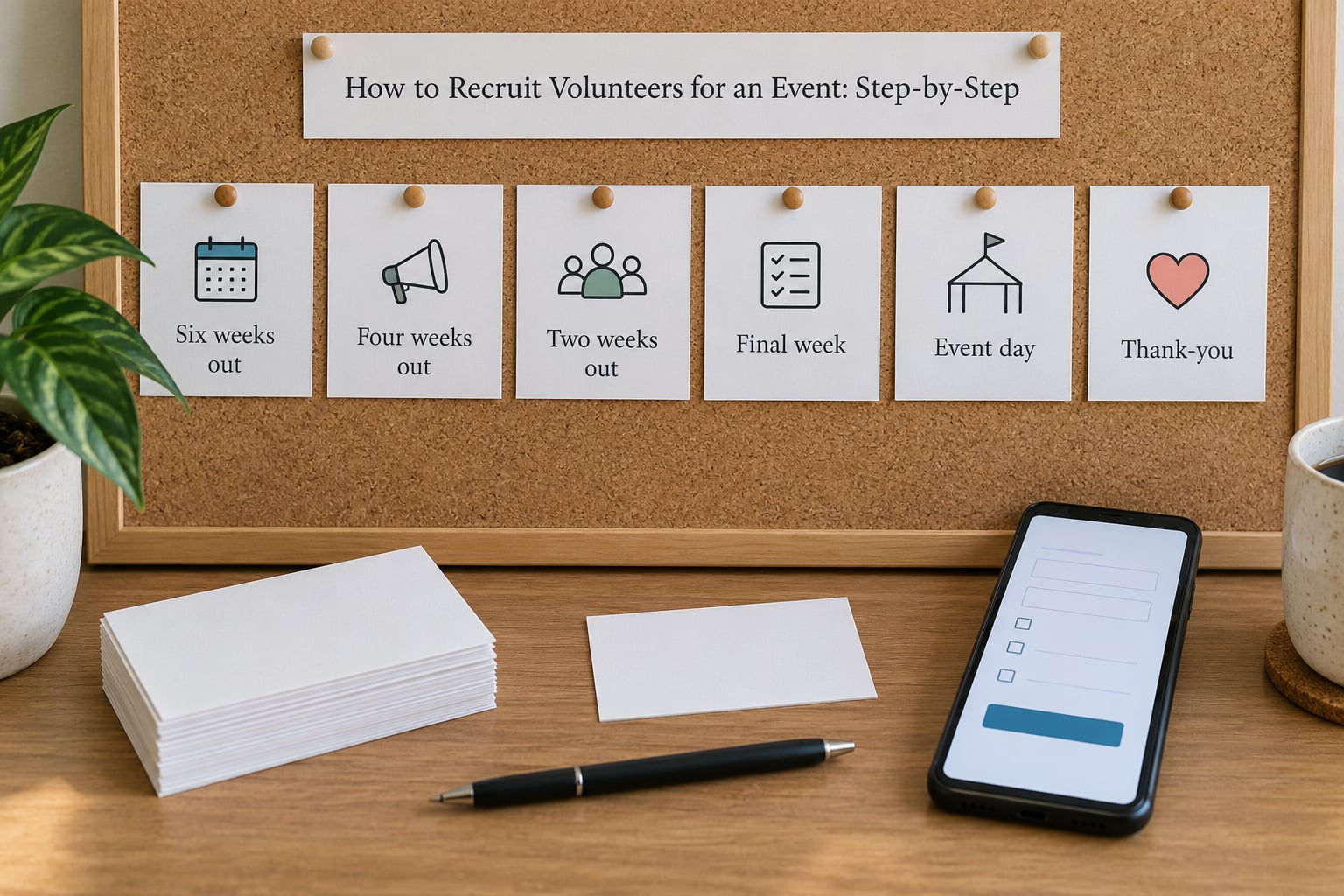
Six steps, in order, take you from an empty volunteer list to a briefed team that knows where to be. Work through them once and you can reuse the same system for the next event.
Define the Event and Volunteer Needs
Start by writing down what the event needs, not who might volunteer. Every organizer already knows the gaps: registration will be swamped at the door, setup will run long, and the tent needs someone watching the water cooler.
Turn those gaps into a number. A practical starting point is one volunteer per 25 to 30 attendees for a public outdoor event, plus setup and breakdown crews that work outside the public window. A ticketed gala with a bar, a silent auction, and two rooms may need a dozen front-of-house volunteers for 150 guests.
Multiply that figure by 1.2 and treat it as your recruitment target. The extra 20 percent absorbs the no-show that always happens, the person who brings a friend, and the shift that needs a second pair of hands.
You will know this step worked when you can read your list and see, for each role, a task, a start time, and an end time. If a line still reads “help with stuff,” keep working on it.
Create Specific, Friendly Volunteer Roles
A good volunteer role description answers six questions: who, what, when, where, why, and how. That framework is the difference between a signup form people finish and one they abandon halfway.
For a community festival, the welcome table role reads like this: you greet attendees at the check-in table, answer two or three common questions, and direct people to the info booth. It runs from 11 a.m. to 3 p.m., you’ll get a break at 1 p.m., and your lead will check in with you twice during the shift.
Always state the physical requirements honestly. Setup and breakdown work involves lifting, bending, and being on your feet for hours, and saying so up front does not scare people off, it just means the wrong person doesn’t sign up and then have a bad day.
You will know this step worked when someone who has never met you can read a role and tell you what they will be doing at 2 p.m. on event day.
Choose Where and How to Recruit
Your own network is the most reliable channel and the general public is the hard one. Volunteer organizers say this constantly, and it’s true: start with people you already know, then work outward in layers.
- Friends, family, and past volunteers. Highest conversion of anything you will try. Ask directly, by text or call, not by group post.
- Existing volunteers and attendees. Anyone who came to a previous event or bought a ticket is a warm lead. A personal note beats a broadcast.
- Email lists and community partner organizations. Youth groups, faith communities, alumni networks, and local advocacy groups can each supply a handful of people in one ask.
- Social media and neighborhood groups. Local Facebook, Nextdoor, and community forums work well for block parties and street fairs. Keep the post concrete about time and place.
- Volunteer platforms. VolunteerMatch, Idealist, Taproot Plus, Points of Light, JustServe, and Volunteer.gov cover civic and nonprofit roles, though they skew toward ongoing commitment rather than one-day events.
- Campus and employer channels. Student organizations, service-learning offices, and corporate volunteer days produce teams rather than individuals, which is useful for setup and breakdown.
- In-person recruiting. A sign-up table at a local fair, at your organization’s other events, or at a neighborhood meeting converts better than you would expect.
Here is a short outreach message you can adapt without sounding generic:
We’re putting on [event name] on [date] at [location], and we need about [number] people to help. No experience needed. You’d be doing [specific task], from [start time] to [end time], and we’ll brief you beforehand and provide everything you need. If you’re interested or know someone who would be great at this, reply to this message or email [contact].
You will know this step worked when responses start arriving before your deadline and at least a quarter of them come from outside your personal circle.
Make Sign-Up Simple and Track Responses
Every extra field on a sign-up form costs you sign-ups. Keep it to eight fields or fewer and you will do better than any clever form design can fix.
Ask for: name, email or phone, the role or shift they want, when they are available, any accessibility needs or accommodations, whether they can work outdoors or lift, and one emergency contact if the event involves minors or higher-risk duties. Add a yes or no checkbox for being photographed at the event.
That last field matters more than people expect. At community events, especially Pride events and fundraisers where attendees are visible by default, some volunteers and guests do not want their image online. One checkbox, asked once, prevents an argument later.
Set a firm sign-up deadline, keep responses in one tracker, and send a short reminder three days before the deadline listing which roles still need people. You will know this step worked when you can answer “how many do I still need, and where” without digging through messages.
Confirm, Orient, and Support Volunteers
Confirmation turns a maybe into a commitment. Send every volunteer a short message with the date, arrival and end time, what to wear or bring, the check-in location, the name and phone number of their lead, and who to contact if something changes.
Brief people before the day if you can, even for fifteen minutes at a coffee shop. If you cannot, hand out a one-page briefing at check-in and give ten minutes of group time before doors open.
On the day, have one person per area as the named lead, a designated volunteer break spot with water and a chair, and a check-in process so you know who is actually there. Volunteers who get a real break and a clear answer to their questions tend to come back, and that is worth more than any swag item.
You will know this step worked when the schedule runs without you answering the same question all day.
Follow Up and Build a Future Volunteer Base
The thank-you is not politeness, it is the next recruitment campaign. Send it within two days, while people still remember the day.
Keep it specific. Mention what the event raised, how many people attended, and what a volunteer actually did, rather than a generic “thanks for your service.” Offer an hour certificate or written verification if any volunteer needs service hours, and invite people to sign up for the next event in one click from that same email.
Store volunteer details with their consent and note who gave permission to be contacted again. A small spreadsheet with a name, role, date, and a yes or no on future contact is enough, and it respects the people who would rather not hear from you again.
You will know this step worked when a good number of volunteers reply to your next ask without any prompting.
Common Mistakes
Almost every failed volunteer recruitment traces back to one of these. Fix them and the same event works next year with half the effort.
Asking vaguely and hoping for the best
“Anyone want to help?” gets silence, because answering requires effort and no specifics. Replace it with two named roles, a time, and a place. Vague asks are the single most common reason organizers end up short-handed.
Assigning too many responsibilities to one person
One volunteer doing registration, setup, and cleanup is a person who will be useless during the busiest hour. Split roles, stagger shifts so there is overlap, and put a named lead in charge of each area.
Recruiting too late
Volunteers plan their month around whatever they signed up for first. Starting two weeks out means competing with jobs, school, and every other event on the calendar. Six weeks is comfortable, three is a scramble, and ten days is prayer.
Ignoring accessibility
If your only meeting point is a set of stairs, or the only way to help involves heavy lifting, you have quietly ruled people out. Ask about accommodations at sign-up, name a contact for access needs, and offer roles that can be done seated or remotely.
Failing to communicate changes
Time, location, or start time changes that go out as a text at 9 p.m. produce no-shows and resentful volunteers. Send changes from the same contact address you used originally, and send them early.
Relying on one channel
One group post is a bet. Layers of outreach, personal asks first and public posts second, are what make the difference between nine sign-ups and nine cancellations.
Two habits carry most of the weight. Be specific about every role, and treat your volunteers like guests. Both take an extra ten minutes and do more for next year’s staffing than any platform or app.
Frequently Asked Questions
How far in advance should I recruit volunteers for an event?
Start four to six weeks ahead for a single-day event, and eight weeks or more if you need corporate teams, campus groups, or anyone requiring training or clearance. Three weeks works only if your roles are simple and you already have a warm list to contact. Publish the ask early, then set a sign-up deadline about a week before the event so you have time to fill gaps.
Should I offer incentives or payment to event volunteers?
Payment is complicated by labor rules and tax treatment, and most community events run without it. What works far better is recognition that costs little: an hour certificate, a written reference, a letter of thanks naming what the person did, priority seating at the next event, or a small item from a sponsor. Cover out-of-pocket costs like transit or meals if your budget allows.
What should I do if a volunteer cancels or does not show up?
Recruit about 20 percent more than your shifts require, then keep a short backup list of people who offered to be called. Text or call everyone on that list the moment you know you have a gap, and describe the shift honestly. If you still come up short, reduce the role’s scope rather than the hours, and tell your remaining volunteers what changed.
How can I recruit volunteers when I do not have an existing community list?
Start with partner organizations rather than individuals. Youth groups, faith communities, alumni networks, small businesses nearby, and local nonprofits can each supply a few people from one conversation, and a named contact inside each group does the recruiting for you. Add local social and neighborhood groups, a sign-up table at a community fair, and volunteer platforms to widen the net.
How many volunteers do I need for an event?
A rough starting point is one volunteer per 25 to 30 attendees for a public outdoor event, plus separate setup and breakdown crews. Ticketed events with a bar, auction, or multiple rooms usually need more at the front of house, often 10 to 15 for 150 guests. Then multiply by 1.2 to cover no-shows, and check the plan against your peak arrival time rather than the whole day.
Conclusion
Start with one action today: write down what your event actually needs, pick two or three roles, and give each one a task, a time, and a name to report to. Then send the ask to ten people directly, and put the same message in a public post.
Six weeks of lead time, twenty percent more volunteers than you need, one contact person, and a thank-you that names what each person did is a complete recruitment plan. Everything else is detail. The result is a crew that knows where to be, feels useful, and is already in your inbox when the next event comes around.