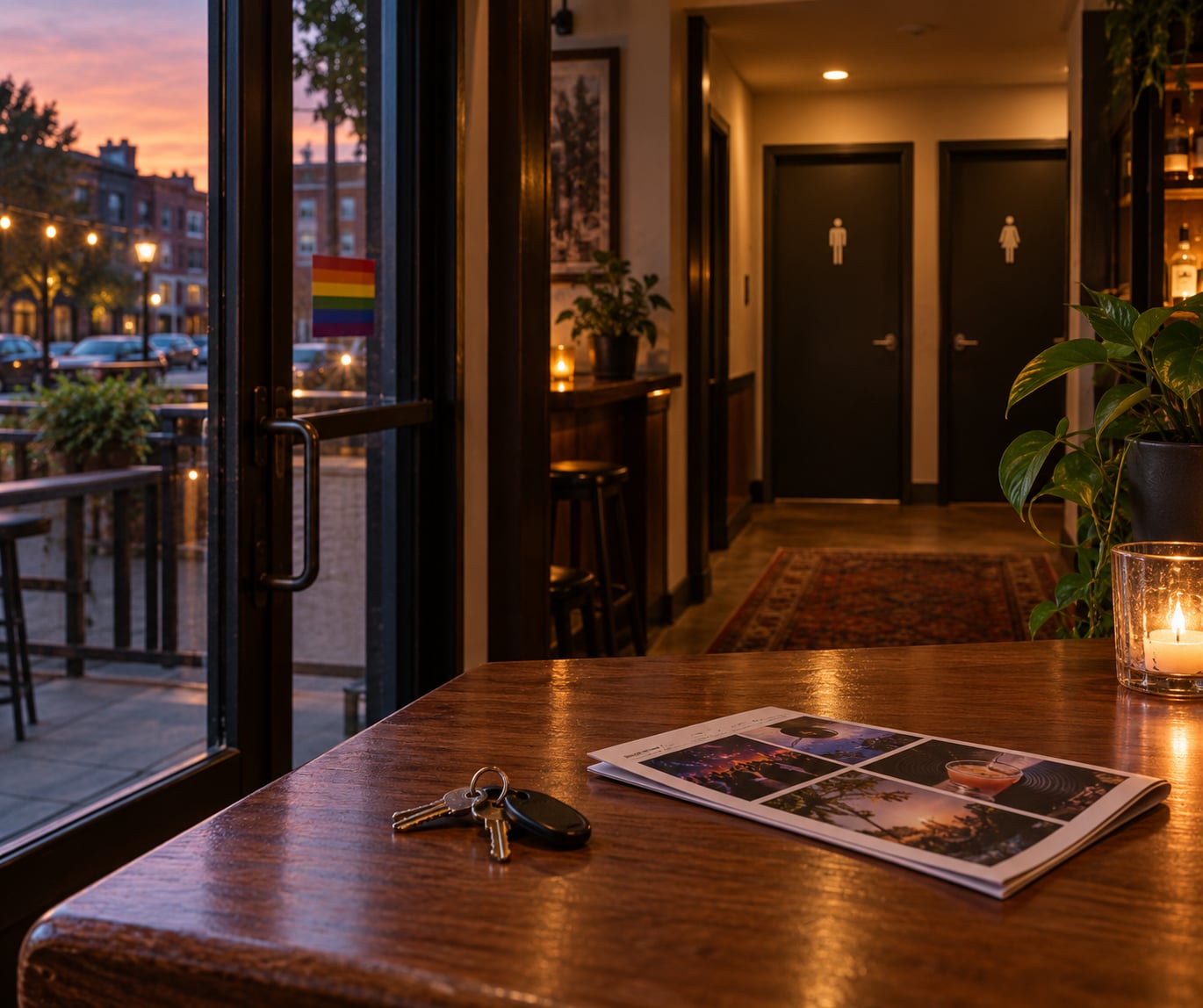
A rainbow flag in the window proves a bar wants Pride traffic. It proves nothing about what happens at the door, in the restroom, or when a trans woman walks in on a Friday. To know how to tell if a bar is actually queer friendly, look past decor and check the operations: who works there, who runs the calendar, what the posted code of conduct says, and whether queer people describe the room as theirs.
That test matters because “queer friendly” stopped being a description and became a marketing category. Venues learned that a flag and a June promotion sell tickets, so the claim on the window and the room behind it have come apart. Get it wrong and the cost lands on someone else: a friend misgendered at the bar, outed by a camera, or left standing outside because the vibe felt wrong and no one would say why.
This guide gives you nine checks you can run before you leave the house, in the first ten minutes after you arrive, and during the night itself. Most take a few minutes. None of them requires you to out yourself or anyone else.
Table of Contents
- What You Need
- Step-by-Step: how to tell if a bar is actually queer friendly
- 1. Read the bar’s official LGBTQ+ inclusion information
- 2. Check the calendar for queer-centered events
- 3. Read recent reviews from LGBTQ+ patrons
- 4. Look at how queer people are represented
- 5. Understand the door, dress code, and bathroom policies
- 6. Look for visible staff practices and safety measures
- 7. Ask LGBTQ+ community members directly
- 8. Visit during a lower-risk time and observe carefully
- 9. Decide whether the experience meets your needs
- Common Mistakes
- Frequently Asked Questions
- What qualifies a bar as queer friendly?
- Does a rainbow flag or Pride event mean a bar is queer friendly?
- Should I contact a bar before going to confirm LGBTQ+ inclusion?
- How can I tell if a bar has a safe atmosphere?
- What should I do if a bar ignores harassment or discrimination?
- Can a bar be queer friendly but still have accessibility problems?
- Conclusion
What You Need
You do not need insider contacts or a membership card. You need a little time and a way to look up the venue before you go.
- The bar’s own channels — website, Instagram or other social accounts, and any posted policies. A business with nothing published is telling you something.
- The event calendar — at least a few months deep. One event tells you about a night, a season of events tells you about a room.
- Recent reviews — the ones from the last six months, not the top five lifetime reviews. Look for the low ones, too.
- Community accounts — local queer Facebook groups, subreddit threads, Discord servers, or a group chat. These carry the detail venues do not publish.
- A way to ask — an email address, a DM, or a phone number. A short, neutral question gets a surprisingly honest answer.
- Your own specifics — whether you need step-free access, a low-sensory night, a room where you won’t be hit on, or a place safe to be alone.
Write your specifics down before you start checking. A venue can pass a generic test and fail yours, and the difference is usually not subtle once you know what to look at.
Step-by-Step: how to tell if a bar is actually queer friendly
The nine checks run in three passes: what the bar publishes, what the community says about it, and what the room actually does when you are standing in it. The passes are ordered on purpose, because the cheapest way to rule a venue out happens before you leave the house.
1. Read the bar’s official LGBTQ+ inclusion information
Start with whatever the venue has published about itself. A values page, a mission statement, a conduct policy, a statement posted after an incident — these are the only places a bar describes its intentions in its own words.
What you are looking for is specificity. “We welcome all kinds of people” tells you nothing, because every bar says it. A written code of conduct naming harassment, misgendering, unwanted touching and photography tells you the room has a rule and probably someone enforcing it.
Be careful with the annual Pride material. A single takeover of a corporate bar’s marketing, complete with a sponsored post and a themed night that ends in June, is a promotion, not a policy. The test is whether the statement survives February.
2. Check the calendar for queer-centered events
Recurring programming is one of the stronger online signals. Drag nights, queer trivia, open-mic and community-hosted evenings that run weekly or monthly mean someone is booking this on purpose, repeatedly, with staff who understand the audience.
One weekend in June is not a calendar. A single themed takeover is usually bought in bulk by a marketing agency, hosted by people who were hired for one Saturday, and gone by July.
Also read how the events are described. Does the listing say who the night is for and who it is organized with? Queer-specific nights frequently name the community they serve, the group they partner with, or the host who built the format. That detail is the difference between a hosted event and a marketing slot.
3. Read recent reviews from LGBTQ+ patrons
Generic review scores tell you very little. The useful review is the one a queer patron wrote after a specific night, and the details they mention are what you should be scanning for: how staff behaved, what the restrooms were like, whether a dress code or door rule caught anyone out, whether a problem got handled, whether the room was accessible, and who else was in it.
The threshold that matters is repetition. One angry review about a bartender is an anecdote. Three separate reviews across three months describing the same problem with the same door policy is a pattern, and patterns are what you are hunting.
Read the low ones carefully. People are suspicious of write-ups that mention no drawbacks, and rightly so. A review that says the room felt welcoming but the restroom was grim and the queue moved at the wrong moments is more credible than five stars and an exclamation mark.
4. Look at how queer people are represented
Go through the official photos, event pages, menus, and feeds and ask a narrow question: do real, varied queer people appear here, or is there one type?
Stock imagery, a single drag performer used as the face of the venue, or a marketing image that could belong to any bar are weak signals. Stronger signals look like a team photo where the staff are visibly diverse, an event hosted by a known community member, a menu that features queer-owned producers, or a feed that shows the same regular faces over months.
Representation is not proof of safety. Plenty of genuinely welcoming rooms have mediocre photography. But a venue that has never once shown a trans or nonbinary employee in a year of posts is telling you something about who it pictures its customers to be.
5. Understand the door, dress code, and bathroom policies
The restroom is where good intentions get tested, because a bathroom is a physical facility someone had to pay to change. Signage that only offers men’s and women’s rooms, a single-stall bathroom with a lock on the outside of each door, or a permanent out-of-order sign on the accessible stall all send a message about how trans inclusion is being handled.
Signs matter less than the fix. A bar that has one all-gender room with clear, ordinary signage is doing more than a bar that installed a beautiful sign above a bathroom that still functions as two separate rooms. One Reddit thread about a gay bar in Seattle described stall doors that locked from the men’s side and not the women’s — the kind of detail you only learn by asking, and the kind that matters more than any flag.
Now read the door policy. Unexplained gender restrictions, inconsistent entry standards, and rules that seem to apply differently depending on how someone presents are all reasons to pause. Written policies also drift from actual practice, so treat them as a starting point rather than a guarantee.
Dress codes deserve the same scrutiny, particularly when they are vague about presentation and enforced unevenly. Ask directly how they are applied if you can.
6. Look for visible staff practices and safety measures
Prepared rooms leave traces. Staff who appear to know the venue’s conduct policy and can describe it. A posted set of expectations near the entrance or the bar. A step-free route from the street and a restroom that is genuinely usable rather than technically compliant. Staff who do not look startled when a question about safety is asked.
None of this is a business requirement to advertise. Treat it as evidence, not a checklist of demands. The bar that cannot describe any of it is not automatically hostile, but it has given you nothing to weigh.
7. Ask LGBTQ+ community members directly
Local community groups are where the operational detail lives. Ask which nights are quiet, whether anyone has had a problem at the door, whether the management actually responds when something goes wrong, and who works there.
Bartenders get described, in community threads, as the front desk of the local scene — the people who know what night is busy, what is nearby, and who to call. That reputation is a fast read, and it is the single most trusted signal in most of the discussion around this question.
Mind the date stamp. A thread from four years ago describes a different staff team, possibly a different owner. Weight recent posts heavily, and treat an unresolved old complaint that still has no follow-up as a question worth asking out loud.
8. Visit during a lower-risk time and observe carefully
For a first visit, go with a friend, early in the evening, on a weeknight. The room will be calmer, the staff less overwhelmed, and you will have more attention to spare for what is actually happening.
Then watch. Who is behind the bar, and do they look like they belong to the room’s intended audience. Who is in the seats, and whether anyone appears to be performing for an audience they did not ask for. What happens when someone is rude, and how quickly staff move on it. Whether the restrooms are clean, unlocked and usable by the people who need them.
Keep the bar’s own advertising in view while you do it. That gap between what a venue says and what a room does is the entire point of the exercise.
9. Decide whether the experience meets your needs
Weigh five things: whether you felt physically and socially safe, whether the room looked like it was built for people like you, whether the policies were clear enough to rely on, whether the representation was genuine, and whether the live experience matched what was promised online.
Then hold the result loosely. A welcoming room on a Tuesday can feel different on a Saturday with a headliner booked, and a new management team can change everything in a season. Treat your first visit as current information, not a permanent verdict, and re-check when the calendar or the ownership changes.
Common Mistakes
Judging a bar by its Pride branding. Flags, rainbow coasters and a sponsored post in June are marketing, and marketing is seasonal. A poster on r/MtF described a wave of local queer bars pulling their trans flags down or moving them indoors, which is exactly why window decor is an unreliable measure of what is happening inside. Fix: skip the decor entirely on your first pass and read the conduct policy, the calendar and the recent reviews.
Relying on one viral comment. A single post, whether glowing or savage, describes one night with one staff member. Fix: require repetition before you act on it. Look for the same observation across several accounts over several months.
Confusing a large LGBTQ+ crowd with a safe space. These are different things, and a packed room is not evidence of either. Instinct Magazine put the distinction plainly: acceptance is not the same as security, and visibility is not the same as belonging. A room can be full of queer people and still have no rules about being touched, filmed, or talked over. Fix: ask what happens when something goes wrong, not how many queer people are standing at the bar.
Overlooking access needs. Stairs at the entrance, a bathroom up a narrow staircase, a door policy that treats a mobility device as a bag check. A bar can be genuinely welcoming and still fail the person who needs a step-free route. Fix: ask about the physical route from the sidewalk and the restroom layout before you travel, and treat an unanswered question as an answer.
Assuming every queer person wants the same room. “LGBTQ+” covers lesbian, gay, bisexual, trans, nonbinary, asexual and queer people, and rooms serve different subsets of that. A leather bar, a video bar, a neighborhood bar and a sapphic supper club can all be excellent and be completely different nights out. Fix: decide which sub-community you want to be around and check whether the venue actually serves that one.
Confusing a friendly night with a friendly bar. One bartender being warm is a person, not a policy. Fix: check whether the friendliness is written down somewhere, because that is what will still be there when the kind staff member is off.
Letting an ally’s comfort drive the destination. If a straight friend wants the bar with the best music and queer people are the decoration, the room is being used as a backdrop. Fix: choose the venue for the community you are actually part of, and let the night happen around that.
One last piece of context worth carrying: there are far fewer of these rooms than people assume. Meg-John Barker has written about why queer-specific spaces still matter, and research by Kailey P. Peckford published in Sexualities looked at who is actually using queer spaces and why. Both point at the same thing. Fewer surviving rooms, each carrying more weight, is why the quality of a night out is not evenly distributed.
Frequently Asked Questions
What qualifies a bar as queer friendly?
A bar qualifies as queer friendly when its everyday operations are built around LGBTQ+ patrons rather than its window decor. Look for queer or trans staff and leadership, a posted code of conduct, trans-inclusive restrooms that actually work, programming booked by people who understand the community, and a clientele that belongs in the room. There is no certification and no official list, so every claim has to be checked against behavior.
Does a rainbow flag or Pride event mean a bar is queer friendly?
No. Flags and Pride promotions are marketing decisions, and venues routinely take them down or move them indoors when the season ends or the political mood shifts. A rainbow flag is a useful starting point, nothing more. Check whether the venue still publishes the same commitment in February, and whether its policies and staffing match what the window advertises.
Should I contact a bar before going to confirm LGBTQ+ inclusion?
Yes, and it is simpler than it sounds. Ask what their conduct policy covers, whether the restrooms include an all-gender option, and who runs their LGBTQ+ nights. A short neutral message gets a straight answer more often than not, and it is a normal request that any venue should be able to satisfy. No one has to disclose anything personal to ask it.
How can I tell if a bar has a safe atmosphere?
Watch what happens when something goes wrong. A safe room has written expectations, staff who move on harassment and misgendering quickly, and patrons who treat performers and strangers as people rather than attractions. Safety is not about how many queer people are present; it is about whether problems get addressed when they occur. Queering the space and making it a spectacle are different things.
What should I do if a bar ignores harassment or discrimination?
Leave first, then say so plainly. Tell the manager while you are still there if you feel able, and ask what they are going to do about it; a specific answer is worth more than a vague one. Afterward, post an account in a local community group so others have the information, and report the venue to its directory listing if the listing claims inclusivity it did not deliver. Silent non-response is how problems persist.
Can a bar be queer friendly but still have accessibility problems?
Frequently, yes. Stairs at the entrance, an inaccessible restroom, a queue that forces a long wait for anyone who cannot stand for an hour, or a door policy that treats a mobility device as a problem to solve. These are separate systems, and a venue can care deeply about inclusion while failing anyone who needs a step-free route. Ask about the physical layout before you travel, not after you arrive.
Conclusion
Start tonight, before you go anywhere. Read the venue’s current conduct policy, scan the last few months of its calendar, and search recent community posts for the same complaint appearing more than once. Then, if you go, watch the first ten minutes: who works there, who is in the room, and what the restrooms say. To know how to tell if a bar is actually queer friendly, the answer is always operational, never decorative.