Planning your first pride weekend comes down to four decisions: which city, which dates, how you will get there, and what you will actually do once you arrive. Everything else is detail. Pick a city, read that city’s official Pride page, book a refundable room near the parade route, and build a schedule with one big anchor event and plenty of space around it. Most first-timers over-plan the logistics and under-plan the pacing, and that is what turns a great weekend into an exhausting one.
This guide takes roughly two hours to work through end to end, most of it in the first week of research. Nothing here requires a budget you do not have, a friend group, or any previous Pride experience. It works equally well for a first parade in your hometown and for a first trip across the country.
Your first pride weekend in eight steps:
- Choose the city and the dates, and check that city’s official Pride schedule.
- Set a realistic budget covering travel, lodging, food, tickets and a cushion.
- Book transportation and a refundable room, ideally within walking distance of the route.
- Build a flexible itinerary: one marquee event, two or three smaller ones, real gaps.
- Confirm tickets, entry rules, bag policies and accessibility details.
- Pack for weather, comfort and connection rather than for a photo shoot.
- Set a meeting point, a check-in time and an exit route before you go.
- Run a final check the night before, then stop planning and start the weekend.
If you only remember one thing, remember the gaps. Pride weekends are loud, hot and physically demanding. A plan with empty space in it survives contact with reality far better than a packed one.
Table of Contents
- What You Need
- Step-by-Step
- 1. Choose the city and dates
- 2. Set a realistic budget
- 3. Book transportation and lodging
- 4. Build a flexible itinerary for your first pride weekend
- 5. Confirm tickets, entry rules, and accessibility
- 6. Pack for weather, comfort, and connection
- 7. Plan for safety and staying connected
- 8. Run a final check before leaving
- A Sample Pride Weekend Schedule
- Common Mistakes
- Frequently Asked Questions
- Is it better to attend Pride in my hometown or travel to another city?
- How do I find official events for Pride weekend?
- Do I need to buy tickets before planning my first Pride weekend?
- How much should I budget for my first Pride weekend?
- How can I attend Pride alone and feel safe?
- What should I do if I feel overwhelmed at a large Pride event?
- Conclusion
What You Need
Six things, and none of them are expensive. You need a chosen city and set of dates, identification and at least two payment methods, an arrival and departure plan, somewhere to sleep or a trusted local contact, a schedule with room in it, and a charged phone with offline maps and emergency contacts saved.
Tickets and transit reservations are the two items that get treated as certainties when they often are not. Many parade and march routes are free and open, and many cities run extra transit service without requiring a reservation. Some festival grounds are ticketed and some ticketed parties sell out weeks ahead. That is exactly why checking the official event page is non-negotiable: it is the only place with current rules.
On identification, carry a photo ID even if you do not plan to drink. It gets you back into a venue after a re-entry sweep, and some festivals require it for entry regardless of age. Bring a second card in case one fails, and keep a small amount of cash for places that cannot take a tap.
On lodging, you have three workable options: a hotel or rental near the route, a friend or family member in the host city, or a planned day trip where you sleep at home and commute in. All three are fine. What is not fine is booking nothing and assuming you will find a room the week of the parade. Major cities sell out for Pride months ahead, and refundable rates cost you little extra in exchange for flexibility.
Download the transit map and the parade route to your maps app before you travel. Cell service at a parade is unreliable at best, and you do not want to be the person squinting at a loading screen trying to find the restrooms.
Step-by-Step
1. Choose the city and dates
Choose the city by atmosphere first and scale second. Major cities like New York, Los Angeles, Chicago, San Francisco and Toronto give you a march with tens of thousands of people, a festival with multiple stages, a march or candlelight vigil, and a nightlife scene that runs late. Mid-size host cities often give you a tighter community: a parade where you will recognise people, easier transit, lower lodging rates and a festival that fits in an afternoon.
Compare on six axes: city atmosphere, event scale, cost, transportation, weather, and the specific activities you want. Someone who wants a big production needs a metro area with a festival that runs two days. Someone who wants to sit at a café and watch the world go by will enjoy a small-town parade more. Someone whose family situation makes an out-of-town trip impossible can still have a full weekend locally.
Late June is the most common window, and the last full weekend of June is the traditional anchor. But dates differ by city, some festivals run earlier in June, and a few run into early July. Verify the official local schedule rather than assuming.
How you know this step worked: you can say the city, the Saturday date and the one event you most want to see, without opening a browser.
2. Set a realistic budget
A first Pride weekend out of town typically lands somewhere between a few hundred and well over a thousand dollars depending on the city and how far you travel. Lodging and travel eat most of it. The useful move is to build line items rather than a single number: transport, lodging, food, event tickets, drinks, souvenirs, plus a cushion of ten to fifteen percent for the things you will forget.
Book refundable where you can. A slightly higher nightly rate that you can cancel is cheaper than a flight change fee you did not see coming. When comparing neighborhoods, factor in transit access and how you will move at night. The cheapest room in a suburb with no evening transit can cost more than a pricier room near the route.
There is a free layer to Pride worth budgeting toward. Parades and marches usually cost nothing. Most cities run free daytime programming: park stages, community tables, food vendors, art. Museums are often discounted or free during Pride Month. Volunteering sometimes gets you a wristband or a tote and always gets you a day with people. If money is the binding constraint, plan two free days and one paid evening.
How you know this step worked: you have a number, you know which line items are flexible, and you know which bookings can be cancelled.
3. Book transportation and lodging
Compare driving, train, bus, flight and local transit on four things: cost, travel time, accessibility and how likely schedules are to change. Driving wins when you have several people splitting fuel and parking and you want gear in the car. It loses badly in a city where parade streets close for days and parking rules change hourly.
Trains and intercity buses win when the city has a rail hub or a central station near the route. Flights win on time and price for distant cities, at the cost of a day of travel each way. Local transit and rideshare are the practical answer inside a host city, though rideshare surge pricing after dark in a parade city is real and worth budgeting for.
Book earlier than instinct suggests. For a major city, lodging is the constraint, and rooms near the route go first. Check cancellation terms in writing, and be wary of unofficial accommodation claims, especially ones asking for payment outside a reputable platform.
How you know this step worked: you have a confirmation for both directions and an address or a person to call on arrival, and you know which transit lines run near your door.
4. Build a flexible itinerary for your first pride weekend
The shape that works is one headline event plus two or three smaller ones, with deliberate empty space between them. Anchor your Saturday around the parade or march, since that is the one thing you cannot reschedule. Put something small and low-effort on Friday evening and Sunday morning. Leave the Friday night and Saturday night nights open enough that a new plan can replace them.
Distinguishing event types matters, because they have different rules. The official Pride events are the parade or march, the festival with stages and vendors, and the official party. Community events are smaller and often free: a park picnic, a bookstore reading, a community centre dance, a trans and non-binary gathering. Nightlife listings are ticketed parties in bars and clubs, often with their own door policies and age rules. Check the organizer’s own page rather than a repost or a screenshot.
Give yourself permission to drop something. The best itineraries have a Plan A and a Plan B for the same block, because weather, transit and crowd density will change your mind at least once.
How you know this step worked: you could lose one event and still have a good day, and no two things are scheduled on top of each other.
5. Confirm tickets, entry rules, and accessibility
Work through the official page in order. Is the event free or ticketed? Are tickets sold by the organiser itself, or by a third-party listing? Is there an age restriction? What is the bag policy, and what is the prohibited-items list? Is photo ID required? Is re-entry allowed, and is it guaranteed? These are the five questions that cause the most day-of surprises.
Accessibility deserves its own check. Look for wheelchair-accessible route and seating, accessible restrooms, ASL interpretation or captioning, and any sensory-friendly zones or low-sensory hours. If you need an accommodation that the published information does not cover, email or call the organiser directly. Organisers publish accommodation request deadlines in advance of the event, so early is better than apologetic.
When published information is unclear or contradictory, contact the organiser. It is a normal request and it is answered faster than you would expect.
How you know this step worked: you have screenshots of the schedule, the ticket confirmation and the prohibited-items list, saved for offline reference.
6. Pack for weather, comfort, and connection
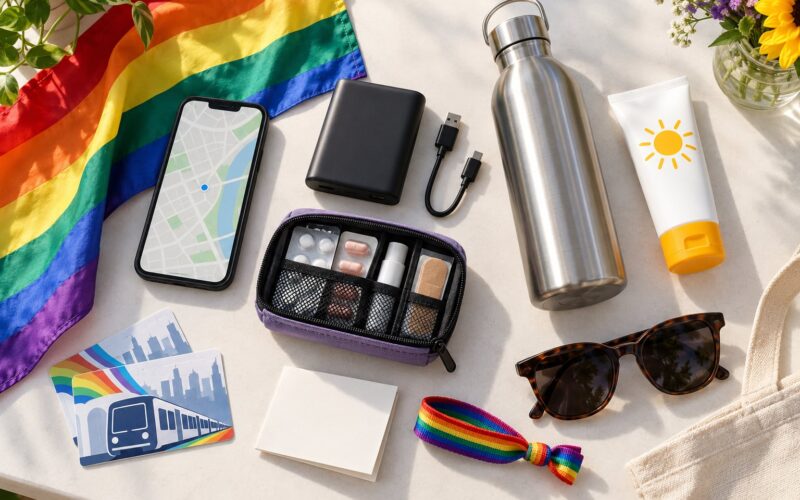
The recurring advice across every first-timer thread we read is the same: sunscreen, water, practical shoes, and a small first aid kit. Nobody regrets carrying those. Build around them.
- Shoes that are already broken in and that you can walk a parade route in. Parades run longer than people expect, often over an hour from first float to last.
- Sun protection, plus a hat or parasol and a portable fan if it is warm out.
- A refillable water bottle where the event permits it, and a plan for where you will refill it.
- Light layers and a rain jacket. A packable jacket beats an umbrella in a dense crowd.
- A portable charger and a cable. Your phone is your ticket, your map and your way home.
- Your medications, plus blister plasters and any basics you always need.
- ID and two payment cards, plus a small amount of cash for vendors or outlets that cannot take a tap.
- A small crossbody bag or fanny pack rather than a large tote. Big bags get turned away at some gates.
- Snacks. Long events and long waits between them make food a real need, not a luxury.
- Earplugs if you are noise-sensitive, and sunglasses that will not fall off your face.
Two items deserve separate mention. First, ear protection and a sensory-friendly zone are the whole game if crowds overwhelm you; know where that zone is before you need it. Second, keep your drinks in your own sightline, do not take drinks or food handed to you by strangers, and check the water policy and bag rules before you go.
Flags, face paint, matching shirts and costumes are all optional. The lowest-effort version people describe loving: one flag and a plain t-shirt. What you wear is not the measure of how much this means to you.
How you know this step worked: your bag fits what you need without you touching the ground, and nothing in it would make you unhappy if it got rained on.
7. Plan for safety and staying connected
Before you leave, agree on three things with someone who is not going: where you will meet if you get separated, when you will text a check-in, and who they should call if you do not answer. Pick the meeting point as a specific, findable landmark rather than “by the stage”. A cafe name and a corner works better than a vague area.
On the day itself: keep your phone charged, use official transit and venue information rather than secondhand posts, and stay in well-lit public spaces when you are moving between neighbourhoods at night. Note two exit routes from wherever you are standing, and know where the medical tent and volunteer stations are. Volunteers are there to help and they are easy to spot.
If you are trans or non-binary and someone at home does not know where you are, add privacy planning to the same list. Some attendees use a code word in check-in texts instead of naming the event. Some travel in groups with someone who knows the full plan. Some simply decide in advance which people are told and which are not, so that a stray notification is not the thing that outs them. Choose the level of privacy you can actually hold for three days.
If you feel unsafe or overwhelmed, the response is calm and physical. Move toward a staffed or crowded area rather than arguing. Find a volunteer or security post. Leave the area without making a scene. Call emergency services when there is immediate danger, and do not hesitate because the harassment felt small at first. If your family is not fully accepting, an outing can carry real consequences, so decide your own threshold in advance, before you are tired and hot in a crowd.
How you know this step worked: you can say your meeting point out loud and someone else could find it.
8. Run a final check before leaving
The night before, run this list once: tickets and QR codes, photo ID, both payment cards, cash, transit details and any reservations, accommodation address or contact, weather forecast for each day, meeting point and check-in time, emergency contacts, and the official schedule with its start times. Re-download anything you saved online.
A successful check means you know the first and last event of each day, you know how you are getting back to where you are sleeping, and you have a backup if weather or transit ruins the plan. Once you have those three things, stop planning. The rest of the weekend is not a checklist to complete.
How you know this step worked: you could hand your itinerary to a friend and they would understand your weekend without you explaining it.
A Sample Pride Weekend Schedule
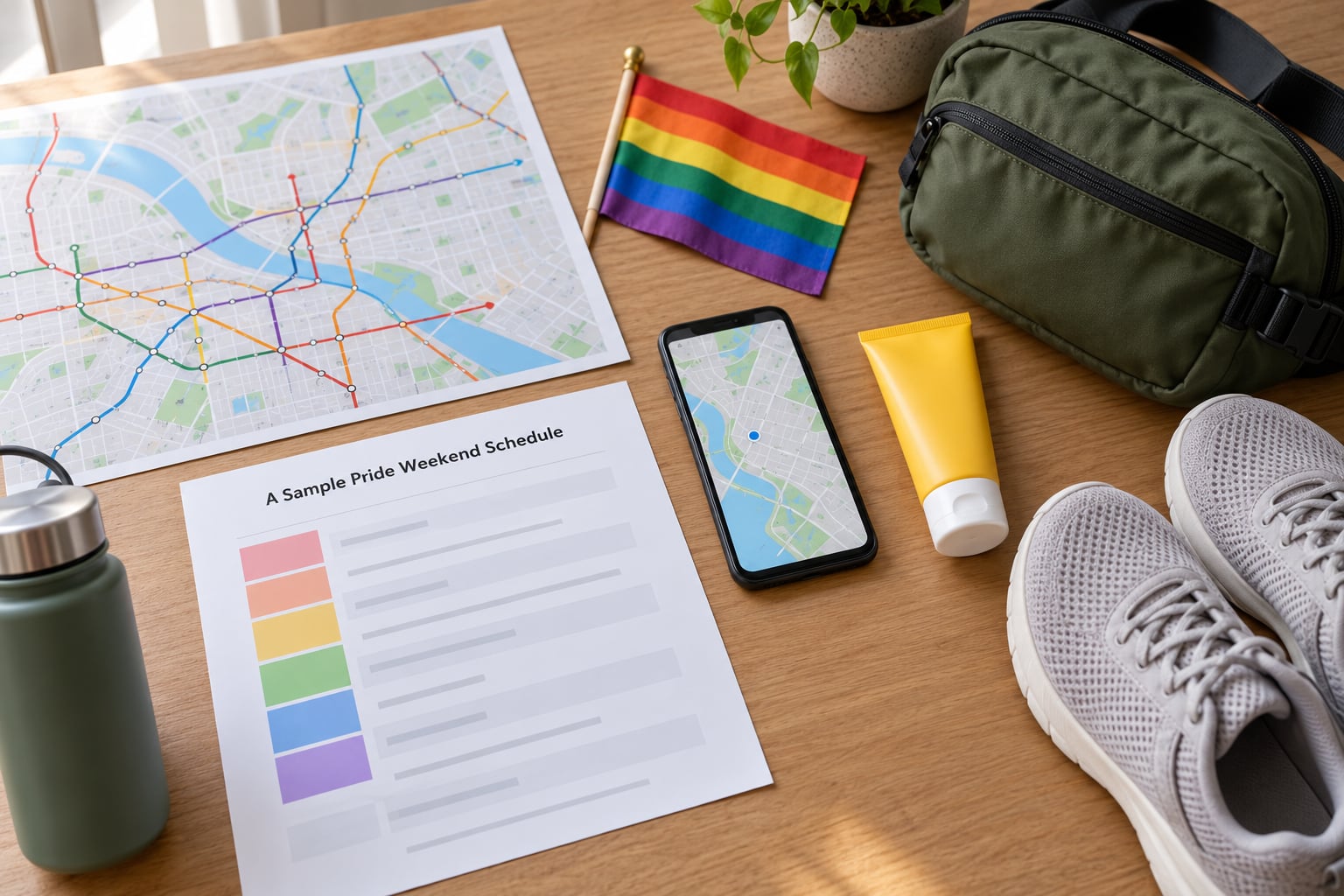
This is a shape, not a template. Adjust the times to your city’s actual schedule and to your own energy level, then keep the pacing: one demanding anchor per day, one quiet hour, and nothing scheduled straight through from morning to midnight.
| Day | Morning | Afternoon | Evening |
|---|---|---|---|
| Friday | Arrive, check in, drop bags, pick up anything you forgot | Walk the route so you know it before Saturday. Get a feel for the neighbourhoods and find your café and your transit stop | Low-key. One community or cultural event if it interests you, then an early night |
| Saturday | Early breakfast, sunscreen, arrive at your viewing spot 45 to 60 minutes ahead if you want a good one | Parade or march, then the festival. Festival blocks with volunteer stations, medical tent and quiet zones | One evening event. If you go out, eat something first, keep water with you, and know your ride back |
| Sunday | Sleep in. Coffee somewhere with air conditioning and a chair | A slower community event, a park gathering, or volunteering. Or nothing at all, which is a legitimate plan | Pack, then travel home rested rather than exhausted |
Two notes on this schedule. It assumes you want one big day and two easy ones, which is the right default for a first time. If you are an early riser or a night owl, move the hours around rather than adding more. And if you are going alone, keep Friday and Saturday evenings deliberately open: the best plans at Pride are often the ones that form after dark at a party you almost did not go to.
Common Mistakes
Picking the city too late. Pride is a destination event. Lodging in a major host city often sells out months ahead, so the cheap option you were hoping for disappears and you pay more for a worse location. Fix: decide the city first, then look at rooms, then pick a neighbourhood you can walk or ride one line away from.
Overbooking the schedule. Filling every hour looks efficient on paper and feels miserable in practice. Crowds are slow, transit runs late, and sitting down somewhere quiet may become the highlight. Fix: cap each day at one anchor event plus one optional thing, and leave at least one full block empty.
Assuming every event is free. Parades and marches usually are. Festival grounds, parties and clubs often are not, and some sell out. Fix: assume anything in a nightclub, anything with a wristband, and anything you found on a resale page needs a ticket. Buy from the organiser.
Relying on outdated listings. Last year’s Instagram post is not this year’s schedule. Venues change, routes change, item rules change. Fix: treat the official city Pride page and the individual event’s own page as the only sources that count, and screenshot what you need.
Packing for the outfit instead of the day. A new pair of shoes is the wrong call when you will be standing on concrete for hours. Fix: broken-in shoes, layers, a rain jacket instead of an umbrella, sunscreen, water, and a bag that stays on your front.
Neglecting local transit. Parade routes close, streets get blocked and parking becomes a puzzle. Fix: check the transit agency’s special service page for the weekend, plan to arrive early, and have a fallback like a rideshare pickup point a few blocks away from the crowd.
Travelling alone with no check-in plan. Going solo is genuinely common and it is genuinely fine, but not with no structure at all. Fix: one meeting point, one check-in time, one named contact who knows where you are. If you can, go to a day-before meetup; it is the single fastest way to know people by the time the parade starts.
Drinking more than you planned. Pride runs on the same rules as any big event: keep your drinks in sight, pace yourself, and eat real food. Alcohol blunts the thing that makes the day worth attending. Fix: set your limit before you arrive, eat before you drink, and keep water in your hand all night.
What to wear. There is no dress code at Pride. The only real constraints are practical: comfortable shoes, weather-appropriate layers, sunscreen, and clothing that suits how you want to be seen. A plain t-shirt is a perfectly good outfit, and so is a hand-painted flag shirt. Wearing a rainbow top does not make you more welcome, and if you are a straight ally, ordinary clothes with a flag pin read as genuine in a way that costume does not.
A few final tips. Leave something for next year: a photo you took of a stranger who said yes, a name, a new favourite place. And if you go and it lands somewhere between overwhelming and wonderful, that is the most common first-timer experience we found, not a sign you picked the wrong city.
Frequently Asked Questions
Is it better to attend Pride in my hometown or travel to another city?
Go to your hometown for your first one. A local Pride gives you a shorter trip, cheaper lodging, an easy exit when you need one, and a crowd you could learn over several years. Travel for your second, when you know what you want from the weekend and can pick a city for a reason rather than for Instagram.
How do I find official events for Pride weekend?
Start with the host city’s official Pride website, then follow the individual organisers. The city page lists the parade, festival, march and official parties with dates, times and ticket links. Nightlife listings, reposts and screenshots go in the second tier. If you cannot find an event on an organiser’s own page, assume it is either unofficial or not happening.
Do I need to buy tickets before planning my first Pride weekend?
Often no. Parades and marches are usually free and open, and many cities add transit service without a reservation. Festival grounds, ticketed parties and club nights do sell out, sometimes weeks ahead, and those need buying from the organiser. Rule of thumb: assume anything with a wristband or a door queue costs money, and check the item and bag rules before you go.
How much should I budget for my first Pride weekend?
For a trip within your own region, expect roughly 400 to 900 dollars for two nights of lodging, travel, food and tickets. A flight from another country or region can run well past 1,500 dollars once a room is included. Lodging is the line that moves most, so book a refundable room early and keep ten to fifteen percent of your total free for taxis and changes.
How can I attend Pride alone and feel safe?
Set one meeting point, one check-in time and one named contact before you go. Choose a specific findable landmark, not a vague area. Arrive early, stay near volunteer stations, and go to a day-before meetup if the city has one, which is the fastest way to know people. If you feel unsafe, move toward a staffed area, ask a volunteer, and call emergency services when there is immediate danger.
What should I do if I feel overwhelmed at a large Pride event?
That is common and it is not a sign you are doing Pride wrong. Find the sensory-friendly or quiet zone most organisers provide, get out of the sun, drink water and sit down. Drop the rest of the schedule without guilt. You do not have to see the parade to have been at Pride, and the calm hour you take for yourself often becomes the part you remember.
Conclusion
Start with the city, the dates and your three priorities. Everything else follows from those: the budget sets what you can book, the official page tells you what the events actually are, and your priorities tell you which one gets your Saturday. Then confirm tickets and entry rules, book lodging with a refundable rate, choose transportation that ends near your door, and set one meeting point with one person who knows where you are.
Then leave space in it. A first Pride weekend does not need to be packed to be good. It needs one thing you are genuinely looking forward to and enough calm around it to enjoy the parts you did not plan.
So here is the first action, today: pick the city you are leaning toward and write down its Pride dates. Everything else is downstream of that one line on a page, and it takes two minutes. From there, plan your first pride weekend properly and go see it for yourself.