Explaining your family to a curious kid works best as a series of short, honest answers instead of one big talk. Name the people, name what they are to each other, use words your child already understands, and stop where their questions stop. A toddler, a nine-year-old, and a fifteen-year-old each need a different version, and none of them need a speech.
Most parents searching for this are trying to work out the wording, not the philosophy. They know their family is worth explaining plainly. They just want the sentence, tonight, that lands without a lecture attached.
So here is the method, step by step, in the order that tends to work: pick a calm moment, give a simple overview, use clear relationship names, cover birth and adoption and donor details honestly, draw the map together, answer hard questions straight, and let your child decide how far the conversation goes. Change the words for your family. Keep the order.
Table of Contents
What You Need
Before you explain your family to a curious kid, gather four things. Nothing here needs buying, and nothing takes more than ten minutes.
Know the age you are actually writing for
Decide whether you are talking to a two-year-old, a seven-year-old, or a thirteen-year-old, because the facts you share and the words you choose both shift with age. If you have more than one child at different stages, plan two separate conversations.
Sort the facts into needed now and needed later
Write down the family facts your child already knows, the ones they are likely to ask about soon, and the ones that can wait years. This step is where most parents over-share, and it also stops the conversation from becoming a download of your entire life story.
Pick accurate relationship labels
Choose the words for each person before you speak: mom, dad, parent, co-parent, donor, aunt, uncle, grandmother, grandfather, caregiver, chosen mom. Use the words your household actually uses, not the ones that sound most defensible to somebody else.
Choose a quiet time and one visual
Find ten minutes with no deadline, no television, and no audience. A sheet of paper with a few crayons is enough to draw your map, or you can skip it entirely and just talk. If your child is tired, hungry, or already upset about something else, wait.
That is the whole setup. When you have those four pieces, the actual explaining becomes much easier.
Step-by-Step
Learning how to explain your family to a curious kid is less about finding perfect words and more about sequencing them. Work through these seven steps in order, and adapt each one to your household.
1. Choose the Right Moment
Start when your child is calm, curious, and not already dealing with something bigger. A question during a fight, right before a deadline, or in front of a whole family dinner will get a worse answer than the same question asked on a lazy Sunday afternoon.
Openings tend to announce themselves. A kid pointing at a photo says, “Who’s that?” A child studying two adults on the couch says, “Are you two married?” A five-year-old meeting your partner for the first time simply asks, “Are you my mommy now?”
A relaxed answer sounds like this: “Good question. Sit down, I’ll tell you.” That sentence buys you the pacing, which is the thing parents say they most wish they had in the moment.
2. Start with a Simple Overview
Describe the people, their roles, and how they connect to one another. Skip the biography, the history, and the reasons. Ten sentences of overview, then wait for the follow-up question.
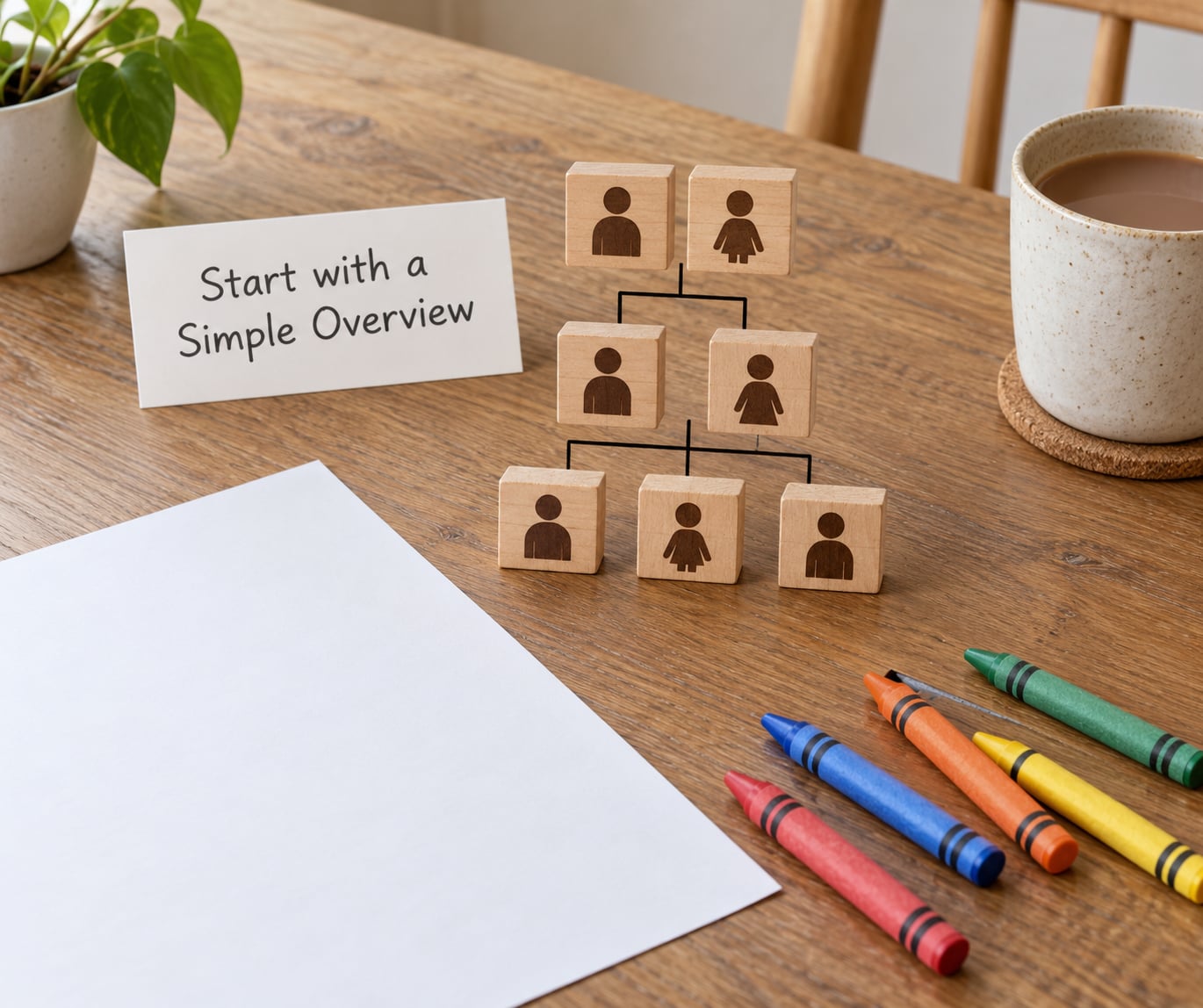
Here is the pattern, adapted to different households:
- Two parents, adopted child: “You’re our kid. We chose each other, and then we chose you. We’re all one family.”
- Two moms, donor egg and surrogacy: “You grew in a woman’s body who helped us out, and an egg came from a person who wanted to help us have a baby. Now you live with us.”
- Two dads, foster or guardianship: “You stayed with us for a while. Then it turned out we were your people, so we made it official.”
- Blended household: “This is Sam. Sam’s dad is my husband, and Sam is your stepbrother. He’s still your brother, just with a different last name.”
- Chosen family: “These are the people who show up for us. Family isn’t only the people we’re related to by birth.”
- Separated parents: “You have two homes and two parents, and both of us love you the whole same amount.”
Notice what all six do. They name people, they name the connection, and they stop. None of them apologizes or announces that the family is unusual, because to the child listening, it is simply the family.
3. Use Clear Names for Each Relationship
Use the relationship word the child already knows, then build outward from there. Most three-year-olds understand mom, dad, baby, grandma, and grandpa. Anything beyond that gets a plain definition the first time you say it.
- Parent: someone who takes care of you and is your parent, whether or not they gave birth to you.
- Co-parent: the other adult who is also your parent but lives somewhere else.
- Donor: an adult who gave something needed to make a baby, and is not your parent.
- Surrogate or birth mother: the person who carried and gave birth to you. If she is not your parent, say so directly: “She helped, and she’s not your mom. I’m your mom.”
- Chosen family: people you are not related to who act like family, on purpose.
- Guardian: an adult whose job it is to take care of you and help with decisions.
Say the word, give the one-line meaning, and move on. Do not define six words in a row, and do not wait for a child to ask before you name a person who matters to them. Proactive naming means they never have to ask a stranger’s question at the grocery store.
4. Explain Birth, Adoption, and Other Connections
Have a couple of accurate scripts ready before you need them, because the birth question usually arrives mid-sentence and you will not have time to write one on the spot.
Birth through a donor: “Babies start when a person who can make eggs and a person who can make sperm come together. We got help from an egg donor and a sperm donor, and then you were made. You grew in a surrogate’s body for nine months, and you came home to us as a baby.”
Adoption: “You were born, and then you lived with another family for a while. We became your parents, and the law and the paperwork made it official. Both things are true, and you can ask me more anytime.”
Foster care or guardianship: “When you were little, you needed a safe place to stay, and we offered. That turned out to be forever. That’s how we became your family.”
Shared parenting across two households: “You have two homes. You have a mom here and a dad there, and both of us are really your parents. Neither one is the lesser parent.”
A non-binary parent: “My friend Rae is my husband, and Rae goes by they. Some people’s bodies make babies and some don’t, and some people change how they live so their body matches who they are. Rae is your dad, no matter what.”
Every one of these scripts ends the same way: you can ask me more. That sentence is what makes the explanation safe to give, because the child now knows the door stays open.
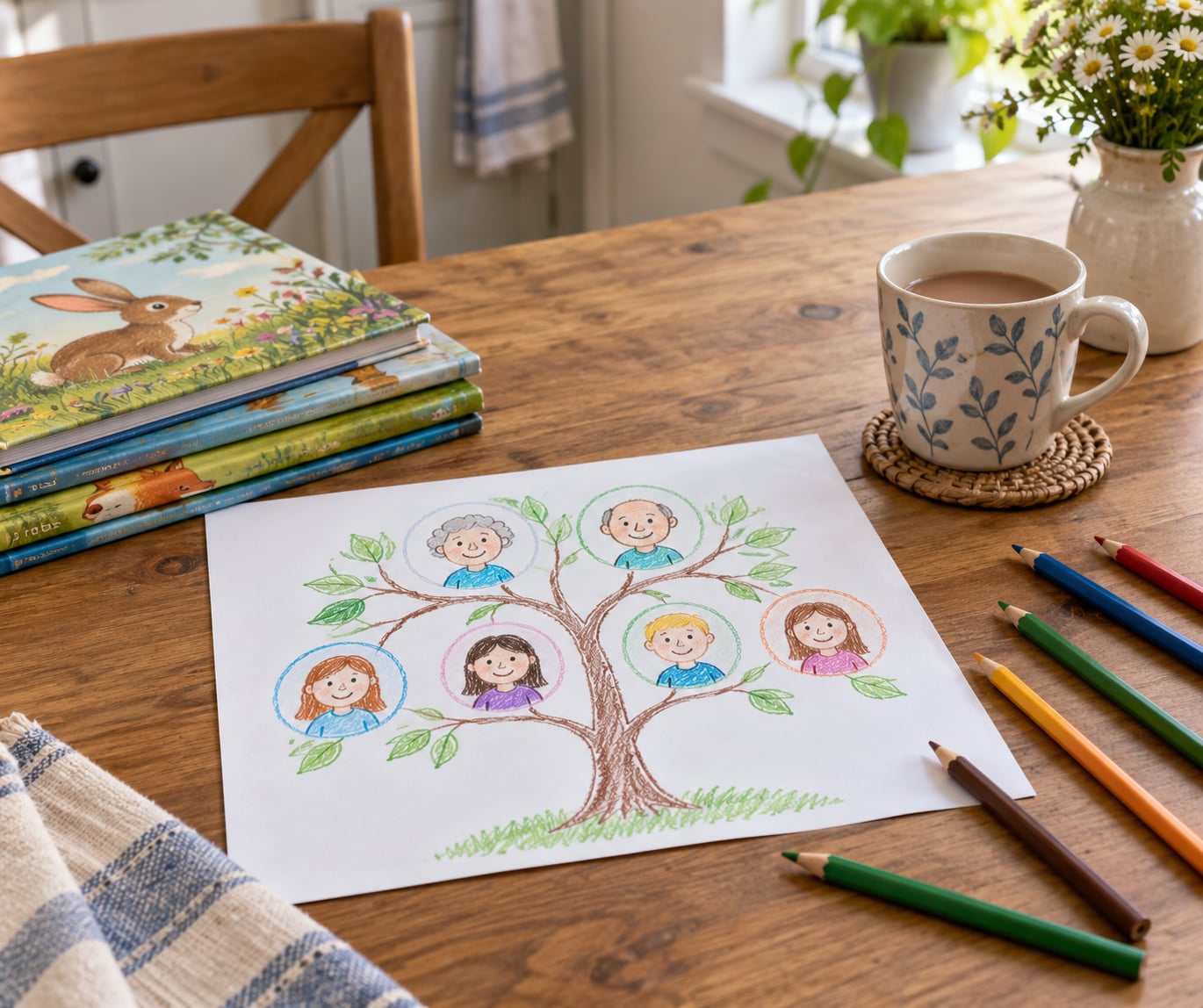
5. Draw a Family Map Together
A picture does something a speech cannot. It puts the shape of the family where the child can point at it, and pointing is easier than talking for a lot of kids, especially younger ones or kids who are still deciding whether the conversation is safe.
Draw only the people and connections that matter to your child. Circles for people, lines for relationships, and a name under each one. Then hand them the pen and say, “Is anybody missing? Did I put anybody in the wrong spot?”
Let them correct you. If your child does not treat a person as family, do not draw that person in and argue the point. The map belongs to them as much as to you, and a map they have accepted is worth more than an accurate one they argue with.
Keep the map somewhere ordinary, not on the fridge in front of guests. A note on the bedroom door or a page inside a homework folder works well.
6. Answer Questions Honestly and Calmly

Three phrases carry most of the weight here: “I don’t know yet, but I’ll think about it.” “I can find that out.” And “You can ask me anything, and I won’t always have a good answer.”
Say the true thing, in a flat tone, and stop. “Yes, I’m gay. It means I’m attracted to people like me. Now you have a question?” That is a complete answer. The calmness of your voice teaches more than the words do, because children read your nervous laugh louder than they read your sentence.
You also get to hold things back, and that is not dishonesty. A child under six does not need donor medical history, conception timeline details, or what happened between two adults in a car last year. “That’s an adult question, and when you’re older I’ll tell you some of it” is honest, kind, and it keeps your word later.
What you never hold back is the label for the people in your child’s life. Everything else can wait.
7. Let the Child Set the Follow-Up
End the first conversation while it is still pleasant. Most kids forget roughly half of what they hear and remember the feeling of the room, so a five-minute talk that ends with you reading together gets remembered as comfortable.
Normalize the forgetting. “You asked me this last month and I think I’ve already told you” is a fine answer. Kids cycle, and the same question arriving three times in a year means the question matters, not that you failed.
Give them a private channel back to you. A note under the bathroom door, a text message, a code word, or just a standing offer to come sit with you when they want to. Many kids ask the second question only once nobody else is in the room, and a parent who made that easy will get asked.
A successful next step looks like one of three things: another conversation a week later, a question at dinner, or your kid pointing at the map on their own. All three mean it worked.
Common Mistakes
These are the avoidable ones, with the fix next to each.
Overexplaining. You give the whole backstory of how you met, the clinic details, the paperwork. Fix: give the overview and wait. If they want chapter two, they will ask.
Hiding the inconvenient parts. You dodge the birth question or imply an adoption was a birth. Kids catch evasions and start filling the gap themselves. Fix: answer the simple true version, and give the detailed version later.
Insisting on one correct definition of family. You correct your kid when they say a grandparent who babysits is family. Fix: agree with them. Family is who takes care of you, and children are usually right about that.
Dropping labels before explaining them. You say “that’s your auntie” and the child has never heard the word. Fix: use the label, then define it once, then move on.
Answering defensively. You correct the question or explain why the child should not have asked. Fix: answer the question first, ask about the curiosity second.
Treating a question as a challenge. A flat, unbothered tone does more for how your child thinks about their family than any content of the answer itself.
Three habits protect the rest: keep it consistent between adults in the household, keep it warm enough to come back to, and treat every repeat question as a welcome rather than a failure.
Frequently Asked Questions
What age should I explain my family situation to my child?
Name the important relationships before your child starts asking about them, usually between two and four, and keep the sentences very short. A three-year-old only needs to know who the important people are. The details around birth, donors, or adoption can wait until they ask. Most parents find that the child sets the pace better than any schedule does, so a short answer now beats a long answer they were not ready for.
How do I explain a chosen family to a child?
Explain it as care rather than blood. Say that family is the people who show up for you, so some family is made on purpose. Name each person and what they do: this is my roommate, this is the friend who drives us to school, this is the auntie who has known you your whole life. Children accept chosen family fastest when each person gets a concrete job in the household instead of an abstract explanation.
How do I describe biological parents who are not part of our family?
Use plain words and avoid softening them into confusion. You can say that a person gave birth to them or provided what was needed to make them, and that person is not their parent, and you are. Then let it rest. Children rarely need the full history at once, but they do need clarity about who is the parent, and they need to hear it from you rather than work it out later on their own.
What if my child keeps asking the same question about our family?
That is normal, and the repetition is information rather than a warning. Answer it again the same way each time, using the same simple words, so your child hears a consistent answer every time. If you have already answered it, say so warmly and check whether something underneath the question is worrying them. Many kids repeat a question because they did not believe the first answer or forgot it entirely.
What if my co-parent and I explain the family differently?
Agree on the core facts first: who the parents are, what each person is called, and what stays private. Small differences in tone or detail matter far less than a child hearing two different names for the same person. Pick one version, tell your child that grown-ups sometimes say things a little differently, and keep the labels identical. If the disagreement is larger than vocabulary, that is a separate conversation, not a kid problem.
Start with One Simple Family Story
Pick one person and tell your child today how that person is connected to them. Two or three sentences, calm voice, then stop. If the questions come tomorrow, you will have the answer ready, and so will they.
That is how to explain your family to a curious kid without a speech, a lesson, or a confession. Name the people, name the relationships, use one picture, answer the true thing plainly, and leave the door open for the next question whenever your child is ready to walk through it.