The fastest way to find queer podcasts is to stop browsing “trending” feeds and start searching with deliberate terms like queer, trans, sapphic or nonbinary, then cross-check results in a niche directory and a community list. Most listeners who rely on app recommendations alone end up hearing the same five shows forever, because mainstream algorithms chase volume, not representation. It takes about an hour to build a listening list that will last you a year, and almost none of that hour is spent typing.
That last point matters. The barrier was never access. Every queer podcast worth hearing is free to search, most are free to listen, and all of them sit in the same apps you already use. The real barrier is the gap between what a listener wants and what an algorithm is willing to promote, and that gap only opens when you search in a specific way.
What follows is the process I use, refined across a lot of evenings of hunting for shows: name your topics, search with the right vocabulary, go deeper with search operators, read the show’s own words, sample one full episode, and keep what survives in a system you will actually use. It works whether you are a longtime listener who has run out of new things or someone starting from zero this week.
Table of Contents
- What You Need
- Step-by-Step: How to Find Queer Podcasts You Will Actually Listen To
- Common Mistakes
- Frequently Asked Questions
- Where can I find queer podcasts for free?
- How do I find LGBTQ+ podcasts about my city or local community?
- What is the best podcast app for finding and organizing queer shows?
- How can I find podcasts hosted by trans, nonbinary, or queer people?
- How do I tell whether an LGBTQ+ podcast is worth following?
- Are there good queer podcasts for learning and personal growth?
- Conclusion
What You Need
Almost nothing. That is the honest answer, and it is worth saying plainly because the way finding queer podcasts is usually described makes it sound like a research project. You need four things, and three of them you already own.
A podcast player. Any of them works. Apple Podcasts, Spotify, Pocket Casts, Overcast, YouTube, a smart speaker, even a browser tab. Discovery quality varies between them, but any of them can return a queer show if you type the right term. If your player cannot search well, Pocket Casts and Overcast are the two most aggressive search tools in the category right now, and both are free to download.
Two or three topic interests, written down. This is the step people skip, and it is the one that decides whether you find something you love or something merely acceptable. Not “queer stuff” but “queer trans history”, “sapphic fiction audio drama”, “Black queer interviews”. Write them the way you would say them out loud, because that is roughly how a host describes their own show.
A place to save candidates. A queue inside your player plus one note, either a phone note or a shared list. This sounds trivial. It is the difference between a discovery session that produces results and one that produces forty tabs you never reopen.
Optional: a niche directory and a community account. QueerPodcasts.net is a free directory that browses by category rather than by popularity, and it is the fastest single tool for browsing. Reddit adds the thing no directory can: other people’s honest opinions, including the negative ones. Both are free. Neither is required to get started, and both improve results a lot once you have a topic in mind.
Step-by-Step: How to Find Queer Podcasts You Will Actually Listen To
The process runs in six steps, and each one has a clear signal that it worked. If you cannot tell whether a step worked, you have not finished it yet.
1. Choose Your Main Queer Podcast Topics
Start by naming what you want the podcast to do for you, because the same show can be brilliant and useless depending on the job. Pick two or three, not ten. Ten topics means ten mediocre searches instead of two that actually surface something.
The categories that reliably produce results break down like this. News and politics covers current events, legislation and organising. History and archive shows dig into queer pasts, archival recordings and the people who rarely got written about. Story-driven and narrative podcasts are hosted memoirs and long-form documentary work. Fiction and audio drama is a real and thriving category that almost nobody searches for properly. Comedy and roundtable formats are two or more hosts talking, often unscripted, often about dating, family or work. Relationships and dating includes dating apps, open relationships, and the mundane logistics of queer couples. Wellness, therapy and mental health is the fastest-growing corner, with several shows run by practising therapists. Local and community shows cover a city, a campus or a state, and they are the most reliably under-discovered thing on this entire list.
Convert each into the words a host would use. “News and politics” becomes “queer news”, “LGBTQ politics”, “trans activism podcast”. “Wellness” becomes “queer mental health”, “LGBTQ therapy podcast”. Write the list somewhere you can see it, because you will refer back to it constantly during the next hour.
How to tell this step worked: you have three or fewer specific phrases, and each one describes a listening experience rather than an identity. If your notes say “trans stuff”, you are not finished.
2. How to Find Queer Podcasts in Podcast Apps and Directories
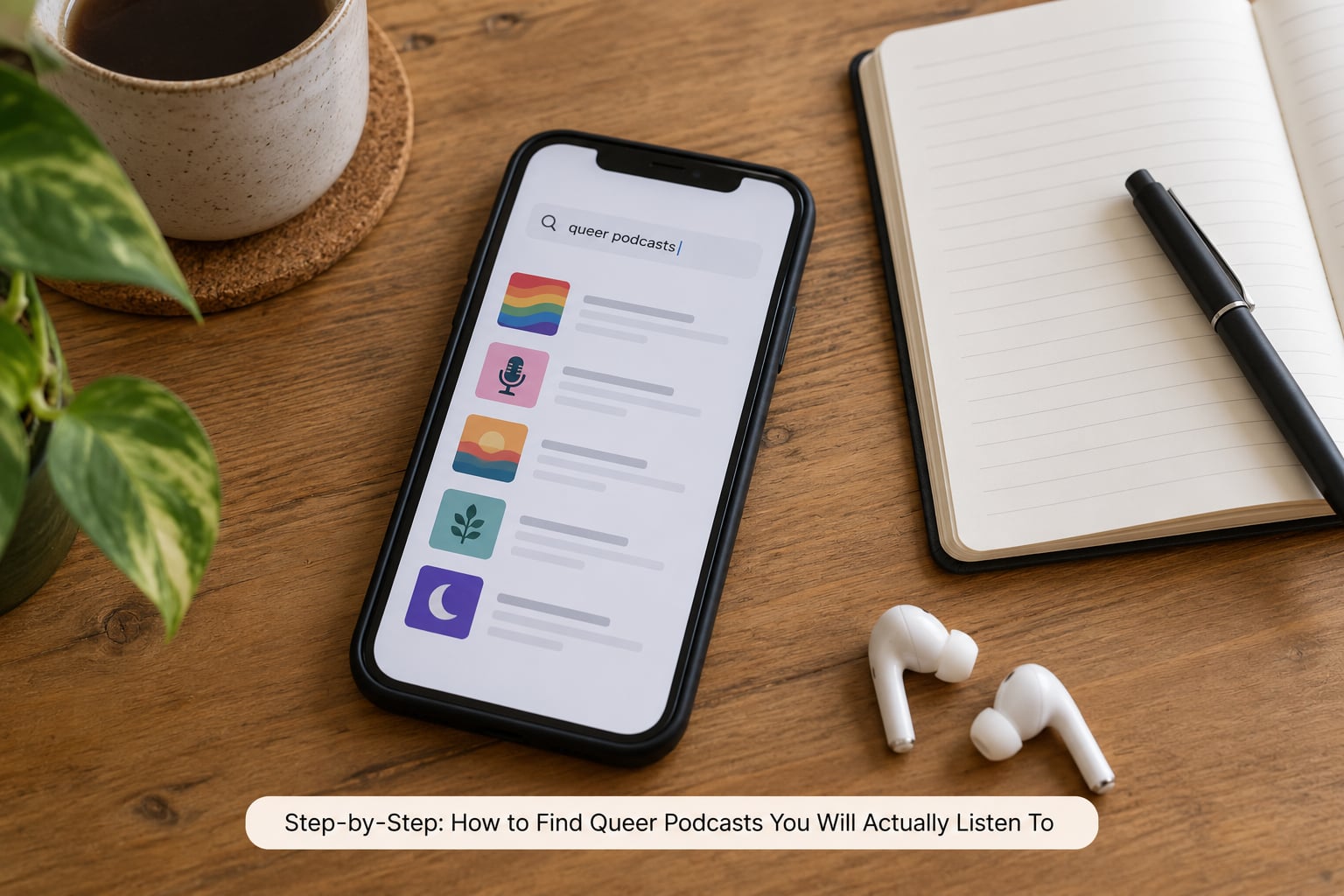
Type your phrases into the search bar of whichever player you use, then widen the vocabulary one term at a time. The mainstream apps index the words a host puts in their show title and description, so synonyms matter more here than anywhere else.
Search each of these in turn, and notice which produce results you have never seen before:
- queer — the broadest term, and the one most likely to surface cis allies discussing queer topics
- LGBTQ and LGBTQIA+ — different shows pick different versions, so run both
- gay, lesbian, bi and bisexual — usually finds shows a generic “queer” search misses
- trans, transgender, nonbinary and non-binary — both hyphenations index differently, so run both spellings
- drag and ballroom — a genre of its own with a distinct set of shows
- queer history, queer fiction, queer family — compound terms that filter out the noise automatically
After searching, open a show’s detail page rather than its episode list. You are looking for four things: who hosts it, what the show claims to cover, when the last episode posted, and whether the description names specific subjects instead of vague warmth. A show that updated this spring is alive. A show whose last episode was three years ago is a backlog, which is a completely different thing and sometimes exactly what you want.
Then open a directory and compare notes. QueerPodcasts.net sorts by category, including less common ones like fiction, kids and family, sports and government. That category structure is the point: it lets you find a trans podcast in a category most apps would bury under a general LGBTQ filter. Podchaser is broader and deeper and better suited to finding the very small independent shows, at the cost of a busier interface. FeedSpot’s curated lists, including its long queer relationship podcast list, work well when you know your subcategory and want volume.
How to tell this step worked: you have at least ten candidates, most of which you had not heard of, and you know the host and posting cadence for each.
3. Use Focused Search Operators to Dig Deeper
Search operators are the single most underused tool in queer podcast discovery, because almost nobody realises they work on podcast search, on podcast directories, and on general web search. They are the reason you can find the show nobody has recommended yet.
The operators worth memorising are few:
- Quotes — “queer fiction” finds the exact phrase. Use this when you want a specific format and will accept fewer results.
- OR — trans OR nonbinary podcast widens a search that returned too little. Most apps support this, and it is the fix for a search that feels too narrow.
- Minus — queer podcast -cishet -ally removes results you do not want. This is how you cut through the “about” shows that keep appearing under every identity search.
- site: — site:reddit.com queer audio drama confines a web search to one domain. It is the most powerful operator here for community mining.
Web search is the channel most people skip entirely, and it is where the long tail lives. A forum thread where someone asks for trans audio drama with real representation, and the answers underneath, will hand you shows no app surfaces. Reddit’s own search handles the site: operator internally, so you can search within a single community by typing author: or title: alongside your topic terms.
Now layer in location and format. Adding a city name turns a general search into a local one. Adding interview, documentary, roundtable, fiction, or narrative filters by format. A query like queer podcast Chicago interview community finds a very different set than queer podcast interview, and the second one is the query most people stop at.
How to tell this step worked: you have found at least one show that no algorithm proposed to you, and you found it by a specific term rather than by luck.
4. Check the Host, Description and Episode Topics
This is where you decide whether a show is genuinely queer-focused, and it takes about ninety seconds per candidate. The question is not whether queer people appear in it. The question is who made it and who it is for.
Read the host bio. Hosts who are part of the community they are covering are the signal listeners consistently rank highest, because the perspective is lived rather than reported. A show hosted by a trans person about trans life carries something an ally-hosted show about trans issues structurally cannot, and that is not a knock on allies. It is a difference in vantage point that listeners hear immediately.
Skim ten episode titles. You are checking three things: do the episodes stay on the show’s stated subject, do the guests vary, and does the show cover the whole range of experiences or one narrow slice presented as the whole. Consistent subject plus varied guests is healthy. A guest list that is the same five people every month is a favour network, not a community.
Check the credits too. Transparent production credits, named producers, a clear production company, these are small signals that a show takes its work seriously. So is a visible transcript on each episode, which matters for deaf and hard of hearing listeners, and for anyone whose first language is not the one being spoken. Accessibility is one of the least advertised and most reliable quality markers available, and several shows publish transcripts while larger shows do not.
Check the last three months of output. A show that promises weekly and posts monthly is fine. A show that stopped quietly often still has a strong back catalogue, and that is worth knowing before you write it off.
How to tell this step worked: you can say in one sentence who made the show and who it serves, and you have found transcripts or confirmed their absence.
5. Listen to One Full Episode Before Subscribing
One full episode, not a trailer and not thirty seconds. Trailers are written by producers; episodes are made by hosts. The gap between the two is where the useful information is.
During that episode, listen for tone. Does the room sound comfortable? Are people laughing at the right places, or is everyone performing? Does the host ask follow-up questions or move to the next point? Interview shows where the host genuinely does not know the answer yet are usually the ones worth your time, and you can hear the difference in the first five minutes.
Then check three practical things. Is the audio usable, or is it thin, clipped or badly mixed? If you listen at 1.5 or 2 times speed, does it still hold together, or does the host rush and lose coherence? And is the episode useful on its own terms, or is it 50 minutes of preamble before the substance starts?
Most shows look fine at 2x and sound thin at 1x, and that is a real discovery filter. It tells you whether the host writes tight sentences, which is a decent proxy for how they think. If you have accessibility needs, note whether spoken content is described and whether the pace allows for processing time.
Give the show a fair shot even if the first episode is not its best. Many well-made shows open with their weakest episode because the producer had no idea yet what the show was. A second episode is usually more representative than the first.
How to tell this step worked: you have a clear yes or no, and it is based on the sound of the show rather than its cover art.
6. Save Shows in a Personal Listening System
Everything you found disappears without a system, so build one that takes under a minute to maintain. Every player has follow, queue and download features, and most people use none of them well.
Follow, do not subscribe to everything. Following is reversible and costs nothing. Subscribing in some apps pushes a show into a feed that competes with the others. Keep follows short, maybe fifteen shows, and prune monthly.
Use the queue as a holding pen. When an episode is recommended to you mid-commute, drop it in the queue rather than deciding in the moment. The queue is a short list of things you already decided were worth your time.
Download the commute episodes, not the whole feed. Auto-download is how a queue becomes 300 unplayed episodes. Download a specific episode when you know you will be offline, and let the rest stream.
Keep one written note, and only three lines per show. Title, host, and why you saved it, plus the date. That last field matters, because shows end and back catalogues stay good for years. A note dated last spring tells you later that the silence is not new information.
Build one playlist for a recurring slot. A 40-minute playlist for a weekly walk or a monthly train trip beats shuffling a follow feed, because you stop making decisions every day. This is the step that turns discovery into a habit.
How to tell this step worked: after two weeks, you can name the shows in your queue without opening the app, and none of them is a show you saved but never played.
Common Mistakes
Most people fail at this not because the tools are bad but because of habits that quietly filter out the shows they actually wanted.
Relying on a listicle from two years ago. Queer podcast lists stagnate fast. Shows end, hosts change names, and the same ten entries circulate for years. Fix: check the publication or update date, and treat any list as a starting point rather than an answer. If a list has no date, ignore it.
Picking by popularity. Listener counts favour shows that have been running for years and already have an audience. The 800-episode show with 200,000 downloads is not better than the 40-episode show with 2,000, and the smaller one is more likely to say the thing you have not heard yet. Fix: judge recency and subject fit first, and treat listener count as a tiebreaker at best.
Using search terms that are too narrow. Searching only for a show type that has no results feels like proof that nothing exists. The word is usually just different. Fix: run the synonym set from step two, both hyphenations, and use OR when a term comes back empty.
Skipping local and small shows. The city you live in has shows about its own queer life, and nobody outside that city is going to recommend them. They are also the most likely to feel like listening to a neighbour’s conversation, which is either exactly what you want or not. Fix: search your city name with queer, and check campus and community radio directories, which carry a lot of student and local shows.
Judging a show from its cover art or title. Cover art tells you the budget, not the content. A plain design can hide the best audio in the category, and a handsome design can hide an hour of rambling. Fix: read ten episode titles before you look at the artwork at all.
Ignoring transcripts. If you are deaf, hard of hearing, or listening in a second language, the absence of a transcript is a practical reason to skip a show. Several excellent ones provide them and never mention it. Fix: check every episode page, and prefer shows that attach transcripts to every single one rather than only the flagship episode.
Assuming queer fiction does not exist. Audio drama and fiction with queer characters and queer writers is substantial, and it is the hardest category to search for. It rarely carries the word queer in the title, so identity-based searches miss it entirely. Fix: search format first, then representation, and mine r/audiodrama, where people post casts and themes in detail.
Waiting for an algorithm to do the work. Recommendation feeds optimise for session length, which favours established shows. Niche queer content rarely wins that metric. Fix: assume the feed will under-serve you and schedule a deliberate search every few weeks instead of waiting.
Treating one bad episode as the verdict. Some of the best queer shows have rough early episodes and inconsistent guests. Fix: listen to the three most recent episodes before deciding, and check whether the host was still finding the format.
Frequently Asked Questions
Where can I find queer podcasts for free?
Almost all of them. Apple Podcasts, Spotify, YouTube and most indie podcast apps let you listen to any show at no cost, and the directory and community methods in this guide cost nothing either. You only pay when a show gates part of its back catalogue behind a supporter tier, or when you want transcripts and editing rather than raw episodes.
How do I find LGBTQ+ podcasts about my city or local community?
Search your city name with identity terms, such as queer podcast Chicago community, and browse campus and community radio directories, which carry a lot of student and local shows. Local queer podcast awards and Pride event media often name the best new city shows each year. Search r/lgbt or your city subreddit for recent recommendations, since people looking for local shows rarely get algorithmic support.
What is the best podcast app for finding and organizing queer shows?
For search, Pocket Casts and Overcast are the most responsive to specific keyword queries. For organizing, every major app handles follow, queue, download and playlists, so the deciding factor is what you already use. QueerPodcasts.net is the better discovery tool, not a player. Most listeners keep one main app for listening and use a directory purely for finding.
How can I find podcasts hosted by trans, nonbinary, or queer people?
Search trans, transgender, nonbinary and non-binary separately, since shows use different spellings and platforms index them differently. Then read the host bio: hosts who are part of the community they cover are the strongest quality signal listeners report. Community spaces like r/asktransgender discuss specific shows by name, which is more reliable than any app recommendation.
How do I tell whether an LGBTQ+ podcast is worth following?
Read ten episode titles, check the host bio, and look for a transcript on every episode. Follow shows with a clear stated subject, varied guests, and reliable recent output, and be cautious of shows whose guest list never changes. One full episode decides it faster than any review or rating, and a second episode gives fairer results than the premiere.
Are there good queer podcasts for learning and personal growth?
Yes, and they are often the easiest shows to vet. Wellness and therapy shows run by practicing therapists publish episode titles that read like sessions, which makes relevance obvious. History and archive shows cover material you will rarely find elsewhere, and story-driven memoirs give you someone else’s experience in detail. For structure, a show with a stated method and named guests beats a freeform panel every time.
Conclusion
Pick one topic tonight and turn it into three search terms, because specific search terms are how to find queer podcasts that recommendations never surface. Run those terms in two different apps and one niche directory, sample a full episode from anything promising, and keep only what survives. About an hour, fifteen follows, and a note list that keeps working for you long after the search session ends.
Updated for 2026.