Learning how to cook for a crowd on a budget comes down to three decisions: pick one anchor dish, buy ingredients that stretch, and serve them in a format where guests help themselves. A pot of chili with cornbread, a build-your-own taco bar or a sheet-pan pasta feed 30 people from your own kitchen, and most of the work happens the day before.
The math is less intimidating than it looks. Once you know roughly how much each person eats and which containers fit inside your oven, cooking for a crowd stops being a leap and starts being arithmetic.
Table of Contents
What You Need
A headcount you trust, a written ceiling for what you are willing to spend, and an honest look at your kitchen. Everything else on this list is easy to borrow or skip.
A real guest count
RSVPs are unreliable, especially for community events where people drop in. Plan for everyone you invited plus about 10 percent. If your number came from a conversation rather than a reply, treat it as a floor.
A meal format, not a menu of five dishes
One main, one or two sides, one dessert. Three dishes scale; six dishes turn a cookout into a two-day project with a sink full of pans. Crowds are forgiving about repetition. They are not forgiving about a cold main.
A written budget
Decide the ceiling before the shopping trip, not during it. Pick your most expensive item first, find out what it costs, and build the rest of the menu around what is left. Planning first also tells you when the event is not feasible as designed, which is far better to learn a week ahead of time.
Dietary needs, gathered early
Ask about allergies, vegetarian and vegan diets, gluten restrictions, and religious requirements when you send the invitation, not the morning of. One clear question in the invite saves you from cooking two complete dinners.
Equipment that actually fits
Most home kitchens have one oven, four to six burners and one refrigerator, and that is the real constraint on a crowd meal. Know which of those you can use simultaneously before you commit to a menu. A slow cooker or two, plus sheet pans that hold roughly a dozen servings each, will carry a meal further than a recipe that needs constant stirring.
Servingware and a cleanup plan
Big bowls, a couple of insulated serving dishes, tongs, and a ladle for every pot. Ask guests to bring a plate and cutlery if you want to skip the dishwashing, and start the dishwasher before anyone arrives rather than after.
A shopping list written by category
Group it: protein, starch, canned and dry goods, fresh produce, dairy, and non-food items such as cups, foil and ice. Lists organized this way are faster to shop and much harder to blow the budget on, because impulse buys live at the ends of aisles, not in the sections you planned.
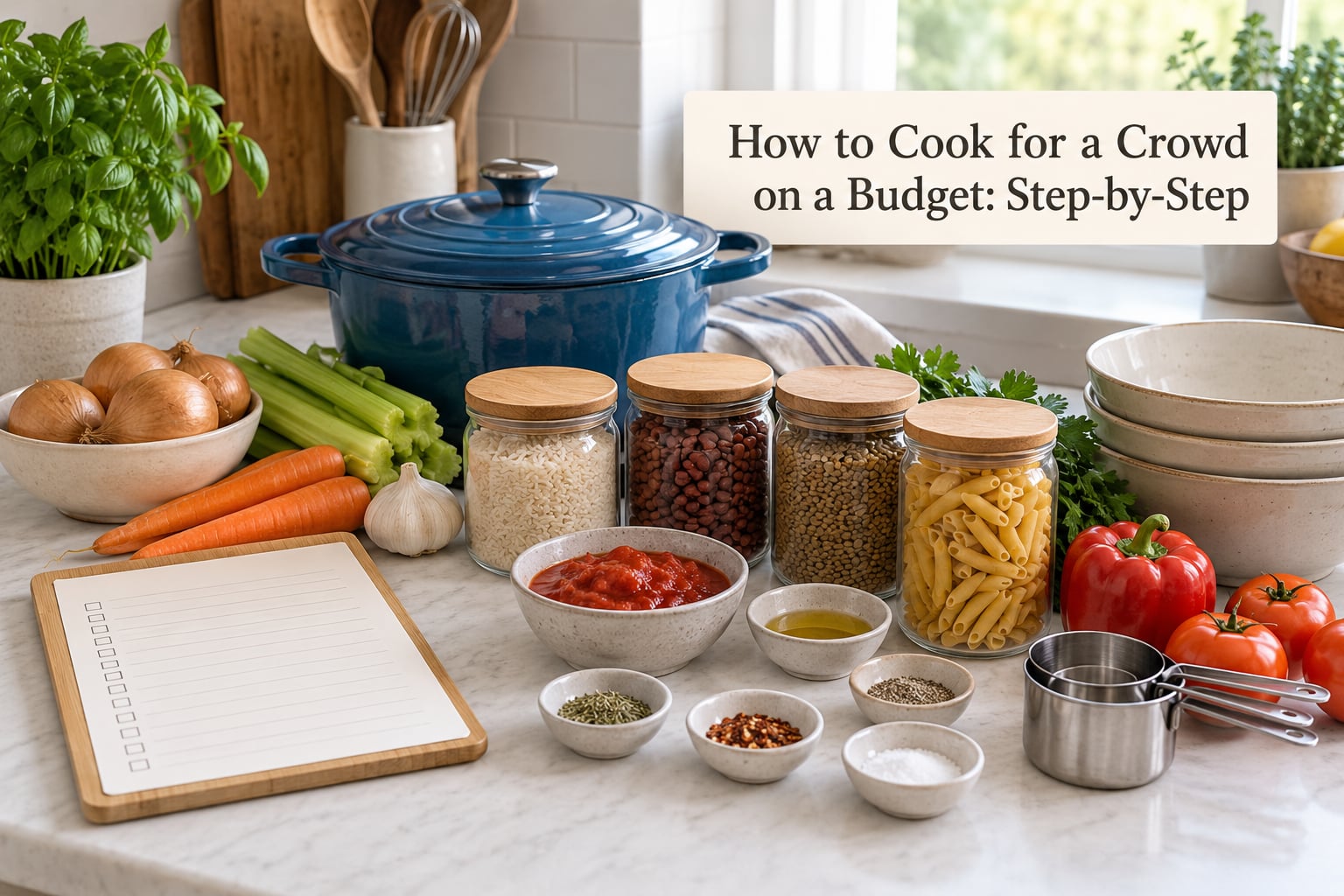
How to Cook for a Crowd on a Budget: Step-by-Step
1. Set the Guest Count and Choose the Meal Format
Start from the headcount and work backwards to the format. Under about 15 people, a single one-pot meal served at the table works fine. From 15 to 40, a self-serve bar keeps you from carrying dishes. Past 40, the food has to be transportable and holdable, because you cannot ferry hot pans from the stove to the table repeatedly.
Ask one question: plated, family-style, or self-serve? Plated means you are serving 30 meals while the rice gets cold. Self-serve means each guest builds a plate once and sits down, which is calmer for you and faster for them.
Cheap formats share a few traits. They use a starch as the base, a protein that stretches with beans or rice, and a topping or sauce that people add themselves. One person doing one or two jobs well beats three people doing three jobs badly.
2. Build a Flexible Budget Menu
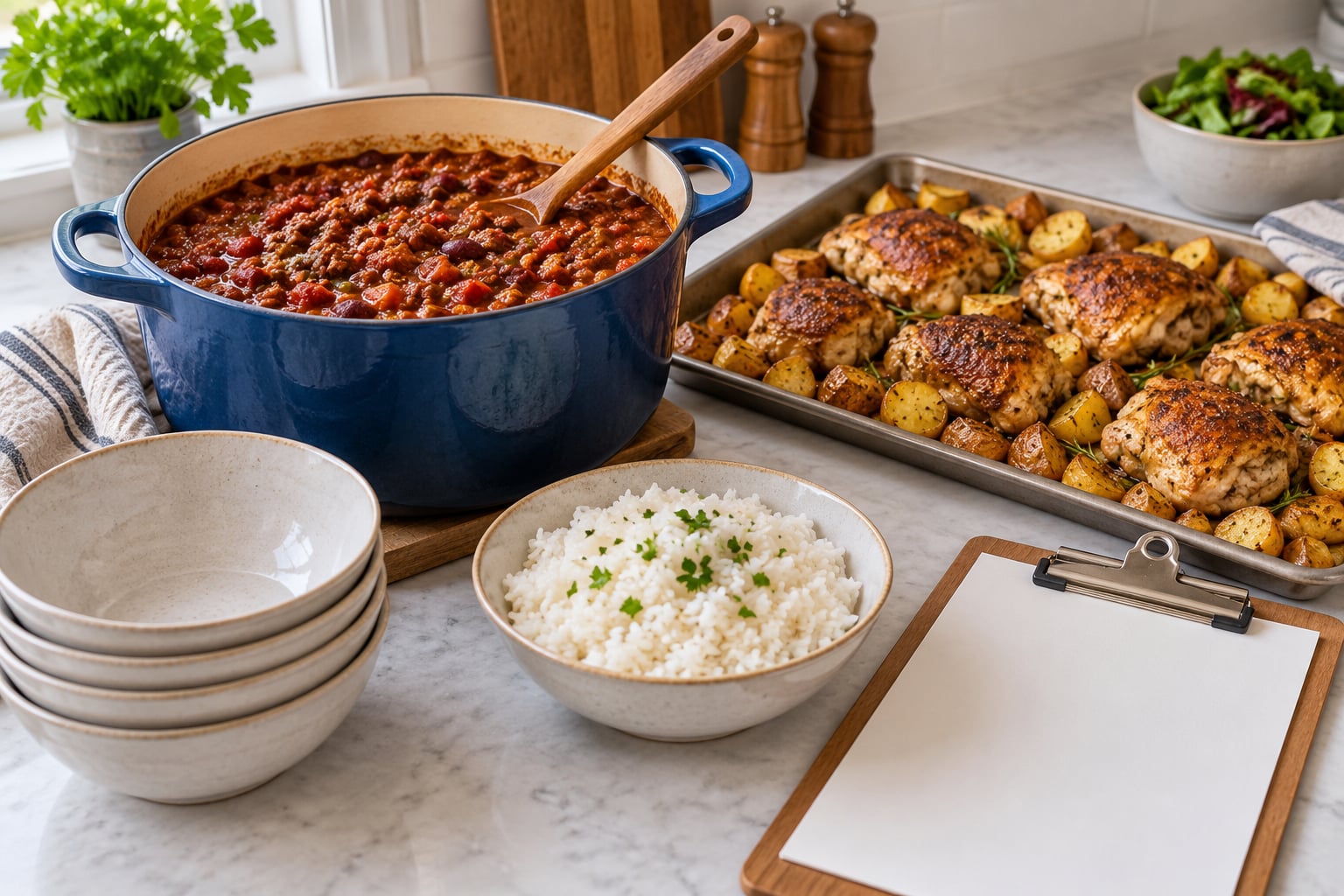
Pick the anchor dish first, then let the sides fall out of what’s cheap and on hand. Pork shoulder or chicken thighs roasted with rice and beans, a big pot of chili with cornbread, a taco bar with ground beef, black beans and rice, or a pasta bar with penne, marinara and meatballs all work because the expensive part is a minority of the volume.
The single biggest lever is the ratio of filler to protein. Ground beef is the most expensive thing in the pot, so brown less of it and let beans, rice, pasta or potatoes carry the rest. Canned beans cost pennies per cup and stretch a pound of meat considerably further.
Make dessert something that needs no last-minute work: a sheet cake from a mix, brownies baked a day ahead, or a fruit cobbler in a disposable pan. Skip anything that has to be frosted, filled or plated while guests are waiting.
3. Plan Portions and Make a Shopping List
Budget roughly one and a quarter cups of finished food per adult and about three quarters of a cup per child, then add your 10 percent buffer. That is a total, not a per-dish rule, so a starchy side and a salad count together rather than each earning a full portion.
For a main dish, most hosts land on about half a pound of raw protein per adult only when protein is the centerpiece. In a bean-and-rice or pasta dish, a quarter pound is plenty. Convert from package size: a pound of dry penne yields roughly eight adult portions, a can of beans measures about one and a half cups, and a half-sheet pan holds around a dozen servings depending on the dish.
| Guest count | Main, cooked volume | Raw protein if it is the centerpiece | Canned beans or sauce |
|---|---|---|---|
| 10 people | About 13 cups | About 2.5 pounds | About 4 cans |
| 20 people | About 25 cups | About 5 pounds | About 8 cans |
| 50 people | About 63 cups | About 12.5 pounds | About 20 cans |
| 100 people | About 125 cups | About 25 pounds | About 40 cans |
Once quantities are down, write the list in categories and check the pantry before you leave the house. Buy the protein and anything seasonal first, then fill in. Walking into the store without that order is how people arrive home with three kinds of snack and no rice.
4. Prep and Cook in Efficient Batches
Most of the stress people associate with this job comes from trying to cook everything fresh on the day. Shift the work instead: chop vegetables a day ahead, brown meat a day ahead, make dessert two days ahead, and cook the grain the morning of because it is nearly hands-off.
Then work in parallel rather than in sequence. While the chili simmers, the oven handles cornbread. While the rice cooks, the stockpot boils pasta. One person can run three dishes comfortably if each needs attention only every 15 minutes or so, so choose recipes that tolerate waiting.
Cook and cool in batches too. Use your largest pot first, then the second largest, so you are not juggling three small pans that each need stirring. Taste as you go and adjust seasoning at full strength, since a crowd-sized pot dilutes it faster than a small one.
5. Keep Food Warm and Serve It Smoothly
Slow cookers on warm are the cheapest reliable holding method most homes already own. Set them to warm rather than high, and start them an hour before guests arrive so the food is already steaming when the line opens.
For a long buffet, follow the two-hour rule: food sitting at room temperature should be used or refrigerated within two hours, and the danger zone sits between 40 and 140 degrees Fahrenheit. If a tray has been out longer than that, either warm it back up properly or put it in the fridge. Cold items belong on ice, not on the counter, and you refill them rather than topping up an empty bowl all evening.
Cook to safe internal temperatures and stop guessing. Poultry reaches 165 degrees Fahrenheit, ground meat 160, and whole cuts of beef, pork and fish 145.
Set the line up in one direction, with plates first, then the main, then sides, then dessert at the far end so people are not reaching across each other. Label anything that is vegetarian, vegan or gluten-free, and keep a serving spoon for each dish so a scoop of dairy does not end up on a vegan plate.
6. Use Extra Portions and Control Waste
That 10 percent buffer is meant to become lunch boxes, not trash. Refrigerate leftovers within two hours, use them within three to four days, and divide them into single portions as soon as you get a chance rather than picking at one container all week.
Stretch what remains deliberately. Chili becomes topped baked potatoes and then quesadillas. Roast pork becomes pulled sandwiches with coleslaw the next day. Pasta becomes a cold salad with oil and herbs if it never made it to the table hot. Freezing soup, chili, pulled pork and baked beans in flat bags buys you several future meals that cost nothing extra to make.
A timeline that keeps the day calm
Two days out, buy dry goods, choose the menu and make the dessert. One day out, shop fresh, brown meat, assemble the chili or sauce base, chop vegetables, and set out the serving dishes. The morning of, cook the grain, reheat what you can safely reheat, fill the slow cookers and set the line up. One hour before guests arrive, turn on the oven for anything that needs it, check the bathroom, and put on music so the room sounds ready before it looks finished.
Common Mistakes
Cooking five dishes instead of three. Every extra recipe multiplies your shopping list, your pans, your oven time and your dishes to wash. Pick three, cook them well, and spend the saved effort on food that arrives hot.
Shopping without a headcount. This is the mistake that costs the most and shows up most often on Reddit crowd-feeding threads. People describe the same pattern every time: a group that should have been 20 becomes 30, and the food runs out an hour early because nobody bought for the buffer.
Topping up on the day. A second run to the store before an event feels sensible and quietly adds a large share to the bill. Instead, buy one extra package of the thing most likely to run short, usually tortillas, buns or a base, and let it sit in the pantry.
Cooking for one oven and four burners. The menu promises four dishes finishing at the same hour. Stagger them instead, or move one dish into a slow cooker the morning of so it holds instead of races.
Leaving food out too long. Buffet hours are where good intentions go wrong. Set a timer, use the two-hour rule, and keep cold trays on ice nests so you are not constantly replacing everything.
Ignoring cleanup. Run the dishwasher before guests arrive, use disposables for the bar, and borrow serving bowls rather than borrowing a dishwasher. If you can, ask people to bring a plate and a cup; it removes an entire phase of the evening.
Planning leftovers nobody wants. Excess is only useful if it becomes an intentional next meal. Decide before you cook what the leftovers become, and that decision changes how you season and store them.
Frequently Asked Questions
How much food should I prepare for a crowd?
Plan about one and a quarter cups of finished food per adult and three quarters of a cup per child, then add a 10 percent buffer for late arrivals and second helpings. For a main dish served with sides, half a pound of raw protein per adult is generous; a quarter pound works when beans, rice or pasta carry most of the volume.
What is the cheapest way to feed a large group?
Make beans, rice or pasta the bulk of the meal and treat meat as a flavor rather than the centerpiece. A pot of chili built on ground beef and canned beans, a taco bar with black beans and rice, or pulled pork over rice stretches further than a meat-forward dish. Sheet-pan chicken thighs with potatoes uses one pan and almost no attention.
Should I cook extra food for leftovers?
Yes, but on purpose. The 10 percent buffer you add to your headcount should be destined for lunch boxes and freezer bags rather than the bin. Refrigerate within two hours, use refrigerated leftovers within three to four days, and freeze flat so they thaw quickly. Portion them out the same evening so nobody grazes from one container all week.
Which dishes are easiest to prepare for a crowd?
Big-batch chili, pulled pork, sheet-pan chicken thighs, baked beans and taco bar filling all scale well and mostly cook unattended. They are forgiving of timing, they hold warm in a slow cooker, and they travel without turning to mush. Avoid dishes that must be plated quickly, that need constant stirring, or that go from perfect to dry in twenty minutes.
How can I accommodate guests with dietary restrictions on a budget?
Build one base everyone can eat, then add a second protein for people who need it. Chili made with meat works fine with beans and corn added separately; taco fillings separate cleanly; a pasta bar can offer one gluten-free shape alongside. Ask about allergies when you send the invitation, keep serving spoons separate, and label each dish plainly.
How do I keep food warm without drying it out?
Use slow cookers on the warm setting rather than high, start them an hour ahead, and add a splash of liquid to thin anything that thickened overnight. For sheet-pan dishes, tent loosely with foil and keep the oven at its lowest safe temperature. Cover the line loosely with foil so heat stays in, and refill small batches instead of letting an open tray sit for hours.
Start tonight: write down your real guest count, add 10 percent, and choose the one dish you are most confident cooking. Everything else on this list falls into place around that decision, and how to cook for a crowd on a budget stops being a question of resources and turns into a question of plan.