Hosting Friendsgiving is mostly logistics: pick the weekend before Thanksgiving, send invites about a month ahead, cook the main dish yourself, and let your guests fill in the sides. That single rule, the host cooks the entree, is what turns a month of planning into one afternoon of actual cooking. Here is how to host Friendsgiving comfortably whether you are feeding eight people or twenty-four.
Planning and invites
- Host on the weekend before Thanksgiving, ideally Friday dinner or Saturday lunch.
- Send invites about four weeks ahead and set an RSVP deadline three weeks ahead.
- Count chairs before you count names, then invite two more people than you have seats for.
- Put every side dish on a shared spreadsheet with categories so nobody brings green bean casserole twice.
Setup and flow
- You cook the entree. Guests bring assigned sides, bread, a salad or a dessert.
- Ask about dietary restrictions when you send the invite, not at the door.
- Everything except the roast can be made the day before.
- Put drinks, ice and glassware in one station away from the kitchen.
- Let guests box their own leftovers so you are not packing containers at midnight.
This guide was put together for the 2026 holiday season and updated for 2026. Nothing here needs a specialty kitchen or a big spend. It needs a date, a guest list, a main dish you trust yourself to cook, and a plan for the afternoon.
Table of Contents
- What You Need
- How to Host Friendsgiving: Step-by-Step Plan
- How to Host Friendsgiving: Set the Date, Format, and Guest List
- How to Host Friendsgiving: Build a Menu Everyone Can Eat
- How to Host Friendsgiving: Make a Two-Day Preparation Timeline
- The day before
- The day of
- How to Host Friendsgiving: Set the Table and Serving Area
- How to Host Friendsgiving: Welcome Guests and Keep the Evening Flowing
- How to Host Friendsgiving: Close the Gathering and Handle Leftovers
- Common Mistakes
- Frequently Asked Questions
- How many people should I invite to Friendsgiving?
- Should Friendsgiving be a potluck or should the host provide everything?
- How do I handle dietary restrictions at Friendsgiving?
- What can I prepare for Friendsgiving the day before?
- How do I host Friendsgiving without spending all day cooking?
- What should I serve for drinks at Friendsgiving?
- Conclusion
What You Need
Most hosting disasters come from missing one small thing, not from the food. Gather these before you send a single invite.
Planning
- A guest list with a firm headcount and a plus-one policy. Write the policy in the invite: plus-ones welcome, or one each, or no plus-ones for small tables.
- A shared spreadsheet for the potluck, with columns for name, dish and category. One link in the invite does the coordinating for you.
- A rough budget split in your head: entree, drinks, sides, dessert, ice, serving basics, plus whatever you need to rent.
- A realistic timeline with your own deadline for renting, buying and cooking.
Kitchen
- An instant-read thermometer. This is the one tool that turns a guess into a fact.
- A roasting pan or disposable foil roasting tray, plus foil and a couple of sheet pans.
- Storage containers and a marker for labeling leftovers.
- A cooler or ice tub if drinks are outside or in another room.
- Your oven space, honestly counted. One roast plus two casseroles is a full kitchen at 350°F.
Serving
- One serving spoon per dish, so nobody has to fish with a serving spoon that has been in three dishes.
- Small cards or masking tape and a pen to label every dish, especially anything with nuts, dairy or gluten.
- Napkins, ice, a corkscrew and a bottle opener in the same place.
- Disposal plates and cutlery if you would rather do one bag of trash at the end than wash dishes after midnight. Hosts on Reddit swear by this shortcut and it buys you an entire evening of being a guest at your own party.
Guest comfort
- Coat and bag space. If you live in a cold climate, that hallway or bedroom closet is doing real work.
- A playlist started before anyone arrives. Music fills the awkward first ten minutes better than conversation can.
- A low centerpiece, unscented candles if anyone is sensitive to fragrance, and one warm light over the table.
Guest-count math
Plan quantities from the number of confirmed guests, not the number of invitations. Sent a headcount of twelve? Cook for fourteen.
| Guests | Main dish | Sides to assign | Place settings | Drink servings | Tables |
|---|---|---|---|---|---|
| 6 | One main, about 10 lb turkey or a 2 kg roast | 3 sides plus bread | 8 | 12 | 1 |
| 10 | One main, 12 to 14 lb turkey | 4 sides plus salad | 12 | 20 | 1 long table plus 2 folding |
| 14 | One large main, or a main plus a vegetarian centerpiece | 5 sides plus bread | 16 | 28 | 2 |
| 18 | Two mains, one of them meat free | 6 sides plus salad | 20 | 36 | 3 |
| 24 | Two or three mains | 7 sides plus bread | 26 | 48 | 3 to 4 |
Drink servings assume one welcome drink and one with dinner, and that you are stocking alcohol-free options with equal care. On seating, plan on 18 to 24 inches of table edge per person; anyone at a card table in the corner will drift away from the conversation by dessert.
How to Host Friendsgiving: Step-by-Step Plan
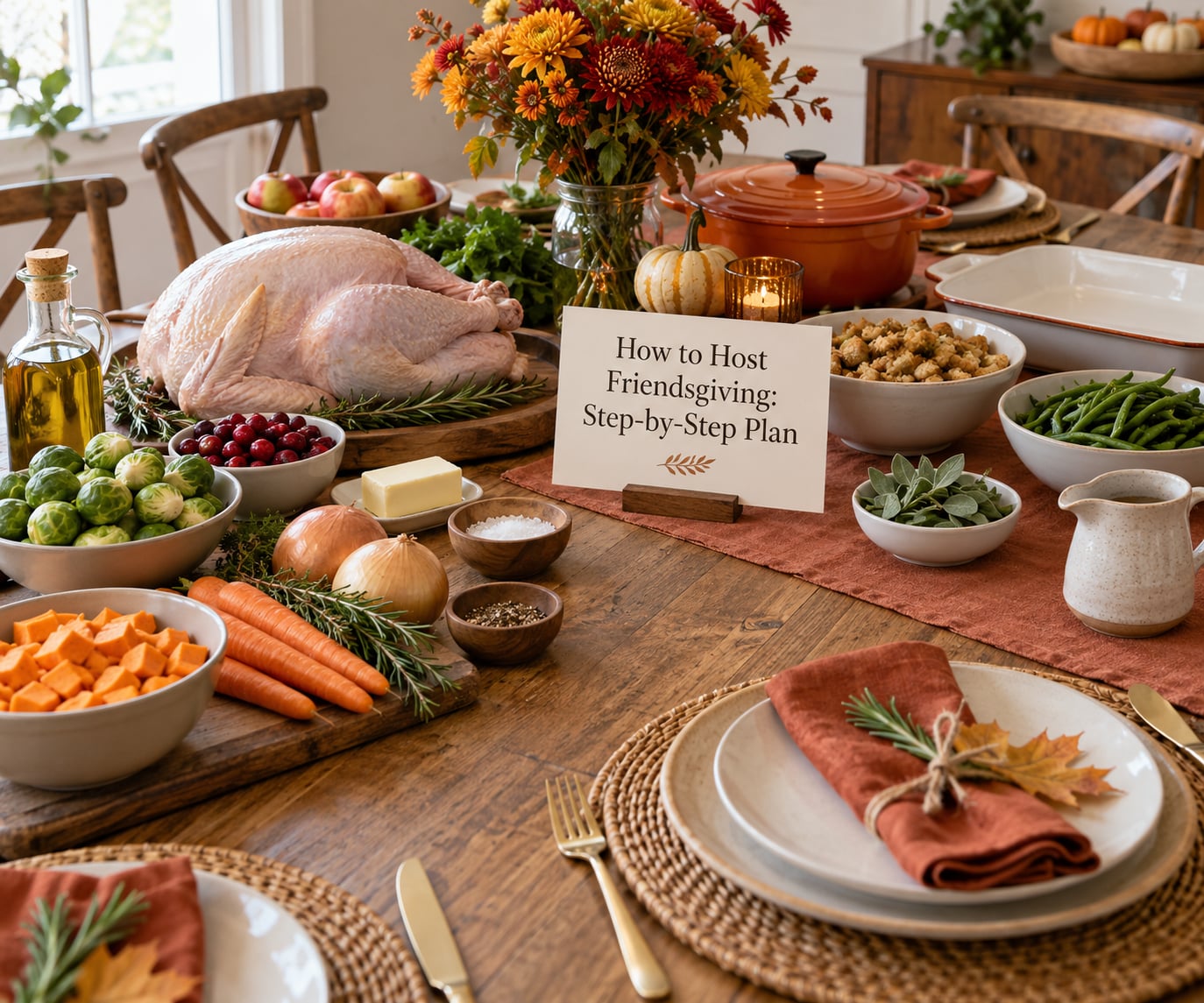
How to Host Friendsgiving: Set the Date, Format, and Guest List
The weekend before Thanksgiving is the date that works for almost everyone. It leaves the holiday week free, it gives guests a reason to travel a day early, and it avoids competing with Thursday night plans. Pick a Friday dinner or a Saturday lunch, then name the exact time food will be on the table and say so in the invite. Arrivals open 30 minutes before the meal; dinner starts at the time you wrote down.
Next, choose a format honestly. Each one trades money for your time in a different direction, and picking wrong is the usual reason hosting feels hard.
| Format | What you buy | Hands-on the day of | Best for |
|---|---|---|---|
| Potluck, host cooks the entree | One main, drinks, ice, serving basics | About 2 hours | Groups over 10 and friends who like contributing |
| Family-style seated dinner | The whole menu, all from you | 3 to 4 hours | Fewer than 10 people and a quieter evening |
| Store-bought or deli main | Prepared entree tray plus sides, salad and dessert | About 45 minutes | Busy weeks, first-time hosts, larger groups |
| Catered | Per-person package set by the caterer | Serving only | Big groups when you want to stay out of the kitchen |
A store-bought entree is a legitimate choice, not a compromise. So is a potluck where every guest leaves with the same dish in their lap.
Build the guest list from what your space can hold, then invite two more people than you have seats for. Keep the plus-one policy in writing, and set an RSVP deadline three weeks out so you are not cooking for a number that shifted on Tuesday.
Your invite should carry five things: the date and arrival window, the address, what you are providing, what guests should bring (or the spreadsheet link), and one question about dietary restrictions. That last question is the whole job. Ask it once, calmly, when people are not standing in your kitchen hungry.
How to Host Friendsgiving: Build a Menu Everyone Can Eat
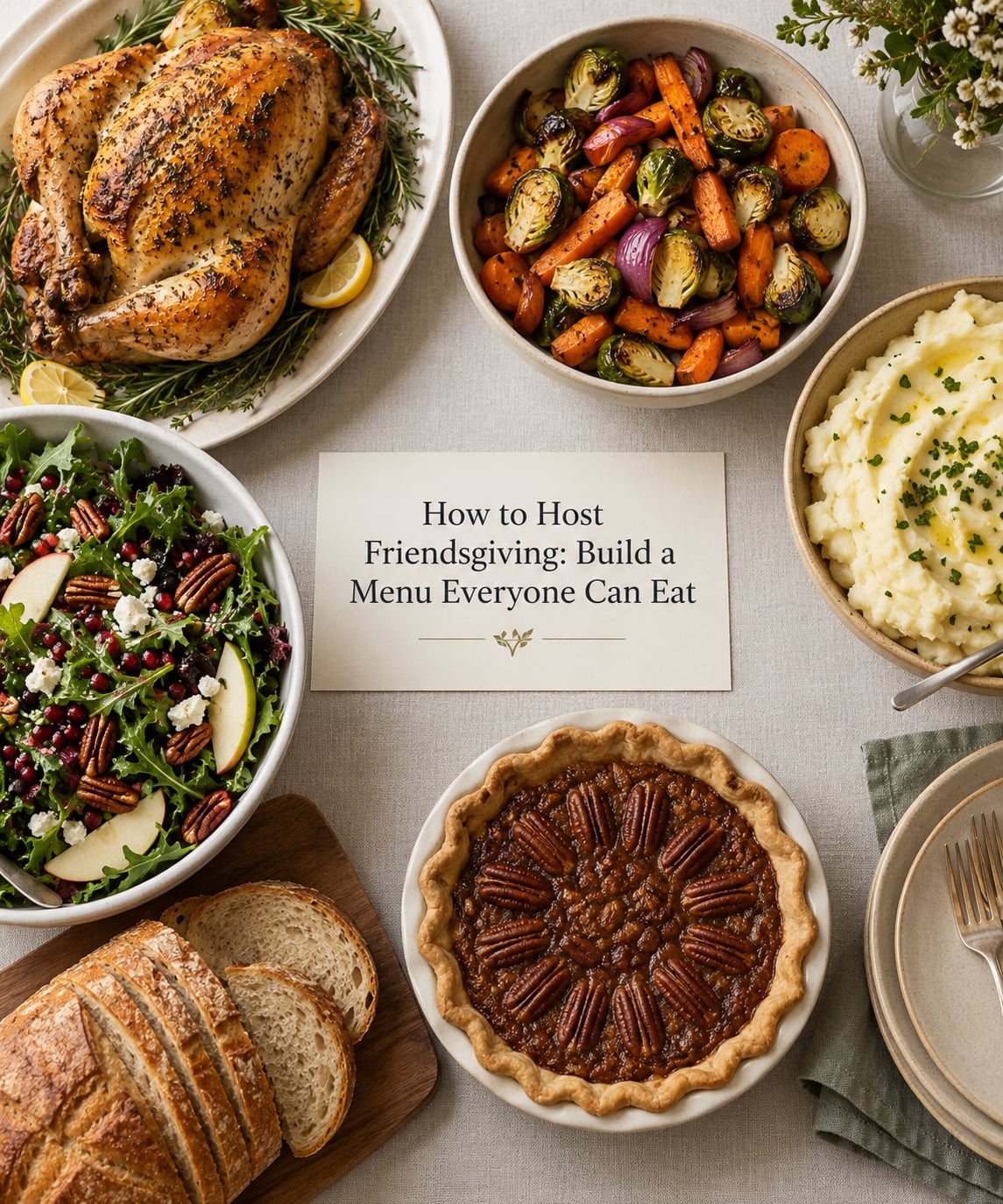
A menu that works has one main, three or four sides, bread, a salad and one dessert. Anything more is cooking for leftovers you will be eating in December. The best version of this is familiar dishes plus exactly one new thing, so nobody is nervous and somebody gets to try something.
Assign sides by category instead of by dish. Soups, starches, vegetables, salads, breads, desserts, drinks. Once those columns are filled there is no room for six green bean casseroles and no rolls. Guests who want to cook bring a dish in their column; guests who would rather not cook bring bread, a salad, ice, a bag of sparkling water, or dessert from a bakery, and nobody has to explain that.
On dietary restrictions, be generous and be specific. Ask about allergies separately from preferences, because an allergy is a safety matter and a preference is not. Make one main that is meat free and not an afterthought, keep the labels on every dish, and do not promise to cover every restriction in the house. Guests with serious allergies often bring their own dish and tell you beforehand. Being the person who made that easy, rather than the person who made a big show of it, is what people remember.
Plan the alcohol-free option with the same care as the wine. Put one good seltzer, one batch mocktail and a pot of spiced cider on the station. People who do not drink should not have to ask for something or hold an empty glass all night.
Keep hot food above 140°F and cold food below 40°F, and do not let perishable dishes sit out longer than about two hours. If you are checking a roast, the safe target is 165°F in the thickest part of the breast and thigh before you carve.
How to Host Friendsgiving: Make a Two-Day Preparation Timeline
Everything except the roast can happen the day before. This is the single change that turns a stressful day into an ordinary one.
The day before
- Make the dessert, any casserole, gravy and the cranberry sauce, which keeps well for several days refrigerated.
- Chop vegetables for roasting, cover them and put them in the fridge.
- Set the table, place cards and all, so morning-of you is not doing decor in a sweaty shirt.
- Chill drinks and pack the cooler. Stock ice in plastic bags so it is not a block you have to break with a hammer.
- Label your leftover containers and set them out with a marker and masking tape.
- Set out the serving spoons, the food labels and the napkins.
The day of
- Roast first, then start reheating sides at 350°F while the roast rests.
- Toss any salad last so it does not go limp.
- Warm bread in the oven right before serving if you want it warm.
- Start drinks and appetizers 30 minutes before the time you told guests.
- Put out the main dishes about five minutes before you sit down, and let people serve themselves.
A cold dish is not a disaster. A dish that never arrives because it was still in your oven at sitting time is worse, so ask a guest to start their casserole ten minutes before dinner rather than at dinner.
How to Host Friendsgiving: Set the Table and Serving Area
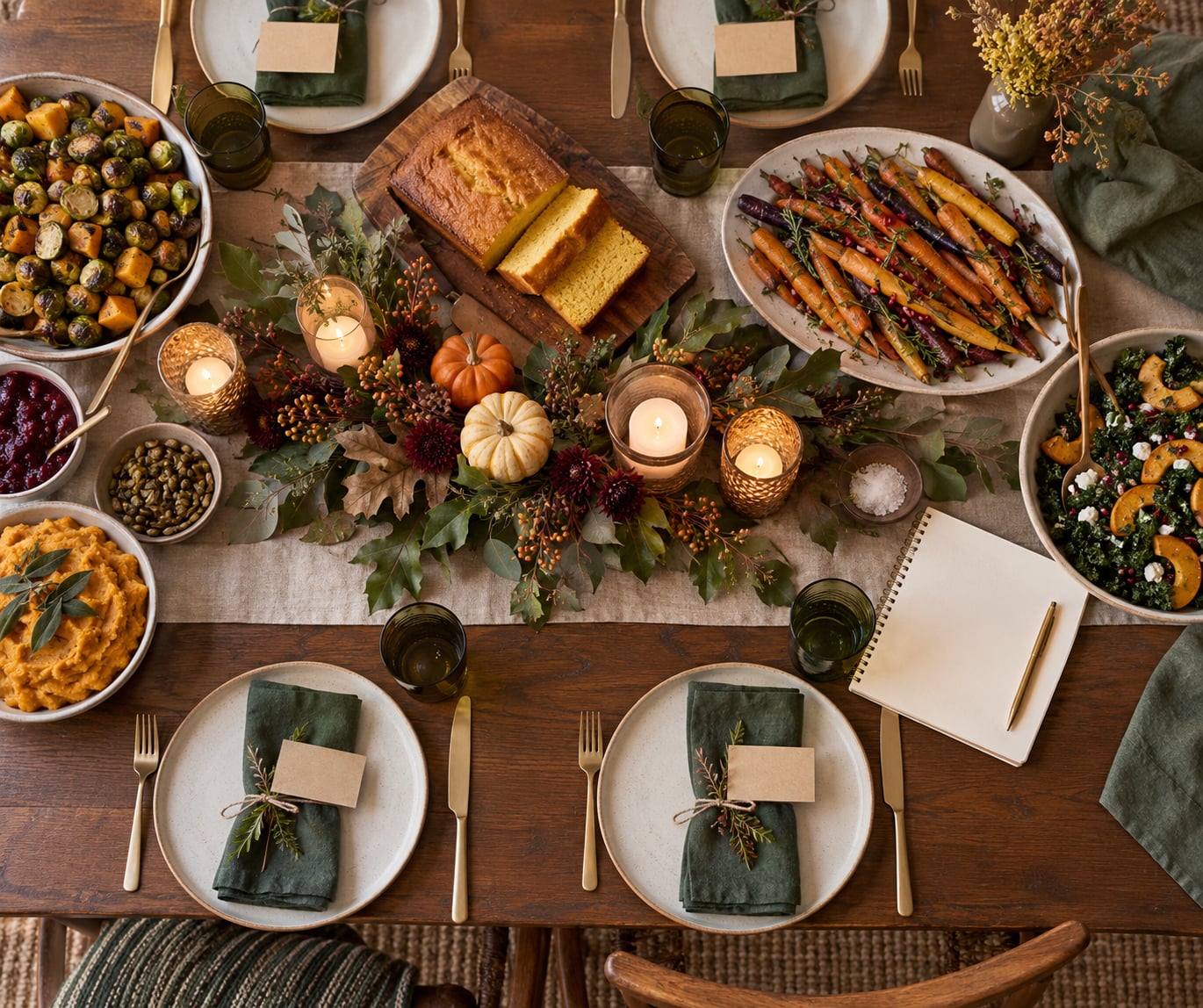
The goal is warm, not fussy. A plain tablecloth or a runner over a clean table, cloth or paper napkins, and one low centerpiece that people can talk across. Skip the tall floral arrangement; it becomes a wall between your two halves of the table.
Decide on one of two serving systems and stop thinking about it. Seated family-style is warmer and works best under about twelve people, because the platters land in the middle of the conversation. A buffet line handles eighteen-plus, small kitchens and mixed seating, and it lets people move, which some guests need. For a buffet, run the line once for the mains before everyone sits, so nobody pushes through the queue twice.
Label every dish, put a serving spoon in each, and keep the drinks station in a different room or at the far end of the table from the food. Ice melts, spills happen and nobody can reach anything from a packed kitchen.
To keep guests out of your kitchen, do not issue a general plea for help. Nobody knows what to do with a general plea. Assign three micro-tasks instead, which is the trick that keeps coming up from experienced hosts: one person owns the cooler and ice, one person handles plates, cutlery and napkins, and one person owns the trash and recycling. Ten-minute jobs with owners beat a two-hour job nobody claims.
How to Host Friendsgiving: Welcome Guests and Keep the Evening Flowing
Do the host jobs yourself for the first hour. Have a drink ready, name coats and bags, and take coats as people arrive if the weather is wet. Put the playlist on before the first guest, not after.
The evening usually runs like this, and the schedule is what keeps it from drifting:
- Arrivals, about 30 minutes, with a welcome drink and something small to nibble that can sit on a plate for an hour without falling apart.
- Dinner called at the time on the invite, not when the food is finally ready.
- Main course, then clearing together. Asking three people to carry plates to the kitchen takes four minutes and turns cleanup into a shared thing.
- Dessert and coffee with music still on.
- One activity that works without forcing everyone to talk: a card game with a table of friends, a short slideshow of photos, or a playlist of embarrassing group photos.
Expect one thing to go wrong and decide in advance that it will not ruin the evening. The potatoes are late, someone’s chair leg wobbles, the oven tripped, the dog is underfoot. Say out loud, once, what happened, then move on. Guests take their cue from you.
How to Host Friendsgiving: Close the Gathering and Handle Leftovers
Most people linger longer than the host expects. Give it a soft ending: a clear announcement about a good time to head out, a car service plan if anyone drank, and a visible stack of leftover containers.
Handling leftovers well means making guests do it. Put out small containers, a marker and a roll of masking tape, and tell people to label their own with their name. The ones that get eaten at your table or handed to someone going home need no storage at all.
Put refrigerated food away within two hours of coming off the heat. Cooked meat and poultry keep three to four days in the fridge, and cooked rice keeps three to four days as well. Reheat leftovers to 165°F before serving them again.
Then do the load before you sit down. Start the dishwasher, gather the cans and bottles, and take out whatever is going out to the bin. Do not scrub every pan that night; leave the ones soaking. Return rented tables and chairs by the time they promised, which is the whole reason renting them was a good idea.
Common Mistakes
Cooking for the invite list instead of the confirmed list. Two extra portions covers a surprise plus-one. Twenty extra portions becomes three days of reheating.
Not asking about dietary restrictions. Put the question in the invite, follow up once with the people who did not answer, and label every dish on the table.
Cooking everything on the day. If you can only make one thing ahead, make the dessert. It is the easiest to transport and the hardest to improvise at 4pm.
Packing the table too tight. Rent folding tables and seating costs less than the quiet sulk of someone stuck at the card table. Leave 18 to 24 inches per person where you can.
Ignoring drinks. Assign someone to the cooler and ice, and plan alcohol-free options in the same quantity as the alcoholic ones. Guests who do not drink should not be the only ones fetching anything from the kitchen.
Hosting with no help at all. Three assigned micro-tasks, as described above. Trying to cook, greet, clean and entertain at once is the actual reason hosts complain.
Letting the potluck drift. One spreadsheet with categories, one link in the invite, and a firm nudge to anyone who has not signed up by two weeks out.
Over-contributing or under-contributing guests. If someone brings three dishes, thank them warmly and ask right away whether they want containers to take two home. If someone arrives with a bottle of wine and nothing else, that is a perfectly normal contribution; no host should make a guest feel like they failed. Etiquette here is about what the host does with it, not about what the guest brought.
One more mistake worth naming: doing the whole thing alone because it is your house. Ask for help out loud, early, in specific terms. Hosts who say, “I am cooking the turkey and I need someone to bring bread and someone to handle ice,” get both. Hosts who say, “can anyone help?” get silence.
Frequently Asked Questions
How many people should I invite to Friendsgiving?
Invite two more people than you have comfortable seats for, and cook for your confirmed headcount plus two. Under ten guests suits a seated family-style meal. Fourteen or more works better as a buffet with a second table. Renting folding tables and chairs usually costs less than a cramped dining room, and it keeps conversation at one end of the table.
Should Friendsgiving be a potluck or should the host provide everything?
The host provides the entree, and guests bring assigned sides. That single rule is the reason potlucks work, because nobody ends up responsible for eight dishes. Assign by category, such as starches, vegetables, salads, bread and desserts, so there are no duplicates and no gaps. For eight guests or fewer, doing everything yourself is manageable and often calmer.
How do I handle dietary restrictions at Friendsgiving?
Ask about allergies and preferences in the invite, not at the door, and follow up once with anyone who did not reply. Make one meat-free main that is a real dish rather than a side dish, label every platter with its ingredients, and keep one dish entirely gluten-free and nut-free if someone needs it. Guests with serious allergies usually bring their own food once they know you have asked.
What can I prepare for Friendsgiving the day before?
Practically everything except the roast. Desserts, casseroles, gravy, stuffing and cranberry sauce all hold well overnight, and chopped vegetables for roasting can be covered in the fridge. Set the table, chill the drinks, pack the cooler with bagged ice and label your leftover containers. On the day you are reheating, finishing and plating, which is a normal evening of cooking.
How do I host Friendsgiving without spending all day cooking?
Buy the main. A prepared roast or deli entree tray turns a four-hour job into a 45-minute one, and nobody at the table knows the difference. Guests usually read that as generous rather than lazy, especially when the sides, drinks and company are good. Cook two sides yourself so the meal still feels like yours.
What should I serve for drinks at Friendsgiving?
Plan a welcome drink that needs no ice or shaker, something with dinner, and a coffee or tea option for the end. A spiced apple cider with orange slices and cinnamon makes a full table smell like the holiday and works in a slow cooker. Stock alcohol-free options in the same quantity as the alcoholic ones, including a batch mocktail, so nobody has to ask.
Conclusion
Hosting Friendsgiving comes down to four decisions made early: the date on the weekend before Thanksgiving, the format, the guest count your chairs and kitchen can handle, and one dependable main dish. Everything after that is the spreadsheet, the labels, the cooler and the three people you assigned to help.
So start tonight. Write the guest list, send the invite with the dietary question in it, and put your one main dish in the calendar. The rest of the plan can be done in an afternoon the day before, with the oven doing the heavy lifting on the day. For anyone hosting away from family this year, chosen family counts, and a table set for eight people who actually want to be there beats a quiet chair at someone else’s.