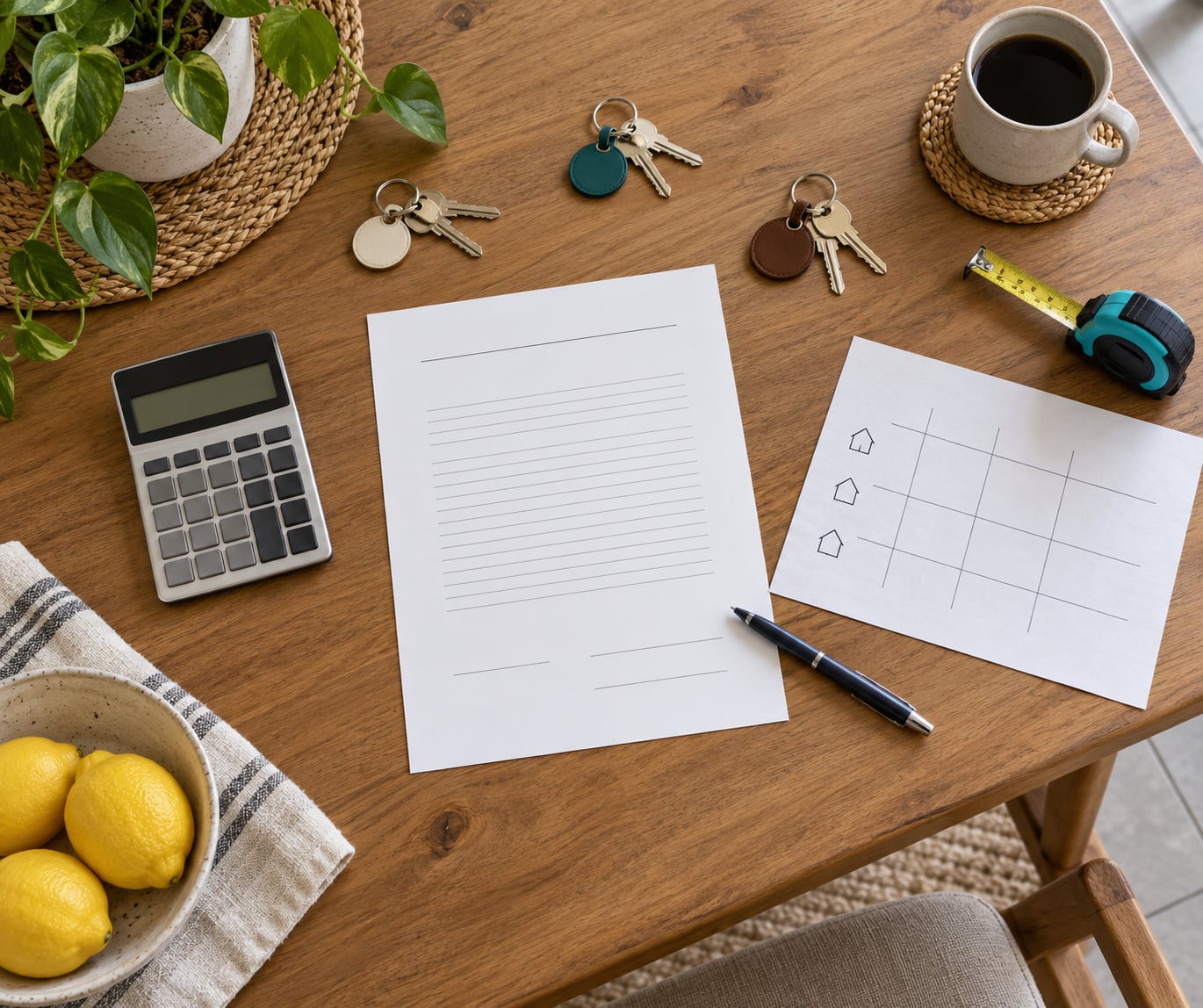
If you are searching for how to split rent fairly with roommates, the answer is not one formula. It is a formula chosen before anyone signs a lease, written down in dollars, and reviewed on a date everyone knows about. Most roommate blowups I have watched were never about the math. They were about a deal agreed in a hurry, never written down, and quietly resented by month three.
Six steps gets you from a group chat argument to a signed one-page plan. Budget about 30 minutes for the first sitting, plus 10 minutes a month to keep it current. You do not need a lawyer or a spreadsheet template to do this properly, just the actual numbers and a decision everyone agrees to out loud.
Table of Contents
- What You Need to Split Rent Fairly with Roommates
- Step-by-Step
- Common Mistakes That Make a Rent Split Feel Unfair
- Frequently Asked Questions
- How should couples split rent with a single roommate?
- Is a 50/50 rent split fair?
- What can I do if my roommate doesn’t pay their half of the rent?
- How do you split utilities fairly when one roommate uses more?
- How do I write a rental agreement for a roommate?
- Should rent be split based on income with roommates?
What You Need to Split Rent Fairly with Roommates
Gather these before the first conversation, not after. Deciding numbers while everyone is still annoyed is where bad agreements come from.
- The signed lease, or the listing if you have not signed yet. This tells you the legal names on the lease and the base rent, which is often not the number people quote to each other.
- A full list of monthly housing costs. Base rent, parking, storage, pet rent, amenity fees, renter insurance, and every utility that is not in your name.
- Room measurements or a floor plan. A tape measure and a phone photo of each room with the closet door open is enough. You do not need a professional appraisal.
- Everyone’s rough income range. Needed only if you consider an income-based split. Nobody has to share a payslip.
- A shared tracker. Splitwise and Spliddit are free and browser-based, and they handle the running balance of who owes whom. A shared note in your group chat also works, as long as one person owns it.
- One evening with no other plans. Rooms get assigned in this conversation, because room choice is what drives the whole split.
One legal fact worth knowing up front: on most residential leases every signer is jointly and severally liable, meaning the landlord can demand the entire unpaid rent from any one of you. Your private agreement with each other does not change that. It only decides who pays the landlord back afterward, which is a much harder conversation to have than the original split.
Step-by-Step
Step 1: Review the Lease and Total Housing Costs
Pull every recurring housing cost out of the lease and onto one list, then total it. Most people only argue about the base rent because nobody wrote the rest down.
Start with the number on the lease, then add anything billed to the household: parking, a storage cage, a pet fee, an amenity charge, and utilities the landlord passes through. Note the deposit too, since that is usually a separate chunk of money on move-in day.
Write the total as one figure. That figure is what you split, not the base rent alone. A 3,200 dollar rent with 180 dollars of parking, storage, and pet fees is a 3,380 dollar housing cost, and dividing 3,200 three ways quietly undercharges the parking space.
Step 2: Decide What Will Be Split Equally
Sort each cost into one of three buckets before you assign percentages. Anything you cannot name a rule for will resurface as an argument by the third bill.
- Fixed and equal: trash, water, base rent, building insurance. Same cost no matter who is home, so split by headcount.
- Fixed but per-person: internet, streaming services, gym memberships. Same cost, so still per head, which keeps it simple.
- Variable with usage: electricity and gas, mostly heating, cooling, and hot water. Usage matters here, so equal or usage-based, never anything fuzzy.
- Private: your phone plan, your food, your medication, your car, your streaming password. Not shared costs, no matter how much someone else enjoys them.
Internet is the one cost people most often get wrong. It is fixed and everyone uses it, so split it evenly and treat it as a line item separate from rent. That way nobody decides that streaming counts as internet use.
Step 3: Account for Private Rooms and Unequal Benefits
Square footage of the private bedrooms is a starting point, not a finished answer. A 10 by 9 foot room with a window, a walk-in closet, and direct bathroom access is worth more than a 13 by 11 foot room in a basement, and that gap is exactly what people fight over.
Two methods work well. The first is cost per square foot of private room space: total rent divided by the total private bedroom square footage, then multiplied by your room’s square footage. Only count the bedrooms people sleep in. Counting the living room, kitchen, and bathrooms multiplies the number by roughly two and makes the math look fancier than it is.
The second is room points. Each room earns points for what it actually gives you: window and natural light, closet space, private or ensuite bathroom, a door that closes, a balcony, a setup that works as a home office, and how much hallway traffic passes it. Two points, or three, for a genuinely better room. You then divide the rent by the total points.
Whichever you pick, write the reasoning into the agreement so a future disagreement is about facts and not about memory. Forum threads about this topic converge on one pattern: a 50/50 base split with a fixed adjustment for the bigger room is the compromise most people actually live with happily.
Step 4: Calculate Everyone’s Payment
Here is one identical scenario run through five methods. A 3-bedroom, 2-bath apartment at 3,200 dollars a month, with private rooms of 143, 110, and 90 square feet, three incomes of 62,000, 55,000, and 42,000 dollars, and the big room also getting the balcony and the ensuite half bath.
| Method | Formula | Room A | Room B | Room C |
|---|---|---|---|---|
| Even split | Total divided by 3 | 1,067 | 1,067 | 1,066 |
| Room square footage | 3,200 divided by 343 sq ft | 1,334 | 1,026 | 840 |
| Room points | Share divided by 6 points | 1,600 | 1,067 | 533 |
| Income ratio | Share of combined income | 1,248 | 1,107 | 845 |
| Even split plus room offset | Even split, 150 dollars moved | 1,217 | 1,067 | 916 |
| Envy-free bid | Each pays their own bid | 1,350 | 1,050 | 800 |
All figures are dollars per month, rounded to the nearest dollar, with the leftover dollar going to the smallest share. The square footage math works out to about 9.33 dollars per square foot of private bedroom, so Room A at 143 square feet comes to roughly 1,334 dollars.
For the envy-free version, everyone privately bids on each room. In this scenario the big room bid at 1,400, the middle at 1,100, and the small at 800 sums to 3,300, which is 100 dollars more than the rent, so nobody bids. Adjust to 1,350, 1,050, and 800 and the bids clear exactly at 3,200. Each person gets the room they bid on, and nobody envies anyone else’s deal because everybody pays their own number. With two roommates the same trick is simple: one bids 1,000 for the room with the balcony, the other bids 800, and at a 1,800 rent it clears immediately.
Matching method to situation keeps it from becoming a philosophy debate. Even split works when the rooms are close. Square footage or room points work when one room is visibly bigger. An income ratio works when income differences are large, and it carries a hidden cost: it depends on goodwill, because the person paying more resents it if the other person’s salary grows. The even split with an offset is the safest middle ground most groups land on.
You do not have to run the math yourself. Spliddit walks two people through assigning rooms and prices, the New York Times rent division calculator handles the square footage version, and Splitwise keeps a running balance once the numbers are settled. Use a calculator to check a first round of figures, then write the answer down by hand, because a number three people agree to out loud holds up far better than one somebody else typed.
Do not negotiate the split by text message one variable at a time. Propose a full plan in a single message so everyone reacts to the same set of numbers, and give each person a day to reply before anything is considered settled.
Step 5: Create a Written Roommate Agreement
A roommate agreement does not need to be notarized in most places, because it is a private contract between adults rather than a lease with a landlord. What matters is that everyone signs it and keeps a copy. Attach it to the lease as an exhibit, or store the signed PDF somewhere all three of you can reach.
Include these clauses, in this order:
- Monthly rent total and each person’s exact share in dollars, not just a percentage.
- Due date, a grace period, and what a late fee costs. Late fees are the one lever that works without anyone being unpleasant.
- How utilities are split, which costs are per head, and which depend on usage.
- Internet and any subscriptions billed to one person.
- Security deposit amount per person and when it gets returned.
- Guest policy, including how often a partner may stay over.
- Chores, quiet hours, and cleaning expectations.
- Notice period for moving out, and what happens to the remaining lease time if someone leaves early.
- How a replacement roommate is approved and added.
- How disagreements get raised, with a cooling-off rule.
- Signatures and the date.
Free templates exist for every clause above, and searching a word processor for roommate agreement template gives you a workable starting page in a couple of minutes. Many cities also publish plain-language versions through legal aid offices, which are more readable than anything you will find on a template farm.
Step 6: Review the Plan and Set Check-In Dates
Every arrangement decays. Salaries change, one person starts working from home, a partner starts staying over most nights, someone gets a dog. A written plan with no review date becomes a stale plan.
Set three checkpoints. A 10-minute money check in the first week of each month, before rent is due, covering anything unusual on the tracker. A quarterly written look at whether the room assignments still match reality. And a full renegotiation at renewal, which is the one moment you can leave without penalty and change the split entirely.
Handle surprises with one rule: any cost over an agreed threshold, say 50 dollars, gets flagged in the tracker the day it lands rather than mentioned at the next argument. For occupancy changes, give notice in writing before the lease is up, and expect to do a walkthrough with photos at move-out so the deposit is not disputed later.
On deposits specifically, many landlords return the money within 14 to 30 days of the move-out inspection once they have a written forwarding address. Chicago adds its own layer: the city ordinance generally caps a residential security deposit at one and a half times monthly rent and requires interest on deposits above a small threshold for year-long leases. Verify what 2026 requires before you sign, and photograph the apartment condition yourself regardless of where you live.
Common Mistakes That Make a Rent Split Feel Unfair
- One vague spreadsheet with no due dates. A shared balance with no deadlines is a history of what already happened, not a plan. Fix: add a due date and an amount to every recurring line before the first payment.
- Ignoring recurring bills entirely. Rent gets paid on time and the electric bill becomes a surprise in month four. Fix: list internet, electric, gas, water, and trash on the tracker from move-in day.
- Assuming equal rent means equal benefit. A windowless room next to the laundry room is not worth the same square footage as a bright room with a door that closes. Fix: add room points for light, storage, bathroom access, and noise.
- Relying on a verbal promise. Every roommate remembers the agreement slightly differently, usually in their own favor. Fix: one page, signed, dated, and stored where everyone can open it.
- No deadline and no late fee. Without a consequence, the person with the money is always the one carrying the risk. Fix: put a real late fee in writing and agree it applies to everyone equally.
- Spending half the year on one utility split. Two people arguing over 60/40 on electric never get past 60/40. Fix: either split it per head and accept it, or use a rough usage rule set in advance, such as the person with the sunniest room pays 60 percent of the heating season.
Two habits help more than the rest. Keep every shared dollar in one tracker, including rent, utilities, and supplies, so nobody has to reconstruct a month from memory. And talk before the next bill lands, not after. Delay is what turns a five-minute conversation into a month-long standoff.
One more worth naming for this site specifically: if you are living with chosen family rather than a romantic couple, write the guest and privacy terms down explicitly. Stating how often a partner may stay, who has keys, and what happens if someone wants a lock on their bedroom door removes an awkward conversation later without making the arrangement less warm.
Frequently Asked Questions
How should couples split rent with a single roommate?
Treat the couple as one economic unit with two incomes. Agree on a fixed dollar amount the couple pays each month, rather than a per-head split, then decide inside the couple how they cover it. That way the single roommate is not covering a partner’s share by accident, and the arrangement stays fair if one person’s income drops.
Is a 50/50 rent split fair?
It is fair when the rooms are genuinely similar in size, light, storage, and noise, and when everyone uses the space about the same amount. It stops being fair the moment one room is much better or someone works from home daily. In that case, keep the even split as a base and add or subtract a fixed amount for the better room.
What can I do if my roommate doesn’t pay their half of the rent?
Send one written reminder with the date, the amount, and the deadline, and reference the clause you both signed. If there is no response, tell the landlord before the due date passes, because on most leases every signer is liable for the full rent. Pay the landlord yourself only if you can cover it, then ask for reimbursement in writing. Mediation through a local legal aid or tenant hotline is the next step before you consider moving out.
How do you split utilities fairly when one roommate uses more?
Set the rule before the first bill. Fixed costs like internet and trash split evenly per person, while electricity and gas can use a simple usage proxy, such as the person with the sunniest room paying 60 percent of the heating season. Tracking exact metered usage by room is not practical in most apartments and turns into a monthly argument nobody enjoys.
How do I write a rental agreement for a roommate?
Keep it to one page and cover rent totals, each person’s dollar share, due dates and late fees, how utilities are split, deposits, guest rules, quiet hours, notice for moving out, and how disputes get raised. Everyone signs and dates a copy. Attach it to the lease so it travels with the apartment instead of living in someone’s inbox.
Should rent be split based on income with roommates?
It works when income differences are large and everyone is comfortable discussing money. On a 3,200 dollar rent with incomes of 62,000, 55,000, and 42,000 dollars, an income ratio produces shares of about 1,248, 1,107, and 845 dollars. The catch is that it depends on goodwill, since the person paying more will notice the moment the gap grows or shrinks, so review it every year.
Start with one evening: total every housing cost, pick one formula, write each person’s share in dollars, and sign it. Anyone can learn how to split rent fairly with roommates this way, and it takes less time than one month of avoiding the topic. Then put a 10-minute check-in on the calendar before rent is due each month, and a real renegotiation on the calendar for renewal.