To write a roommate agreement, sit down with the people you are sharing a home with and write down what each of you agrees to pay, do, and respect. It is a one or two page document, signed by everyone, and it covers the things a lease never mentions: chores, guests, quiet hours, groceries, and what happens if one person moves out early.
Write it before anyone moves in, while the arrangement is still friendly. Half the value of the document is that everyone signed the same version of the rule before the rule was ever argued about.
It also matters most when only one person is on the lease. A roommate agreement does nothing about your landlord, but it does give you something signed and dated to work with when the question is who owes what.
Table of Contents
- What You Need
- Step-by-Step: How to Write a Roommate Agreement
- Start With the Basics: Identify the Home, Roommates, and Dates
- List Rent, Utilities, Deposits, and Other Money Matters
- Divide Chores, Purchases, and Household Work Fairly
- Set Boundaries for Guests, Quiet Hours, Privacy, and Personal Space
- Add Rules for Conflicts, Changes, and Moving Out
- Review, Sign, and Store the Roommate Agreement
- What Should a Roommate Agreement Include?
- Common Mistakes
- Frequently Asked Questions
- Conclusion
What You Need
Gather these before the first draft. Ten minutes of prep makes the writing session twice as fast, because the hard part is agreeing, not typing.
- The lease. A copy of the signed lease, so you can see the rent, the deposit, the due date, and any rules about additional occupants, pets, or subletting.
- Every monthly amount, named. Rent per person, the internet bill, the electric bill, renters insurance, parking, a shared supplies budget. Write the number, not a percentage.
- Deposit details. How much was paid, to whom, and what the landlord calls ordinary wear and tear versus damage.
- Bill due dates. When rent is due, when utilities are due, and how many days late a bill is before it matters.
- House rules that already exist. Building rules from your landlord or campus housing office, plus anything your lease already forbids.
- Schedules. Work hours, class schedule, sleep schedule, any regular hours the apartment is empty or occupied.
- A sense of the shared list. Groceries, cleaning supplies, paper towels, toilet tissue, and whether you are sharing food or keeping separate shelves.
- Move-in and move-out dates. Exact calendar dates, not “end of summer.”
- Contact information. Full legal names, phone numbers, email addresses, and an emergency contact for each person.
Bring a list of deal-breakers too, the things you would actually walk away over. A smoking apartment in a non-smoking building is a deal-breaker. Leftover dishes are an annoyance. Mixing them up on the first page is how an honest disagreement turns into a fight.
Step-by-Step: How to Write a Roommate Agreement
Six steps, in order. Follow them and you will have a signed document in one sitting, and a household that argues about the rule instead of about what the rule meant.
Start With the Basics: Identify the Home, Roommates, and Dates
Open with the identifying details, so nobody can later claim they signed a different document. Include the full rental address, the names of every person the agreement covers, the lease term, the move-in date, and the date the house rules take effect.
List the landlord’s name and contact details too, even though the agreement is only between the people living there. You want one place to look when something goes wrong at the building level.
Write it like this: “This Roommate Agreement is made on [DATE] between [FULL NAME], [FULL NAME], and [FULL NAME] for the home at [ADDRESS]. It begins on [DATE] and covers the lease term [START] to [END]. The landlord or property manager is [NAME], reachable at [EMAIL/PHONE]. Where this agreement and the lease conflict, the lease governs.”
That last sentence costs you nothing and saves an argument later.
List Rent, Utilities, Deposits, and Other Money Matters
Every dollar figure gets a name, an amount, a due date, and a payment method. Vague splits fail because two reasonable people can read “split utilities evenly” in very different ways once one of you works from home and blows through the electric bill in July.
- Rent. The total, the split, the due date, who pays the landlord, and what happens if someone is short. If rooms differ in size, say so: “the larger room carries [AMOUNT] more per month.”
- Utilities and who is the account holder. Name the person whose name is on each account. The account holder pays the bill, takes the credit risk, and gets reimbursed by a date you pick, not by “when I get around to it.”
- Internet. Amount, whether it is in a name or shared, and what happens to the account if that person moves out mid-term.
- Shared supplies. A small monthly budget, a person, and a receipt rule. Keep a shared note of what was bought.
- Security deposits. The amount, where it is held, and the condition photos taken on move-in day, saved to a shared folder with dates on them.
- Late payment. Say what you will actually do. “The late person covers the late fee and sends the money within three days” is enforceable between you. A threat to “tell the landlord” is not.
Also state how a charge gets disputed. Something like: “If a roommate thinks a charge is wrong, they say so in writing within seven days, and the two of you talk about it. Unresolved charges are split evenly.” That last part prevents the silent resentment pattern, where one person quietly stops paying for months.
Divide Chores, Purchases, and Household Work Fairly
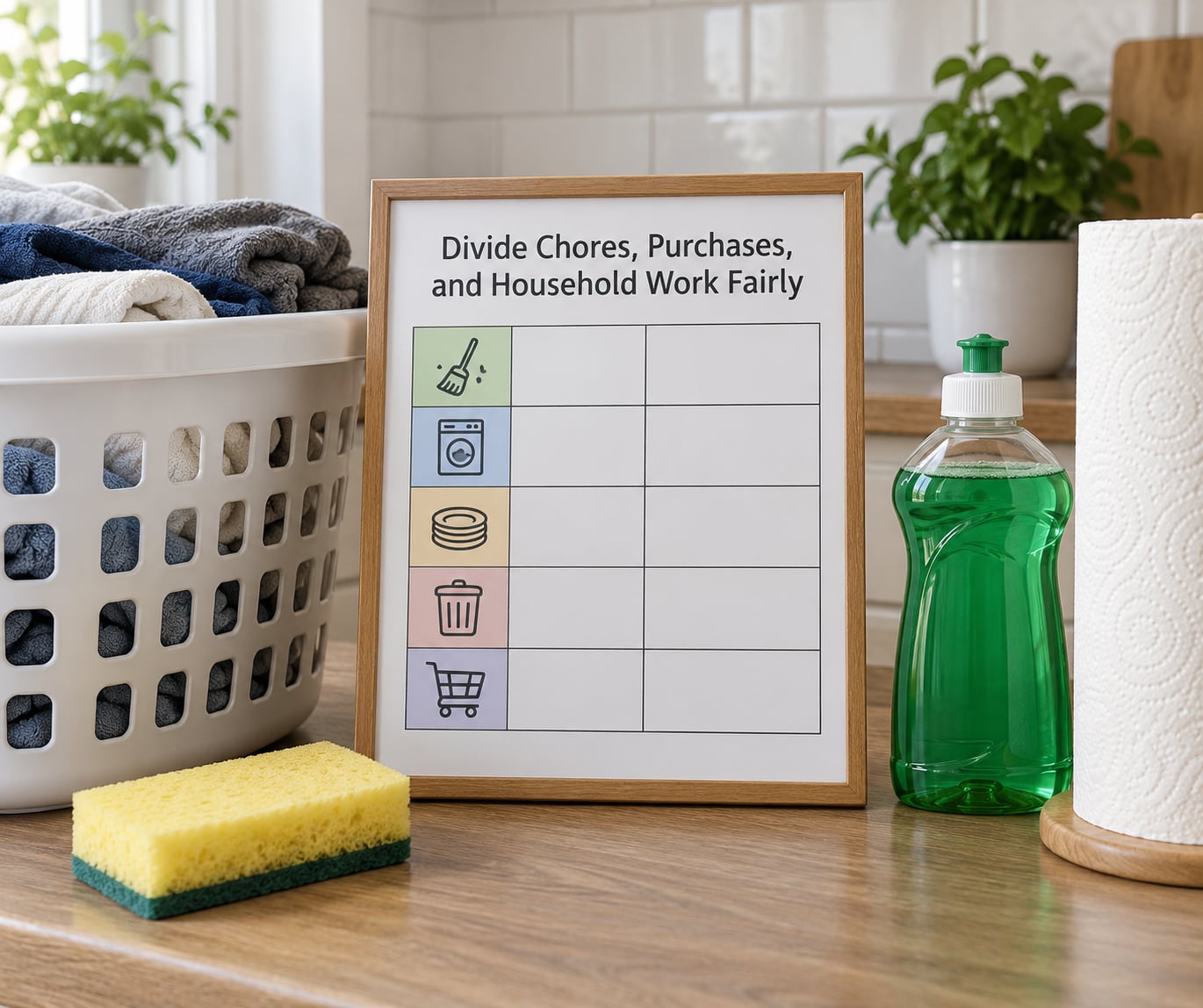
Chores need a name attached to each one, a schedule, and a definition of done. “Keep the kitchen clean” is a values statement that can start an argument. “Whoever cooks loads the dishwasher by 9pm” cannot.
- Name the person for each recurring task. Dishes, trash and recycling, bathroom, vacuuming, common floors, laundry, and the supplies restock.
- Give each one a frequency. Daily, twice a week, weekly, monthly. For anything weekly, name the day.
- Define done, briefly. “Dishes are done: washed, put away, and the counters wiped.”
- Decide the rotation rule. Either a fixed weekly rotation with names and dates, or “the person whose turn it is is the one who cooked last, and this alternates automatically.”
- Set how the division changes. “If someone wants a different arrangement, they ask; the change takes effect the next full week and is written down.” Nobody renegotiates chores at 10pm after a hard day.
Two cases come up constantly, so plan for them. If there is no dishwasher, decide whether dishes are a nightly two-minute job or a weekly chore, and decide who handles it on the days the kitchen user is not home. If either of you has ADHD or struggles with executive function, write the reminder into the rule itself: a shared calendar, a phone alert, or a checklist on the fridge. Naming the mechanism is the difference between a rule and a hope.
For groceries, pick one model and write it down: fully shared, fully separate, or a hybrid with a designated shelf and a shared shelf. Hybrid is the most common and the least resentful, because it names the shelf instead of relying on vibes.
Set Boundaries for Guests, Quiet Hours, Privacy, and Personal Space
Boundaries work best as numbers and clocks, not as requests to be considerate. Write the number of nights, the hours, and the notice required.
- Guest policy. A number: “Up to [N] overnight guests per month, with [N] days notice, and no more than [N] nights in a row by the same person.” Daytime visitors can be a separate, looser line.
- Quiet hours. A window, like 10pm to 8am on weeknights, and what counts as breaking it: no loud music, no video calls in shared rooms after 11pm, no dishes after 11:30pm, headphones in shared spaces.
- Who is exempt. A partner or chosen family member, or a roommate with a different schedule, might reasonably break quiet hours on weekend nights. Say whose nights are different, so the rule does not quietly become one-sided.
- Privacy and personal space. Bedrooms and the inside of closed closets are private. No entering without a knock, no borrowing without asking, no reading messages or opening mail addressed to someone else.
- Personal property. What happens to each person’s things if they move out early, and how much notice someone gets before a roommate’s belongings are moved or stored.
- Pets and smoking. State the building’s rules and the household’s. If the lease bans smoking in the unit, the agreement does not need a debate about whether the balcony counts.
One clause worth adding if it fits your household: who gets told what. Some roommates are not out to their family, their employer, or the landlord, and a guest rule written carelessly can expose someone. A clause that says guest information stays inside the home, and that no roommate is required to explain a guest’s name, relationship, or identity to anyone, costs a sentence and protects a real person.
Add Rules for Conflicts, Changes, and Moving Out
This is the section most agreements skip, and it is the section people need most. Write a short process for disagreements, a process for amendments, and the full early move-out sequence.
Conflicts. Name a first step that is not an argument. A 24 hour cooling-off rule, a written message instead of a raised voice, a standing weekly 20 minute housekeeping check-in, and mediation through a friend or a local mediation service if things stall. Also say what is off limits: no posting screenshots in group chats, no recruiting other roommates as a side, no locking anyone out of shared space.
Changes. “Amendments are written, agreed by everyone, and signed and dated. An unwritten change is not a change.” Name a review date, usually 60 days in, plus an event trigger such as a new job, a new baby, a new partner, or a change in work hours.
Early move-out. Write these five terms, and you will thank yourself later:
- Written notice, at least 60 days ahead where the lease allows, delivered in a message that is easy to find later.
- A replacement roommate. Either the person leaving finds one, or the remaining roommates choose one, with a right to interview and say no.
- Continuing to pay. The person leaving keeps paying rent until the replacement is approved by the landlord, or pays a stated buyout amount. This protects the roommates still on the lease, who are usually liable for the full rent.
- Deposit handoff. The landlord gets a written accounting of deductions, photos are taken at the handoff walkthrough, and the person leaving gets copies of everything sent to the landlord.
- Final bills. A date for the last internet bill, a plan for moving a phone plan or an account in someone’s name, and a mailing address for the deposit refund.
If you are the only person on the lease, add the leak clause: “Roommates are not on the lease with the landlord. The lease signatory is responsible for the full rent to the landlord and is not required to cover amounts other roommates owe to the landlord. Roommates owe amounts owed to the lease signatory, reimbursable by [DATE].” Then keep the rent receipts. It is not a silver bullet, but it is a clear, dated, signed record of what was due, and that is the thing that actually helps you later.
Review, Sign, and Store the Roommate Agreement
Reading the finished draft out loud together is the fastest way to find the sentence nobody understood. Anything that makes someone pause, reword it. A good test: can each person restate the rule in their own words?
Check that names and dates are filled in everywhere, the totals are right, the due dates are specific, and the notice period is real. Then everyone signs and dates the same version, and each person gets a copy. A photo of the signed pages in a shared folder counts, but a printed copy in a folder beats both when a relationship goes sideways.
Put the copy somewhere everyone can reach, and add a review date. Thirty or sixty days in, people reread it once the initial optimism has worn off. That is also the moment to fix a rule that turned out to be wrong, while changing it is still easy.
What Should a Roommate Agreement Include?
If you only remember twelve items, these are the ones that come up in almost every dispute:
- Names, address, lease term, and the date the rules take effect
- Total rent, the split, the due date, and what happens if someone is short
- Which utilities, and which of you is the account holder on each one
- Reimbursement terms with a date, not a vague promise
- Security deposit amount, plus move-in condition photos with dates
- Chore list with a name, a schedule, and a definition of done for each
- Shared versus separate groceries and fridge space
- Guest limit, notice required, and quiet hours with a start and end time
- Privacy, personal space, and personal property rules
- Conflict process, amendment rules, notice period, and early move-out terms
- Emergency contact for each person
- Signature and date lines for everyone
A free, fill-in-the-blank roommate agreement template is worth copying before you start. This site does not have one to hand you, but nearly every university housing office publishes a printable version, and a one-page form is all it takes to cover the twelve items above.
Common Mistakes
Most agreements fail for the same handful of reasons, and each one has a small fix.
- Vague rules. “Keep things clean” and “be considerate” cannot be enforced by anyone. Fix: add a person, a frequency, and a one-line definition of done.
- An even split of unequal work. Two people doing the same job differently does not make the split even. Fix: list tasks, count hours for a week, then redistribute.
- No deadlines anywhere. “Reimburse me soon” is how resentments grow. Fix: give reimbursements, notices, and reviews actual dates.
- Legal language nobody understands. Long paragraphs borrowed from a sample form get skipped, and skipped rules are broken rules. Fix: short sentences, plain words, one idea per line.
- Nothing about moving out. Fix: the five early move-out terms above, written before you need them.
- Verbally agreed, never written. Fix: type it, sign it, date it, keep it. An unsigned note in a group chat is a start, not an agreement.
Two habits make the difference between a document that works and one that sits in a drawer. Write it before the first conflict, not after, and keep it short enough that everyone actually reads it. Two pages with specific numbers beats ten pages of careful prose.
Talk about your deal-breakers out loud before you write anything. “I need the place quiet on Sunday mornings” or “I am not comfortable with a partner staying four nights a week” is much easier to say in a friendly conversation in week zero than it is to enforce in month four.
Frequently Asked Questions
Do I legally need a roommate agreement?
No, almost nobody does, and where a rule exists it usually comes from the lease or building policy rather than from law. A roommate agreement is a private contract between the people sharing the home, so it does not have to satisfy a legal form to be useful. What makes it valuable is that it is signed and dated before anyone moves in, which settles what was agreed.
Is a roommate agreement the same as a lease?
No. A lease is a contract with the landlord and covers rent, deposit, term, and building rules. A roommate agreement is a contract between the people living there and covers chores, guests, quiet hours, groceries, and early move-out. It sits alongside the lease. Where the two conflict, the lease wins, and the landlord is not bound by anything in the roommate agreement.
What if one roommate does not want to sign?
Ask why before deciding how to respond. Someone hesitant usually has a specific worry, such as being tied to rent after they move out, and naming that clause usually settles it. If they genuinely refuse, keep the clauses you agreed in writing anyway, confirm the key money terms in a dated message, and take move-in condition photos with their agreement in writing. Consider a shorter document covering the essentials rather than nothing.
How do we divide utilities and shared expenses fairly?
Fair usually means matching use, not splitting every bill down the middle. Name the account holder for each utility, decide a reimbursement date, and use a separate shared note for supplies so nobody has to remember. If someone’s work pattern uses far more power or water, agree on a small adjustment or a fixed cap rather than arguing about the bill at the end of the month.
Can a roommate agreement change the rules in our lease?
No. It cannot override the lease or your landlord’s rules, and it does not bind the landlord at all. Two agreements on the same subject, such as overnight guests, are best handled by the stricter one. Before signing, read the lease for its rules on additional occupants, subletting, and pets, because a roommate agreement that assumes a partner can move in will clash with a clause that forbids it.
How often should we review the agreement?
Once after the first month, then whenever something material changes: a new job with different hours, a partner moving in, a new baby, a pet, or a change in income. Put the review date in the document so it happens without anyone having to suggest it. Amendments should be written, agreed by everyone, and signed and dated, because an unwritten change is not a change.
Conclusion
Start by talking through the big terms out loud, where they belong: rent, utilities, chores, guests, quiet hours, and what happens if someone leaves early. Then write them down, have every roommate read the same version out loud, sign and date it, and keep a copy everyone can reach. Ten focused minutes before move-in costs far less than one month of an argument about dishes.