To write a profile of a local artist, you research the person and their community, run one good interview, then shape the results into three paragraphs: who they are, what they make and why, and where readers can see the work next. Budget a week for the first profile you write and about a day for the tenth, once the source-checking routine is second nature.
Most guides on this topic are written for artists writing about themselves. This one is for the writer on the other side of the table — the community journalist, the newsletter editor, the arts-council communications volunteer, or the student handed an assignment about someone whose studio is two blocks from their apartment.
The format matters because a local artist profile does a specific job. It introduces one maker to an audience that walks past their studio door every morning and has no idea what happens inside. It also gives the artist a piece of press copy they can reuse on a gallery application or an About page. Done well, it documents a scene that readers will want to return to.
Table of Contents
What You Need to Write a Profile of a Local Artist
You need a source folder, an interview kit, a permissions record and a fact-check list. Most of that is free and most of it is boring, which is exactly why it should be set up before you meet the artist rather than the night before you hit publish.
- A source folder. Every link, PDF, exhibition handout and message thread in one place, each labelled confirmed or unconfirmed. Confirmed means you can point to a document or a public record.
- An interview kit. A recorder or a reliable note system, charged battery, spare batteries, a quiet room, and a printed question list so you are not scrolling through notes mid-answer.
- A written consent line. Ask permission to record on the record, and ask again before you publish a pull quote from a recording. Artists have been burned by journalists who recorded first and asked later.
- Visual materials. Studio process shots, artwork in its setting, the artist’s hands, the neighbourhood. Confirm in writing that you may photograph the work and reproduce it.
- A naming and attribution note. Correct spelling, correct pronouns, preferred form of the name, and whether they want to be described with a specific identity detail. If an artist has not come out publicly, never publish that detail on their behalf, and confirm this every time rather than assuming it from a previous piece.
- A fact-check list. Titles of works with quotation marks and correct capitalisation, dates of exhibitions, award names, the exact name of a gallery or institution, and any figure that could be read as a claim.
Finding subjects is the slow part when you have no contacts. Open calls and community art fairs put emerging work in front of you before it has any press. Studio visits, gallery rosters, neighbourhood murals, the poster on the library noticeboard, and the person whose ceramics turn up at three local cafes all count.
Ask who teaches at the community art school, who chairs the local arts council, and who shows at the smallest venue in town. Then pick someone whose work you can genuinely describe, not someone with the biggest name on your list.
Step-by-Step
How to Write a Profile of a Local Artist: Research the Artist and Community
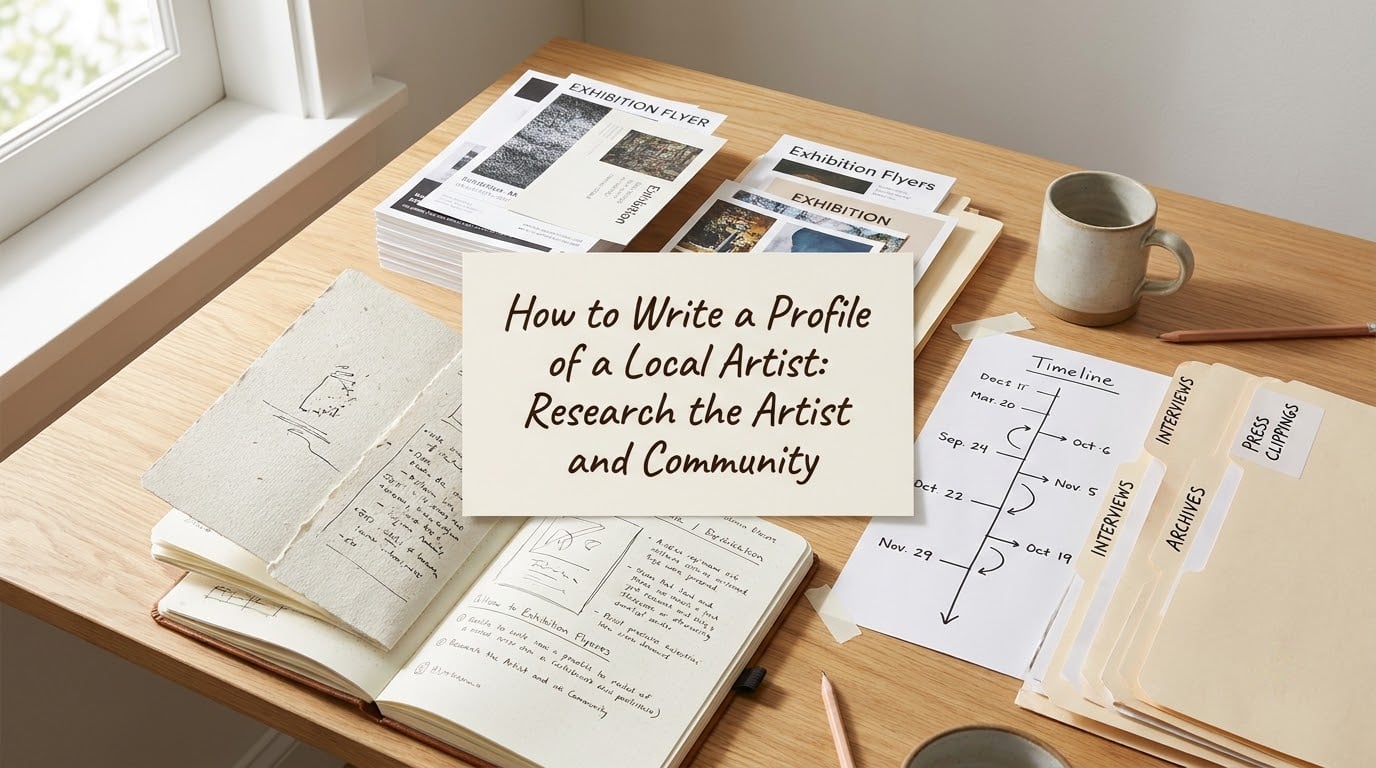
Start by writing one sentence that says why this artist, this month. Not because they won something, but because the work answers a question the neighbourhood is already asking.
Then read everything that already exists: the artist’s own website and social posts, gallery announcements, local press archives, exhibition catalogues, and interviews they have given other outlets. Read those other interviews mainly to find out what everyone asks, because repeating the same six questions is how a profile ends up interchangeable with everyone else’s.
Next, map the local scene. Which neighbourhoods have studios, which venues show work regularly, which community organisations run open calls, and what is changing around the artist. A profile that mentions the studio’s location and the rent pressure on that block says more about the local art scene than three paragraphs about the artist’s childhood.
Split everything into two lists as you go: confirmed facts, and things somebody claimed but nobody has documented. The second list is your interview agenda.
How to Write a Profile of a Local Artist: Prepare and Conduct the Interview
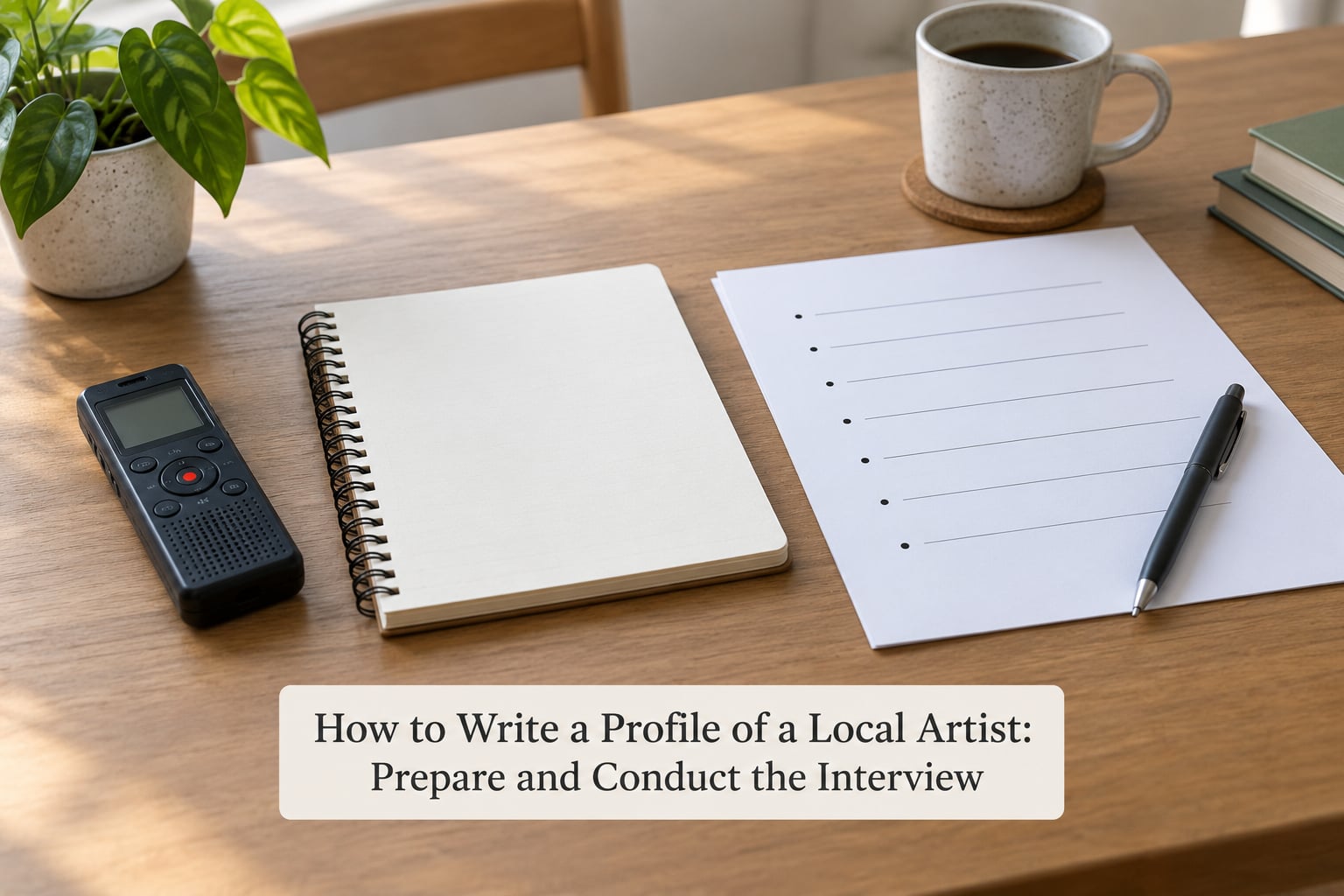
Turn your unconfirmed list into questions, then add open questions that let the artist set the priorities. Ten prepared questions plus room for the conversation to surprise you beats a scripted forty.
Group your questions by theme. On beginnings: what was happening in your life when you first made this kind of work? On process: what does a bad day in the studio look like? On place: how does the neighbourhood affect what you make? On influence: whose work did you look at until it stopped being an influence and became a voice? On the work itself: which piece in the current show would you defend hardest, and why that one?
The five C’s of interviewing are concrete, curious, concise, connected and closed. Concrete means asking about a specific piece rather than a general idea. Curious means following the answer instead of jumping to your next bullet. Concise means one question at a time, phrased in a few words.
Connected means linking each answer back to what they said before. Closed means ending properly: tell them when you will send the draft, how long they have to respond, and that a factual check is not a rewrite of their opinions.
Ask whether you may record, and say where that recording goes. Musicians and other working artists notice repetition fast, and the advice that circulates in industry forums is consistent: ask what nobody else asks, then stay quiet long enough for the real answer to arrive.
For an artist with no exhibition history, the awkwardness runs the other way. Self-taught makers often feel they lack the credentials to qualify, and some say so in the first ten minutes. Do not paper over it. Ask what they are trying to figure out, not what they have won.
How to Write a Profile of a Local Artist: Build the Narrative
Choose one organising approach and commit to it. The three-paragraph blueprint below is the one I return to, because it survives almost every subject.
| Paragraph | Purpose | Target length | Question it answers |
|---|---|---|---|
| Lede and introduction | Name, medium, location and the specific reason this person matters now | 50-80 words | Who is this and why should my readers care? |
| Practice | Materials, recurring subjects, how the work is made and what shapes it | 80-150 words | What do they make, and what goes into it? |
| Close | Confirmed details, then where and when to see the work | 40-70 words | What has happened, and what can I do next? |
Write the lede in the present tense with a concrete detail in the first sentence. A stack of unfinished vessels, a studio on the third floor of a building with a bakery downstairs, a series built from objects pulled out of the river.
Use dates rather than durations. Since 2019 stays accurate for a decade; for the past six years quietly expires. That single habit removes most of the errors I see in profiles that get republished years later.
Balance quotes with reported detail. Two or three pull quotes in a 400-word piece is plenty; more and the profile reads like a transcript. Trim quotes for length with ellipses, never for meaning.
Describe the work for someone who has never visited a studio. Say how large the pieces are, what they are made of, how many there are, and what the room feels like. Terms like site-specific or material investigation can stay, but only when you also explain what they mean here.
Match your length to where it runs.
| Length | Use case | What it can do |
|---|---|---|
| 50 words | Social post, event listing, studio announcement | Give one fact and one hook |
| 120 words | Gallery submission, newsletter intro, playlist or programme note | Cover medium, themes and one current project |
| 250 words | Community paper, arts council feature, podcast description | Add a short quote and where to see the work |
| 600 words and up | Magazine feature, standalone webpage, exhibition catalogue text | Carry scene context, process detail and a fuller close |
How to Write a Profile of a Local Artist: Draft, Fact-Check, and Revise
Draft from your notes, not from memory of the conversation. Put the artist’s words back exactly as they were said, including the sentence breaks, then cut the parts that do not carry meaning.
Here is the difference a lede makes. Weak: local artist Dana Reyes is a talented and emerging painter whose work has been gaining attention. Strong: Dana Reyes paints the same six-foot panel of corrugated steel every Thursday, and the last one leans against her studio wall in a hallway the width of her shoulders.
Neither version invents anything. The second one just lets a reader see the person, which is the entire point.
Now check every sentence against your fact list: spellings, titles in quotation marks, exhibition dates, award wording, venue names, quantities. Send the draft to the artist for a factual check, mark their corrections visibly, and accept the ones about facts. If they disagree with your characterisation, hear them once and then decide whether the characterisation is inaccurate or simply uncomfortable.
Let the piece sit overnight and read it aloud. Any sentence you stumble over needs shortening. Check that the headline, the caption and the pull quotes all say the same thing, and that the captions describe what the reader is actually looking at.
Common Mistakes
Eight failures account for most weak profiles I have edited. Each has a straightforward fix.
Starting with Generic Praise
Fix: Cut every adjective that could describe any artist anywhere. If a sentence works with an artist swapped out, it is not about your artist. Replace it with something you observed.
Turning the Profile Into a Résumé
Fix: Keep the achievements, but move them to the close and limit them to the two or three that mean something. A list of every exhibition since 2016 is a CV, not a profile.
Relying on One Source
Fix: The artist’s own website is a starting point, not verification. Confirm exhibition details against the venue, awards against the awarding body, and any claim about another person against that person’s own words.
Using Unverified Personal Details
Fix: If it came up in conversation and might affect how the artist is treated at work, at school or in the community, ask whether it is in. Honour a no, and honour a change of mind after publication without treating it as a betrayal.
Hiding the Work Behind Jargon
Fix: Explain the term once, in plain words, then use it. If you cannot explain a phrase a reader would not know, cut it.
Mismatched Quotes
Fix: Quote only what was said and check the transcript before trimming. When someone asks how to answer the inevitable tell me about yourself question, the honest answer is one specific thing that happened to them, which is exactly why the writer must not reshape it.
Skipping the Local Angle
Fix: Name the neighbourhood, the venue, the community organisation and the audiences that already show up. That is the part only you can report.
Writing About Queer Artists Carelessly
Fix: Use the artist’s own words and correct pronouns for their identity, keep the focus on the work, and check what is already public before adding any detail that could out someone who has not chosen to be public. Accurate naming is not a stylistic preference; it is basic accuracy.
Frequently Asked Questions
How long should a local artist profile be?
For a newsletter or community paper, 250 to 400 words is the useful range. Shorter works for social posts and event listings, where 50 words is plenty. A full magazine feature needs 600 words or more to carry scene context and process detail. The length should follow the venue, not the length of the interview transcript.
How do I write a profile for an artist with no exhibitions or awards?
Write about practice, place and process instead of credentials. Ask what they are trying to figure out, how they learned, what the neighbourhood means to the work, and where they are showing informally. Self-taught artists often feel unqualified in the first minutes of an interview, so treat that hesitation as material rather than a problem to route around.
What are good interview questions for an artist?
Ask about a specific piece, a specific obstacle and a specific place. Questions like which work in the current show they would defend hardest, what a bad studio day looks like, and how the neighbourhood shapes the work produce concrete answers. Avoid anything already answered on their website or in a previous interview.
Can I record an interview and quote from the recording?
Ask permission to record before you press the button, and ask separately before publishing any quote from that recording. Say where the audio will be stored and when it will be deleted. Artists have a reasonable expectation that a conversational aside stays off the page, and a recording you did not have permission to make is a bigger problem than a clumsy quote.
How do I describe an artist’s work for readers who know nothing about art?
Describe size, material, count and setting first, then the theme. Say how large the pieces are, what they are made of, how many fill the room, and what it feels like to stand in front of them. Add any technical term only when you explain it in plain words in the same sentence.
Conclusion: Start With One Clear Story
Writing a profile of a local artist comes down to three habits: research far enough to ask a sharp question, interview without rushing to the next item on your list, and cut every sentence that could describe anybody.
Start with one clear story and one specific reason this artist matters right now. Write that sentence before you request the interview, build your questions around it, and let the piece end with where the work can be seen.
2026 is a good year to do this. Small presses, community papers and arts newsletters are still short of profiles of the people whose work their readers pass every day, and the gap is easy to fill.