
An employee resource group (ERG) is an employee-led, company-supported community built around a shared identity, lived experience, or professional interest, created to build belonging, offer support and development, and give people a collective voice on workplace issues. Learning how to start an employee resource group takes less time than most people expect: most first meetings happen within eight to twelve weeks of a first conversation, and almost none of that work needs a budget or a headcount.
I have watched groups launch in places with 30 employees and in multinationals with thousands. The ones that survive the first year are rarely the flashiest. They are the ones with one clear sentence about why the group exists, a handful of people who actually show up, and a sponsor who will answer a message. That is the whole formula, and it fits on one page.
Below is the process in seven steps, the materials you need before you start, and the mistakes that quietly kill groups in their first six months.
Table of Contents
- What You Need
- Step-by-Step: How to Start an Employee Resource Group
- Step 1: Define the employee resource group’s purpose and name
- Step 2: Find a sponsor and founding members
- Step 3: Create a lightweight charter
- Step 4: Plan the first three months
- Step 5: Recruit members inclusively
- Step 6: Launch with a useful first event
- Step 7: Review impact and keep improving
- A first-90-days timeline that actually fits
- Common Mistakes
- Frequently Asked Questions
- Do I need company approval to start an employee resource group?
- What should an employee resource group include in its mission statement?
- How do I keep an ERG confidential while still being visible?
- How much time should members commit to an employee resource group?
- How do I measure whether an ERG is making a difference?
- Can an ERG start without a senior leader as its sponsor?
- Start With One Clear Purpose
What You Need

Everything below fits into a single folder. If you can gather these eight items, you are ready to schedule a first meeting.
- A one-sentence purpose. The problem this group exists to solve for members, in plain words. Not a slogan.
- A sponsor or an approving partner. One person with enough standing to say yes to a calendar invite and a mailing list.
- Three to five founding members. People who will show up to the first two meetings, not just the announcement.
- A one-page charter. Mission, membership, leadership, meeting cadence, privacy rules, and how decisions get made.
- A three-month calendar. Meeting dates, not vague intentions. Dates you can hold.
- Communication channels. One internal channel people can actually read, plus a way to reach people who do not use it.
- An accessible meeting plan. Room, time, format, and how someone takes part without speaking out loud.
- A feedback method. A short anonymous survey after each gathering. Five questions is enough.
That is the whole list. A logo, a branded template, and a launch party can come later, and honestly some groups never need them.
Step-by-Step: How to Start an Employee Resource Group
Step 1: Define the employee resource group’s purpose and name
Write one sentence that names the community and the need. A good version sounds like: “This group gives transgender and non-binary employees a place to build community, get practical support, and raise workplace concerns with a collective voice.”
Then draw a line between three things people often blur together: social connection, professional development, and advocacy. Most groups start in the first two and only add the third when members are ready and the sponsor agrees.
On naming, pick something members recognize and outsiders can understand. A Pride group called something long and acronym-heavy reads like a federal program. Ask three people who would not be in the group whether they could repeat the name after hearing it once.
How do you know it worked? A stranger can tell, from your one sentence, who the group is for and what changes because it exists. If they cannot, keep rewriting.
Step 2: Find a sponsor and founding members
Approach the sponsor with a problem and a small ask, not an idea and a big one. “Five people have told me they are tired of explaining their pronouns to the same teammates every quarter. I want to run one 45-minute session a month and write down what comes up.” That is easy to say yes to.
Look for someone who is supportive in public and reachable in private. A sponsor who attends a launch and then vanishes is worse than no sponsor, because members notice.
For founding members, aim for three to five and choose for reliability rather than seniority. Your founding group should include at least one person who joined the company in the last year, since that perspective is easy to lose later. Popularity is not the same as commitment.
Step 3: Create a lightweight charter
The charter is where most founders overbuild. One page is enough, and it should cover nine things: mission, who can join, leadership roles, meeting cadence, communication norms, how decisions are made, privacy rules, inclusion expectations, and when the group reviews itself each year.
The privacy clause matters more than founders expect. State plainly that what is said in the group stays in the group, that no one is required to share personal experiences, and that the group does not act as a substitute for HR when someone needs a formal channel.
The inclusion clause should say who may participate. Identity-based groups often allow allies with a clear role and expectation. Spell out what that expectation is, or you will get the same argument every year.
Step 4: Plan the first three months
Pick a meeting rhythm you can keep. Monthly is more sustainable than weekly for volunteers. Then fill three months: one launch gathering, two working sessions, and one session that gives something back to the company, such as a mentoring hour or an onboarding buddy signup.
Assign an owner to every item. The person who books the room is not the person who writes the follow-up note, and the person who collects feedback is not the person who designs the next agenda.
Reserve space that works for people with mobility needs, and pick a time that does not always land on the same shift or the same people. Remote attendance should be an option from month one, not an afterthought after someone moves teams.
Step 5: Recruit members inclusively
Describe the group in terms of what members get, not what the group stands against. Invite by describing a real session: “Come for 45 minutes to swap notes on how to handle a coming-out conversation with your team.” Attendance goes up when the invite names an activity instead of a value.
Share through channels the community already reads, plus your sponsor’s channels, plus a real conversation with people who do not use internal social tools. Not everyone who would benefit is in a Slack channel, and that pattern is where groups accidentally end up monocultural.
Make joining low-pressure. Say that people can attend before they commit to anything, that first-timers get a sentence of context before each meeting, and that nobody has to disclose anything about themselves to participate.
Step 6: Launch with a useful first event
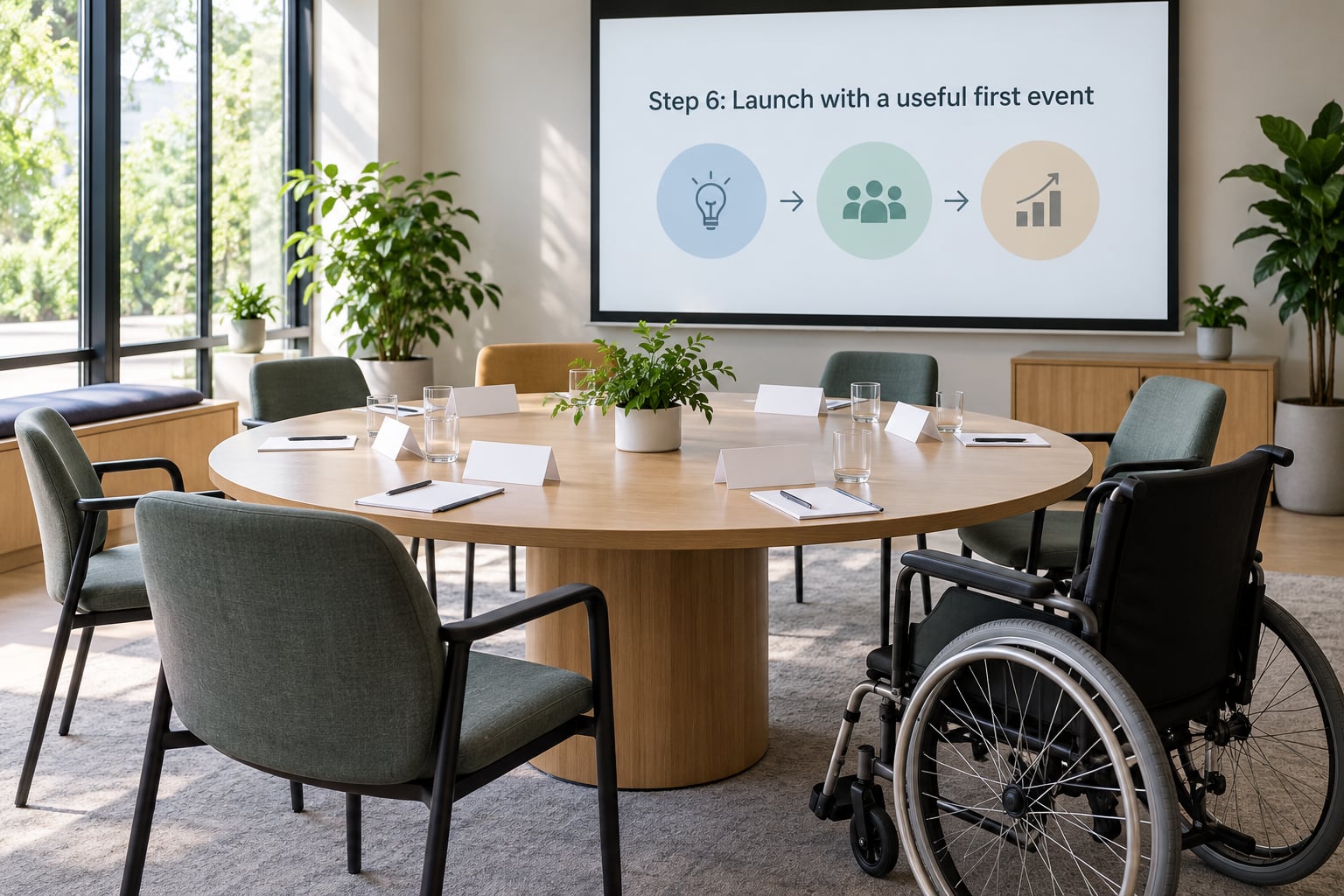
Give the first gathering a three-part agenda and keep it inside 45 minutes: five minutes on what the group is for, twenty-five minutes on one topic members picked in advance, and fifteen minutes on what happens next.
Write a short welcome you read out loud. Say the group’s purpose, the ground rules, how people can pass on any question, and where the anonymous feedback form lives. It sounds obvious. It is the moment that decides whether first-time attendees come back.
Offer three ways to take part: speaking, writing questions on a shared board, and listening. Nobody should have to disclose a personal experience to be included in the room.
Send a follow-up note within a day listing what was said, what was decided, and the date of the next meeting. Then close with one feedback question: would you come back, and what should change?
Step 7: Review impact and keep improving
Once a quarter, pull five numbers: how many people attended, how many joined, how many came to a second meeting, how many actions you completed, and what members asked for more than once. Add one qualitative note from your survey answers.
The second-meeting number is the one that predicts survival. A big first crowd that does not return usually means the invite promised one thing and the room delivered another.
Write down what worked before you forget. Keep the agenda format, keep the room booking habit, keep whatever made people talk in the first ten minutes. Then change one thing for next quarter, not five.
A first-90-days timeline that actually fits
- Weeks 1 to 4: purpose sentence, three to five founding members, sponsor conversation, first draft of the charter.
- Weeks 5 to 8: charter approved, three months of dates booked, communication channel set up, anonymous feedback form ready.
- Weeks 9 to 12: launch gathering, first working session, follow-up note out, first quarterly numbers pulled.
- Month 4 onward: monthly rhythm, one action completed per quarter, annual charter review on the calendar.
Common Mistakes
Writing a mission that says nothing. “To foster belonging and inclusivity across the organization” could belong to any group at any company. Name the people and the problem, and you will get more members in the first month.
Promising things HR has not agreed to. Funding, paid hours, and policy changes are not yours to announce. Offer proposals, not declarations.
Leaving leadership out of the room early. A sponsor who learns about the group from an announcement will feel ambushed and will usually pull back. Bring them in before the launch, not after.
Booking an inaccessible event. One room, one bad time, one format with no written option, and the people you most wanted in the room are the ones who cannot get there. Fix this before you promote anything.
Collecting sensitive information. Do not keep a list of who is LGBTQ+, who has a disability, or who is on medication. If the group needs to understand its own membership for programming, anonymous options work fine.
Becoming a one-person group. If one organizer does all the work, the group dies when that person changes roles. Share the roles in writing from month two, even if the people are informal about titles.
Stalling forever in the approval queue. When a request to HR goes quiet, follow up once in writing, then take it up through your sponsor. If a company has quietly stopped supporting groups, that is worth knowing early, and your charter and cadence will survive it better than a group with no structure.
Frequently Asked Questions
Do I need company approval to start an employee resource group?
Not legally, but practically yes. An ERG usually needs a company email list, a calendar invitation, a room, and occasionally a small budget, so getting a manager or HR partner on board early avoids building something you cannot use. Plenty of groups start as an informal monthly lunch and formalize later once attendance proves there is real interest. What matters is that no one is required to participate and that membership stays voluntary.
What should an employee resource group include in its mission statement?
Keep it to one or two sentences that name the community, what members get, and where the group fits alongside HR. Something like a place to connect, a route to development and mentoring, and a way to raise workplace concerns collectively. Avoid mission statements long enough to need a lawyer. If a reader cannot tell who the group is for after one reading, rewrite it.
How do I keep an ERG confidential while still being visible?
Separate the two goals. Visibility means members can find the group, the dates are public internally, and leadership knows it exists. Confidentiality means what is said inside a meeting stays there. Put the privacy rule in the charter, say it out loud at the first gathering, and never use the group to share identifying details about individual members. Members disclose as much or as little as they want.
How much time should members commit to an employee resource group?
Monthly gatherings of 45 to 60 minutes, plus an hour or two between for people who help run them, is a realistic rhythm for volunteer-led groups. Weekly formats work when the work is time-boxed and the employer counts it as work. Ask your sponsor how meeting time will be treated on a timesheet, and be explicit about what you expect from members so nobody quietly accumulates a second job.
How do I measure whether an ERG is making a difference?
Track five things each quarter: attendance, new members, repeat attendance, actions completed, and the requests members make more than once. Add one short anonymous survey with two questions. Numbers matter less than the story around them, so write three sentences at each review describing what a member said the group changed for them. Share that summary upward, because sponsorship grows when leaders see evidence rather than activity.
Can an ERG start without a senior leader as its sponsor?
Yes, though it is harder. Start small and informal, keep the cadence light, and build the record of participation first. Then approach potential sponsors with evidence instead of an idea. A manager, a department head, or even a long-tenured peer who advocates upward can fill the role early. Treat the sponsor as someone who opens doors rather than someone who runs the group.
Start With One Clear Purpose
Here is the shortest version of everything above. Write the one-sentence mission. Find two or three people who will actually show up. Ask one person with standing to be your sponsor, with a small, specific ask. Book one low-pressure 45-minute session in an accessible room at an hour that is not always yours. Then expand the calendar only after that first session has a second one.
Groups do not fail because the idea was wrong. They fail because the idea stayed in a document. Put a date on the calendar this week.