
How to decide whether to go home for the holidays takes about ten minutes, a pen, and an honest list of what the trip actually costs you. There is no universal right answer. The choice turns on a small number of checkable factors, and the only hard gate is safety. Everything else is a comparison you can actually score.
The calendar does not owe you a visit. What follows is a six-step process that gets you to a decision you can defend, a way to say it out loud, and a plan for whichever branch you pick.
Table of Contents
- What You Need Before Deciding
- Step-by-Step: Make the Decision Without the Pressure
- Common Mistakes and How to Fix Them
- Frequently Asked Questions
- What if I am not sure whether to go home for the holidays?
- How do I say no to family expectations without causing conflict?
- Should I spend the holidays with biological family or chosen family?
- What should I do if I do not feel physically or emotionally safe at home?
- Can I decide to go home for the holidays at the last minute?
- Conclusion
What You Need Before Deciding
Gather the raw material first. Deciding in the abstract is guessing; deciding with specifics is arithmetic.
- The exact dates, including travel days on both ends.
- What the trip costs you in money, and in hours of travel each way.
- Any work, school, childcare, or care-for-a-parent obligations that land in that window.
- Who has actually invited you, and who you would enjoy seeing.
- Health needs, accessibility, medication, and whether anyone can cover them where you would be.
- Emotional energy. Be honest about your reserves, not your intentions.
- Safety concerns: physical, social, or identity-related.
Write it down rather than keeping it in your head. The point is to see the whole shape of the trip at once instead of the loudest worry about it.
Two details catch people out more than they expect. The first is the week on either side of the trip, which is usually where the exhaustion lives. The second is that costs multiply: one round trip is manageable, and three of them at holiday rates is a different conversation. If money is the deciding factor, run the numbers before you argue with yourself about it.
Also ask who else is coming. The same house feels completely different depending on whether it is your aunt and her two polite kids or six hours of relatives who want to debate things. A gathering where you would spend most of the time on edge is a very different plan from one where you would genuinely be glad to be there.
Step-by-Step: Make the Decision Without the Pressure
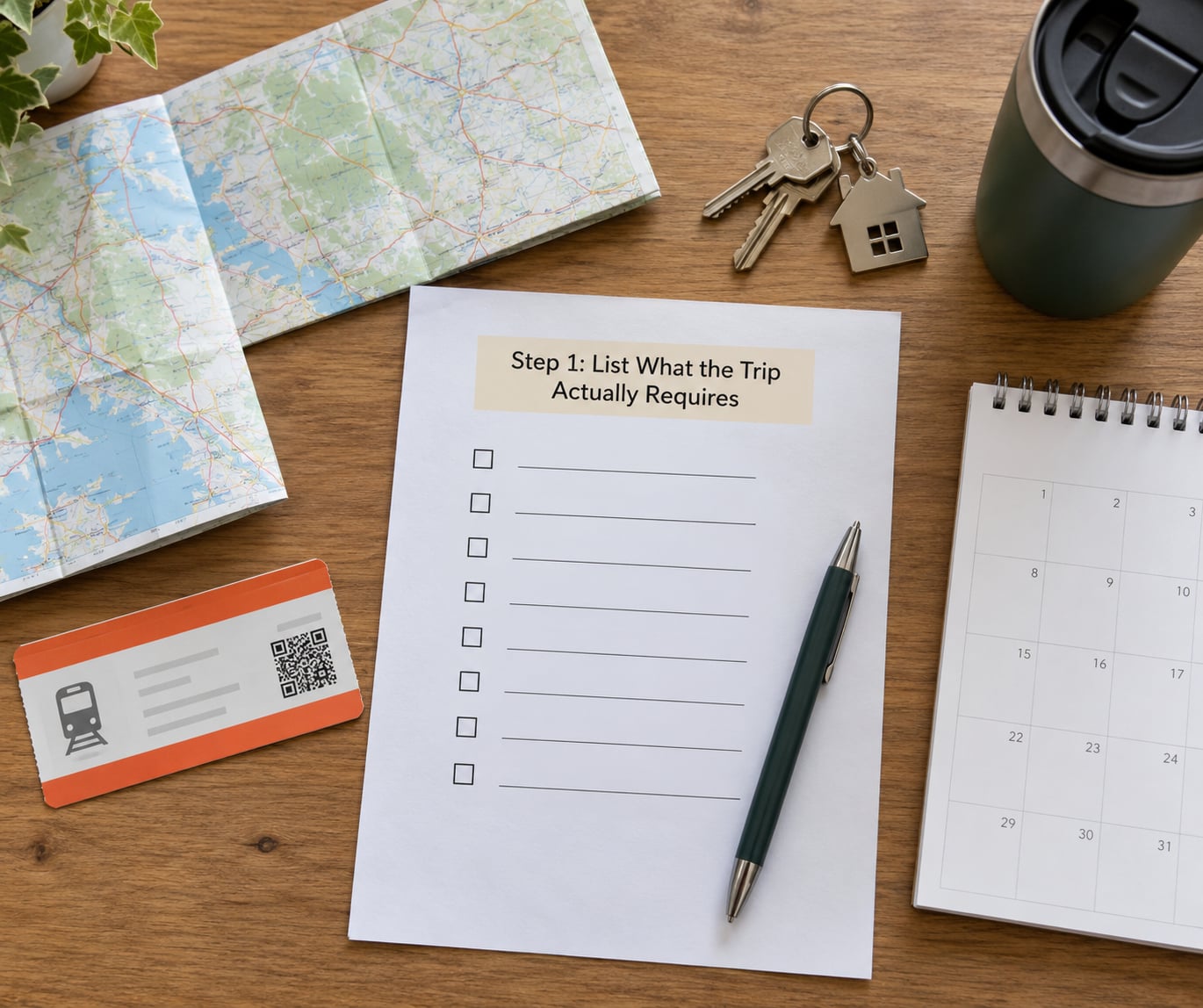
Step 1: List What the Trip Actually Requires
Build a logistics list, not an idealized version of the holiday. Travel time, transportation, lodging, food, gifts, childcare, accessibility, and work or school conflicts all belong on it.
It worked when the list reads like a project plan rather than a scene from a movie. If the real total is two days of transit, you know something you did not know this morning.
Step 2: Identify What You Need to Feel Safe and Welcome
Separate genuine needs from assumed ones. Physical safety, alcohol and food boundaries, a room you can lock, chosen-family support, rest, privacy, accessible facilities, and access to affirming healthcare or transportation are all legitimate requirements.
Safety is a constraint, not a preference, and you do not owe anyone a negotiation about it. In r/AskGaybrosOver30, readers describe the anxiety as anticipatory — it starts weeks before travel, which is a signal, not a character flaw.
Step 3: Check Your Emotional Capacity
Ask what the trip would actually ask of you: performing cheerfulness, sitting through a relative’s political rant, being misgendered for three days without a good exit.
Would attending bring connection, rest, obligation, or repeated strain? Be careful with the last one. If you go once more hoping it will be different, that is a pattern, not a plan.
Step 4: Compare Going, Staying, and Splitting the Holiday
Put three columns on paper: go, stay, split. Under each, write who you would see, what the days look like, what it costs, and how you expect to feel on the fourth day.
Include the middle paths in the third column. A two-night visit, a different week, a solo trip, a video call, or hosting your chosen family locally are all legitimate options, not consolation prizes.
Some of these are more common than people think. A top-ranking r/christmas thread on the topic is full of adults in long-distance relationships who stopped the annual trip after a decade or two, and the reason is almost never logistics. It is that the trip stopped being rest. A commenter in the same thread describes skipping the holiday and telling nobody, which is allowed, quiet, and works for plenty of people.
Try the fourth-day test on each column. Picture yourself on day four: bored, slightly overfull, deciding whether to stay for one more dinner. Which version of that day would you rather have? Your answer usually settles it faster than more thinking does.

Step 5: Make the Decision and Stop Rebooking It
Find the deciding factor. Usually it is one thing: a safety concern, an impossible schedule, or a genuine wish to see someone specific.
Test the choice against your nonnegotiables. Then pick a confidence level. Certainty is rare and not required — a decision made at 70 percent confidence that you act on is worth more than a 95 percent decision you keep re-litigating.
Step 6: Communicate Your Choice and Make a Backup Plan
Say the decision first, then the reason, then an alternative. Keep it short. A neutral line that works: “I’ve decided we’re not traveling this year. I love you both, and I want to spend a quieter holiday. Can we do a call on the 24th?”
Confirm the practical arrangements, and name a fallback for if the visit or the non-visit becomes unworkable — an extra night, an earlier departure, or a friend you can call.
Three tones, depending on how much you want to negotiate. Warm, if the relationship is worth the effort: “I have been thinking about this all year and I’ve decided not to travel. I love you, and I want a low-key holiday. Let’s do a long call on the 24th.” Brief, if explanations will turn into a debate: “We’re not coming this year. I wanted you to hear it from me first.” Final, for pressure that has already happened more than once: “I hear that you’re disappointed. My decision isn’t changing, and I would rather talk about February than keep having this conversation.”
Say the decision before the explanation. It is the single change that makes these conversations shorter.
Common Mistakes and How to Fix Them
Overpleasing to keep the peace
You go to avoid an argument you would win. Fix: ask whether the argument is actually about the holiday. Usually it is about guilt, and guilt is not a logistics problem.
Letting guilt decide
Holiday guilt usually arrives through comparison — a cousin who went, a sibling who called every year. Fix: name the mechanism out loud. It stops feeling like truth the moment you can label it.
Comparing your best holiday to their worst one
You are measuring your worst year against someone’s memory of a good one. Fix: compare the same holiday to the same holiday, year over year.
Ignoring safety
Treating a hard constraint as a preference is how people get hurt. Fix: if the safety gate fails, everything else is irrelevant.
Spending past what the trip can carry
Fix: set the number before you book anything, and treat going over it as data, not failure.
Treating someone else’s disappointment as proof
Disappointment is a reaction, not a verdict. Fix: ask whether the people you’d be disappointing would still want you there if you came miserable.
A few tips that help more than they sound: decide before you discuss it, so the conversation informs rather than steers. Write the choice down, because you will re-litigate it in your head at 2 a.m. Tell one supportive person first. And give notice early — most of the pain lands in the surprise, not the absence.
Plan for the other side too. A quiet apartment in late December has its own risks, and pretending otherwise makes a good decision feel like a mistake by day three. Put something on the calendar before you make the announcement: dinner with friends, a night at the theatre, volunteering on a shift, a trip somewhere you do not have to celebrate anything. The readers who handle a non-visit best are the ones who planned it as an event rather than an absence.
If safety is the factor and you are not sure what support exists, The Trevor Project runs a crisis line for LGBTQ young people, and the 988 Suicide and Crisis Lifeline answers to anyone, any time. Center on Halsted and PFLAG are established Chicago and national resources for LGBTQ families and friends. This article is informational and is not affiliated with any therapy practice or booking service.
Frequently Asked Questions
What if I am not sure whether to go home for the holidays?
Uncertainty usually means the logistics are still vague, not that you lack conviction. Finish Step 1 and Step 2 first: write down the real cost, the travel time, and what you need to feel safe. Those three answers resolve most of the doubt on their own. If you still feel torn, that is a legitimate reason to choose a middle path such as a shorter visit or a different week.
How do I say no to family expectations without causing conflict?
State the decision before the reasoning, keep the explanation short, and offer one concrete alternative such as a call or a visit in February. Most conflict comes from ambiguity, not from the no itself. Expect some disappointment and let it be theirs to manage: you are not responsible for managing your parents’ emotional needs as an adult child.
Should I spend the holidays with biological family or chosen family?
Both count, and the comparison is about wellbeing rather than biology. Chosen family is still family. Ask which setting leaves you more rested and less on guard after four days. Some readers host a chosen-family gathering in Chicago and visit relatives for one meal, which gets both without pretending the whole week is going to be easy.
What should I do if I do not feel physically or emotionally safe at home?
Treat it as a constraint rather than a preference and do not negotiate it. Consider a shorter visit, a hotel nearby, arriving late and leaving early, or not going at all. If you are in immediate danger, contact the 988 Suicide and Crisis Lifeline or emergency services. The Trevor Project also offers confidential support for LGBTQ young people.
Can I decide to go home for the holidays at the last minute?
Yes, but late decisions are usually logistics rather than feelings. Check whether flights, trains, and lodging are still workable and whether anyone is expecting you. Tell people quickly and plainly, without a long explanation, since short notice lands harder. If you decided to stay at the last minute, treat the decision as final so the season does not turn into a week of renegotiating.
Conclusion
Start with the nonnegotiables. Write down what you need to feel safe, what the trip genuinely costs in money and hours, and what the fourth day would feel like. Then compare that against staying, and give the middle paths a fair look before you rule them out.
Whichever option you pick, say it plainly, name an alternative, and treat the decision as final. A calendar date does not oblige you to spend time with people who make you miserable, and nobody else gets a vote on whether you come away whole.