A queer game night is a board game or card game gathering built for LGBTQIA+ players and allies, where the host picks games that treat queer identities with respect and sets ground rules that let anyone join, pass, or bow out without making a scene. Learning how to host a queer game night is mostly logistics: pick a format, curate a short game list, send expectations ahead of time, and set up a room people feel comfortable in.
The whole thing takes two to three hours of actual play and about an hour of prep. I ran a monthly version of this for years in a living room, and the difference between a good night and an awkward one almost never came down to the games. It came down to whether people knew what was going to happen before they walked through the door.
Below is the plan I use, in the order I use it.
Table of Contents
- What You Need to Host a Queer Game Night
- Step-by-Step
- Common Mistakes
- Frequently Asked Questions
- What are some LGBTQIA+ friendly games for a game night?
- What games should I avoid bringing to a queer game night?
- How many games should I bring if I do not know how many people will show up?
- Can allies host a queer game night?
- How do I handle alcohol and sober guests at the same table?
- How do I explain rules without making new players feel singled out?
- Conclusion
What You Need to Host a Queer Game Night
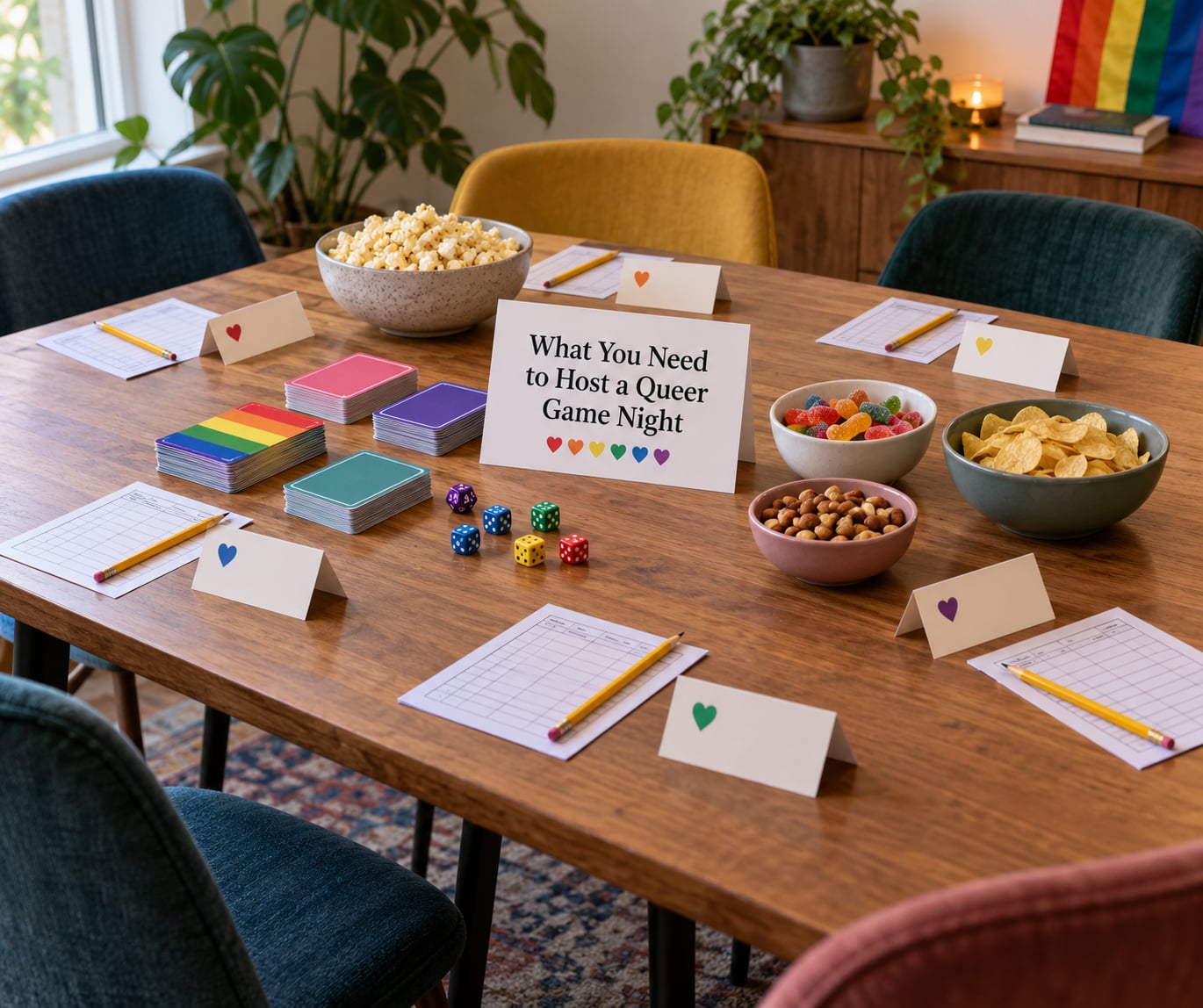
You need far less than most people expect. A living room works. What matters is the set of decisions you make before anyone arrives, because each one removes a reason for a guest to feel like an outsider.
- A guest list and a number. Pick a target headcount before you invite anyone. Five to eight people is comfortable, and a hard ceiling above ten means splitting the room into tables. People answering an invitation tell you how many games to plan for, not how many people they hope show up.
- Four to six games, not twelve. Pack a short list plus one backup and one known-bad-free option you can teach in two minutes. Everything on that list should be playable in under an hour.
- A space with clear table space. One main table if the group is small, two if you are over eight. Leave a path to the restroom and to the door that nobody has to squeeze past a seated player to reach.
- Food and drinks with real choices. At least two non-alcoholic options that are as easy to grab as the alcoholic ones, and labels on anything that contains nuts, dairy, gluten, or alcohol.
- Name-based supplies. Sticky notes or index cards for name and pronouns, a pen by each seat, score pads, pencils, and a bowl of markers. Let people write rather than announce.
- Transit and restroom information. Send it with the invitation, not at the door: where to park, which transit stop is closest, and whether there is an all-gender restroom. If there is not one, say that clearly so nobody has to ask.
- An accessibility note. One step-free route in, seating that is not fixed, and a quiet corner away from the main table for anyone who needs a break.
- A plan for leaving early. Tell guests they can leave whenever they want without explaining. Nothing on your invitation should make an early exit feel like a social failure.
Step-by-Step
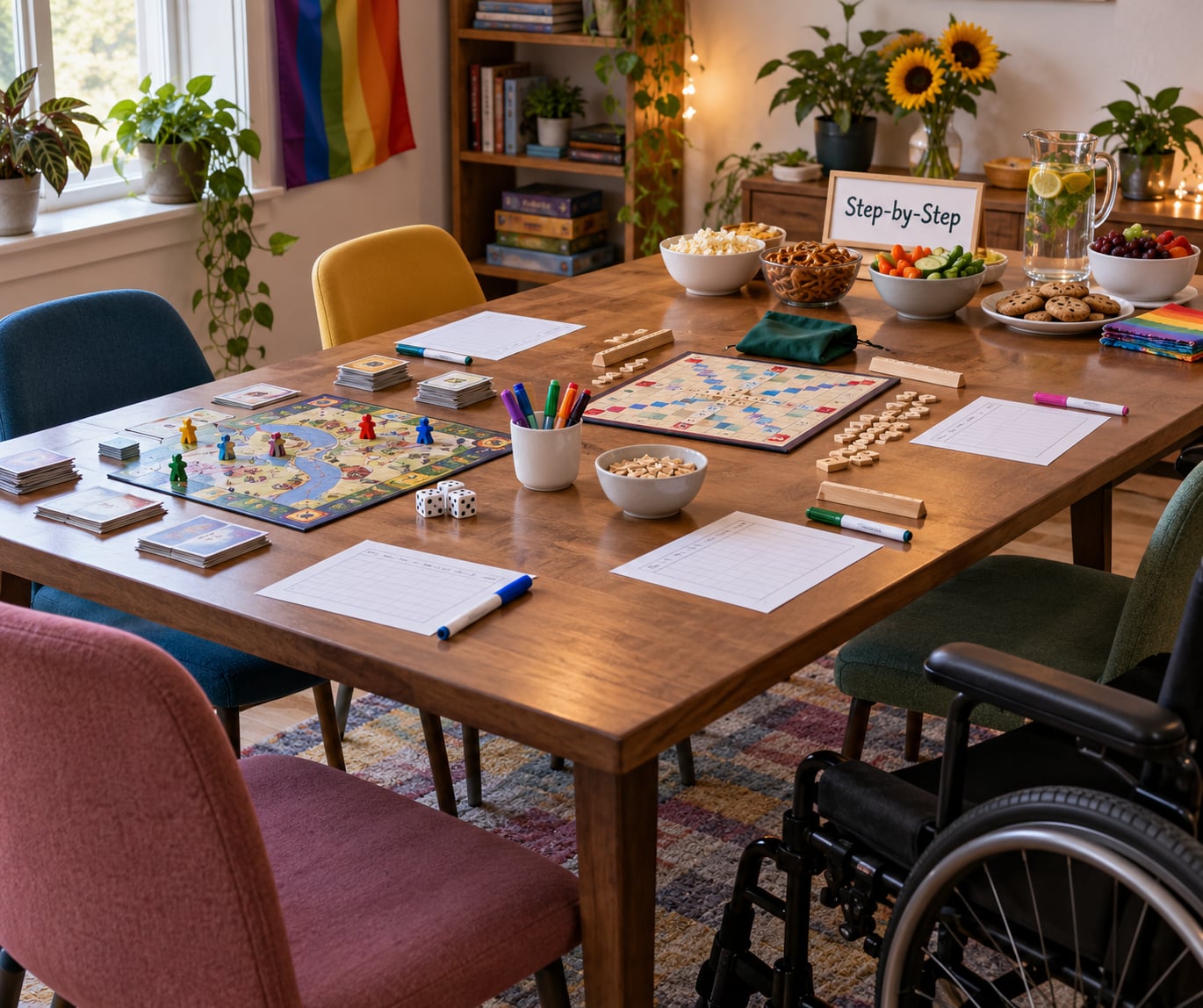
Plan How to Host a Queer Game Night for Your Group
Start by choosing the format, because the format decides everything else. Party games move fast and forgive mistakes. Cooperative games keep the room on one side and punish nobody. Strategy games reward people who already play. Trivia is the easiest night to run alone.
Match the format to three things: how many people are coming, how much energy they have, and how comfortable they are with competition. A group of six first-timers at a table of eight-player strategy games is a rough night. Six people who play every week will get bored by two rounds of a drawing game.
Thread after thread on r/boardgames keeps landing in the same place: three to six players is the sweet spot where a host can still watch the room. Past that, split into tables and give each table its own rules reader. If you are solo, do not plan a single table of twelve. Plan two tables of six and put yourself in the middle, where you can move between them.
Choose Games That Fit the Group
Build a spread rather than a specialty. One game that teaches in a minute, one that rewards strategy, one with theme, and one that needs no reading at all covers nearly any room.
Here is a shortlist that works well for this kind of gathering. Player counts and timings tell you how much of the evening each one eats up.
- Codenames — 4 to 8+ players, 15 to 30 minutes. Two teams, constant talking, zero elimination, easy to teach in two minutes.
- Wavelength — 2 to 10 players, 30 to 45 minutes. Guesses a target word from a one-word clue; pairs and self-play options keep uneven groups comfortable.
- Tsuro — 2 to 8 players, about 30 minutes. Tile placement with almost no rules overhead, a great warm-up for new players.
- Diamant — 3 to 8 players, about 30 minutes. Push-your-luck treasure game, short, and the tension stays light.
- Dixit — 3 to 8 players, about 30 minutes. Beautiful cards and soft artwork, low aggression, works at mixed experience levels.
- Carcassonne — 2 to 5 players, about 45 minutes. Tile laying with no player elimination; steady, familiar, easy to drop into late.
- Hues and Cues — 2 to 8 players, 20 to 30 minutes. The two-part hint mechanic gives quieter players a real role instead of a spectator seat.
- Telestrations — 4 to 8 players, 20 to 30 minutes. Drawing and guessing, funny without ever needing anyone to disclose anything.
- Exploding Kittens — 2 to 10 players, about 20 minutes. Short rounds, lots of laughing, and no one is ever out for long.
- Queerz! — up to 15 players, 20 to 30 minutes. An explicitly queer party game built for a large group and rapid rounds.
- The Queer Agenda — 5+ players, 30 to 60 minutes. Fill-in-the-blank card game written for queer players, works as a mid-evening round.
- Rainbow Quest — 2 to 5 players, 30 to 60 minutes. Rainbow-themed roll-and-write game, quiet and self-contained, works for small tables.
- Pride or LGBTQ+ trivia — any number of players, 30 to 45 minutes. Easy to run solo, and phone voting means nobody is stuck holding a buzzer.
Screen anything you have not played before. Read the box, read the reviews, search the title with a couple of terms that would turn up discriminatory content. Red flags are usually obvious once you look: punchline cards built around a slur or a stereotype, a whole party game built on deodorant or kitchen-sink jokes aimed at trans people, a social deduction game where the traitor is always the same gender, or art that leans on a slur as an aesthetic.
Two red flags deserve an automatic no. Anything that makes queerness the joke, and anything where a player’s deck has to be manually swapped or edited to get past the content. If a game needs a mod to be playable in your room, bring a different game.
Queer-themed games are worth having on the table, but they are not the whole plan. A room of eight people needs options that a straight ally or a brand-new player enjoys as much as anyone else, and that is true of themed games too.
Set Welcoming and Consent-Based Expectations
Send your expectations in the invitation, not at the door. A short block of text that everyone reads at home does more than a fifteen-minute speech over snacks.
Keep it to five points: use the name and pronouns you are given, and share your own first; anyone can pass on a turn, skip a role, sit out a round, or change the subject; no means no on the spot and no one owes an explanation; no photographs without asking everyone in the frame first; and anything said here stays here unless the person says otherwise.
Model it. If you introduce yourself with pronouns at the start, guests who want to share theirs have a template. It takes about ten seconds and it changes the tone of the entire room.
Make opting out frictionless. Agreeing to a rule is not permanent consent, so treat a change of mind as normal rather than as a big conversational event.
Prepare the Space, Food, and Supplies
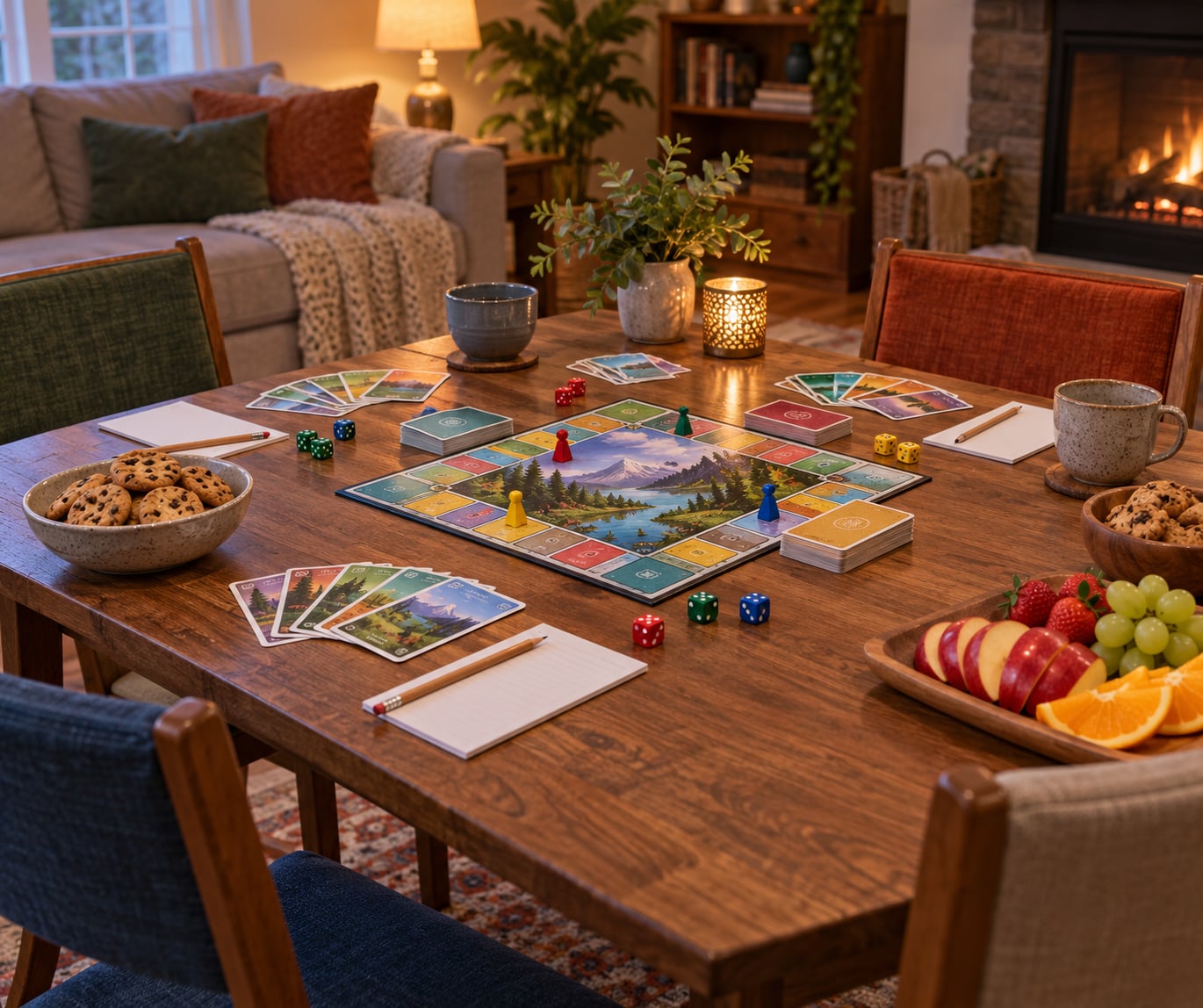
Push tables together so everyone can see the board, and keep seats at even intervals so nobody is stranded at the head. Bright overhead light makes people tired and a little exposed, so aim for a warmer lamp or a string of lights over the table. Keep music low enough that people can hear each other across a six-foot table.
Put snacks within reach of the seats but away from the playing surface. Anything that is grabbed with greasy hands is going to end up on a card, and a sticky card ends a round early. Tray-based snacks solve most of this.
Reserve one chair spot as a genuine exit rather than an afterthought. Someone who wants to step out of a loud table should be able to walk to a chair in another room without explaining why.
On drinks, the test is simple. Would a sober guest have to ask for something, or could they just pour it? Make the non-alcoholic option the same shape as the alcoholic one. A pot of the good coffee and a bottle of something cold sitting next to the beer does the work for you.
Explain the Games and Keep the Energy Welcoming
Teach one game well instead of five badly. Read the rules out loud in a minute, then play a throwaway demonstration round with the host reading their own hand badly on purpose, so that mistakes look normal.
After the demo, ask one person to restate a rule. If they cannot, someone else did not get it either. Assign a rules reader per table if you have more than one, and make it an explicit job so nobody volunteers by accident and then runs the game badly all night.
Watch the room rather than the board. The most common derailment is not a rules problem, it is a table that turns into a pile-on over several rounds, or one very loud guest setting the volume for everyone else. Step in with something neutral. Announce a switch to another game, call a snack break, or move the whole room to a different format. Interrupt early and lightly; a long quiet word at the end of the night does nothing for the person who already spent it sitting out.
End the Night with Connection
Give the last fifteen minutes a shape. A final round that everyone can win, then a soft landing where people are just talking. A recurring series lives or dies on this part, because it is where people decide whether to come back.
Before people scatter, check that you have everyone’s game, phone, and coat. That sounds trivial until the night someone leaves with somebody else’s deck.
On contact details and photos, ask rather than assume. Offer a sign-up sheet or a link for the group chat, and skip the group photo unless everyone in the frame says yes. If you take any, keep them for the people who were in them.
Say what happens next while the room is still warm: the next date, and how new people can get on the guest list.
Common Mistakes
Only bringing loud party games. A room of high-energy games with no quiet option excludes people who are tired, hungover, autistic, or simply done. The fix is one game per energy level, and one that can be played mostly in silence.
Saving the ground rules for the night itself. Consent and naming conventions do not work as an opening speech, because nobody has relaxed yet. The fix is sending five lines with the invitation, then reinforcing them once out loud when people arrive.
Filling the whole evening. Five consecutive games makes the night feel like a tournament. The fix is two or three games with a real break in the middle, and a plan to let a fourth happen only if the room asks for it.
Assuming everyone drinks. Alcohol-only hosting quietly sidelines sober guests, who then leave early or stay in the kitchen. The fix is non-alcoholic options in the same location, in the same quantities, without anyone having to request them.
Skipping accessibility. A fixed seating plan and a single narrow route through a room can end someone’s night in the first five minutes. The fix is to walk your own route before guests arrive and to reserve a chair near an exit.
Letting friend groups clump at the table. Four people who already know each other will settle in together and quietly turn the night into a private party. The fix is mixed seating you assign when people arrive, plus a second table so the group is not forced to negotiate it.
Becoming the host, the rules reader, and the loudest voice at once. This is the version that burns hosts out. The fix is to hand off. Ask for a rules reader, a snack monitor, and someone on door duty, and keep one of those jobs free for a first-timer who would like to help.
Having no plan B for a small turnout. Hosts planning a Pride festival event have described averaging four people at similar nights. The fix is to choose games that work at four and scale up by adding a second table, not by adding more games. Two-player-friendly games on the list handle the small night without any awkwardness.
Frequently Asked Questions
What are some LGBTQIA+ friendly games for a game night?
Queerz!, The Queer Agenda and Rainbow Quest were written specifically for queer players, and LGBTQ+ or Pride trivia decks work well as a mid-evening round. Pair at least two themed titles with untagged standbys like Codenames, Tsuro, Wavelength or Hues and Cues so newcomers and allies enjoy the night as much as anyone else. Pick one short game, one strategy game, and one theme game as your floor.
What games should I avoid bringing to a queer game night?
Skip anything that uses a slur or a stereotype as a punchline, games built around mocking accents or gender presentation, and social deduction sets where the villain or traitor is always the same gender. Also avoid titles that require swapping card content to remove stereotypes. If a game needs a mod before it can be played in front of your guests, bring a different one.
How many games should I bring if I do not know how many people will show up?
Bring four to six titles, all playable in under an hour, and make at least two of them work for two players. Regulars tend to say three to six players is the sweet spot, so plan for one table at that size and add a second table only if numbers justify it. Add a spare rather than a full extra set; an overstuffed bag slows down every choice you make mid-game.
Can allies host a queer game night?
Yes. Plenty of the most consistent meetups are hosted by allies. What matters is that the host centers the guests rather than the hosting. Model pronoun sharing, follow the rules you announced, keep the event about the community rather than your own identity, and put real hosting work on queer guests, including rules reading and table facilitation, instead of leaving them to be guests.
How do I handle alcohol and sober guests at the same table?
Stock non-alcoholic options in the same quantities and put them in the same place as the alcoholic ones, so serving yourself is identical either way. Skip punch bowls that are mostly alcohol. Mention in the invitation that the evening is not alcohol-centered, which sets expectations before anyone commits, and keep the space genuinely dry so nobody has to manage a choice all night.
How do I explain rules without making new players feel singled out?
Teach everyone, not the table. Read the rules once for the group, then run a deliberately bad demonstration round where you misread your own cards, which makes mistakes look normal. If you check for understanding, ask the whole table rather than one person. Assigning a first-timer as rules reader for the next game turns a weakness into a job, which is usually the fastest fix there is.
Conclusion
Four actions, in order. Choose the format based on who is actually coming and how much energy they have. Pick two or three games from the shortlist above, plus one two-player title for a small night. Send your five expectations with the invitation, a week ahead, and include parking and restroom information. Then set up a room with warm light, seats at even intervals, labeled snacks, and one chair near a door.
That is the whole job. Everything else about how to host a queer game night is judgment in the moment, and the setup you did beforehand is what makes that judgment easier. If you are planning a Pride Month event or want to start a monthly series, run it small first. Four people and one good game night will tell you more than a guest list of thirty ever will.