To start a Pride event in a small town, you need a handful of local organizers, a modest budget, a permitted route or venue, and about six to nine months of lead time. The work is bureaucratic more than creative: most of it happens on the phone with your parks department, your main street merchants, and the nearest Pride in the next county over.
Scale is not the hard part. Liz Kovarsky organized the first Pride in Bath, Maine, from a single question at a coalition meeting. It drew an estimated 300 to 400 people, roughly half of them under 20. That is a good year one in a town of 10,000, and it is enough to become an annual fixture.
The sections below follow the order organizers actually work in: what to line up first, then nine steps from purpose to year two, then the mistakes that sink first attempts.
Table of Contents
- What You Need
- How to Start a Pride Event in a Small Town: Step-by-Step
- 1. Define the Event’s Purpose, Audience, and Format
- 2. Build a Small but Representative Organizing Committee
- 3. Research Local Rules, Safety Concerns, and Community Context
- 4. Choose an Accessible Venue and Create a Realistic Budget
- 5. Design an Inclusive Program and Participant Experience
- 6. Recruit Partners, Vendors, Performers, and Sponsors
- 7. Promote the Event Locally and Online
- 8. Run a Rehearsed, Welcoming, and Safe Event Day
- 9. Review the Event and Build Next Year’s Foundation
- Common Mistakes
- Frequently Asked Questions
- Conclusion
What You Need
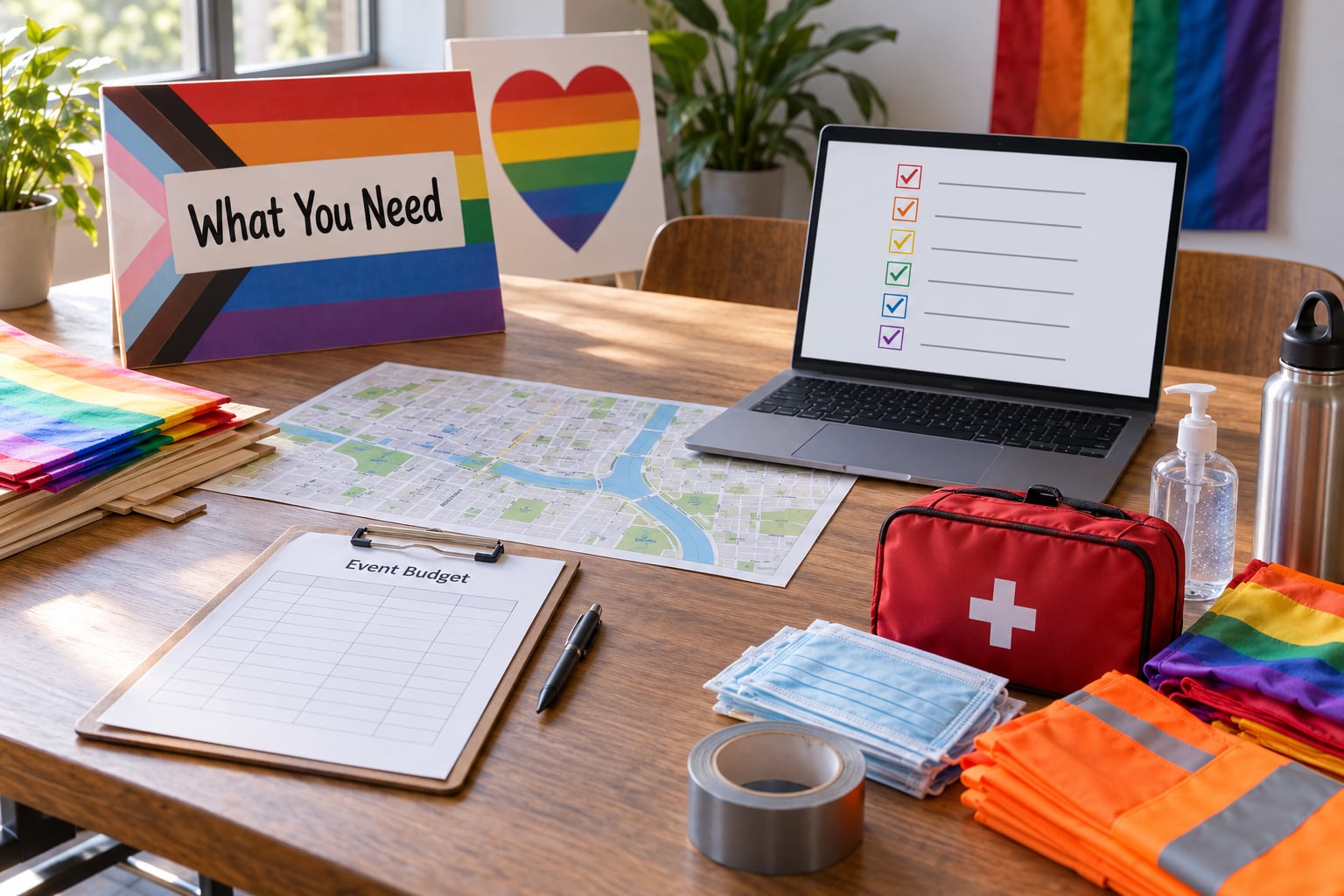
You can begin without most of this list, but the following items are what separate a group that runs an event from a group that has an idea.
- A planning team of five to eight people who can each own a piece of the work, and at least two of whom are local LGBTQ+ residents.
- A budget and a bank account in the name of the organizing group, ideally under a nonprofit entity if you have one.
- A venue or a route confirmed with the municipality, plus written approval for anything involving public streets.
- Event liability insurance and a certificate of insurance naming the town or property owner as an additional insured, since many small towns require it before they will release a permit.
- An accessibility plan: step-free routes, accessible restrooms, seating, shade, and a published line you can be reached on.
- Safety provisions: trained volunteers, a first-aid station, a written de-escalation approach, and a decision about police presence made by the committee rather than assumed.
- Partners: at least one local business, one community organization, and one health or youth service provider.
- Promotional materials: a logo, a rainbow flag or two, posters, and a social page. A website is nice, not required. Bath’s organizers ran the whole first year on an Instagram page.
How to Start a Pride Event in a Small Town: Step-by-Step
Nine steps, in the order that saves you rework. Steps one and two happen in a room; everything after that happens on the phone with people who have never heard of you.
1. Define the Event’s Purpose, Audience, and Format
Write one sentence that says who the event is for and what it is meant to do. “A one-day gathering where queer and trans residents of the county and their families can be visible together” is a working purpose. It also tells you instantly whether a block party fits and a three-day festival does not.
Format follows budget and volunteer count, not ambition. A rally on a park lawn is the cheapest and easiest to permit. A block party needs street closures and merchant agreement. A parade needs a route, traffic control, and insurance. A festival needs toilets, sound, and a stage, which is where volunteer burnout lives.
For a town that has never hosted one, a daytime community event with a short march beats a nighttime festival. It is cheaper, easier to staff, and far more likely to be repeated next year.
2. Build a Small but Representative Organizing Committee
Five to eight people is enough to run a first event. More than that and you spend the winter meeting. Recruit for gaps rather than enthusiasm: someone who knows permits, someone who knows local businesses, someone who is genuinely local and queer, someone who can handle the money, and someone calm enough to be on site when something goes wrong.
Give each person a written role. Chair, permits and municipal liaison, budget and fundraising, programming, volunteer coordinator, safety lead, promotion lead. The safety lead and the programming lead should not be the same person, because those two jobs pull in opposite directions on event day.
Set a simple decision rule early, such as a majority of the committee with a tie broken by the chair, and put a written conduct policy in place before promotion starts. Include LGBTQ+ residents in leadership rather than treating them as an audience you are planning for. A committee of only allies will miss things that matter.
3. Research Local Rules, Safety Concerns, and Community Context
Call your city clerk or parks department first and ask what a public event requires. You will usually find a parade or special event application, a street closure or amplified sound permit, a certificate of insurance requirement, and a debris or cleanup rule. Ask for the application by email the same day so you have it in writing, and note the deadline; small towns often have 30 to 60 day review windows.
Work through a simple timeline. Twelve months out, form the committee and call the neighbouring Pride. Six months out, submit permit applications and open sponsorship conversations. Three months out, lock the venue and start vendor and volunteer sign-ups. One month out, publish the final run of show and brief every volunteer. Event week, confirm the weather plan and print the signage.
Then listen to the town. Talk to the police chief, the school counselor, the local paper, the ministerial association, and the shop owners on your route. Some of them will be hostile, and organizers should know what they are walking into. But hostility on social media is far more common than hostility in person, and the Bath organizers had zero incidents at their first event with no counter-protesters in attendance.
What you do with a room full of angry voices is the whole test. Write a statement, keep it short, and say what the event is and why it exists. If the town council formally declines a permit, that is a real and blocking problem: ask in writing for the reason, appeal if the denial looks procedural rather than political, and keep the non-public-space version of the event alive (a park gathering, a march that does not require a permit, a fundraiser at a private venue) so the group does not lose momentum.
4. Choose an Accessible Venue and Create a Realistic Budget
Compare a public park, a community center, a school field, a stretch of main street, and a private business lot. Ask each the same questions: is there step-free access, are there accessible restrooms, can you get a permit, is there power, is there shade, and can you control the sound. A community center usually wins year one because it already has toilets, parking, and a building to move people into if the weather turns.
On budget, the honest headline is that a first Pride in a small town can be run for very little, and that money usually comes from three or four sources: local business sponsorships, small individual donations, a modest vendor fee, and in-kind support. Many towns also have community grant programs and county tourism funds that nobody applies to for this.
Budget ranges below are typical US ranges for a one-day small town event with 200 to 500 attendees, in USD:
| Line item | Low | Typical | High |
|---|---|---|---|
| Permits and fees | 0 | 250 | 900 |
| Event liability insurance (1-day policy) | 150 | 350 | 700 |
| Toilets and hand-washing units | 0 | 300 | 800 |
| Sound or a small stage | 0 | 400 | 1,500 |
| Printing, signs, flags, banners | 100 | 300 | 700 |
| First aid and water | 100 | 250 | 600 |
| Performer honoraria | 0 | 400 | 1,500 |
| Cleanup and waste | 50 | 200 | 500 |
| Contingency (10 to 15 percent) | 50 | 300 | 800 |
Roughly speaking, a rally or block party lands in the low hundreds, a parade with a route and traffic control in the low thousands, and a festival with sanitation, sound, and staging well above that. The line items that surprise people most are insurance, portable toilets, and cleanup. Put a contingency in the budget on day one, because something always does.
5. Design an Inclusive Program and Participant Experience
Program for a mixed crowd. Reading names or holding a quiet moment for people who have lost someone gives the day a center of gravity. Local musicians and a short emcee set keep energy up without a headliner budget.
Include a resource and community booth with local health, youth, and support services, plus a youth space that has its own adult volunteer. Families and allies should be able to participate without the event feeling like a nightclub with a kids’ table in the corner. Gender-neutral restrooms, seating with backs, and shade matter more to attendance than any performer you can book.
Watch for tokenism. If a single trans or queer person is asked to represent the whole community on a stage or in the press, you are using them. Invite people to speak for themselves, pay honoraria where you can, and keep the microphone open to more than one voice.
6. Recruit Partners, Vendors, Performers, and Sponsors
Approach businesses with a specific ask and a specific benefit: naming on a banner, a logo on the program, a thank-you post, a booth, or employees volunteering. Bath’s largest employer, Bath Iron Works, went beyond a sponsorship check and sent staff in company shirts, which produced more visible allyship than any banner.
Keep the sponsor list public and thank people by name on the day and afterward. People who support a first Pride in a small town are usually doing it on purpose, and they notice whether it was acknowledged.
Vendors should pay a modest fee that covers insurance, electricity, and your sanitation costs, and you should ask every vendor for a certificate of insurance naming the organizer. A cafe, a bookshop, a clinic, and a farm stand are easy first recruits in a town that has no LGBTQ+ retail.
7. Promote the Event Locally and Online
Local promotion is the part first-time organizers most underestimate. A small town’s audience is not online; it is in a weekly paper, a school newsletter, a church bulletin, a library board meeting, and a feed store counter. Get the date into community calendars in the spring, not the week of the event.
On social, one well-maintained page beats five neglected ones. Post the schedule, the accessibility details, the volunteer sign-up link, and the rain plan. Write the copy so that an ally can share it without feeling like they are posting a political statement, and so that a teenager who is not out at home can read it and see themselves in it.
State the purpose plainly. “First Pride in the county, all ages, free, march and afternoon festival at the park” tells people more than three posts about rainbow flags do.
8. Run a Rehearsed, Welcoming, and Safe Event Day
Write a run of show with clock times and names, and give every volunteer a copy. A typical day: setup and accessibility check, volunteer check-in and briefing, vendor and performer arrival, march or program start, closing and thanks, cleanup walk, and a short debrief before everyone leaves.
Staff a first-aid station and name the person running it. Train volunteers in de-escalation and active bystander response, which is the standard method bystanders use to interrupt harassment safely; Bath’s team sent eight trained volunteers and had no incidents.
Decide the weather call in advance and tell everyone the same time you will decide. Post your conduct policy where it is visible and enforce it. Assign one person to document the day with photos, with the understanding that those photos get used carefully.
On the police question, committee members disagree for good reasons and you should decide explicitly rather than drift. Some organizers hire or request police for traffic and traffic control; others, including the Bath team, chose not to, relying on trained volunteers and a medic instead. Whichever you pick, tell your volunteers and your public what the plan is.
9. Review the Event and Build Next Year’s Foundation
Within two weeks, gather attendance numbers, money in and money out, a short survey from attendees and vendors, and notes from every volunteer on what broke. Thank everyone by name, publicly, while the day is still fresh.
Then decide honestly whether to grow, change, or stay the same size. Bath’s first year worked partly because the organizers co-hosted with an existing town event, the Bath Art Hop, whose organizers already had relationships across the city. That kind of partnership is usually worth more than a larger crowd. Write down who is likely to hand over the keys next year, and find out what the event needs to look like in 2026 before the energy fades.
Common Mistakes
Starting with a festival. A stage, sanitation, and a full weekend of programming on a first-year volunteer base is how events collapse. Fix: run a daytime block party or a march to a park, prove it, then add a stage next year.
Treating permits as a formality. The application is the first real conversation you will have with your town. Fix: submit it on time, keep copies of everything, and ask for each requirement in writing by name.
Depending on one or two organizers. The Bath team explicitly identified volunteer burnout as a first-year risk. Fix: every role has a named backup, and no one person holds the money, the permits, and the social accounts alone.
Overpromising security. You cannot guarantee safety, and a promise you cannot keep damages trust faster than admitting limits. Fix: describe the plan honestly (trained volunteers, first aid, a de-escalation approach, a named decision about police) and stick to it.
Forgetting accessibility until late. Step-free routes, accessible restrooms, and seating need to be confirmed with the venue, not improvised on the morning. Fix: put them in the venue conversation in writing, and publish them in your promotion so people can plan.
Planning for allies instead of with LGBTQ+ residents. A committee of supportive friends who have never organized this will miss the things that actually keep people safe. Fix: put local queer and trans residents in decision-making roles, and pay them for their time where possible.
Letting a social media post cancel the event. One hostile message does not represent a town. Fix: post a short response, block and move on, and save screenshots of genuine threats for the police or a lawyer.
Frequently Asked Questions
What is community Pride?
Community Pride is a locally organized celebration of LGBTQ+ people and their allies, usually a one-day parade, march, rally, block party, or festival on a town main street or in a public park. It is produced by a volunteer committee, funded mostly by local businesses and small donations, and open to the public. A small town Pride often doubles as the only visible gathering place for queer and trans residents in the county.
Why are there Pride events?
Pride events grew out of the 1969 Stonewall uprising in New York and the marches that followed in 1970, and they exist to make LGBTQ+ people visible rather than invisible. In small towns the practical reason matters most: the nearest Pride festival is often an hour or more away, so teenagers grow up without a welcoming public gathering they can see. A local event delivers visibility, belonging, and a clear signal that they are not broken or alone.
What activities should be included at a first small town Pride?
Keep the first program short and mixed: a march or gathering, one or two local musical acts, a resource booth with health and youth services, a children’s craft or face-painting tent, a merchandise or raffle table to fund next year, and a named moment for people who have lost someone. Add food vendors, drag performance, or silent-auction items once you have volunteers and money to run them. Bath’s first Pride drew roughly 300 to 400 people.
How much does it cost to put on a small town Pride?
A park rally or block party can often be run for a few hundred dollars once sponsors and volunteer help are counted. A parade with a route, traffic control, and insurance usually lands in the low thousands, and a festival with portable toilets, sound, and staging goes well above that. The line items people forget are one-day event liability insurance, portable toilets, and cleanup fees. Put a 10 to 15 percent contingency in the budget from the start.
Do I need a permit and event insurance for a small town Pride?
Almost always, yes. Any event on a public street or park usually needs a special event or parade application, and often separate amplified sound and street closure approvals. Many towns also require a certificate of insurance naming the municipality or property owner as an additional insured. One-day event policies are widely available online and typically cost a few hundred dollars. Ask your city clerk for the full list in writing, and submit it 60 days ahead when you can.
Should police be present, and how do organizers handle backlash?
It is a real committee decision, not a default. Some groups request police for traffic control; others, including the Bath team, rely on active-bystander-trained volunteers and a volunteer medic instead, and reported no incidents that year. Whatever you choose, decide it explicitly and tell volunteers and the public. For backlash, respond once, briefly, and in writing; save genuine threats as screenshots for police or a lawyer, and do not argue in comments.
Conclusion
Start with three things this month: call the nearest town’s Pride organizers and ask for their playbook, hold one meeting with five to eight people, and email your city clerk for the permit list. Everything else, from sponsors to signage, follows from those three.
How to start a Pride event in a small town is mostly an exercise in asking your neighbors for things and being honest about what you can deliver. Keep the first version small, put local LGBTQ+ residents in charge, and treat the people who show up as the reason to do it again next year.