To make a party playlist that keeps a room moving, you need three numbers and one order: about 20 songs per hour, a fifth more than that as buffer, and a deliberate sequence for the whole night. Shuffle is what kills most party playlists. Build it this way and the music never stalls, never peaks in the first hour, and never dies at 1am while people are still on your couch.
The hard part was never finding songs. It is arranging them so the room warms up instead of flattening out, and so you are not scrambling at the door when somebody asks for one specific track. The process below takes about an hour the first time and about twenty minutes once it becomes habit.
Updated for 2026
Table of Contents
What You Need
None of this is expensive or hard to find. Gather it before you start picking tracks.
- Your music source. The streaming service you actually use, plus a second one if guests will be adding songs from their own accounts. Spotify, Apple Music and YouTube Music all support collaborative playlists; free tiers work fine for a house party.
- A device with storage to download the list. Streaming dropouts are the most common way a night falls apart. Download the finished playlist to the phone that will run the music, not just the laptop you built it on.
- Output equipment and its location. One speaker, an aux cable or Bluetooth pairing, and a spot in the room where it sits at ear height rather than on the floor, where the bass gets swallowed.
- The party length. Start time, expected end time, and whether guests tend to arrive early and stay late.
- A guest snapshot. Roughly how many people, which age groups, and whether it is dancing, talking or both.
- A notes file for the do-not-play list. Titles that would end the night early. Keep it separate from the playlist so you never scroll past it by accident.
- A way to collect requests. A shared playlist link, a group chat, or a printed QR code taped somewhere visible.
- Thirty minutes for a test run. This is the step people skip and the one that saves the evening.
How to Make a Party Playlist Step by Step
Set the goal, length, and mix of the party
Write down one sentence about what the room should feel like, then size the list to match. A four-hour house party and a three-hour dinner party need very different amounts of music, and a talk-heavy evening needs fewer tracks per hour than a dance night.
The working baseline is 20 songs per hour of party time. Add a fifth again as buffer, because a slow start, a long story about someone’s cat, or an encore nobody called for will all eat into the run time.
| Party length | Tracks at 20 per hour | With a 20% buffer |
|---|---|---|
| 2 hours | 40 | 48 |
| 3 hours | 60 | 72 |
| 4 hours | 80 | 96 |
| 5 hours | 100 | 120 |
When the night is request-heavy and people will call out titles all evening, plan closer to 25 songs per hour instead. You will be glad you did at midnight, when the main list runs dry and the requests folder is still full.
Choose a starting sound and build a core collection
Pick two or three styles that sit comfortably next to each other. Two adjacent styles usually beat five, because every switch between distant genres asks the room to pay attention again.
From those styles, gather a seed list of six to eight tracks that nail the mood. Then sort everything you collect into three buckets: openers that get people talking, peak-time tracks for when the floor is full, and cooldown material for when people need to breathe or talk over the music.
Collect more than you need. Three times the number of tracks you calculated gives you room to be picky during the ordering stage instead of stuck with whatever you grabbed first.
Balance familiar songs with new favorites
A workable split is roughly 70 percent tracks the room will recognise, 20 percent newer or deeper cuts, and 10 percent floor fillers you can drop in anywhere if the energy dips. Familiar material gets people moving; the unfamiliar material keeps the night from sounding like a loop.
The other 20 percent is where your personality shows, and it is also where you can alienate people if you lean too far. Two or three tracks per hour that the room has never heard is plenty for most parties.
On a mixed crowd, resist the temptation to treat everyone as one taste. At a queer party especially, Pride anthems, house, disco, pop, Latin and ballroom all belong in the mix, and a request for K-pop or country is worth a separate queue rather than something you fold reluctantly into the main list.
Order tracks by energy, not by genre alone
Genre is a starting point, not a sequencing system. What actually moves a room is tempo, rhythm, how hard the track is mixed, and how much singing it demands.
Look at tempo and energy together and you will see the shape of a good night: open in the 95 to 110 BPM range, climb through 118 to 126, hold the peak for a while, then drop back into the 110s for an hour or two of relief before the last climb.
- Start calmer than you think. Opening with the loudest track you own burns the ceiling before you reach it. People arrive gradually, and so should the tempo.
- Ride in waves, not ramps. Three up, one down works. A short breather every hour or so gives the room somewhere to go, and the next climb lands harder because of it.
- Watch the vocals. A run of heavy vocal tracks needs a break. Two in a row is conversation, five in a row is a wall.
- Match production style. Two tracks that are mixed very differently, back to back, feel like two different parties.
- Close on purpose. Decide what the last song does. An all-together singalong and a slow exit need completely different endings.
Test transitions, volume, and dance-floor comfort
Play the whole sequence once, start to finish, at the volume you will actually use. Not skimmed with your phone in one hand. Skimming hides every problem that matters.
One trick from the top advice in the r/Music thread on this exact question: listen to the last thirty seconds of each track and choose the next one from there. That outro tells you more about how a transition will feel than the first thirty seconds of the incoming song does.
While you listen, flag anything jarring, then listen to it again. Also play a few tracks that were made before streaming mastering, because loudness normalisation makes older records sound quieter than modern ones and the drop surprises people mid-song.
Finish on the real speaker, in the real room, on a real phone. Bass on a small speaker is nearly nonexistent, and a playlist balanced on headphones can fall apart once it hits a room full of people talking.
Save, back up, and share the final playlist
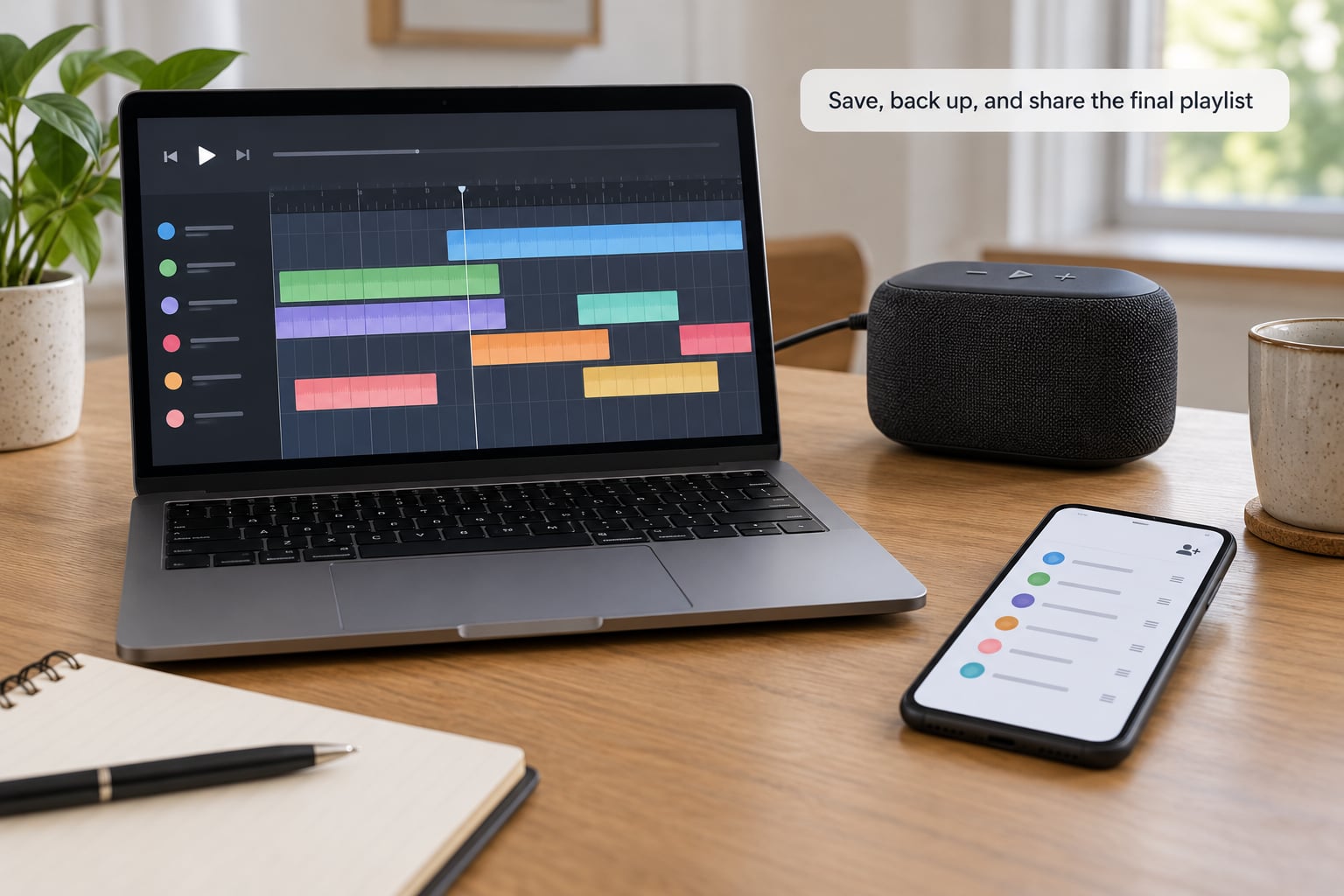
Name the playlist so future you understands it: occasion, date, venue. An unlabelled list called “New Playlist” is impossible to find again six months later.
Before the night, save a copy of the ordered list somewhere outside the streaming app. A screenshot of the running order in your notes is enough.
Download the tracks for offline use on whichever device plays the music, and confirm the download finished rather than assuming it did. One failed track in the middle of a silent kitchen at midnight undoes a whole evening of preparation.
Share a separate collaborative playlist for requests rather than opening your main list to edits. That way the running order stays intact, and anything a guest adds still lands somewhere you control.
Common Mistakes
Everything sits in one genre. A night of a single style feels narrow after hour two. Fix: pick two adjacent styles as the spine and let one genre be the guest appearance, not the whole evening.
High energy from the first track. You will peak in the first twenty minutes. Fix: open in the mid-90s to low-100s BPM and save the loudest material for after the room has filled.
Transitions nobody checked. A jarring jump every few tracks makes the night feel amateur. Fix: do one full listen-through and flag every transition that makes you wince.
No volume check. The track that works in headphones can disappear on a phone speaker in a busy room. Fix: test on the actual speaker in the actual room at the actual hour.
Requests take over. If every track comes from the crowd, you have a queue, not a playlist. Fix: keep one main list and one request list, and treat requests as strong suggestions rather than commands.
The list is exactly the right length. Parties run long, and running out of music with people still present is the worst possible failure. Fix: add that 20 percent buffer every time.
The do-not-play list lives inside the main playlist. Move it to a separate note. A title hidden in the middle of a 90-track running order will eventually come up.
A few quick habits tie it together: keep at least six tracks on hand that you can insert at a moment’s notice, learn to skip without apologising every time, and decide in advance which songs are yours to play when the floor goes quiet.
Frequently Asked Questions
How long should a party playlist be?
Plan about 20 songs for every hour of party time, then add another fifth as buffer. A three-hour party needs roughly 72 tracks. Request-heavy nights, where people call out titles all evening, run closer to 25 songs per hour. Build longer than the evening itself so a slow start or a chatty living room never leaves you with silence.
How many songs should I add to a party playlist?
Once you have the runtime, aim for roughly 70 percent tracks the room will recognise, 20 percent newer or deeper cuts, and 10 percent floor fillers you can drop in anywhere. For a four-hour party that lands near 96 tracks after buffering. Gather about three times that many candidates first, then discard freely while you order the final list.
Should I mix different music genres?
Yes, but pick two or three styles that sit comfortably beside each other and make one of them the main thread. A genre switch that is too far apart asks the room to pay attention again. On a mixed crowd, including a queer or Pride party, give strong requests like ballroom, Latin or K-pop their own queue rather than squeezing them into the main list.
How do I keep a party playlist from getting repetitive?
Watch for two tracks by the same artist close together, and for the same song appearing twice because you liked it twice. Aim for variety in tempo, production style and vocal density, not just genre labels. A useful check: can you name the last five songs you played from memory? If not, the repetition is already audible to the room.
How do I make transitions sound smoother?
Listen to the last thirty seconds of each track and pick the next song from that outro rather than the incoming intro. Keep tempos within about ten BPM of each other in the middle of the night, and avoid placing two heavily mixed or two heavy vocal tracks back to back. A short crossfade setting on the app smooths the rest.
Should I let guests add songs during the party?
Let them add, but never into the list you are playing. Open a separate collaborative playlist and a QR code or link, then treat what arrives as a strong suggestion rather than a command. Tell people the request list gets played in a block around the same time each hour, which keeps the main running order intact and stops the room from fighting over the aux.
Conclusion: Start With the First Three Tracks
The whole method comes down to three moves: name the occasion, choose a sound, and order the first three tracks before you worry about the other ninety. Get those three right, size the rest at 20 songs an hour plus a buffer, and the rest is patience.
Test the full run once on the real speaker, keep the requests in a separate list, and leave yourself six tracks you can drop in at any moment. That is how to make a party playlist that other people describe as a good night rather than a playlist.