
To manage seasonal depression, the combination that works best is morning light, a steady daily routine, movement, and human contact — with professional care added when symptoms start affecting work, relationships, or safety. Seasonal affective disorder (SAD) is a recognized form of major depression that follows the calendar, and because it repeats, you can plan for it rather than react to it.
This guide is educational information, not medical advice. Nothing here should replace an assessment from a licensed clinician or your primary care provider. If you have bipolar disorder, talk to a clinician before starting light therapy or any antidepressant, because both can trigger mania in people with that diagnosis.
Here is the short version of what tends to help, in roughly the order most people find useful:
- Get light early. Outdoor daylight within the first two hours of waking is the single highest-leverage habit. If the weather will not cooperate, a UV-filtered 10,000-lux light box used for 20 to 30 minutes in the morning is the closest indoor substitute.
- Hold the routine, not the motivation. Keep wake time, meals, and one small activity fixed even on bad days. Motivation arrives after action far more often than before it.
- Move in small, repeatable doses. A ten-minute walk counts. Exercise supports mood and sleep, but it is not a treatment on its own.
- Protect contact with people. Plan one reliable connection per week before the season rather than hoping invitations will come.
- Start early. Beginning light therapy and routines in early autumn, before symptoms take hold, makes them easier to keep and tends to reduce severity.
- Ask for help when it stops being manageable. Therapy, medication, or both are legitimate options, and they are not failures of character.
Table of Contents
- What You Need
- Step-by-Step: How to Manage Seasonal Depression
- Common Mistakes
- When to Ask for Urgent Help
- Frequently Asked Questions
- What month is seasonal depression the worst?
- How do I know if I have SAD or just the winter blues?
- What time of day should I use a light box?
- Does seasonal depression ever go away?
- Are there any supplements that can help with seasonal depression?
- What are the symptoms of seasonal depression in the summer?
- Conclusion
What You Need
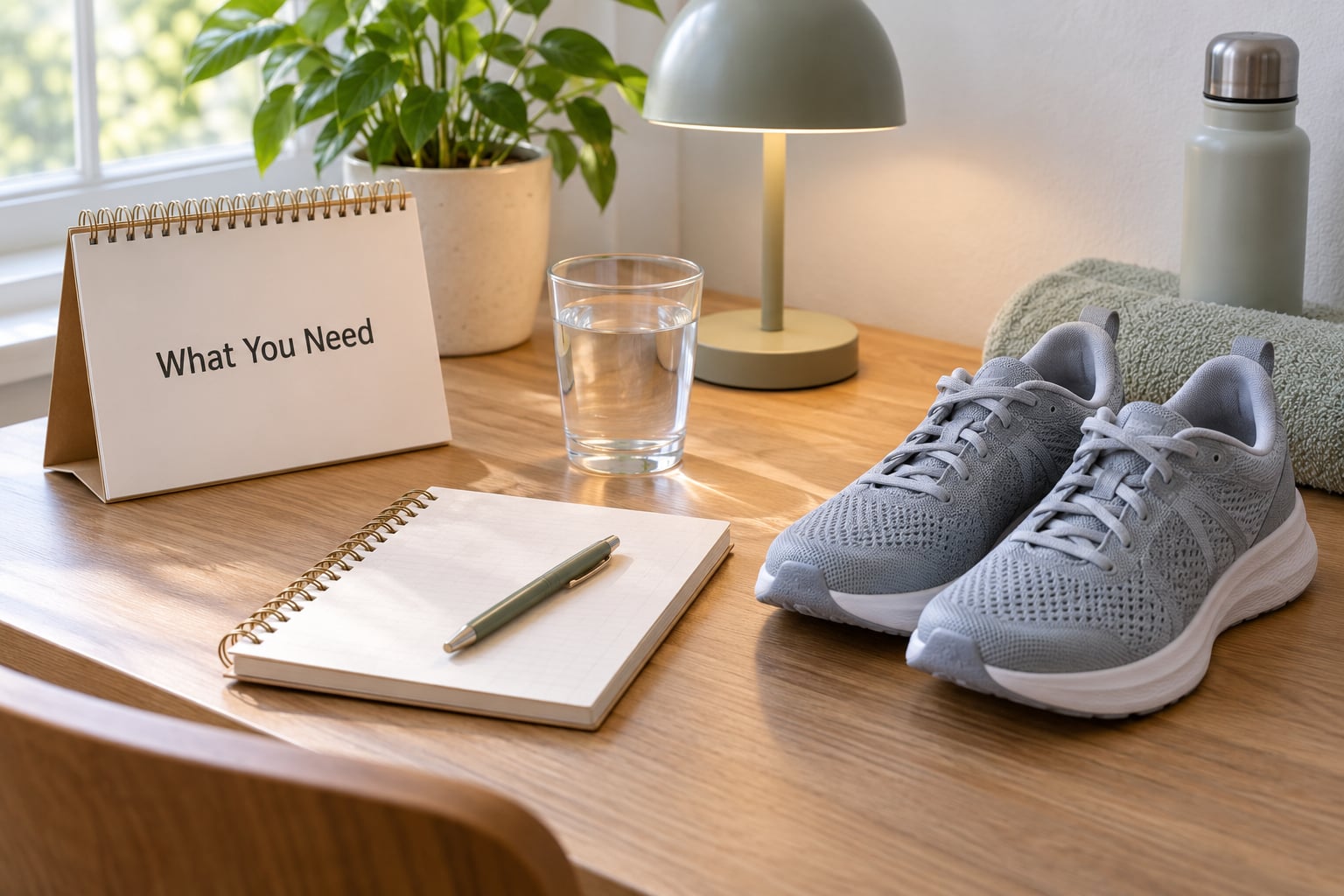
You do not need a complicated kit. You need five things in place before the dark weeks arrive, because the point of preparation is that it removes decisions from the days when making decisions is hardest.
- A calendar or habit tracker. Something visible that lets you see patterns in mood, sleep, and daylight across weeks. A paper notebook works as well as an app.
- A reliable light source. Either a safe route to daylight — a window seat, a walkable block, a bus stop you like — or a UV-filtered light box rated at 10,000 lux at the distance you will actually sit at. Check that the box states its lux rating at a stated distance, and follow the manufacturer’s instructions and safety warnings.
- One form of movement that is not a negotiation. Walking fits most people’s lives. So does stretching on the floor of a shared apartment, a dance class, or a stationary bike in a basement gym.
- A trusted person who knows the plan. Someone who will check in, who knows what your early-warning signs look like, and who will notice if you stop replying.
- A route to professional care. Your primary care provider’s name, a therapist you have seen before, and the local crisis number saved in your phone. Finding care in January is much harder than finding it in October.
If money or insurance is the barrier, that is a solvable logistics problem, not a character flaw. Community mental health centers, sliding-scale therapists, telehealth intake, and peer support groups all exist, and a clinic or a primary care office can usually point you toward the local options that fit your situation.
Step-by-Step: How to Manage Seasonal Depression
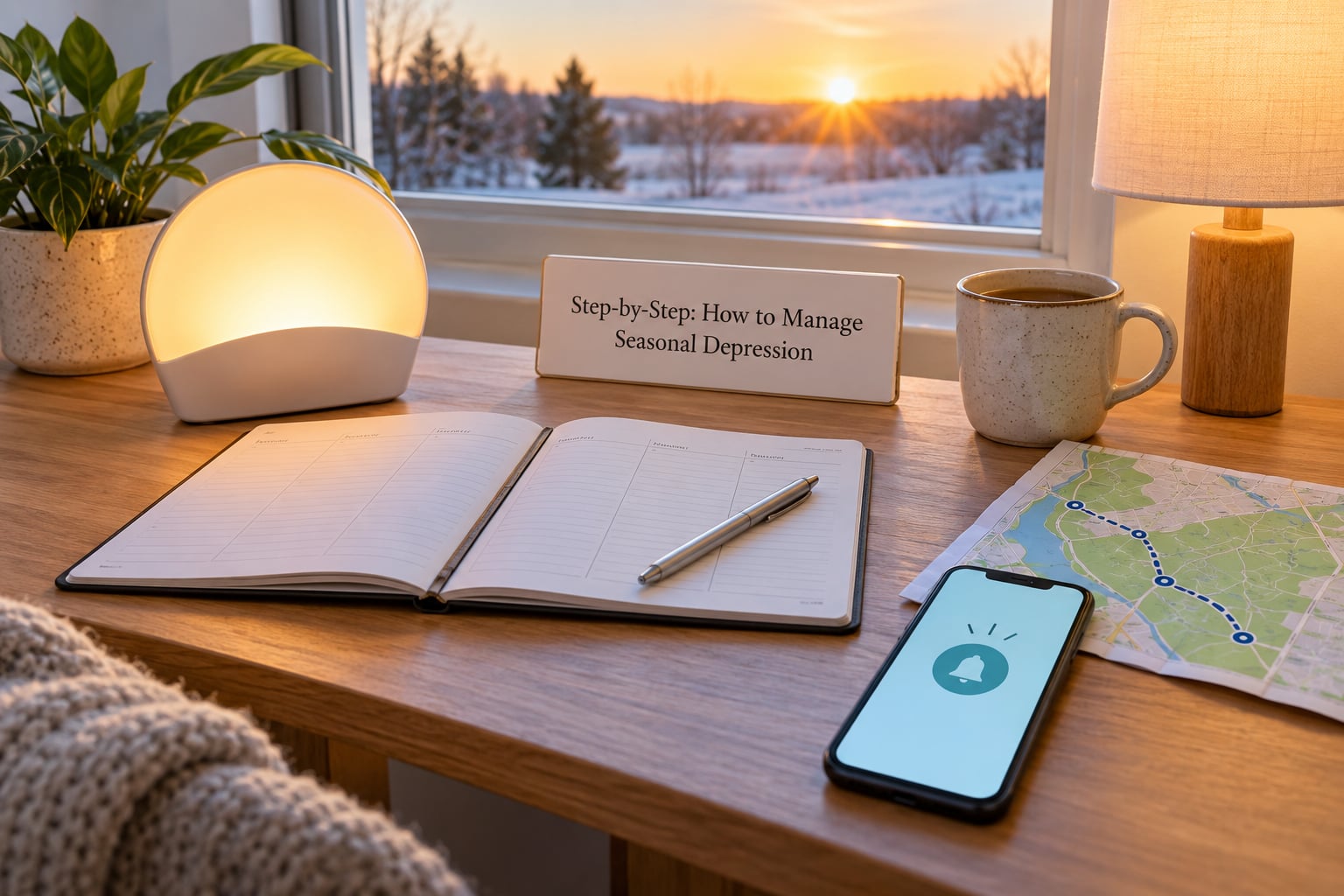
The plan has six parts. Each one describes the action first and then the signal that tells you it is helping, so you can tell the difference between a plan that needs adjusting and a plan that needs more time. Most people searching how to manage seasonal depression are not short on tips; they are short on order, and on a way to know which part is working.
Set Up a Routine That Reduces Daily Friction
Anchor four things and let everything else be flexible: wake time, first light, breakfast, and one scheduled activity. Write them down the night before so that on a hard morning you are following a note instead of making a decision.
The hardest part of a fixed wake time is the first two weeks, particularly if you sleep heavily in winter. Set the alarm anyway and get up; the pattern usually holds within a couple of weeks. You will know the routine is working when you stop dreading mornings and start waking before the alarm on some days.
Keep the anchor small enough to survive a bad day. Ten minutes of movement counts. A walk to the corner counts. Two pieces of toast before noon counts. The goal is continuity, not performance.
Get Consistent Daylight Without Making It Complicated
SAD is driven largely by reduced winter daylight. Less morning light shifts the circadian rhythm, melatonin production drifts out of phase with the day, and serotonin and vitamin D levels tend to fall. The result is fatigue, oversleeping, cravings, and withdrawal from other people.
Start outside. Aim for daylight within the first two hours of waking, even on an overcast day, which still delivers a meaningful amount of light. If you can, step outside rather than sitting by a window; glass filters out much of the useful light and puts a barrier between you and the sky.
When outdoor light is not possible, a light box is the practical replacement. Look for one that is UV-filtered and rated at 10,000 lux at the distance it states. Sit close enough that the stated rating applies to you, use it in the morning, and follow the instructions that came with it. Common complaints are eye strain, headache, and irritability, which usually mean the distance is wrong or the session is too long — not that you should push through.
One caution worth repeating: if you have bipolar disorder or have ever had a manic episode, do not start light therapy without asking a clinician first. You will know the timing is roughly right if your sleep and energy start shifting within a week or two, and winter mornings stop feeling like the hardest part of the day.
Use Small, Repeatable Sources of Movement
Movement helps sleep, appetite, and mood, and it gives dark winter days a shape. It is also, on its own, not a treatment for depression — anyone who tells you a walk replaces medical care is overselling it.
Pick options with a low starting point. A ten-minute walk, five minutes of stretching, dancing to one album in your kitchen, or chair-based movement during a commercial break all count. Cold-water swimming has come up repeatedly in reader accounts as a genuinely effective winter support, and Chicago has plenty of people doing it — but that is a personal practice, not advice for everybody, and it is something to build gradually in warmer months.
Readers in local forums talk about investing in real winter outerwear so being outside stops being a negotiation with the weather. That is unglamorous and it works. You will know movement is helping when sleep is more solid and your mood dips are shorter, even if the overall level has not changed yet.
Protect Social Connection and Enjoyable Activities
Withdrawal is both a symptom and an accelerant, so this part needs to be scheduled rather than organic. Tell one or two people how the season affects you, what your early-warning signs are, and what kind of response helps. Then ask them to hold you to it.
Plan activities in advance, then lower the bar for actually going. SAD specifically makes people cancel the exact plans that would help them, so the plan has to survive a low-energy day. A standing weekly call, a recurring class, a recurring meal with the same people — anything with a fixed time — beats a vague agreement to hang out sometime.
For readers whose social world has changed, or who live somewhere cold without chosen family nearby, this gets harder and deserves direct attention. Chosen family counts as family. Queer community spaces, sober social events, and volunteer shifts put you in a room with the same people repeatedly, which is the mechanism that makes connection stick. If you are isolated, that is a problem worth solving with other people rather than waiting to feel like solving it yourself.
Talk With a Professional When Symptoms Interfere With Daily Life
Self-care has a ceiling, and it is worth knowing where yours is. The threshold is functional: symptoms that are disrupting your work, your studies, your relationships, your eating, your sleep beyond recovery, or your safety.
Reaching out does not have to mean starting medication. A primary care provider can rule out other contributors — thyroid problems, anemia, vitamin D deficiency — and can start or refer treatment. A therapist can help specifically with cognitive behavioral therapy, which has decent support for seasonal depression and gives you concrete tools rather than encouragement alone. Antidepressants, including bupropion XL, are options a prescriber may discuss for seasonal symptoms, often started before the season rather than at the worst of it.
Prepare for the appointment rather than improvising. Note when symptoms started, how they have changed, how sleep and appetite look, what you have already tried, and whether the pattern repeats every year. Write down questions, including what to expect, how long before you should feel a difference, and what side effects to watch for. Bring a family history if you have one; it changes what a clinician considers.
If therapy is not affordable right now, ask explicitly about sliding-scale rates, community clinics, and lower-cost telehealth options. If you are on public insurance, mental health coverage is often included, and the intake office can tell you what your plan requires.
Track Changes and Adjust the Plan
Record five things daily: mood, sleep hours, energy, daylight exposure, and one note about functioning — did you get to work, did you answer the message, did you go outside. Ten seconds a day is enough.
Two to three weeks of entries show you what is actually moving your mood, which is usually not what you would guess. Some people find outdoor light barely registers and that contact with people does the work. Others find the reverse. The point is to stop arguing with your own data.
Adjust one or two supports at a time and give each change two weeks. A hard day is not a failed plan, and abandoning everything on the third bad morning is how the season wins. Keep the routine that is working, change the thing that is not, and keep going.
Common Mistakes
Almost every mistake here is a version of the same problem: doing the hard part first and the flexible part later.
- Waiting for motivation. Motivation is a result, not a prerequisite. Pick the smallest version of the action and do it badly on purpose — the routine holds, the mood catches up.
- Overloading the schedule. A plan with nine daily commitments fails in week two. One anchor that survives a bad week beats five that do not.
- Isolating. Cancelling plans feels self-protective and reliably deepens the low. Pre-commit to the plans, and tell the people you cancelled on that you are still there.
- Relying on alcohol or other substances to cope. Alcohol worsens sleep and mood the next day, which is the day you already needed help with.
- Waiting too long for professional help. If symptoms have lasted more than two weeks and are affecting your functioning, that is the point at which a clinician call costs you far less than another month of white-knuckling it.
- Letting dismissive comments stand. “It’s just the winter blues” from family is common and unhelpful. Naming the pattern, and asking for specific help rather than sympathy, tends to land better.
- Buying the wrong light source. Lamps with no UV filter, no stated distance, or no lux rating are why people conclude light therapy does not work. Check the specifications before you buy.
- Judging the plan by a single day. Look at two weeks of your own tracking, not one difficult evening.
When to Ask for Urgent Help
Seasonal depression is treatable, and it can still get serious. Do not wait out suicidal thoughts the way you would wait out a headache.
Ask for urgent help if you have thoughts of suicide or self-harm, if you feel you cannot keep yourself safe, if you have a plan or access to the means, or if someone close to you is telling you they are worried about your safety. Immediate risk means contacting emergency services or going to the nearest emergency department now.
In the United States and Canada, call or text 988 to reach the Suicide and Crisis Lifeline, which is free, confidential, and available 24 hours a day. In the US you can also call the SAMHSA National Helpline at 1-800-662-HELP (4357) for treatment information and referral, 24 hours a day, 365 days a year. Outside the US and Canada, contact your local emergency number or national crisis line; a search for a crisis line in your country will get you the right one.
Reach out to someone today — a friend, a family member, a therapist, or a doctor — and tell them plainly what is happening. Naming it out loud does not make it worse. It is the single thing that most reliably changes what happens next.
Frequently Asked Questions
What month is seasonal depression the worst?
Symptoms usually begin in early autumn, roughly a month or two after daylight hours drop, and tend to peak during the darkest winter weeks — often December through February — before lifting in spring. In Chicago, the combination of shorter days and stubborn grey skies means many people notice the shift in late October and feel it hardest through January. Starting routines and light therapy in September or October tends to matter more than any particular month on the calendar.
How do I know if I have SAD or just the winter blues?
The winter blues are common, mild, and self-limiting. SAD is a form of major depression that meets clinical criteria, disrupts your functioning, and follows the same months every year. A useful test: with the winter blues, you skip things but still enjoy the things you usually enjoy. With SAD, you withdraw broadly and feel flat even with people who usually lift you. Two weeks of impaired functioning is the usual signal to contact a clinician.
What time of day should I use a light box?
In the morning, within the first hour of waking if you can manage it, and never in the evening. Evening light delays the signal that tells your body night has arrived, which works against the effect you are trying for. Sit close enough that the box’s stated 10,000 lux rating applies at your actual distance, keep it off your direct line of sight, and follow the manufacturer’s instructions. Eye strain or headache usually means the distance is wrong, not that you need to push through.
Does seasonal depression ever go away?
For most people, symptoms do lift with spring, and often the same year they started — that lifting is part of the pattern. What that does not mean is that the underlying tendency disappears. Many people who feel better by April start their light therapy and routines again in early autumn because they know what is coming. If your low period fails to lift by spring, or it deepens, that is worth telling a clinician rather than waiting for the calendar.
Are there any supplements that can help with seasonal depression?
Vitamin D is the supplement most often discussed, because levels commonly drop in winter. The evidence that taking it treats SAD is weak, so it is worth asking your clinician about it if you are deficient or at risk, and worth not treating as a substitute for light or care. Melatonin, St. John’s wort, and fish oil have even thinner support, and St. John’s wort interacts with many medications. Anyone with bipolar disorder should clear any supplement with a clinician first.
What are the symptoms of seasonal depression in the summer?
A smaller group of people has reverse, or summer-pattern, seasonal depression. Symptoms tend to be the opposite of winter-pattern SAD: agitation or restlessness rather than heaviness, insomnia rather than oversleeping, reduced appetite rather than cravings, and a low tolerance for heat and humidity. It is less common and less discussed, which means it is easy to miss. If your mood drops reliably between May and September, say so when you seek help, because the standard winter questions will miss it.
Conclusion
Working out how to manage seasonal depression comes down to order of operations, not willpower. If you do three things, make them these. Choose one daily anchor — a wake time, a walk, a breakfast — and keep it through the season. Add reliable light, outdoors first, with a UV-filtered 10,000-lux box as your indoor backup. And tell one trusted person what you are dealing with, so that if symptoms start disrupting your daily life, you already have someone who will push you toward a clinician instead of waiting for you to bring it up alone.