
To prepare for your first therapy session, finish the intake paperwork, jot down a rough idea of what is bringing you in and what you want different, and sort the logistics: photo ID, insurance card, copay, and a quick camera and microphone test if you are meeting online. That is genuinely all the preparation that asks of you. You do not need a script, a clean backstory, or a story bad enough to justify the appointment.
Feeling nervous, awkward, or even tearful (or completely flat) is normal. Most first sessions are quiet and administrative rather than emotional, and the honest truth from people who have been through several is that the unknown room is harder than anything said inside it. The steps below take about twenty minutes of real work, most of it before you leave the house.
One note before you start: this is general information, not a diagnosis or a treatment recommendation. If you are in crisis or thinking about harming yourself, call or text 988 in the US, or your local emergency number, right now rather than waiting for an appointment.
Table of Contents
- What You Need
- Step-by-Step: How to Prepare for Your First Therapy Session
- Common Mistakes
- Frequently Asked Questions
- What should I say in my first therapy session?
- How should I prepare emotionally before my first therapy appointment?
- What if I start crying during my first session?
- How do I know if a therapist is the right fit for me?
- What should I wear to my first therapy session?
- What happens after my first therapy session?
What You Need

You need a short list of practical things, and permission to skip the rest. If you only do the first four items below, you are ready.
- A photo ID – most offices ask for one at check-in, and telehealth platforms usually ask for it before the first video call.
- Your insurance card, plus the copay or a card for it – fees and session counts vary a lot by plan, and asking about sliding scale or payment plans before you arrive keeps the conversation calm.
- Completed intake forms – consent, privacy policy, and health history questionnaires, sent to a portal you fill out in your own kitchen.
- Three questions to ask – write them on paper or in your phone. They are the thing people most often forget once the session starts.
- A one-paragraph summary – half a page on what is going on and what you want help with. Nothing polished.
- Notes on practical needs – any access needs, privacy concerns, how you want to be addressed, and whether you want your identity, pronouns, or relationships discussed on day one.
- For telehealth – a quiet room, headphones, a stable connection, and a way to tell housemates not to interrupt for fifty minutes.
There is one more item that is not on anybody’s list: the decision that you can quit. You are interviewing the therapist as much as they are getting to know you, and the person you speak to today can be replaced.
Step-by-Step: How to Prepare for Your First Therapy Session
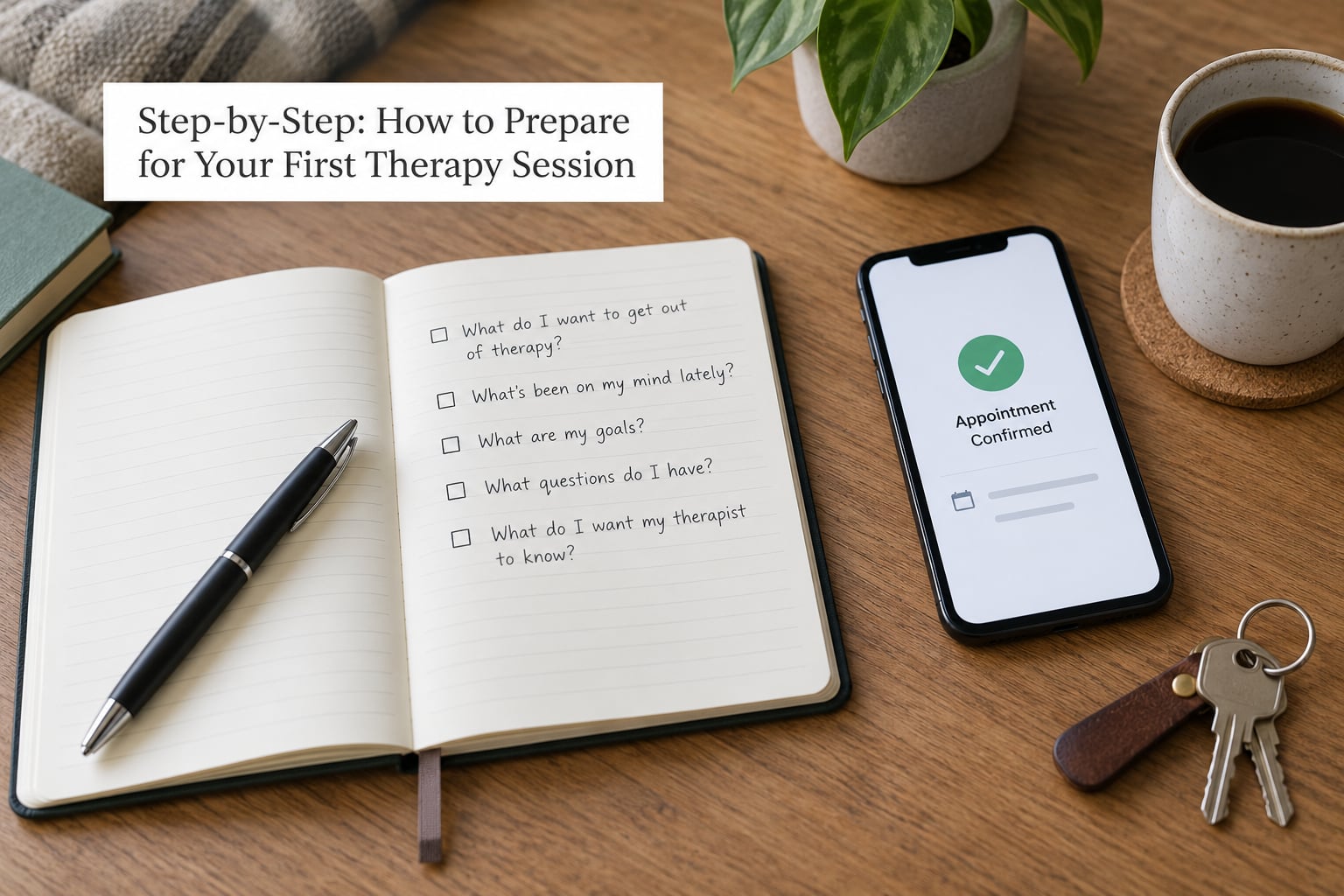
1. Confirm the appointment and ask about the format
Reply to the confirmation email or call the office and get five facts: the therapist’s name and pronouns, session length, in-person location or video platform, the fee or copay, and the cancellation window. Ask whether anything must be submitted beforehand. If you are meeting online, request the join link early so a bad password is not the reason you spend the first ten minutes of therapy troubleshooting.
You will know this step is done when you can say the date, the time, the address or link, and the cost without looking anything up.
2. Write down what you hope to work on
Half a page is plenty. Write what has been going on in plain language, how long it has been going on, and how it shows up in your days – sleep, appetite, work, dating, showing up to things you love. Add one sentence about what you would like to be different in six months.
People worry they need something serious to qualify for the appointment. Low mood, a breakup, burnout, family tension, panic before dates, a year of drifting, or plain restlessness all count. This step is done when your notes sound like you rather than like a case description.
3. Prepare questions about the therapist and the process
Pick the ones that matter to you from this list: What approach do you work with, and what happens in a typical session? How much experience do you have with the specific thing I am bringing? How do you measure whether therapy is working? What is your policy on cancellations, and how much notice do you need? What is your training background, and are you licensed in my state?
Asking about their background is not rude. Most therapists have a credential – LCSW, LMFT, LPC or LPCC – and they will tell you what it means and where it is licensed.
4. Think through practical needs and boundaries
Decide in advance what makes the session usable for you. You might want to be told the name you go by and your pronouns before you have to correct anyone. You might need a step-free office, an interpreter, a phone session instead of video, or a specific safe word for pausing. You might not want your family of origin discussed without your say-so.
For queer and trans clients, this is where it helps to ask directly whether the therapist works with LGBTQ+ clients and what that looks like in their practice – whether they use chosen family, gender-affirming language, and names people correctly by default. You deserve a clear answer, and asking is not a test you can fail.
5. Decide how you want to begin the conversation
Pick the lowest-pressure opening that feels like you. You can read your one-paragraph summary out loud. You can say: Honestly, I do not know how to do this, so I wrote down the main thing, and that is it. You can let the therapist ask questions first. Or you can ask them to walk you through how the first session works before you start talking.
Silence is survivable. If it goes quiet, say so – I have gone blank, can you ask me something easier to start with – and the session recovers. That happens in real sessions, and it is not a failure.
6. Review the session and decide on the next step
Give yourself a buffer afterward. People often leave a first session tired rather than lighter, and a full evening of plans is not the follow-up you need. Jot down two things while it is fresh: what felt useful, and what felt off.
Then pick one of three options – book the next appointment, book a consultation call with someone else, or pause while you think. You will know this step is done when you have decided something rather than simply drifting into week two.
Common Mistakes
Over-preparing. Hours of research on the right modality can turn into a way to avoid the appointment. A paragraph and three questions is enough; the rest belongs to the conversation, not the notepad.
Expecting one session to fix something. A first appointment is mostly intake and orientation. It produces context and a starting plan, not a result, and anyone promising relief in fifty minutes is selling you something.
Holding things back to be approved. Therapists cannot work with a curated version of your life. You decide what to raise and when, and you can change that decision later, but hedging the whole session tends to waste the only hour you have.
Assuming confidentiality means absolute secrecy. It is strong protection, not a guarantee. There are specific limits, mostly around imminent risk of harm to yourself or someone else, abuse of a child or vulnerable adult, and in some situations court orders or a subpoena. Ask your therapist to explain the limits where they apply to you, and how confidentiality works if you meet by video from home. If you are ever in immediate danger, call or text 988 rather than waiting to discuss it in a weekly slot.
Skipping the fit questions. Feeling unseen, talked down to, or corrected within a few sessions is information, not a personality clash. The working relationship between you and a therapist is a stronger predictor of whether things help than any particular method. You are allowed to ask for a referral, and switching is normal self-advocacy rather than something to feel guilty about.
Treating one uncomfortable session as proof it failed. Awkward, boring, and over-full sessions happen. The question worth asking is whether you want another one with this person, not whether today was easy.
Also worth unlearning: you do not have to cry, you do not have to lie on a couch, and you do not have to have a dramatic origin story. If it helps, say any of that out loud in the first five minutes. Therapists have heard it before and it gives you more room for the rest of the session.
Frequently Asked Questions
What should I say in my first therapy session?
Start with whatever is heaviest right now, in one or two sentences, and let the therapist take it from there. A written summary you read aloud works well if free talk feels impossible, and so does saying you are not sure how to begin. Expect questions about your situation, health history, sleep, support system, and what you want from therapy. You never owe the whole story on day one.
How should I prepare emotionally before my first therapy appointment?
Treat it as an ordinary appointment rather than a trial. Nerves are common and usually fade once the session starts and the therapist turns out to be a normal person. Light structure helps more than rehearsing: a short written summary, three questions, logistics settled, and a plan for afterwards. Avoid reading clinical symptom lists at midnight, which tends to raise anxiety rather than lower it.
What if I start crying during my first session?
Let it happen if it happens, and tell the therapist if you can. Crying is common in first sessions and none of it is a performance, so you do not need to stop, explain, or apologize for it. If you want a break, ask for tissues, water, or a pause. If you would rather talk by phone than face to face, that is a reasonable accommodation to request up front or during the call.
How do I know if a therapist is the right fit for me?
Watch whether you feel heard and can speak without being judged, and whether they hold clear boundaries around time, fees, and privacy. Fit shows up over a few sessions, not in one, so give it a fair run and check in with yourself at the second or third appointment. If you consistently feel dismissed or talked down to, ask for a referral and change therapists without treating it as a personal failure.
What should I wear to my first therapy session?
Wear whatever you would wear to a work meeting with someone you do not know well, or to a coffee meeting. In person, layers help, since offices can be cold and you may want your coat or cardigan nearby. For video sessions, solid, comfortable clothes read better on camera than anything patterned or formal. Comfort matters more than impression, and nothing about what you wear affects how you are treated.
What happens after my first therapy session?
Your therapist usually suggests a plan, including a rough session frequency, and may assign a short reflection task. Leave room in the next few hours, since you may feel tired or slightly off-kilter. Jot down what felt useful and what felt awkward while it is still clear. Then decide whether to book again, ask for a consultation with someone else, or take a week to think.
Start with the smallest useful thing: book the appointment, finish the forms, and write half a page about what is going on. That is enough to walk in with, and the rest you figure out in the room with a person who does this for a living.