
If you have to ask the question, that usually tells you something. Most couples who benefit from counseling notice the same things: the same argument keeps returning, conversations end without resolution, or one person has quietly stopped trying. Learning how to tell if you need couples counseling comes down to patterns, not a single bad week. This guide walks through six checks you can run yourself in about half an hour, plus what a first session actually involves and how to find a therapist who fits.
None of this is a diagnosis, and nothing here requires you to decide anything tonight. It is a way to look at your relationship with a little more honesty than you can manage in the middle of an argument.
Table of Contents
- What You Need
- Step-by-Step: How to Tell If You Need Couples Counseling
- 1. Look for recurring patterns, not one bad week
- 2. Notice whether communication has become unsafe or unproductive
- 3. Check whether basic needs and responsibilities are going unmet
- 4. See whether the same issue keeps returning unresolved
- 5. Consider whether distance means you need couples counseling
- 6. Decide whether both people are open to participation
- Common Mistakes
- Frequently Asked Questions
- Does every recurring argument mean a couple needs counseling?
- What if only one partner is willing to try couples counseling?
- How many couples counseling sessions are usually needed?
- Can counseling save a relationship that is in trouble?
- What should we talk about in a first counseling session?
- When should we seek help for abuse or immediate danger?
What You Need

Couples counseling is structured talk therapy where both partners work with a licensed therapist on the interaction patterns underneath the arguments: how conflict starts, how it escalates, and how it ends. It is not a mediation service, a courtroom, or a place where a stranger decides who is wrong. The goal is a shift in how you talk to each other.
Before you decide whether you want it, gather a few things.
- A private place to talk where neither of you can be interrupted.
- A notebook or a shared document, so the same facts are in front of you both.
- Two or three real examples of an interaction that went badly, with what was said.
- Questions about scheduling, session length, fees and how insurance is handled.
Bring examples, not verdicts. A therapist can work with “we fought about bedtime four times last month and I ended up doing it alone” but cannot do much with “he never helps.”
One thing to get out of the way early: nobody has to prove who started it before you are allowed to ask for help. Couples arrive with unequal responsibility all the time, and the work starts from wherever you actually are.
Step-by-Step: How to Tell If You Need Couples Counseling
Run the six checks in order. Each one takes a few minutes of honest recall, and the answer is usually clearer once it is written down.
1. Look for recurring patterns, not one bad week
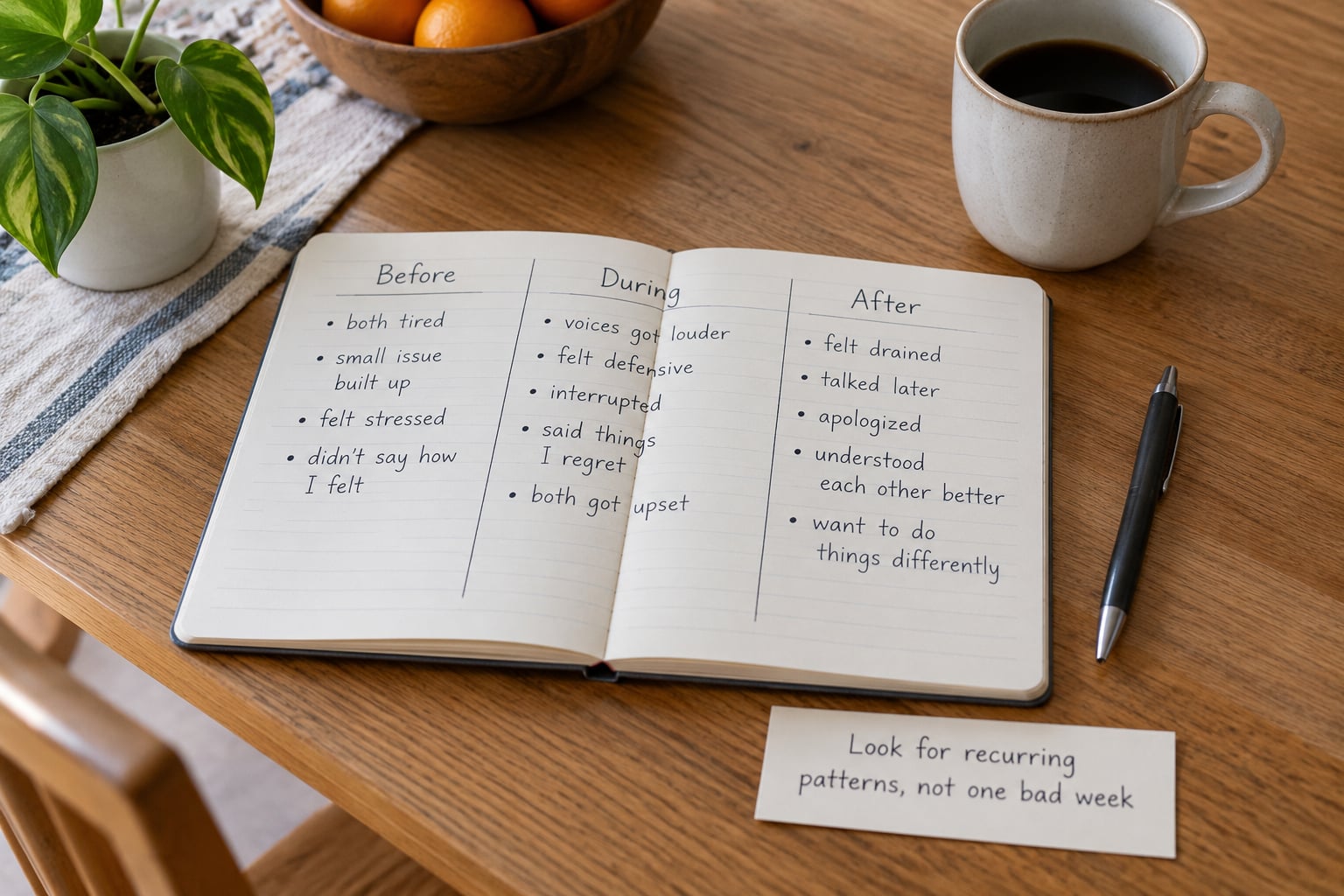
Temporary stress and a broken relationship look different once you plot them on a timeline. A hard month at work, a sick parent, a newborn, a move — those squeeze a relationship and it usually rebounds. A pattern does not rebound.
Pick one interaction that went badly and write down three things: what happened in the hour before it, what happened during it, and what happened in the day after. Do the same for a second incident from a different week. If the shape is the same — her comment about the money turns into an accusation about your mother, you leave the room, three days of cold silence — you are looking at a cycle.
Most people can name a pattern once it is drawn out. Almost nobody can name one from inside the argument itself.
2. Notice whether communication has become unsafe or unproductive
The Gottman Method, one of the most widely used couples approaches, describes four habits that reliably damage a relationship: criticism, contempt, defensiveness and stonewalling. Three signals are worth watching in your own conversations.
- Interrupting that never lets you finish a sentence, no matter who starts.
- Insults, sarcasm, eye rolls or name-calling that go up in intensity as the conversation does.
- Shutdowns — the silent treatment that lasts hours or days with no agreed plan to return to the topic.
One therapist’s shorthand that most people recognize: a conversation is productive when you are still talking afterward. If every discussion about money, sex, family or future ends the same way, with one person hurt and the other exhausted, that is a communication breakdown rather than a disagreement about the dishes.
Contempt deserves its own line. Mockery is not the same as healthy criticism, and researchers who study couples treat it as a stronger predictor of trouble than criticism does. If one partner routinely makes the other feel small for the sake of the room, that is not a communication style to fix at home.
3. Check whether basic needs and responsibilities are going unmet
Frustration that repeats usually traces back to a specific request that keeps getting ignored. Household labor, money, parenting, time together, intimacy, emotional availability, support during illness — the list changes per couple, but the structure is the same.
Write down three things you have asked for in the past six months and the response you got each time. Keep them behavioral rather than character-level. “We have argued about who loads the dishwasher” is workable. “You do not care about me” is not, because it cannot be acted on.
Then swap lists. Often each partner is carrying a burden the other one does not realize exists.
4. See whether the same issue keeps returning unresolved
Different opinions do not mean a relationship needs counseling. Couples are allowed to disagree about money, politics, family boundaries or how often to see your parents. What matters is whether the disagreement gets settled, repaired or at least paused with a plan.
List the arguments you have had more than twice this year. For each one, note whether you reached an understanding, agreed to disagree, or ended the same way you ended the last time. Add any repairs you attempted — a conversation the next morning, an apology, a change in the schedule — and whether they held.
Unresolved is the operative word. You are not looking for harmony; you are looking for a pattern of returning to the same unresolved loop. That loop is what therapy targets, and it is the pattern where you most need a professional rather than another weekend of trying harder.
5. Consider whether distance means you need couples counseling
Emotional drift rarely announces itself. It shows up as logistics-only conversation, affection that has become habit, separate calendars, no curiosity about the other person’s day, and a sense that you manage a shared life rather than share one.
Compare the relationship now with six months or a year ago. Pick three specific things, not general feelings: how often you talk about something that is not a task, how long your last real conversation lasted, and when you last laughed together. If all three have shrunk, you are looking at distance rather than a rough patch.
It also helps to separate circumstance from erosion. Working opposite schedules through a hard season is not the same as sitting in the same room with nothing to say. One is a condition, and the other is a direction.
6. Decide whether both people are open to participation
Couples work responds best to both partners engaging honestly and respectfully, and it works better earlier than later. But one person’s willingness is enough to start the conversation. On r/couplestherapy and r/TalkTherapy, the most common question is what happens when only one partner will even discuss it, and the answer is usually: go alone, ask precise questions, and let the invitation sit without pressure.
What does not work is turning the suggestion into an ultimatum or a verdict. Presenting therapy as evidence of failure reliably produces a no.
If you are the partner who does not want to go, saying so plainly is worth more than a silent refusal. Naming the worry — cost, feeling judged, fear of hearing that it is over — gives the other person something to respond to.
Common Mistakes
Most couples who regret waiting did something predictable first.
Waiting until it is a crisis
Many people describe a turning point: a major fight, an ultimatum, or the discovery of an affair. Threads about couples counseling repeatedly note that the same relationship could have been helped months earlier with far less damage to repair. Early counseling is cheaper emotionally, not necessarily financially.
Treating counseling as a test of who is at fault
A good couples therapist is not a referee. If you go in expecting a verdict and get a listening exercise instead, that is the model working, not failing. Couples who arrive trying to win tend to leave with less than couples who arrive trying to understand the cycle.
Bringing vague accusations instead of specific observations
“You never listen” gets a defense. “When I talked about the trip, you answered with your phone and then asked what I wanted for dinner” gets a real response. Specific, observable behavior can be discussed. Character judgments can only be defended.
Expecting every session to feel better
Sessions often surface old material before anything improves. People frequently describe the early weeks as more intense than the fights they came in with. Comparing a session to an imagined perfect conversation is a good way to decide it is not working.
Choosing a provider on scheduling or fees alone
Availability matters, since you need two calendars to align, but fit matters more. Look for a licensed marriage and family therapist, licensed clinical social worker or licensed professional counselor with actual couples training — Gottman, Emotionally Focused Therapy, IBCT or discernment counseling. Ask what their typical length is, what they charge, whether they bill insurance, and what happens if you decide to stop.
Using counseling to excuse threats, coercion or abuse
Couples therapy asks both partners to be safe enough to be honest. Intimidation, threats, controlling money, tracking a partner, or physical violence are not the kind of conflict a couple can work through together in a room. Those need outside help — and often separate support for the person being hurt. If you are in immediate danger in the United States, the National Domestic Violence Hotline is 1-800-799-7233, and the 988 Suicide and Crisis Lifeline takes calls and texts 24/7. Outside the US, your national domestic violence service will do the same job.
A practical note for queer couples: search for a therapist who works with LGBTQ+ clients and asks about chosen family, coming-out timelines and non-heteronormative assumptions by default. You should not have to train a therapist in your own life before the first session.
Frequently Asked Questions
Does every recurring argument mean a couple needs counseling?
No. Couples disagree about money, family and politics without needing a therapist. The signal is not disagreement but a loop: the same fight returns, ends the same way, and no repair has held for months. If you can name what you both need, try once, and land somewhere different, you are handling it yourselves. If the same conversation keeps resetting to zero, that pattern is worth professional help.
What if only one partner is willing to try couples counseling?
You can still do something useful. Ask for specifics rather than a verdict: what would you want to be different, and what would you be willing to try. Some couples begin with a discernment counselor when only one person is considering separation. You can also book individual sessions for yourself to work out your own goals. A quiet no often softens once the other person keeps showing up without pressure.
How many couples counseling sessions are usually needed?
It depends on the goal and the approach. Couples often book eight to twelve sessions and see measurable shifts in how they argue by the third or fourth. Gottman-based work tends toward a defined arc, while Emotionally Focused Therapy often runs longer because it goes after attachment patterns underneath the fights. Any therapist who promises a fix in two sessions is selling something. Ask at the first visit how many they typically recommend.
Can counseling save a relationship that is in trouble?
It can help, and it cannot promise an outcome. Couples who enter counseling earlier, with both partners willing to work, tend to see the most change. Counseling also makes a decision clearer when one is already leaning toward leaving, and that is a legitimate outcome to work toward. It will not repair a relationship where only one person is participating, or one where someone is unsafe.
What should we talk about in a first counseling session?
Bring the recent argument you can describe most accurately, with what was said on each side and how it ended. A first session is largely intake: your history, whether there is any safety concern, what you each want from therapy, and how you argue best and worst. Many therapists start by asking each partner to speak for a few minutes without interruption while the other listens.
When should we seek help for abuse or immediate danger?
Immediately, and separately from couples work. Threats, physical violence, sexual coercion, controlling money or monitoring your movements are not communication problems to solve together. A couples session asks both people to be vulnerable, which is not fair or safe when one is coercing the other. Contact a domestic violence service or your local emergency number, and consider individual counseling alongside any safety planning.
Start smaller than booking. Pick the one pattern from the six checks above that you could describe out loud without a raised voice, write it down, and take that page to a consultation call. Most therapists offer a free or short introductory call, and you are not committing to anything by asking whether they have seen your kind of situation before. Counseling is maintenance as much as rescue, and nobody has to be in crisis to deserve the conversation.