Social anxiety at events is an intense fear of being watched, judged, or embarrassed by other people, and it changes what you do, where you stand, and whether you show up at all. Most people who feel this way can still get through an event and enjoy parts of it, once they stop treating the whole evening as a single test they can fail. The way to deal with social anxiety at events is to treat it as three separate problems: the hours before, the hours inside, and the morning after. Get the before part calm and the other two get much easier.
A few words on what this guide is not. Nothing here diagnoses anything, and none of it replaces therapy or medication if a clinician has told you those are part of your care. This is the practical layer — the things you can decide tonight, tomorrow morning, and in the ten minutes before you walk through a door.
Table of Contents
- What You Need
- Step-by-Step
- Common Mistakes
- Frequently Asked Questions
- How can I manage social anxiety when I have to attend an event alone?
- Is it okay to leave an event early when I feel overwhelmed?
- Should I avoid alcohol when I have social anxiety at events?
- What should I do if I start having panic symptoms in a crowded room?
- How can I ask an event to accommodate my accessibility or sensory needs?
- Start Small and Keep What Works
What You Need
You do not need to buy anything, download an app, or find a guru. The preparation for dealing with social anxiety at events is mostly five or six decisions made in advance, and all of them are free.
- The actual details. Start time, end time, how long the drive or ride is, whether there is a coat check, where the restrooms are. Most event dread is really dread of not knowing, and unknowns shrink when you fill them in.
- One trusted person. Not a group. A specific friend who knows you are uncomfortable, has your number, and will not be annoyed if you text them from the bathroom.
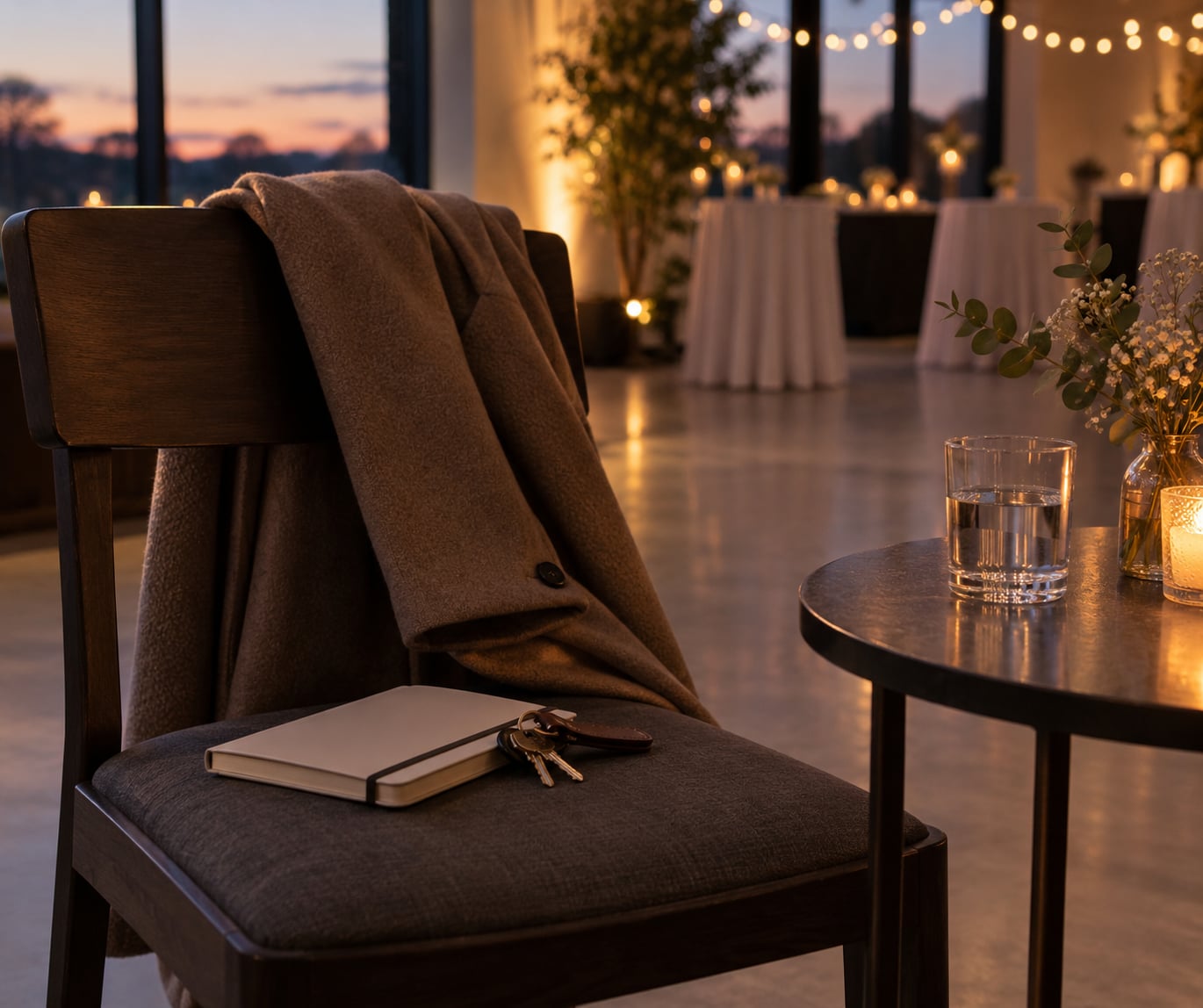
- A familiar object. Your keys, a book, a fidget, a scarf. People describe this as a security blanket, and it works because your hand has something to do.
- Transport you control. Driving yourself or having your own ride is repeatedly described by people with social anxiety as the single biggest reducer of dread, because the exit is guaranteed rather than negotiated.
- A check-in thread. One group chat or a single person, agreed on in advance, that you text when you arrive and when you leave.
- One grounding technique that you have already tried once at home, so it is not new when you need it.
Step-by-Step
1. Choose an Event That Matches Your Comfort Level
Pick events by their logistics, not by how much you wish you could handle them. Before you say yes, check the crowd size, the noise level, whether alcohol is the main activity, the length, the room layout, and how much talking will be expected of you.
Chatty brunches are harder for many people than a loud club, because in a club you can exist next to a group without joining it. A seated dinner is harder still, because you cannot exit without crossing someone’s chair. A festival is mostly weather, walking and shared experience, which some socially anxious people find easier than a reception with strangers.
Cheaper, shorter and smaller versions count. A quiet dinner instead of a party. The first hour of a gig instead of the whole night. Ask directly whether the event feels manageable, and if the honest answer is no, saying no is a legitimate decision rather than a failure.
How to tell it worked: you can say the words I am going to this without your stomach dropping.
2. Decide How to Deal With Social Anxiety at Events
Write the plan down before the day, when you are calm, and keep it in your phone. A written plan is not overthinking — it is a substitute for worrying, because worrying is planning without the answers.
Cover five things:
- Who your one safe person is, and how you will find them when you walk in.
- Your arrival route and your exit route. Walk both before you go if you can.
- Your arrival time. Fifteen to twenty minutes early avoids the door crush and lets you orient yourself first.
- Your boundaries in advance: how late you will stay, whether you are drinking, and what you will not do.
- Your leave time, decided today, with an explicit permission slip: leaving early is not a failure and does not need an excuse.
That last item does more work than the rest. Having a predetermined out removes the whole category of how do I get out of this conversation from your head, and you usually end up staying longer anyway.
How to tell it worked: someone can ask how the night was and you can answer it, because you chose the shape of the evening instead of drifting through it.
3. Arrive With a Familiar Grounding Routine
Ground yourself before you enter and again in the first five minutes, using something you have already practised. Slow breathing is the reliable one — inhale for four counts, hold for seven, exhale for eight — and you can do it in a stairwell, a car park or a bathroom without anyone noticing.
Pair it with orienting: name five things you can see, four you can hear, three you can touch. It sounds cheesy and it works, because it pulls attention out of your own internal monologue and into the actual room.
One quick text to your check-in person, then one familiar object in your hand, then one familiar face to walk toward. That is three anchors, and you only need one of them to work.
How to tell it worked: your breathing comes back under your control within about two minutes, and you can look around instead of staring at the floor.
4. Build the Experience in Small, Manageable Pieces
Treat the event as a series of short segments instead of one long block. Ninety minutes you committed to is far easier to tolerate than an open-ended evening, and most people extend it voluntarily once they are there.
Set your time limit and write it down. Then choose one thing: one person you actually want to talk to, or one activity you would enjoy even if you spoke to nobody. Pick where you stand before the room fills, and prefer a spot with a wall behind you or a clear path to the door.
Most of the time, anxiety at an event shows up in the body before it shows up in your head. These are the six signals worth having mapped in advance, along with the small correction that works for each one.
- Racing heart. Exhale longer than you inhale, five times. Feet flat on the floor.
- Shaking hands. Hold something cold — a glass, a metal rail — and let the attention sit there.
- Nausea. Move to a cooler, less crowded edge of the room. Sip water. Text your person.
- Blank mind. Stop trying to think. Ask one factual question: where they work, how they met the host.
- Feeling watched. Look at one point, then deliberately look away. The spotlight effect is usually wrong by a wide margin.
- Sudden urge to leave. Use the preplanned exit. It is a plan working, not a failure.
Take breaks on purpose rather than waiting until you need one. The bathroom is fine. So is the balcony, the hallway, the car. Plan them so a retreat is not an escape.
How to tell it worked: you can point to at least one segment that was genuinely good, which is the raw material for every later event.
5. Use Small Scripts and Respectful Boundaries
Scripts remove the load of inventing language while your brain is busy. Six lines cover most events, and none of them requires a disclosure.
- Entering a group: Hi, I’m [name] — [friend] mentioned you two, so I wanted to say hello.
- Ending a conversation: I’m going to grab some air, but it was really good to meet you.
- Declining alcohol: I’m good for now, thanks — I’m driving. Or just no, I’m good.
- Dance-floor boundaries: I’m going to sit this one out, but I love this song.
- Asking for space in a loud or crowded spot: Is there anywhere a bit quieter?
You never have to explain a boundary. The version of this that works is short, said clearly, and then not renegotiated. If someone pushes, repeating the same sentence calmly is usually enough. In my experience the room moves on in about four seconds, and the people worth knowing never minded.
How to tell it worked: someone accepted what you said without making a thing of it — which is the overwhelming majority of the time.
6. Leave Early Without Guilt and Reset Afterward
Leaving early is a legitimate use of the plan you made. You do not owe anyone a performance, a reason, or an apology beyond I have an early one tomorrow — tonight was great, let’s catch up. Send that to the host and you have converted an awkward exit into a compliment.
The morning after is where most people lose ground, because the replay starts. Twenty minutes, scheduled deliberately: write down one thing that went fine, one thing you would do differently, and one thing you want again next time. Then stop, and put something enjoyable in the rest of the day.
That debrief is the part most guides skip, and it is the single cheapest fix there is for how to deal with social anxiety at events over time. The reset turns a hard night into usable information instead of a reason to swear off the next one.
It also helps to remember the evidence. After most events, the mental recording of your own performance is longer and harsher than anyone else’s memory of it, and almost nobody replayed a single thing you said.
How to tell it worked: you can think about the event without immediately sliding into a worst-case review.
Common Mistakes
Most bad outcomes come from a handful of habits, and each one has a straightforward correction.
- Forcing a long attendance. You promised three hours to a group when you planned for one. Stick to the time you actually set, and let wanting to stay be a choice rather than a trap.
- Drinking to cope. Alcohol takes the edge off for two hours and reliably brings it back harder, with worse sleep and more rumination. Decide before you go whether you are drinking for pleasure or for nerve control, because the second reason is the one that costs you.
- Relying on someone who might leave. Building your whole evening around one person means their leaving ends your evening. Make a plan that works if they vanish.
- Skipping the exit. Knowing exactly how and when you leave reduces anxiety all evening. Not knowing does the opposite, even if you never use it.
- Rehearsing every conversation in advance. A few openers are useful. A full script is not, because real conversations do not follow scripts, and you end up performing something nobody asked for.
- Treating one hard event as proof. A rough night is data, not a verdict. Nothing you did in that room gets recorded by anyone else.
Three smaller things help too. Tell your safe person before you go, not during. Choose transport that keeps you independent. And put your phone on charge before you leave the house, because a dead battery removes the one safety net most people rely on.
Frequently Asked Questions
How can I manage social anxiety when I have to attend an event alone?
Arrive early and pick one person to orient around before the room fills. Text a single person on arrival and on departure so someone knows you are there. Sit near the edge of a group rather than the middle, keep one activity in mind, and give yourself a firm leave time decided in advance. Arriving alone is harder, but a fixed end time does more for anxiety than any coping trick.
Is it okay to leave an event early when I feel overwhelmed?
Yes. Leaving when you need to is using the plan, not failing it. Tell the host briefly and warmly before you go, something like saying you have an early morning but the night was great. You do not need to justify it or explain the anxiety. People who build in flexibility generally stay longer, and the people who matter rarely mind at all.
Should I avoid alcohol when I have social anxiety at events?
Alcohol often takes the edge off during the event and then gives it back harder, along with broken sleep and more rumination the next day. If you drink, decide beforehand how many, alternate with water, and eat something first. Being sober is fine at most events. If you feel you cannot get through a gathering without drinking, that is worth raising with a mental health professional.
What should I do if I start having panic symptoms in a crowded room?
Move toward less crowded, cooler space and stand facing a wall or an exit. Breathe in for four counts and out for eight, five times. Name five things you can see to ground yourself, and contact your check-in person. Symptoms of panic peak and fade, often within ten to twenty minutes. If you are in immediate danger, call or text 988 in the US or Canada for the Suicide and Crisis Lifeline.
How can I ask an event to accommodate my accessibility or sensory needs?
Contact the host or organiser ahead of time, in writing, and name the specific request rather than a general need. Earplugs, a seat away from speakers, a quieter entrance, accessible restrooms, or written materials instead of loud announcements are all reasonable asks, and venues that cannot deliver usually prefer to know in advance. Ask the venue directly rather than explaining yourself to staff on the night.
Start Small and Keep What Works
Pick one low-pressure event in the next month, write a three-line arrival and exit plan, and practise one breathing routine before you go. That is the whole first step, and it is genuinely enough.
Then keep only what worked and drop what did not. Changing the plan each time is not going backwards — it is how the next event gets easier than the last one. If you have read this far and still feel stuck, a licensed mental health professional is the right next call; how to deal with social anxiety at events is workable, but persistent anxiety that keeps you out of things you want to be part of deserves real support. Cognitive behavioral therapy and graded exposure are well-established routes, and plenty of clinicians offer remote sessions when being in a room is itself the barrier.