
How to plan for retirement when you are self employed comes down to three jobs: work out how much you will actually spend, open an account that suits the kind of income you earn, and automate a contribution you can repeat every month. Nobody is enrolling you, nobody is matching you, and no payroll system is making the decision for you, so the whole plan has to survive on a bad quarter as well as a good one.
The good news is that the accounts built for this exist. A solo 401(k) and a SEP IRA are the two that most people end up choosing between, with a SIMPLE IRA or SIMPLE 401(k) waiting for the day you hire staff, and a traditional or Roth IRA alongside either of them. The whole process takes a weekend.
Nothing here is financial, tax or legal advice. Figures come from IRS limits that are indexed and change, so check the current ones for your tax year before you move money.
Table of Contents
- What You Need
- Step-by-Step: How to Plan for Retirement When You Are Self Employed
- Common Mistakes
- Frequently Asked Questions
- How much should I save for retirement as a self-employed person?
- Should I choose a solo 401(k) or a SEP IRA?
- Can I have a SEP IRA and a solo 401(k) at the same time?
- Can I save for retirement if my income is irregular?
- What happens if I do not save for retirement while self-employed?
- When should I hire a professional for retirement planning?
- Conclusion
What You Need
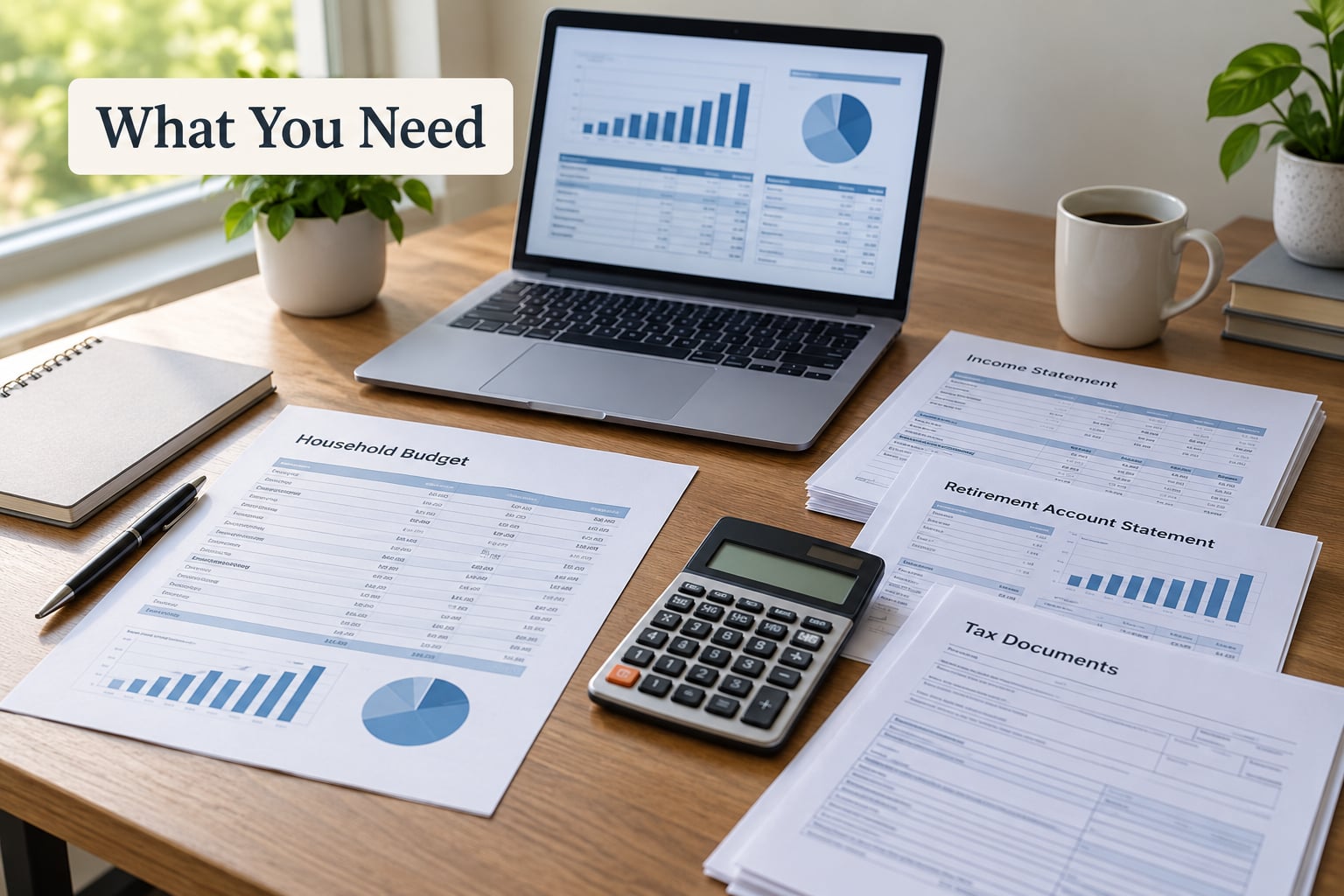
Start by collecting six things. Gathering them first turns retirement planning from a vague worry into arithmetic, and most of it is already sitting in a folder somewhere.
Two to three years of income records
Pull your 1099s, invoices and bank deposits, not your memory of them. What you need is net earned income after business expenses, because that is the base your contribution limit is calculated on. Seasonal and irregular months matter as much as the good ones here.
A spending baseline, not a guess
Three months of bank and card statements give you what you actually spend, which is usually not what you think you spend. Split it into essentials, lifestyle and travel, then decide which parts retire with you and which parts stop when the invoices stop.
Every old retirement balance you have ever had
Former employer 401(k)s, a 403(b) from a school or hospital, an IRA at a former employer’s plan, an old Rollover IRA nobody told you about. Ask each plan administrator for the statement and the plan’s distribution rules, because old accounts carry old rules.
A realistic view of tax and health costs
Self-employment tax is charged on net earnings before you can deduct anything, so it shrinks the base your contributions come from. Separately, price out your own health insurance, because losing employer coverage is the single largest cliff at the moment you stop working.
The business side of your obligations
Note outstanding debts, equipment financing, any buyout obligation, and what happens to clients and recurring contracts if you stop. If you are an S corporation owner-employees, payroll structure affects how contributions get made, which is a conversation for your accountant.
Help worth paying for
A fee-only financial planner for the plan shape and investment allocation, and a CPA or enrolled agent for the tax treatment and filings. Neither is necessary to open an account. Both tend to pay for themselves the moment the numbers stop being simple.
Step-by-Step: How to Plan for Retirement When You Are Self Employed
Step 1: Estimate Your Retirement Needs
Start with spending, not savings. Multiply your realistic monthly retirement spending by twelve to get an annual figure, then add roughly a third for healthcare in the early years of retirement, since insurance costs usually rise before Medicare coverage takes over.
Next, subtract income you expect from elsewhere. Social Security is the big one, and it matters twice for self-employed workers: your earnings record determines the benefit, and a career with lumpy income can produce a lower average than the same total earned steadily. A part-time job, a rental property or a spouse’s income can cover a meaningful slice of the gap.
Then work backward to a monthly number. A widely used planning scenario is the 4 percent rule: if you plan to withdraw about 4 percent of a portfolio in your first retirement year and adjust that amount for inflation each year afterward, a portfolio roughly 25 times your first-year spending is the classic target. Treat 4 percent as a starting assumption to stress-test, not a promise. A 3 to 3.5 percent withdrawal is the more cautious version and demands a bigger pile.
Contributions are the other half of the estimate, and age does most of the work. Fifteen percent of pre-tax income is a common benchmark for retirement contributions, with fifteen to twenty percent more helpful if you are behind. What matters more is duration. The same 500 dollars a month from age 30 over forty years produces a very different balance than the same payment from age 45 over twenty-five years, purely because of the extra compounding years.
That gap is real and common among self-employed people in their thirties and forties, and it is more recoverable than it feels. Smaller automatic contributions that never stop beat larger ones you cancel after two hard quarters.
Step 2: Understand Your Self-Employed Cash Flow
Self-employment makes the money question harder than the account question. Build four separate pots in your mind, and preferably in your bank: money for business costs, money for taxes, money for personal spending, and money for retirement.
The tax pot is the one people skip and regret. Set aside a fixed percentage of every payment the day it lands, not in April. The IRS expects quarterly estimated payments, and underestimating them produces a bill with interest attached.
For personal spending, average your last twelve months rather than your best month. When income is seasonal, pay yourself a fixed salary from the account and let the remainder fund taxes and retirement. That single change stops a slow January from becoming a retirement-funding decision.
Step 3: Open the Right Retirement Accounts
Compare the main options on the things that actually differ: contribution size, who can use it, when it must be set up, and what paperwork follows.
| Plan | 2026 IRS limit | Best fit | Setup timing | Paperwork |
|---|---|---|---|---|
| Solo 401(k) | 72,000 dollars combined for 2026 | Owners who want the highest ceiling and a Roth option | Must be established within the tax year | Adoption agreement, annual Form 5500 |
| SEP IRA | Up to 25 percent of net earned income, within the 72,000 dollar ceiling | Owners who want simplicity and cheap upkeep | Can be set up for a prior year as late as your tax return due date, including extensions | Minimal at most small plan sizes |
| SIMPLE IRA | Indexed annually, below the self-employed ceiling | Small employers with at least one employee | Before the plan year begins | Notice and plan documents |
| SIMPLE 401(k) | Indexed annually, higher than a SIMPLE 401(k) offering on a SIMPLE IRA basis | Small employers past the SIMPLE ceiling | Before the plan year begins | Full plan documents and annual filing |
| Traditional or Roth IRA | 7,500 dollars for 2026 | Side-hustlers, and anyone who also has a W-2 job | Open any time | Simple annual statement |
Limits are set by the IRS each year and are adjusted for inflation. Confirm the figures that apply to your tax year on the IRS pages before you contribute.
Two rules catch nearly everyone out. You cannot open a SEP IRA and a solo 401(k) for the same business in the same year. And you can hold both a SEP IRA and an IRA, which is a common and useful pairing: the SEP scales up in a strong year while the IRA grows every year.
A solo 401(k) puts you in two roles at once, employee and employer, which is why its ceiling is higher. A SEP IRA is employer-only, capped at a percentage of net earned income, and it costs almost nothing to run. Community consensus among solo operators leans toward the solo 401(k) when income is steady and the administrative load is welcome, and toward the SEP when simplicity is the priority.
On tax treatment, the traditional option lowers this year’s taxable income and is usually better when your rate now is higher than you expect it to be in retirement. The Roth option grows tax-free, no withdrawal tax, and works when you expect a higher rate later or want a tax-free buffer for healthcare. A SEP cannot be a Roth, though many solo 401(k) providers offer an after-tax Roth option alongside it.
For withdrawals, money before age 59 and a half generally carries a 10 percent federal penalty plus ordinary income tax, with a long list of exceptions. Required minimum distributions now begin at age 73, and rise to 75 for anyone who reaches 73 after December 31, 2032.
Nobody is making you take the money. Rolling over to another qualified plan or an IRA keeps the tax treatment intact, which is what you want if you are leaving a plan behind. The recurring question on r/tax and r/personalfinance boards is whether a solo 401(k) needs a third-party administrator, and the honest answer is that for a solo operator doing it alone, a good self-directed provider usually handles it. Once you have staff or a plan that gets complicated, that changes, and a fee is cheaper than a missed filing.
Step 4: Build a Separate Retirement Savings Habit
Automate the contribution as a percentage of income rather than a fixed dollar amount. A percentage survives a bad month; a fixed amount gets cancelled in one.
Set it up as a scheduled transfer the day after income arrives, and treat the retirement account as money you have already spent. Where invoices are lumpy, pick a percentage that a weak month can still carry, such as ten percent rather than twenty, and add a bonus contribution when a windfall lands instead of letting lifestyle creep absorb it.
Hold taxes back before you contribute. A retirement plan funded out of money that should have covered estimated tax payments is a loan from yourself with a penalty attached.
Step 5: Protect Your Income and Future Benefits
Retirement savings will not carry a household that loses its income unexpectedly, so protection comes first in the order of operations.
Keep a cash reserve that covers six to twelve months of personal expenses, held separately from business money. Insure the business itself, including disability and liability cover that a W-2 employee would once have received through an employer. Confirm who your beneficiaries are on every account, and update them after any major life change.
Spread your retirement income across more than one bucket, such as tax-advantaged accounts, a taxable brokerage account, and possibly an HSA left untouched for later. And think about client concentration: a plan built on one client is a plan with a single point of failure, no matter how good the account is.
Step 6: Review and Adjust the Plan
Set one annual review, an hour, in the same month each year. Update your spending estimate, check whether last year’s contribution actually landed, and confirm the limit you have been working from is still current.
Rebalance only if your allocation has drifted far from your target, and adjust the contribution rate after any big change: a raise, a new child, a business sale, or a shift from full-time work to a lighter load. When decisions start to involve trust, entity structure or a specific tax election, that is the moment a CPA or fee-only planner earns the fee.
Common Mistakes
Most of the damage comes from a handful of repeated errors, and every one of them is fixable now.
Waiting for the perfect month. A perfect month never arrives, and waiting one costs you a year of compounding every year you wait. The fix is a contribution small enough to survive your worst ordinary month, set up once and left alone.
Calculating the limit from gross income. Contributions are based on net earned income after expenses, and self-employment tax reduces that base before the deduction applies. The fix is to have your accountant run the number before you aim at the ceiling.
Reading a stale limit. Older pages are still ranking and still quoting limit figures from two or three years ago, plus an out-of-date RMD age. The fix is simple and non-negotiable: every dollar figure you act on needs a tax year attached to it.
Missing catch-up contributions. Once you turn 50, extra catch-up amounts become available. Leaving them unused because nobody told you is the most common avoidable loss on this whole list.
Setting up the SEP too late. A SEP can be established for a prior year up to your tax return due date, extensions included, which is a genuine advantage for someone who remembers in April. A solo 401(k) has to be established within the tax year it covers.
Treating retirement savings as the first dollar out. Retirement contributions funded out of the emergency reserve end up funding emergencies at retirement prices. Build the cash buffer first, then contribute.
Going it completely alone. Self-employment removes the plan, the match and the HR department, but not the need for advice. One hour with a fee-only planner or a CPA is cheap against the cost of a missed filing or a badly structured plan.
Frequently Asked Questions
How much should I save for retirement as a self-employed person?
Aim for a savings rate that replaces the income your business provided, then check it against a spending estimate rather than a windfall goal. A common benchmark is around 15 percent of pre-tax income, and 20 percent or more helps if you are behind. Start with an amount your slowest month can carry, raise it in good quarters, and re-run the numbers every year as your lifestyle settles.
Should I choose a solo 401(k) or a SEP IRA?
Choose a solo 401(k) if your income is fairly steady and you want the higher combined ceiling, a Roth option and the ability to borrow from the plan; it must be established within the tax year and requires annual filing. Choose a SEP IRA if simplicity and low cost matter most; it is employer-only, can be set up for a prior year up to your filing deadline, and most small plans avoid extra paperwork.
Can I have a SEP IRA and a solo 401(k) at the same time?
Not for the same business in the same year. You can pair a SEP IRA with a traditional or Roth IRA, which is a common setup because the SEP scales with income while the IRA grows every year regardless. You can also hold a SEP IRA while you have a W-2 job elsewhere, though that job’s plan usually offers better options. You cannot contribute to both a SEP and a solo 401(k) for the same trade or business in one year.
Can I save for retirement if my income is irregular?
Yes, and irregular earners are the main people these plans were built for. Contribute a percentage of every payment instead of a fixed amount, hold back taxes before you contribute, and pay yourself a fixed salary from a separate account so slow months do not become a retirement decision. A strong quarter can fund a bonus contribution, and the deadline extension on a SEP gives you room to act on a good year after it ends.
What happens if I do not save for retirement while self-employed?
You are planning to work longer than you intended and lean on Social Security, taxable savings and possibly family support, and none of that is guaranteed. The bigger cost is compounding: the same monthly payment started fifteen years earlier produces a substantially larger balance. Starting late is still worth doing, because later contributions benefit from the same tax treatment and from years you would otherwise spend working.
When should I hire a professional for retirement planning?
Hire a fee-only planner once your investments, business structure and timeline stop being simple, and a CPA or enrolled agent when entity elections, S corporation payroll or filing obligations are involved. Early on, a competent retirement plan document and clear software are enough. The useful trigger is complexity you cannot resolve with one search, not a particular dollar amount in your account.
Conclusion
Start this week with three actions. Work out your annual retirement spending from real statements, request a statement for every old workplace retirement account you have ever had, and pick a contribution you could fund in your worst ordinary month.
Then open the account that matches your income pattern and set the transfer to run automatically. Check the current IRS limits for your tax year, and bring in a CPA or fee-only planner once the numbers stop being obvious.