How to start investing with small amounts is simpler than most guides make it sound. Open a brokerage account with no minimum, buy fractional shares of a low-cost index fund, and automate a contribution small enough that you will not miss it. Ten or twenty dollars a month is enough to begin, and the habit is the part that actually matters.
The part people get wrong is waiting. A small amount invested for thirty years beats a large amount invested for one, and most beginners who regret their first decade of investing regret starting late, not starting small.
- Open a no-minimum brokerage account. Most large US brokers let you open one online with no deposit floor.
- Use fractional shares. Buy a slice of a share of a fund or stock for as little as one dollar.
- Choose a diversified, low-cost index fund. One broad fund holding hundreds of companies is the whole job.
- Automate the contribution. Set a recurring transfer on payday and leave it alone.
Table of Contents
What You Need
Before you buy anything, four things have to be in place. Skipping them is how small investments turn into small headaches.
An emergency fund
Keep one to three months of essential expenses in a high-yield savings account before you invest a dollar. Bank and credit union accounts are insured by the FDIC or NCUA up to legal limits, and the interest rate moves with the Fed. If a car breaks down next month, you should not be selling investments to pay for it.
High-interest debt cleared or nearly cleared
Credit card interest commonly runs in the teens or higher. Paying that balance down is a guaranteed return on your money, and almost nothing on the market beats a guaranteed one. Student loans in payoff order depend on your rate, balance, and forgiveness programs, so check the current terms on the servicer’s site before assuming which balance goes first.
A brokerage account
Either a tax-advantaged retirement account or a plain taxable brokerage account. Most brokers now offer both, sell commission-free stocks and ETFs, and support fractional shares. Pick one you can actually navigate rather than the one with the longest feature list.
A goal with a timeline
Money you may need in three years and money you will not touch until twenty-five years from now are not the same money. Write down what the account is for and roughly when you will use it, because that timeline decides how much volatility you can survive.
A number you can survive a bad month in
Start from your real budget, not a round number you saw somewhere. If a slow month would make the transfer feel painful, halve it. The amount that survives your worst month is the amount that will still be there in ten years.
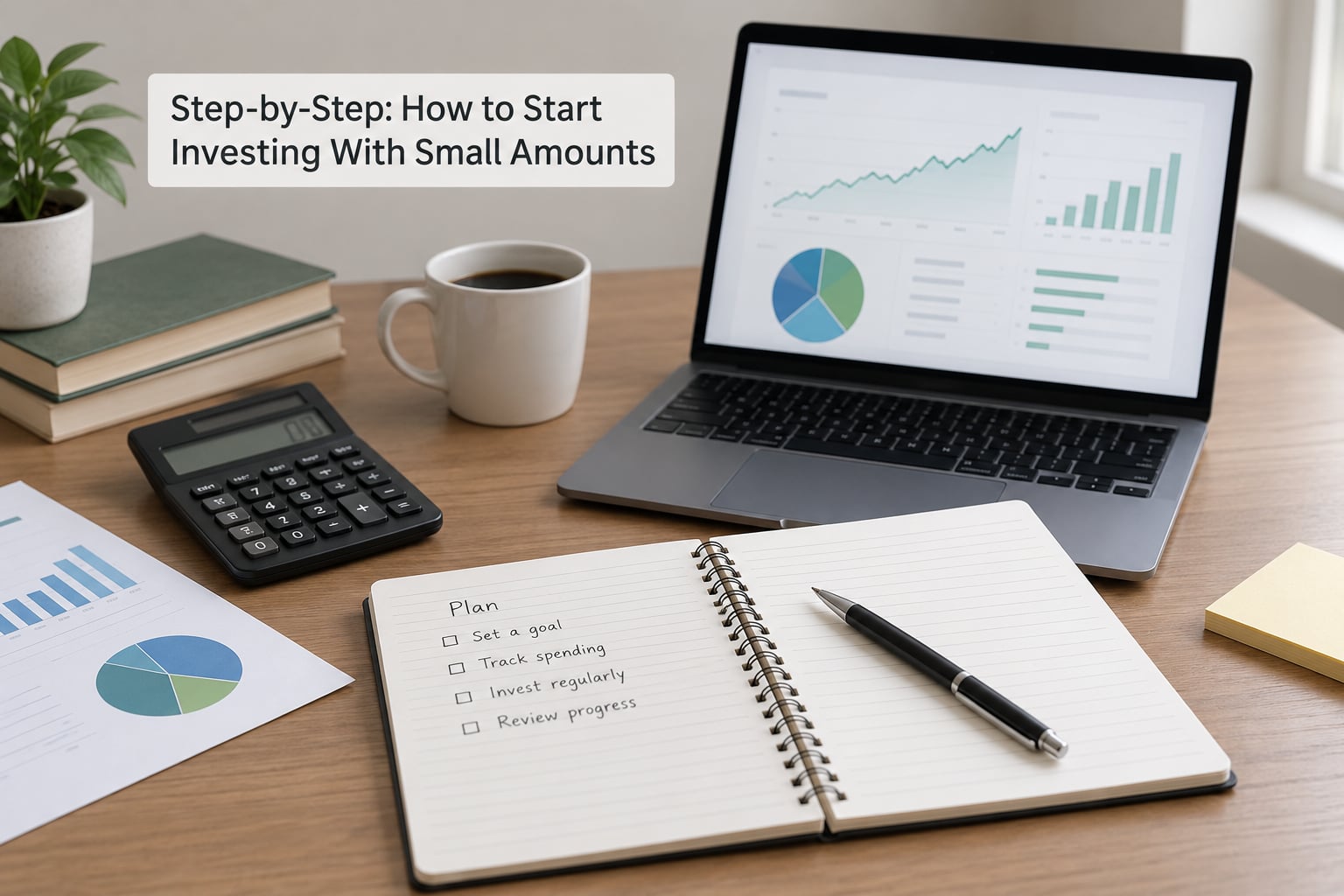
Step-by-Step: How to Start Investing With Small Amounts
Step 1: Set a Small, Sustainable Amount You Can Live Without
Most people start somewhere between five and fifty dollars a week. The exact figure matters less than whether it survives a month where you are short on cash.
Weekly transfers often stick better than monthly ones because they take twenty seconds and feel almost invisible. Monthly transfers of the same total work just as well, and they line up with most people’s paydays. Whichever you pick, set it up to happen automatically so you are not making a fresh decision every time.
Round-up investing is a different habit with the same goal. Spend a few dollars on coffee, the app rounds the purchase up and sweeps the difference into an account. It is a decent way to build the habit, but the totals add up slowly, so treat round-ups as a floor and add a real recurring transfer once you can.
If your income changes month to month, set a percentage rather than a fixed sum. Send a set share of every payment to the brokerage the day it lands, and let the amount float. The transfers stay automatic and the contribution shrinks in lean months instead of stopping.
Step 2: Choose the Right Account Type
The account decides your taxes, your access to the money, and how much you can put in. Four account types cover almost everyone starting small.
| Account | Tax treatment | Access to the money | Annual limits |
|---|---|---|---|
| Employer 401(k) or 403(b) | Deductions reduce taxable income now; withdrawals generally taxed in retirement | Mostly locked until retirement age, with loans and hardship withdrawals | Set by the IRS each year |
| Roth IRA | Contributions made after tax; qualified retirement withdrawals tax-free | Contributions can be withdrawn any time; earnings are locked until retirement age | Set by the IRS each year, with income rules |
| Traditional IRA | Contributions may be deductible now; withdrawals generally taxed in retirement | Early withdrawals often trigger a penalty plus tax | Set by the IRS each year |
| Taxable brokerage account | No deduction going in; dividends and gains taxed as they are realized or received | Fully available whenever you want it | No contribution limit |
Contribution limits, income thresholds and catch-up provisions change every year, so read the current figures on the IRS site rather than trusting a number from an article, including this one.
Two rules of thumb carry most beginners the right distance. If your employer matches retirement contributions, take the full match first. It is an immediate return on money you would otherwise keep in a checking account, and nothing on the market reliably beats it.
A Roth IRA is usually the better next step, because growth inside it is untaxed and withdrawals in retirement are not taxed either. The catch is that contributions generally require compensation, and the annual limit means a small monthly transfer may not fill the room in a single year. Unused room carries forward for a limited number of years, so contributing what you can every year matters more than hitting the ceiling.
Use a taxable brokerage account when you want access without restrictions, when retirement investing is already handled, or when your income puts you over the Roth contribution rules this year.
Step 3: Pick Simple, Diversified Investments
One broad, low-cost index fund is a complete beginner portfolio. It holds hundreds of companies in a single purchase, and its expense ratio is often a fraction of one percent a year. Investors on beginner forums reach for the same conclusion: a total market or S&P 500 index fund first, individual stocks much later if at all.
A hundred dollars is genuinely enough to start. With fractional shares you can buy ten dollars of a broad index fund and own a slice of it, with the leftover dollars accumulating toward a full share. Individual stocks are only split into fractional pieces, so if that is what you are buying, you are still exposed to one company’s news.
Bonds and bond ETFs add ballast to a portfolio that is too stock-heavy, and target-date funds mix stocks and bonds in one pick based on the year you plan to retire. Both are useful. Neither makes you money with certainty, and diversification spreads risk across many holdings without promising a profit or protecting you from a downturn.
Step 4: Check Fees, Minimums, and Risk
Fees are the one thing you fully control, and they are the biggest reason tiny accounts stall. A flat one-dollar monthly fee on a fifty-dollar balance is twenty-four percent a year, which quietly eats the contribution before it invests.
Compare expense ratios first. Broad index funds often charge between zero and four-hundredths of a percent a year, while automated advisors commonly take a quarter percent of assets. On small balances that gap is the whole difference between compounding and standing still. Then check trading costs, bid-ask spreads, withdrawal fees and any account minimum.
Minimums matter more than people expect. Some funds and some account types still require a floor, and a broker that demands a thousand dollars before it will talk to you is a bad fit for a fifty-dollar start. Most large brokers now handle small fractional purchases across their range of funds, but check the current list rather than assuming.
Risk here is simple to describe and hard to feel. Every investment can lose value, including broad index funds, and the longer your money stays invested the more time it has to recover. What matters is the gap between when you need the money and when you plan to use it, and whether you could watch a bad year without selling.
Step 5: Automate Contributions and Avoid Constant Trading
Set the recurring transfer once and stop thinking about it weekly. Turn on dividend reinvestment at the same time so payouts buy more shares instead of sitting in cash. That is dollar-cost averaging in practice: you buy more shares when prices are low and fewer when they are high, without trying to time anything.
Trading often is the expensive habit. Each buy and sell spreads money out in fees and taxes, and reacting to headlines means selling low. The people who describe steady automated contributions as the thing that finally worked for them all say the same thing. The automation removed the decision, and the decision was the problem.
Step 6: Review and Adjust Over Time
Check in a few times a year, not daily. Watch contributions and fees rather than daily balance changes, because balance changes are mostly noise over a short window.
Raise the contribution whenever your income rises. A bump from twenty to thirty dollars a month is worth more over decades than chasing a hot sector. Rebalance once a year if your mix has drifted, and revisit the account type as your income and goals change.
Micro-investing apps get you started, and there is nothing wrong with using one. When the balance outgrows round-ups, or when you want individual funds and tax-advantaged accounts on the same screen, move to a full brokerage and transfer the account. Plenty of beginners describe exactly that path, and it is a reasonable graduation rather than a failure.
Common Mistakes
- Investing the emergency fund. The money you need next month belongs in savings. Keep the fund intact and invest the rest.
- Borrowing to invest. Margin and borrowed money turn a normal bad month into a forced sale. Invest only money you already have.
- Chasing whatever just worked. Popular sectors draw crowds after the run. Slowing or declining funds usually get the loudest attention, right after they fell.
- Putting everything in one holding. One stock is one company with one forecast. A broad index fund spreads that risk for a fraction of the fee.
- Ignoring fees and minimums. On small balances, a fixed fee can wipe out a year of gains. Read the fee schedule before you fund the account.
- Checking the account constantly. Daily watching turns normal volatility into anxiety, and anxiety turns into selling. Look twice a year.
- Believing a quick turnaround exists. Moving a small balance tenfold in a month is not a strategy. Nobody can promise it, and anyone who does is selling something.
- Starting with the account, not the goal. Open the account type that matches when you need the money, then fill it.
Frequently Asked Questions
Is it worth investing a small amount?
Yes, with the right expectation. A small consistent contribution builds the habit and puts real compounding time to work, and it costs you nothing to start today. But small amounts alone rarely fund a retirement, so treat them as a floor and raise the amount as your income grows.
How does micro-investing work?
Micro-investing means buying small amounts rather than whole shares. With fractional shares, a broker sells you a slice of one share, so a few dollars buys a piece of a fund or stock. The amount is held until it adds up to a full share. Fees are usually low, but small balances are sensitive to flat account fees.
Is 100 dollars enough to start investing in stocks?
Yes. With fractional shares, 100 dollars can buy a slice of a broad low-cost index fund instead of one or two individual shares. That gives you exposure to hundreds of companies rather than one or two, which is the safer beginner position. Start there and add money on a schedule.
What is the best way for a beginner to invest small amounts?
Open a no-minimum brokerage, take any employer retirement match first, then buy a broad low-cost index fund with fractional shares and automate a small recurring transfer. Check the expense ratio before you buy, since fees hit small balances hardest. Keep the money you might need soon in savings instead.
Should I pay off debt or invest a small amount?
Pay off high-interest debt first, usually credit cards, because that interest rate is a guaranteed cost you can erase. High-interest debt outranks investing until the balance is gone. Once it is cleared, invest the same amount you were paying, plus whatever you can add without touching your emergency fund.
How can I turn 100 dollars into 1000 dollars quickly?
You generally cannot, and any method that claims otherwise carries a serious risk of loss. Doubling money in weeks usually means leveraged trading, concentrated bets, or a scam. Small regular contributions over years is the reliable route. Steady compounding on an amount most beginners think is too small works.
Conclusion
Start with the first action, not the perfect plan. Build one to three months of emergency savings, clear credit card balances, then open the account that matches your timeline and take any employer match on the table.
From there, put a small sum you will not miss into a broad low-cost index fund every month, automated so you do not have to decide again. Revisit it twice a year, raise the amount when your income rises, and let the time do the work. Revisited for 2026, since account rules and limits change.
Account rules, tax treatment and contribution limits vary by country and state and change from year to year, so confirm the current details with the IRS and your broker. Nothing here is personal financial advice, and every investment carries the risk of losing value.