To prepare for a doctor appointment, write down your main concern, build a current list of every medication and supplement with doses, note when your symptoms started and how they changed, and gather your photo ID, insurance card, pharmacy details and any prior records. Add your pronouns and name on file, plus anything about gender-affirming care or sexual health that is relevant to the visit. Thirty focused minutes the night before is usually enough, and it turns a rushed visit into a plan.
Most providers see up to 20 patients in a day, and the average person manages roughly three visits a year. That gap is where things get lost: the questions you meant to ask, the medication you forgot to name, the detail that would have changed the answer.
Preparation fixes that. It is also the part of the appointment you fully control. This guide walks through what to gather, how to organize it, how to share personal details without over-sharing, and what to confirm before you leave the room. It is written with LGBTQ+ readers in mind, though every step works for anyone.
A note before we start: nothing here is medical advice. Your doctor, nurse practitioner or pharmacist is the right person for anything about your specific body or treatment. If something feels urgent or emergent, do not wait for an appointment.
Table of Contents
- How to Prepare for a Doctor Appointment: What You Need
- Step-by-Step: How to Prepare for a Doctor Appointment
- 1. Define the main reason for your visit
- 2. Build a clear symptom and health-history timeline
- 3. Organize medications, supplements, and medical records
- 4. Write questions and decide what you need to discuss
- 5. Prepare how you will share personal health information
- 6. Plan the practical details of the appointment
- 7. Review the plan before leaving the appointment
- Common Mistakes When Preparing for a Doctor Appointment
- Frequently Asked Questions
- What should I bring to a doctor appointment?
- Do I have to tell my doctor my sexual orientation or gender identity?
- How do I bring up a symptom I find embarrassing?
- How do I prepare for a telehealth appointment?
- What if the appointment is rushed and I did not get to everything?
- How far in advance should I prepare for a doctor appointment?
- Conclusion
How to Prepare for a Doctor Appointment: What You Need
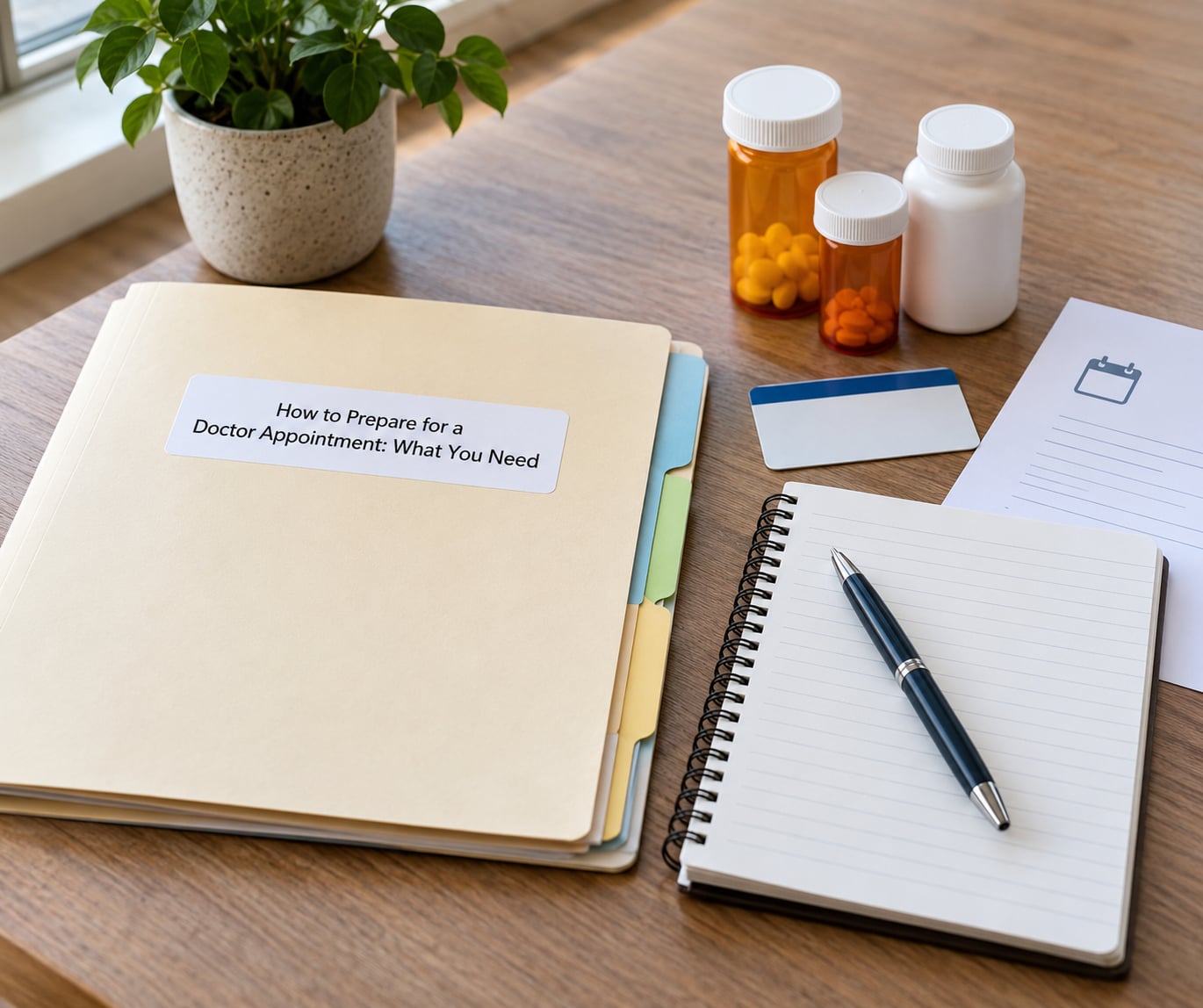
Gather these before you leave the house, not in the car on the way there.
- Photo ID and insurance card. Both, every time. If you are new to the practice, the front desk cannot check you in without them.
- Appointment confirmation. The address, the floor, the parking situation, and whether there are forms to complete online first.
- A written medication list. Prescriptions, over-the-counter drugs, vitamins, supplements, doses, and how often you take each one. Bringing the bottles themselves is even better.
- Allergies and reactions. What you are allergic to and what happened when you were exposed.
- Your pharmacy name, address and phone number. New prescriptions cannot be sent anywhere else without your say-so.
- Prior records. Lab results, imaging reports, discharge summaries, and the name of your last primary care provider. You can request these ahead of time and have them faxed over.
- Your symptom timeline. A few notes on when things started, how they changed, and what makes them better or worse.
- Your questions, ranked. Three to five, in priority order, not eleven.
- Name and pronouns. Your legal name, the name you actually go by, and your pronouns. Knowing how you want to be addressed is a reasonable thing to say out loud.
- Relevant care details. Current hormone therapy or blockers, the clinician who prescribes them, dates of any changes, and what you have had screened before.
- A support person, if you want one. A friend, partner or parent can take notes or repeat back questions. Tell the office when you book so they are counted in the room.
That last group is the one most people skip, and it is where a lot of discomfort comes from. If you are on gender-affirming hormones, your provider needs the details to order labs safely and to avoid interactions. If you take PrEP or are due for STI screening, saying so early gets it scheduled instead of forgotten at the end of a visit that already ran long.
Step-by-Step: How to Prepare for a Doctor Appointment
1. Define the main reason for your visit
Write one or two sentences describing why you are going. Not a diagnosis, just the plain version: “I have had a sore throat for nine days, it is worse at night, and swallowing hurts.”
Then rank your concerns. Many visits have a primary reason plus three things you would like to mention if there is time. Decide now which is first, because once you are in the room the pressure of the clock will do the deciding for you.
You know you have ranked them when you could hand the list to a friend and they would know what to bring up first.
2. Build a clear symptom and health-history timeline
Start dates beat vague descriptions. Write down when the symptom began, how it has changed since, how often it happens, how bad it gets on a scale from one to ten, and what makes it better or worse.
Add context while it is still fresh: a new medication, a change in dose, an injury, a stressful month, a new partner, a change in routine, travel, or a shift in sleep. Clinicians draw real conclusions from that list, and it is the part patients most often leave out.
Note your personal history in whatever chunks apply: past diagnoses, surgeries, hospitalizations, mental health treatment, and family health history such as heart disease, diabetes, cancer or thyroid conditions in relatives. If you do not know a family history detail, say so rather than guessing. Records can be requested later.
You have a usable timeline when you could read it aloud in under two minutes and it would not leave the listener guessing.
3. Organize medications, supplements, and medical records
Medication reconciliation is the step that catches dangerous interactions, so take it seriously. Include prescriptions, over-the-counter drugs, vitamins, supplements, herbal remedies, and anything you take occasionally for sleep, pain or allergies.
For each item, write the name, the dose, and how often. If you take something occasionally, note that too, because the answer to how often is often roughly once a week.
Photograph every bottle on your phone before the visit. Photos of labels beat memory, especially for the multivitamin you started six months ago and take on a schedule nobody else knows.
For records, call the previous office or the specialist and ask them to send relevant labs and imaging to the new provider. Give yourself several business days. Many offices need the request in writing, and some require you to sign a release.
Check whether the visit involves fasting labs, a lab draw during the appointment, or a scheduled procedure. Fasting instructions mean nothing but water, usually for eight to twelve hours, and guessing wrong means a redraw. When the instructions are unclear, ask the office before the visit instead of at the counter.
4. Write questions and decide what you need to discuss
Sorting questions by category is what stops the two that matter from getting crowded out by the twelve that do not.
- Symptoms: what is causing this, what else could it be, and what should worry me about it.
- Tests: what is being ordered, why, when, and how the results will reach you.
- Treatment: the options, the tradeoffs, what happens if I do nothing, and what to expect in the first two weeks.
- Cost and logistics: what your plan covers, whether a referral or prior authorization is required, and which pharmacy they are sending it to.
- Prevention: what screening you are due for and when.
- Follow-up: when you come back, what would trigger a call before then, and how to reach the office after hours.
Keep the ranked top three visible. Readers on r/AskDocs and r/Adulting say the same thing over and over: people walk in with eleven questions, answer the first one, and forget the rest in the parking lot.
You are done when you can say which three questions, if nothing else got covered, you still want answered.
5. Prepare how you will share personal health information
Decide in advance what is relevant to this visit. Sharing everything is not the goal; sharing the parts that change the care is. A clinician cannot advise on hormones, contraception, sexual health or mental health if those pieces never enter the room.
Have a short version ready for how you introduce yourself. Many people say at the start: “I go by Sam, my pronouns are they and he, and I have been on testosterone for two years at a dose of 100mg every two weeks.” That one sentence sets names, pronouns and relevant medical context in about ten seconds, and it removes the chance of your records defaulting to the wrong one.
Some patients prefer to correct each misgendering politely and move on rather than make it a confrontation. Others want it addressed directly. Both are fine. Deciding your approach beforehand means you are not improvising while a gown is open and the clock is running.
Prepare language for the harder topics too. Saying “I have had painful sex for six months and I have not told anyone yet” takes practice, so practice it at home. You can also ask for a chaperone, ask the clinician to write down the name of the diagnosis so you do not have to keep saying it, or ask them to explain a term before moving on.
Two sentences that tend to work: “I know you have got a lot of patients today, but there is one thing I would like to raise before we finish.” And: “I have been researching this online, so please correct me if I have this wrong.”
If a provider responds badly to who you are, you can say what you need plainly: “I need this appointment to be a space where I can talk about my health.” Then use the office manager or patient advocate, and switch providers. Providers who will not work with your identity are not serving your health.
6. Plan the practical details of the appointment
Call ahead or use the patient portal to confirm the time, the address, and how long the visit is booked for. If you are new, ask whether there is paperwork to complete online in advance. Filling it out at home rather than on a clipboard in the waiting room buys you a calmer start.
Work out the logistics that quietly derail visits: childcare, a ride, time off, and whether the office has a late slot. Arrive 15 to 30 minutes early for paperwork and check-in, unless you want to minimize sitting in a waiting room full of sick people, in which case aim for five minutes before.
For telehealth, the setup matters more than most people expect. Confirm the platform and whether you need to download anything or create an account. Test the camera, microphone and speaker in that same app, and know your device’s backup if the connection drops. Charge your phone or plug in your laptop. Have your pharmacy, insurance card and medication list on the screen as images so you can hold up a bottle to the camera when asked.
Privacy deserves thought too. If you share a household or a computer, check whether the portal is on a shared profile and whether the visit link can be seen by others. You can also ask the office whether the visit is recorded and what happens to recordings.
For an in-person visit, wear clothes that let you be examined without a paper gown over your underwear. It sounds trivial until you have been behind a screen in socks.
7. Review the plan before leaving the appointment
The last five minutes protect everything you just did. Before you stand up, ask: what do you think is going on, what are we doing next, and when should I expect to hear results?
Ask for the diagnosis or the working theory in writing, since a recap is normal practice and not an insult. Get the prescription sent and confirm the pharmacy. Confirm whether labs need fasting and when, whether a referral or prior authorization is being filed on your behalf, and the follow-up date.
Also ask what should make you call sooner: which symptoms, how high a fever, how much pain. Without that, a normal reaction in a week has you wondering whether to worry.
Write the plan down in the parking lot while it is fresh. If your phone battery is cooperating, a voice memo of the recap works well. Most offices have an after-visit summary in the portal, and reading it the same evening catches the details you missed while nodding.
You did the job properly if you can repeat the plan, the timeline and the warning signs to someone else without checking your notes.
Common Mistakes When Preparing for a Doctor Appointment
These come up again and again, and each has a simple fix.
- Relying on memory for medications. People routinely misremember doses and skip supplements entirely. Fix: photograph every bottle and keep one written list you update after every change.
- Arriving with no prioritized concern. The visit wanders and the serious thing gets squeezed out. Fix: write the one-sentence summary before you book the room, not in the waiting room.
- Withholding relevant sexual-health or gender-affirming details. Silence does not protect you; it makes the advice less safe. Fix: decide in advance what is relevant and say it in the first two minutes.
- Letting your records carry the wrong name. Fix: state your name and pronouns at check-in and confirm the front desk has them right in the system, not just on a wristband.
- Saving everything for the last minute. A new-patient visit needs records requested days ahead. Fix: start the record request a week out.
- Self-diagnosing before the visit. Research is useful as a list of questions; a diagnosis you arrived with is not. Fix: write what you read and the source, then ask whether it fits.
- Going alone by default. Fix: ask someone to come or join by phone. Call the office ahead so the room is set up for it.
- Not asking about follow-up. You leave without knowing when to return or who to call. Fix: make the follow-up date the last thing on your list.
- Fasting when you should not, or eating when you should. Fix: confirm instructions before the day, and keep water allowed unless told otherwise.
Two more worth naming. Do not bring a stack of another person’s medical issues and expect them solved; if you want to raise a second, unrelated concern, ask whether it fits today or deserves its own appointment. And if you want to ask your insurer what a visit will cost, the front desk and the number on the back of your card are faster than the doctor, who rarely has the answer.
Frequently Asked Questions
What should I bring to a doctor appointment?
Bring photo ID, your insurance card, appointment details, a written list of every medication, supplement and over-the-counter drug with doses, your allergies, your pharmacy contact details, relevant prior lab results or imaging, and your ranked questions. For LGBTQ+ readers, add your name, pronouns, and details of any gender-affirming care you are currently receiving.
Do I have to tell my doctor my sexual orientation or gender identity?
You never have to disclose anything irrelevant to the visit. You do need to share information that affects your care, such as anatomy, hormones, medications, PrEP use or STI exposure, because providers cannot advise safely without it. It is also reasonable to ask that your name and pronouns be corrected in your chart, and to say so plainly at check-in.
How do I bring up a symptom I find embarrassing?
Raise it early rather than at the end, and use specific words. Say when it started, how often it happens and how severe it gets. You can ask for a chaperone, ask the clinician to write down the diagnosis so you do not repeat it, or tell them the topic is hard for you so they slow down. Practising the sentence at home makes it easier to say in the room.
How do I prepare for a telehealth appointment?
Confirm the platform and get the app or link working a day ahead, then test camera, microphone and speaker in that same app. Charge your device, plug in if you can, and keep your medication bottles, insurance card and pharmacy details on screen as photos. Find a private space, close noisy apps, and have your questions written where you can read them quickly.
What if the appointment is rushed and I did not get to everything?
Say so before you leave: there is one more thing I need to ask. If time has run out, book a follow-up before you walk out rather than calling in three weeks. Ask for an after-visit summary, write down what was decided, and use the patient portal to send the remaining question in writing so it gets logged.
How far in advance should I prepare for a doctor appointment?
A week ahead is enough for new-patient tasks such as requesting records, confirming insurance and completing forms online. The night before is enough for a routine visit: write your questions, update the medication list and pack your bag. The morning of, confirm the address and time. If labs are involved, check fasting instructions at least two days ahead.
Conclusion
Five things, in order. Identify your main concern in one sentence. Gather your medications, supplements, allergies and records. Write your questions and rank the top three. Share the personal details that affect your care, including your name and pronouns. Leave with the plan, the timeline and the warning signs written down.
If any of that feels like too much for one evening, start with the medication list and your three questions. That alone puts you ahead of most people in the waiting room.
None of this applies to an emergency. Chest pain, trouble breathing, severe bleeding, stroke signs, a sudden loss of vision, or thoughts of harming yourself need immediate attention at an emergency department or by calling emergency services. Preparation is for the appointment you have already booked.