A eulogy is a short speech, usually three to five minutes or roughly 500 spoken words, given at a funeral or memorial service to tell the people in the room who someone was. If you have been asked to write one, the work is simpler than it feels: gather a handful of true stories, arrange them around one theme, and speak them plainly.
Most people who get stuck are not bad writers. They are grieving, tired, and trying to make something sound beautiful on a deadline, usually with less time than they want. Nobody in that room is grading the speech, either. They want to hear about the person they also loved.
How to write a eulogy without rushing it takes about two to three hours of work, spread across a couple of sittings and several days if you can. Rushing is the one real risk, and it is fixable by trimming later rather than cramming now.
Table of Contents
What You Need
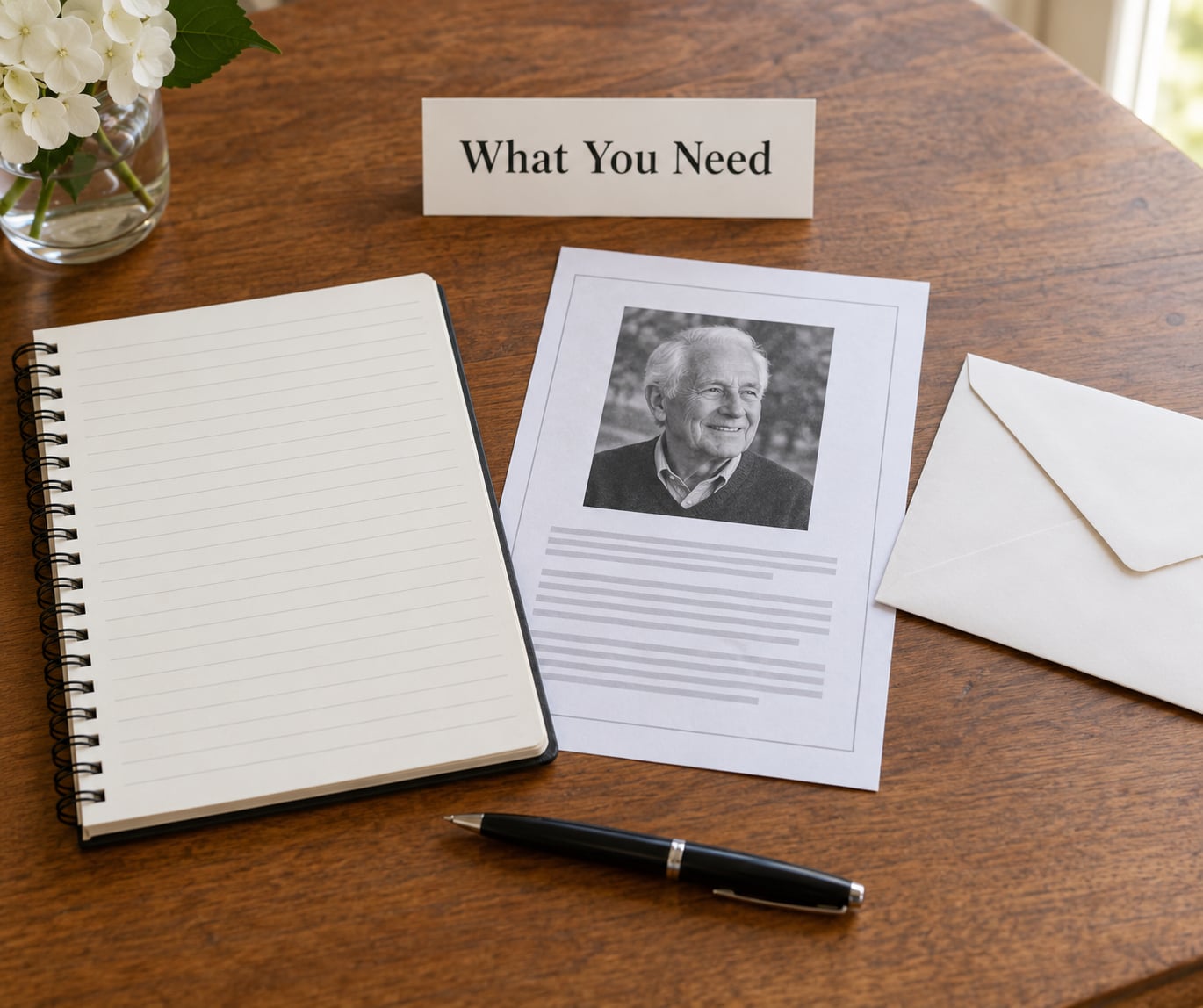
You need less than you think, and most of it is already in the room or in people’s heads.
- Basic biographical facts. Full name, dates, where they lived, what they did for work, and the names of the people closest to them. An obituary covers most of this, and the funeral home will have a printed copy.
- The service details. Date, start time, how long the service runs, and who is speaking before and after you. Call the funeral director or celebrant to confirm rather than guessing.
- Your delivery window. Most eulogies run three to five minutes. If two family members are speaking, ask how your minutes are split, so nobody gets cut off mid-sentence.
- Two or three real stories. A story needs a moment, a detail and a feeling. “She was a great cook” is not a story. “She could tell you exactly how long to boil the pasta and she was never once wrong about it” is.
- A notebook and something to record on. A phone voice memo works better than a blank page for many people. Talking is easier than typing when you are upset.
- One trusted reader. Someone who knew the person well enough to catch a wrong date or a name misspelled, and who will tell you honestly if a story runs long.
You do not need to have been the closest person in the room. You do not need a degree in English, a theology background, or a perfect vocabulary. You need true things, said simply.
Step-by-Step: How to Write a Eulogy
Choose the Voice and Purpose
Decide first what this speech is doing. Is it telling the story of a whole life, describing what the relationship was like, naming a set of values the person lived by, or doing a bit of each? Trying to do all four is the most common reason a eulogy feels shapeless.
For most people, one theme carries three to five minutes cleanly. Generosity, resilience, a love of baseball, a stubborn streak, the way they fed everyone who came through the door. Pick the one that still surprises you a little when you say it, because flat praise lands badly.
Then match the voice to you. Write the way you talk when you tell a story about them at a kitchen table. If you are formal by habit, a slightly warmer register will sound like effort rather than insincerity. Know your audience too: the service usually mixes family, coworkers, neighbors and people who met them once, so inside jokes need explaining or dropping.
Gather the Facts and Memories
Vague recollections make vague eulogies. “He was always there for me” lands as filler, because the audience has no picture of what that meant. Ask people for the specific version instead, and you will get it surprisingly fast.
Send a group text or make a few calls. Good prompts: What is a moment with them you will never forget? What did they do that made you laugh hardest? What did they insist on, every single time? What did they teach you without meaning to? What did their kitchen or car always smell like? What would they say about the person reading this right now?
The specificity is what makes a room go quiet. A particular sound, a particular phrase, a particular Tuesday afternoon. Write those down verbatim, in quotation marks, so you remember them exactly.
If you are writing for a strained relationship, or for someone complicated who did not get along with half the family, you are allowed to be honest and brief about it. Say what was true, name what was good, and leave the rest unsaid. The room already knows more than you think, and a eulogy is not a trial.
Choose a Clear Story Arc
Shape it as a beginning, a middle and an end. The beginning introduces you and the person, and sets the theme in one sentence. The middle proves the theme with two or three stories, ordered so the strongest one lands last. The end says what they meant and what the people in the room can carry out of the building.
Three stories is plenty. Two is fine. Five will turn a memorial into a lecture, and the fourth one usually repeats the third anyway.
If you are stuck on the shape, the eulogy outline is really just three questions: Who were they? What do I know about them that most people here do not? What changed because of them? Answer each one in two or three sentences and you have a draft before you have decided on a single sentence.
How to Write a Eulogy in Three Passes
Do not try to do this in one attempt. Grief makes first drafts bad, and that is normal.
Pass one, rough. Give yourself permission to be bad. Write fast, do not stop to fix anything, and keep going even when it gets clumsy. If you stall, record yourself talking instead of typing. Say the story out loud, in the voice you would use at the lectern, then transcribe it. The transcript is usually warmer and more natural than anything you would have produced while staring at a blank document.
Pass two, accurate. Fix the facts. Dates, spellings, the name of the dog, the town where the job was. This is the pass where you cut hard. Every line that does not advance the theme goes, including your favorite line, especially your favorite line.
Pass three, spoken. Read it aloud and rewrite it for the ear. Sentences you would never say out loud should not survive. Break anything longer than two lines. Mark a slash where you will breathe and a second slash where you will pause for effect.
Personalize the Tribute
Specifics are the whole craft. A detail about how they took their tea, what they always said when you arrived, the jacket they refused to throw out. Sensory details land hardest because they make the room remember instead of watch.
A short quotation helps if you have one that they actually said, and if it reads like them. You can also include a poem or a passage you want read aloud, though it is worth asking the celebrant first about timing.
Humor is fine when the joke would be funny to them and to most of the room. Laughter in a funeral is not disrespect; it is often relief. It fails when it is a punchline about the death, when it references something only three people understand, or when you are laughing because you cannot stop crying.
Be careful with private details. Nothing medical, nothing about an argument, nothing the person would not have wanted announced in a room of strangers. If you are writing for a spouse or partner, including a same-sex partner, chosen family or a long relationship your family never fully understood, this is a good place to say so plainly. The people who matter to you will hear it, and the record you leave behind will have it too.
And if a story only makes sense to you, ask yourself who else is in the room before you keep it.
Read It Aloud and Revise
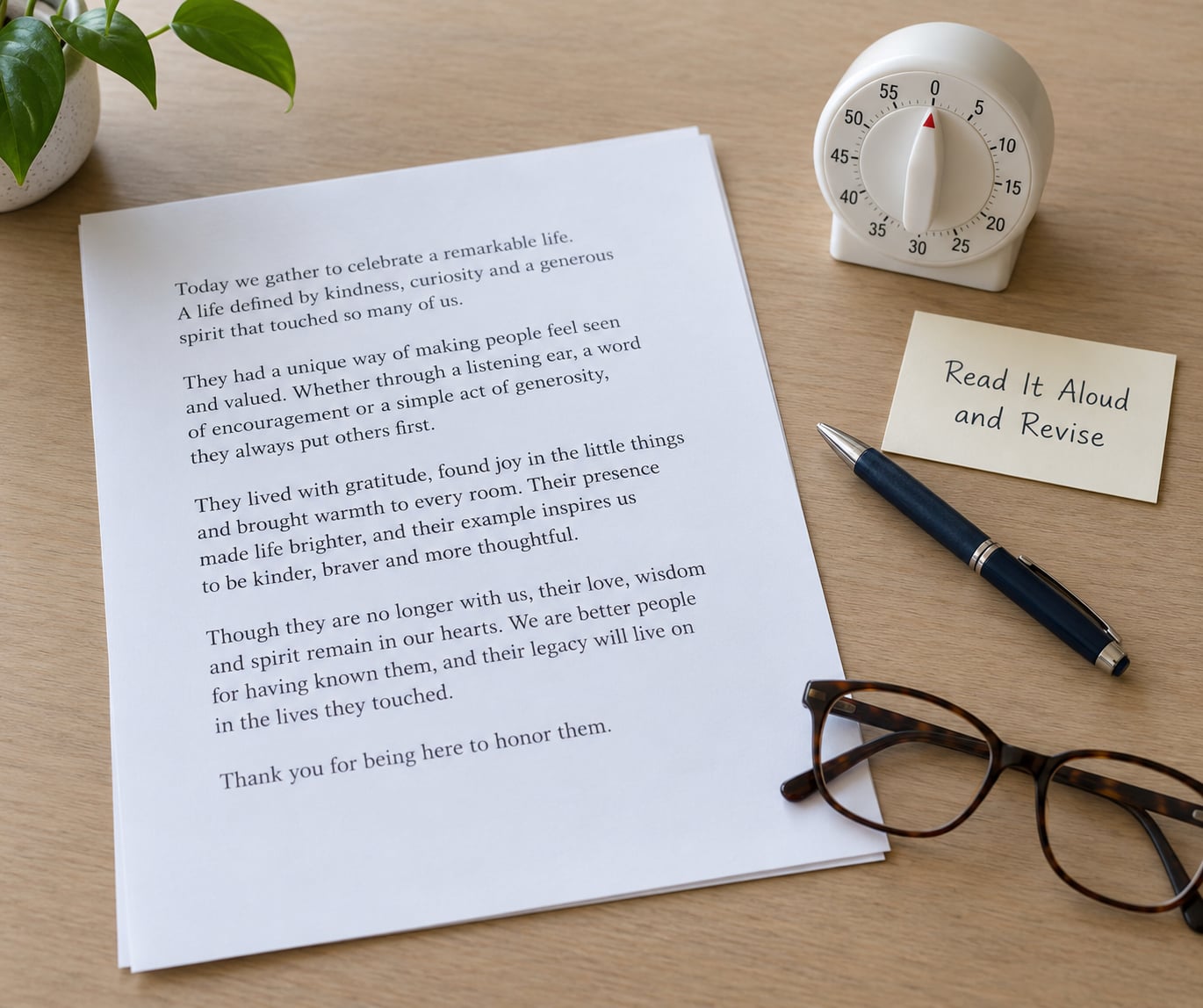
Reading it out loud is the step most people skip, and it is the one that decides whether the speech works. Timing it is the point: reading silently runs roughly a third faster than speaking, so a speech that feels like five minutes on the page can run seven at the lectern.
| Word count | Speaking time | Best for |
|---|---|---|
| 250-300 words | About 2 minutes | A short slot in a service with several speakers |
| 450-550 words | 3 to 5 minutes | The standard eulogy most services expect |
| 650-750 words | 6 to 7 minutes | The only speaker, or a celebration of life with room |
Then check the hard parts: the opening line should be sayable in one breath, and the last sentence should be the one you want echoing in the car afterward.
Prepare for Delivery
Print it in 16pt type, double-spaced, with wide margins. Big type is not about your eyesight, it is about reading around a lump in your throat. Bring three or four copies for the celebrant, the person standing behind you, and yourself, plus one more than you think you need.
Plan the mechanics before the day. Ask the celebrant where in the order you speak and who will introduce you. Stand at the front, breathe out, and count to three before the first word. Have a glass of water within reach.
Then decide in advance what happens if you break. You will pause, you may cry, and you may need thirty seconds. That is allowed and nobody in the room minds. Decide whether you want a second person standing behind you with the same text, and ask them now, not in the moment.
If you decide partway through that this should not be you, you can hand it over. The most repeated advice in bereavement support groups and grief forums is blunt and true: it is fine to decline, and it is fine to pass the pages to somebody else. The service goes on either way.
Common Mistakes
Most bad eulogies come from one of a handful of fixable habits.
- Reading a biography. Dates and career highlights are the funeral home’s job. Fix: cut every fact that does not tell the room who the person was.
- Generic praise. “She was loving and kind” could describe anyone. Fix: replace each adjective with one scene that proves it.
- No single focus. A speech about their childhood, their career, their cooking and their politics tries to be four eulogies. Fix: choose one theme and let the rest go.
- Running long. A nine-minute speech gets shortened by a nervous celebrant mid-sentence. Fix: cut to 500 words yourself and let the best 50 words go.
- Forcing humor. A joke that needs setup and a cold room is a problem. Fix: use one story with an actual punchline, told slowly, and drop it if it feels borrowed.
- Clichés about death. “In a better place,” “at rest now,” “time heals all wounds” and “putting this behind us” all describe everyone, so they describe no one. Fix: say the specific thing that is true of your person instead.
- Skipping rehearsal. Reading it once in your head is not practice. Fix: say it out loud, standing up, twice, with a timer.
- Deciding alone. A draft written with one trusted reader catches errors you cannot see. Fix: have them listen while you read, then fix what they flag.
One more thing people rarely expect to hear: the person being remembered will not hear any of it. That grief is real, and it does not cancel the point of the speech. The good things said out loud in that room are for the family, the friends and the person standing at the lectern holding the pages.
Frequently Asked Questions
How long should a eulogy be?
Aim for three to five minutes, which is roughly 450 to 550 spoken words when you read slowly. Speaking takes about a third longer than silent reading, so time it out loud rather than by eye. Ask the celebrant how long your slot is, especially when two or more family members are speaking, and cut to fit what you are given rather than what you would like to say.
When should I start writing the eulogy?
Start as soon as you are asked, because collecting memories takes longer than people expect. Most drafts are done in two or three sittings over two or three days. If the service is close, write a rough draft today and trim it tomorrow. Nobody has ever regretted starting earlier.
Should a eulogy include jokes or humorous stories?
Yes, when the joke would have been funny to the person and lands with most of the room. Laughter at a funeral is often relief, not disrespect. It goes wrong when the joke is about the death, depends on an inside reference only a few people follow, or covers up the fact that you cannot stop crying. Tell one slow story with a real punchline instead of stringing several together.
Is it better to read a eulogy from notes or memorize it?
Read it. Memorizing removes the ability to pause and makes a stumble feel like a catastrophe. Print the speech in 16pt type, double-spaced, with wide margins, and bring three or four copies. Mark breath points with slashes, and have a second person standing behind you with the same text in case you need to hand it over partway through.
How do I write a eulogy when I am grieving?
If you are learning how to write a eulogy while grieving, lower the bar instead of meeting it. Write fast and badly, then revise for facts and cut for length, and stop while you still have energy. If you cannot start, record yourself talking about a memory and transcribe it, which is often easier than typing. If it is simply too much, say so to the family and ask someone else to read it.
What should the last part of a eulogy say?
Close by naming what the person meant to you and what you hope people carry out of the room, then thank them for listening. Two or three sentences is plenty. End on an image rather than a summary, and rehearse the final line until you can say it without looking down. A simple thanks at the end also gives you a clear, graceful way to step away from the lectern.
Conclusion
Knowing how to write a eulogy starts small. Choose one memory you would tell a stranger today, text three people who loved them and ask for one story each, and write those down before the week gets away from you. From three true stories and one theme, the shape of a eulogy follows on its own.
Then write it badly, fix the facts, read it out loud twice and cut what the clock cannot hold. What is left will sound like you, and that is the only quality a room full of grieving people is actually listening for.