Finding a sliding scale clinic takes three things: a short list of places to call, a clear answer about how the clinic calculates its reduced fees, and the documents that prove your income. Most people who struggle with this never lack options. They lack a method for finding them and for confirming the discount before they walk through the door.
This guide walks through that method step by step, including the exact words to use on the phone, what to bring to the first appointment, and what to do when a clinic turns you down. It is written for uninsured adults, people with high deductibles, self-employed and gig workers, and LGBTQ+ readers looking for affordable affirming care.
If your symptoms are an emergency — chest pain, trouble breathing, severe bleeding, signs of a stroke, or thoughts of harming yourself — skip this guide and go to the nearest emergency room now. Under EMTALA, hospitals must screen and stabilize emergency conditions regardless of your ability to pay.
Table of Contents
What You Need Before You Start Searching
Gather five things before you call anyone. Having them ready turns a ten-minute phone call into a two-minute one, and it stops you from being put on hold while you dig for paperwork.
- Your location. Your ZIP code, plus how far you can travel. FQHC search tools use ZIP codes, and a broader radius usually means more options.
- Your insurance status. Whether you are fully uninsured, have a plan with a high deductible, or have Medicaid or CHIP already. This changes what you can be charged.
- Your income range and household size. Clinics calculate the discount against the federal poverty level, and household size is part of that math. A rough monthly range is enough to start.
- The kind of care you need. Primary care, dental, mental health, substance use treatment, HIV or PrEP services, and gender-affirming care are often funded and staffed separately.
- Your emergency status. If the problem cannot wait for a scheduled appointment, use urgent care or an emergency room instead of the sliding fee process.
One more thing worth doing first: check whether you qualify for Medicaid or CHIP. Many community health centers have enrollment staff on site, and being enrolled can change your cost from a reduced self-pay rate to nothing at all.
Step-by-Step: How to Find a Sliding Scale Clinic
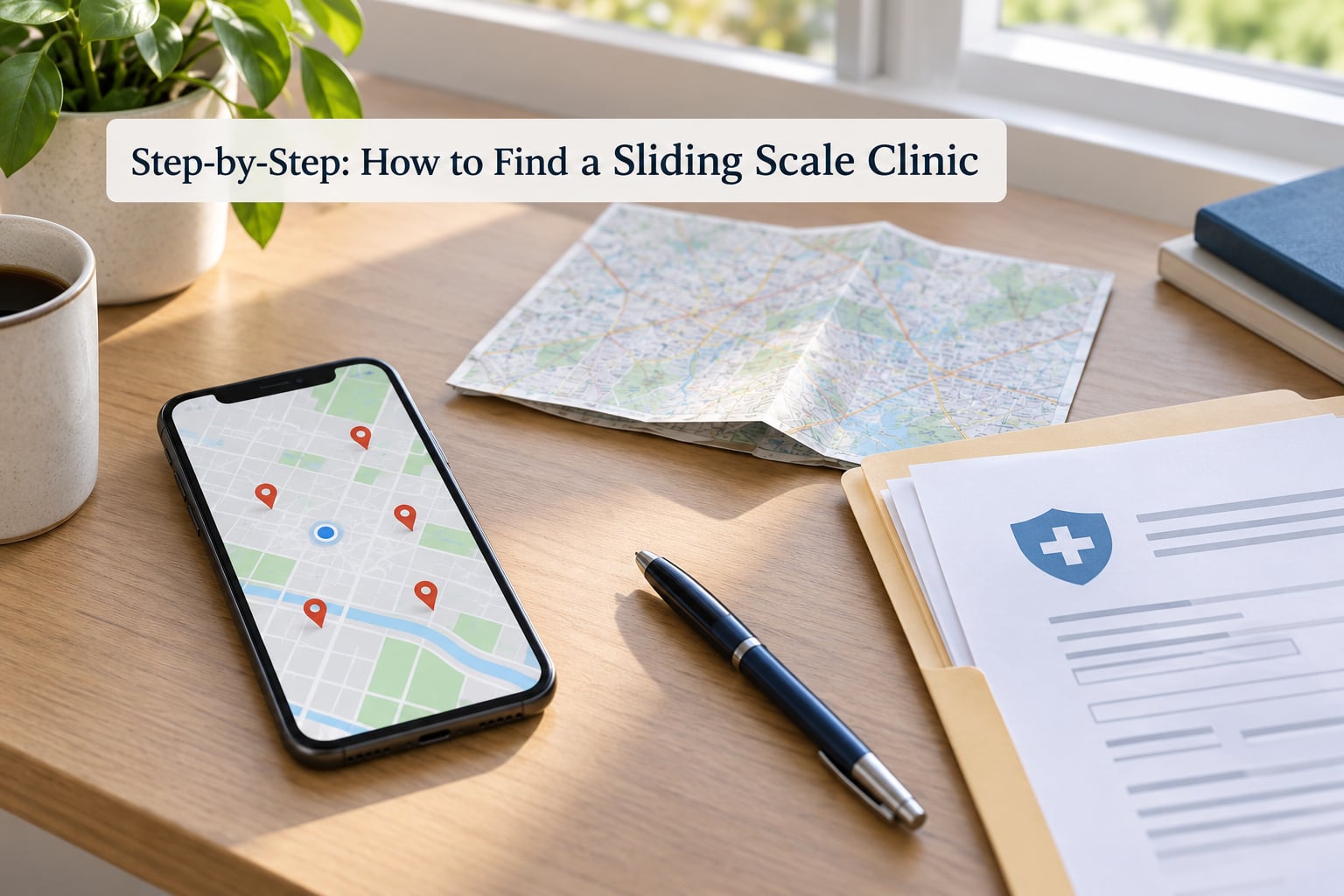
Work through these five steps in order. The order matters because steps one through three narrow the field cheaply and quickly, so you only gather paperwork once you know which clinic actually offers a discount.
Step 1: Search for a sliding scale clinic in your area
Search by clinic type rather than by clinic name. Start with your city or county health department, which publishes lists of public clinics and immunization and screening sites. Then search for community health centers and federally qualified health centers in your ZIP code — an FQHC is federally required to offer a sliding fee discount based on the federal poverty level.
Also check hospital outpatient clinics that operate charity care or financial assistance programs, free and charitable clinic directories, and reputable community directories that flag sliding scale availability. Run the same search for your nearest major city if your suburb returns thin results. Readers in suburban areas often report the same problem in city forums: the clinic exists, it just is not on the first page of results.
When a result says “sliding scale” or “self-pay discount,” mark it and move on. Do not call yet. You want three to five candidates before you start phoning.
Step 2: Call and ask about the self-pay policy
Use this script and adjust the last line to your situation:
“Hi, I’m looking to become a patient and I need to ask about your self-pay policy. Do you have a sliding fee discount for uninsured patients, and how is the fee calculated? Do I need to be uninsured to qualify, or can I use it with insurance? If I bring income documentation for a household of two, roughly what would the visit fee look like? And does the discount apply to lab work and prescriptions from that visit?”
Listen for specifics. A clinic that cannot tell you how it calculates the discount, or that offers one only “if funds allow,” has an informal policy that may not survive a busy week. One that explains brackets, asks about household size, and tells you what proof to bring is running a real program.
Also ask whether they are accepting new patients, how long the wait is, and whether anything is available sooner on a walk-in basis.
Step 3: Compare costs and services
Low-cost does not mean identical. Compare your candidates on what actually changes your experience and your bill: distance and transportation, whether they offer the specific service you need, new-patient wait time, evening and Saturday hours, bilingual staff, wheelchair access, payment methods, and whether the discount extends to labs, imaging, and medication.
If you are looking for LGBTQ+ care, ask directly how the clinic handles names and gender markers in records, whether they use your chosen name, whether they provide gender-affirming care, and whether they offer HIV or PrEP services. Clinics that answer that question plainly and without hesitation are the ones worth driving across town for.
Mental health is a separate search. Therapy and substance use treatment have their own funding streams and their own fee scales, so search for behavioral health or substance use services specifically rather than assuming a primary care clinic covers them.
Step 4: Gather documents and request an appointment
Most clinics ask for some combination of the following, usually only at your first visit:
- Photo identification, such as a driver’s license, state ID, or passport
- Proof of income, such as a recent paystub, a benefits award letter, or bank statements
- Household size, sometimes a short written statement if you have no documents
- Proof of address, sometimes
- Your insurance card if you have one, so they can check benefits before treating you as self-pay
- A list of your medications, doses, and allergies
Clinics ask for income information because the discount has to be tied to something. They also ask because many have staff who can enroll you in Medicaid or CHIP the same day, which may be worth more than the discount itself.
You are allowed to ask what they need before you hand anything over. If you are uncomfortable with a specific document, say so and ask what else they can accept. Ask specifically whether they accept a self-declaration of income for people whose work is cash-based, gig-based, or undocumented. Plenty of health centers do, and it removes the single most common reason people abandon the process. If you are undocumented or a visitor, ask how the clinic handles that before your visit so you are not caught at the front desk.
Step 5: Ask for an itemized estimate
Before you leave the phone, ask what the visit fee covers and what it does not. A discounted visit fee is rarely the whole bill. Ask specifically about lab work, imaging, the cost of any prescription, the fee for a follow-up appointment, and the referral fee if the clinic sends you elsewhere for a test.
Write the numbers down while you are on the call. When you arrive, ask for a written estimate at check-in rather than after the visit, and hand it to the billing staff with a simple request: “Please bill me at the self-pay rate we discussed, and tell me before any cost above that amount.” That single sentence prevents most billing surprises.
Common Mistakes
Most people who get turned away did one of five things first. Each has a straightforward fix.
Assuming a sliding scale means free care. It means the fee moves with your income, not that it disappears. A clinic with a published schedule will usually place you in a bracket that reduces a visit to a nominal charge, but labs and prescriptions are separate line items. The fix: ask for the bracket and the exclusions before the visit, in Step 5.
Trusting a price from a post or an old review. Discount tables are rebuilt when federal poverty guidelines change, and a clinic’s policy can tighten or loosen entirely. A forum answer from last year is a starting point for a phone call, not a quote. The fix: confirm every figure with the clinic, and note the date of your call.
Skipping the eligibility questions. Uninsured patients, patients with high deductibles, and patients with Medicaid each get different treatment. If you lead with “I need a cheap appointment” instead of asking how the fee is calculated, you may get the cash price of an uninsured visit instead of the discounted rate you qualified for. The fix: use the Step 2 script verbatim.
Failing to ask what happens if you cannot produce proof of income. This is where people quietly give up. The fix: ask on the call whether a self-declaration of income or a household size statement is acceptable, and whether the discount can be finalized later once you have documentation.
Treating a search result as a recommendation. A directory listing is a lead, not an endorsement. People worried about whether these clinics deliver competent care should ask what clinicians rotate through the site, whether the clinic has accreditation, and whether it holds an on-site pharmacy. Federally qualified health centers are licensed, audited, and funded under federal requirements, which is not true of every low-cost clinic that shows up in a search.
Frequently Asked Questions
Do I need insurance to use a sliding scale clinic?
No. Sliding fee discounts exist for uninsured patients, and most community health centers will see you without insurance at all. Insured patients can often use the same discount when their plan’s deductible or copay is higher than the self-pay rate. Bring your insurance card if you have one so the clinic can check benefits before applying the reduced fee.
How much does a sliding scale clinic usually cost?
It varies by clinic and bracket, but the structure is consistent: a published schedule maps your household income as a percentage of the federal poverty level to a discount. Near the bottom of the schedule the charge is a small nominal amount. Ask the clinic for its written self-pay fee schedule before your visit, and ask separately about labs, imaging, and prescriptions.
Can I use a sliding scale if I have insurance?
Often, yes. Many community health centers offer the discount on a self-pay basis regardless of your coverage, and some will run both options so you can compare. Insured patients with high deductibles sometimes pay less at a health center than their plan requires. Ask whether the clinic will bill your plan or your self-pay rate, and how a referral affects what your insurer reimburses.
What information does a clinic need to calculate my fee?
Most clinics need your household size, your income or income range, and photo identification. Common documents include a paystub, a benefits award letter, bank statements, or a written self-declaration of income. Some sites also ask for proof of address. Ask the clinic for its list before the appointment, because self-declaration is widely accepted at federally funded health centers but not everywhere.
What should I do if I cannot afford my medication or follow-up care?
Tell the clinic before you leave. Health centers with an on-site pharmacy can quote a cash price, which is often far below the pharmacy counter price, and many have assistance programs or 340B pricing in place. For follow-up, ask whether the fee can be included in your sliding scale bracket. For a bill you already have, ask the hospital’s financial assistance office about charity care, and request an itemized bill in writing.
Conclusion
Start with one action this week: search your ZIP code for a community health center, pick the closest one that lists a sliding fee discount, and call using the Step 2 script. Ask three things before you hang up — whether you qualify, what documents they need, and what a visit with your household size and income would actually cost.
If your symptoms cannot wait for an appointment, go to the nearest emergency room. Stabilizing an emergency is required regardless of your ability to pay, and financial arrangements come after you are treated.