
How to find queer sports leagues is a filtering problem more than a research problem: start with a free league directory, narrow it to your city and your sport, then confirm the league is genuinely all-gender before you pay a seasonal fee. The whole search takes about an hour once you know what to look for, and the hard part is usually not finding listings. It is telling a real league apart from a dead one.
This guide walks through that process for adults who want to play recreationally, whether you have never played the sport, you are a competitive player looking for a team, or you moved somewhere new and know nobody. It also covers what to ask before you hand over money, how to join without forming a team first, and what to do when your city has no queer league at all.
One note on costs: seasonal fees, tournament travel, and gear prices all vary by city and change constantly, so this guide stays focused on finding and vetting a league rather than quoting numbers that will be wrong by next month. Any league worth your time will publish its own fee schedule clearly.
Table of Contents
- What You Need
- How to Find Queer Sports Leagues: A Five-Step Method
- Common Mistakes
- Frequently Asked Questions
- Are queer sports leagues welcoming to people who are not athletic?
- How do I join a queer sports league when I know nobody?
- Are queer sports leagues trans and nonbinary inclusive?
- How much does joining a queer sports league cost?
- What if there are no queer sports leagues in my city?
- Can I join a league after the season has already started?
- Conclusion
What You Need

Most people start this search without a clear answer to one question: which league would you actually enjoy showing up to on a Tuesday night? Pin that down first and everything after it gets faster.
Have these ready before you type anything into a search bar:
- A sport, and a second choice. Softball, kickball, dodgeball, volleyball, bowling, pickleball and flag football are the ones most likely to have a queer league near you. Add a backup because the one you want may be full or seasonal.
- Your honest skill level. Recreational, beginner, intermediate, or competitive. Leagues sort players into divisions, and guessing high is the fastest way to a miserable first season.
- Your season timing. Indoor leagues usually run September through April in most of the US. Outdoor leagues run spring and summer. Some leagues, like bowling, run year-round.
- The schedule you can commit to. Weeknight leagues meet once or twice a week. Tournament teams travel. Both are legitimate, they are just different commitments.
- Gear you already own. Many leagues supply equipment, especially bowling and dodgeball. Others expect cleats, a glove, or a personal ball.
- What you need from the group. A code of conduct, trans and nonbinary inclusion language, accessible facilities, sober-friendly socials, or drop-in options. Decide which of these are requirements and which are nice to have.
Add one more item that people routinely skip: your pronouns and name as you want them used. Leagues collect this at registration, and having it written down beforehand makes an awkward conversation at your first practice unnecessary.
How to Find Queer Sports Leagues: A Five-Step Method
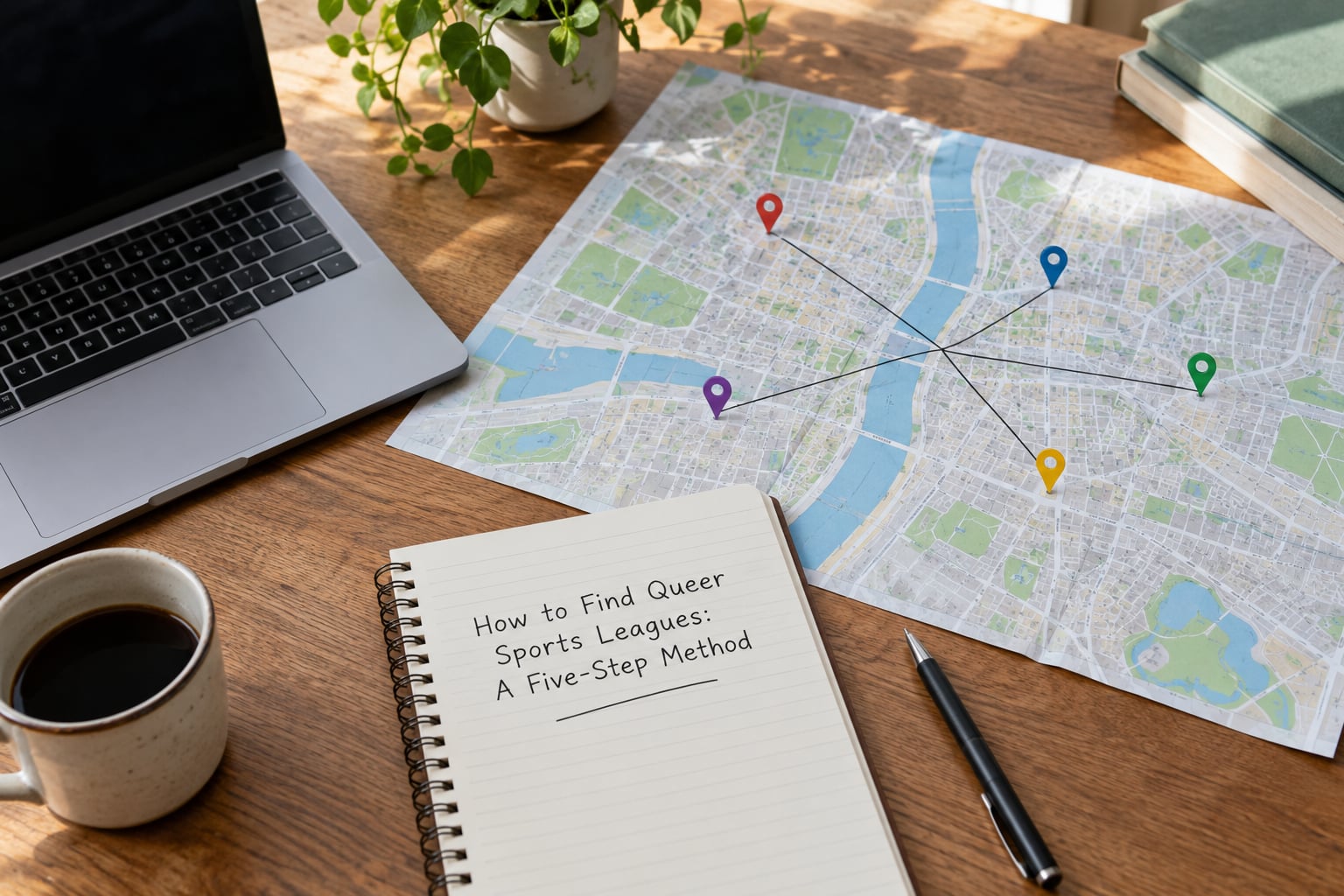
This is the process that works, in order. Skipping ahead to step four and emailing a league you have not checked out usually wastes a week.
Step 1: Choose the Sport and Level That Fit You
People who search how to find queer sports leagues often start too broad, then get buried. Narrow the search by sport, level, and setting before you contact anyone. Search your city name plus the sport plus “queer,” “LGBTQ,” or “all-gender” and read what comes back. That first pass usually turns up two or three real options rather than fifty.
Decide indoor or outdoor, and decide whether you want beginner-friendly rec play or a competitive roster. These are genuinely different searches. Competitive leagues recruit by tryout, and beginner leagues often run as free-agent signups where teams get drawn at random.
If you have never played the sport, say so plainly when you reach out. A league that would rather place you in a beginner division than lose you is a league worth staying with.
Step 2: Search LGBTQ+ Community Resources
Start with the organizations built for exactly this. The United States Gay Sports Network is a free directory built solely around LGBTQ+ sports leagues, filterable by state, city, region and sport, and it links out to national umbrella organizations rather than running leagues itself. It also points to resources like COMPETE and You Can Play for people trying to find or start a league.
OutLoud Sports runs its own programming rather than just listing it. Founded in 2007 out of what was previously the Varsity Gay League, it has grown into a multi-city operation with a wide spread of sports and an explicit non-exclusivity stance. If your city is on their list, that is usually the fastest route from curious to registered.
Alongside those, search your local LGBTQ+ community center, your Pride organization and your city parks and recreation department. Community centers frequently host drop-in nights that never show up on a league directory, and rec departments run all-gender or LGBTQ+ friendly adult leagues that do.
Check the rec department angle even when a dedicated queer league exists. A beginner who wants low-pressure exercise and a beginner who wants a tight team will pick very different leagues from the same city.
Step 3: Check Directories, Social Groups, and Meetups
Directories get you a shortlist; social groups tell you whether the league is still alive. For each listing you find, run a few targeted searches before you email anyone:
- “[your city] queer softball league 2026 registration“
- “[league name] code of conduct“
- “[league name] site:instagram.com” to see when they last posted
- “[league name] reddit” for what past players say
Two signals matter more than anything else on that list. First, recency: a league account that last posted eight months ago may have folded or lost its venue. Second, a published code of conduct or anti-discrimination statement, which tells you more about how a league actually handles conflict than a mission statement does.
Then widen out. Local Facebook groups, queer recreation groups, and meetup-style platforms surface drop-in events and pickup games that never become formal leagues. A Saturday morning pickleball group that meets every week is still an answer to your question, and it carries far less commitment than a season roster.
Step 4: Contact the League and Ask the Right Questions
This is where people hold back, and it is exactly where they get burned. Ask these before registering:
- Are you explicitly all-gender, and is there trans and nonbinary participation in practice rather than only in a mission statement?
- Can I register as an individual, or do I need to form or join a whole team?
- Are there beginner divisions, and what does a typical season look like for someone new?
- What is the fee schedule, and what does it cover: court or field time, officials, insurance, socials?
- What are the practice and game days, and how long does the season run?
- What facility do you use, and is it accessible?
- What happens if a season is already underway: free agents, split fees, or a waitlist?
- Are spectators, partners and allies welcome, and where do post-game socials happen?
That last one matters more than people expect. A large share of queer leagues socialize at a bar by default, which quietly filters out sober players and anyone who does not want their night organized around a drinking spot. Asking where socials happen is a normal question and gets a normal answer.
A volunteer board will usually answer all eight within a day or two. Silence, or vague replies about inclusivity with no specifics, is useful information.
Step 5: Attend a Trial, Practice, or Open Event
Ask to attend one practice or open session before you commit. Plenty of leagues offer them, and the ones worth your time will say yes without making it awkward.
Watch three things. Are beginners actually playing, or are they benched all night? When someone makes a mistake or says the wrong pronoun by accident, does a captain step in constructively? And does the group keep time, or does the evening drift into an hour of standing around before anyone plays?
Then decide. If the vibe is right, register and ask whether a captain can introduce you to the group chat. If the skill range is too high, ask for a beginner division or a different league. Both are normal requests, and a league that reacts badly to either one is telling you something something important about itself.
You can show up alone. Free-agent registration exists precisely for people who know nobody, and asking about it is the single most useful question a first-timer can ask.
Common Mistakes
Trusting a listing you cannot date. Directory entries persist long after a league stops running. Check for a current season date or a social post within the last month before you email anyone.
Assuming inclusivity from the name. A league with queer in its title is not automatically trans-inclusive, any more than a generic rec league is automatically hostile. Ask what participation actually looks like, and whether trans or nonbinary players hold leadership or programming roles.
Skipping the cost detail. Ask what the fee covers before you pay it. Some leagues fold officials and insurance in, others bill separately, and nobody enjoys discovering a surprise charge mid-season.
Only looking at competitive teams. Rec and beginner divisions are where a lot of people first find a community, and plenty of experienced players prefer them. Filter for all skill levels rather than elite.
Confusing a pickup game with a league. A recurring drop-in has no season, no fee structure and no code of conduct. That is fine if you want casual exercise, but do not assume a one-off Instagram post is a signup page.
Treating the league as a dating pool. This worry comes up constantly in community threads about joining, and it is the number one reason people quit before their first season. Pick a league that publishes a code of conduct, has a mix of ages and skill levels, and organizes socials away from bars. Those three signals do more than any mission statement.
Ignoring travel time. A league forty minutes away with a great culture will lose to a decent one twenty minutes away, every single season. Check the drive before you fall in love with the roster.
Waiting for the perfect league. Volunteering one or two hours a week keeps a league alive, and leagues that skip seasons usually do it because nobody volunteered. If you join one, ask where help is needed.
Frequently Asked Questions
Are queer sports leagues welcoming to people who are not athletic?
Mostly yes, and the reason is structural rather than sentimental. Rec leagues exist to keep bodies moving and to give people a recurring night with friends, so a beginner who shows up consistently is usually welcomed more warmly than a strong player who misses three weeks. Look for leagues advertising beginner divisions, all skill levels, or free-agent registration, and ask about the typical skill range before you sign up.
How do I join a queer sports league when I know nobody?
Register as a free agent if the league offers it. Several large chapters run a free-agent model where you sign up individually and teams are drawn at random, which removes the awkward need to recruit anyone first. If your league does tryouts instead, email the board and say plainly that you are new in town and alone. Captains field those emails constantly and welcome the person who is actually trying.
Are queer sports leagues trans and nonbinary inclusive?
Varies by league, and the mission statement alone will not tell you. Ask whether the league is explicitly all-gender, whether there is she/they or trans-specific programming, whether trans and nonbinary players appear on the roster or board, and how the facility handles changing rooms and restrooms. A league that answers those four questions specifically is doing the work. One that cannot is not necessarily hostile, but it is not offering what you need.
How much does joining a queer sports league cost?
Fees vary widely by city, sport and organizer, so check each league directly rather than trusting a general range. Budget for the seasonal registration fee first, then expect possible extras: team equipment, a personal ball or bat, travel to out-of-town tournaments, and a separate social outing after the season. Some leagues waive fees for players who volunteer, which is worth asking about.
What if there are no queer sports leagues in my city?
You have four options before starting anything yourself. Join an LGBTQ+ friendly rec league at your city parks department and ask its captain about the vibe. Check community centers and Pride organizations for drop-in nights. Search meetup and Facebook groups for recurring pickup games, which often precede formal leagues by a season or two. And if nothing exists, contact a national organization such as COMPETE or You Can Play for help starting a chapter.
Can I join a league after the season has already started?
Usually, yes, though the terms differ. Many leagues place latecomers as free agents or run a waiting list until a roster space opens, and some split the seasonal fee into two payments for anyone joining after the first month. Ask about all three in your first email: late registration, fee splits, and whether your position needs a tryout. Do not assume you have missed your only chance for the year.
Conclusion
If you only remember one step from how to find queer sports leagues, make it this one: start with a single directory, filter it to your city and one sport, and email two leagues the same day. Two gives you a comparison, and it takes ten minutes.
From there, ask the questions in step four before you pay anything, and ask to attend one practice. If neither league fits, that is still progress: you now know what your city offers and what it does not.
And if the city has nothing? Rec leagues, community center drop-ins and weekly pickup games fill the gap, and most of them started the same way, with a handful of people showing up alone and hoping somebody else would too.