
Most people think they know how to stick with a gym routine. They build one that requires perfect energy, an uninterrupted hour, and a body they feel good about showing up in. Then life moves, they miss twice, and the whole thing quietly ends. The fix is smaller than most plans make it sound: pick one measurable goal, decide the smallest session that still counts, anchor it to a time block that already exists in your week, and write down what you did. Learning how to stick with a gym routine is mostly about removing the ways a routine can fail before you start it.
This takes about five minutes of setup and a week of honest record keeping before you can tell whether it works. Difficulty is low. The hard part is not information, it is being boring and repeatable on the days you would rather be anywhere else.
What You Need

Five things, and none of them expensive. A clear training goal that you can measure, a realistic view of your week, somewhere to train, a short list of equipment, and one tracking method you will actually keep using.
A goal you can measure. Three strength sessions a week, two 30-minute walks, one class. Numbers, not feelings. Appearance and weight make poor targets because they move slowly and are affected by everything you cannot control.
A realistic schedule. Write down when you are actually free, not when you wish you were free. Include commute time, shift changes, and the days you reliably have no energy left.
Somewhere to train. A full gym, a community center, a hotel pool, or twenty square feet of floor at home. Distance is the single biggest predictor of whether you keep going, so a nearer option usually beats a better one.
Basic equipment. For most people: shoes, water, a towel, and either resistance bands or a pair of dumbbells. Everything else can wait until you have three months of consistency behind you.
One tracking method. A paper notebook, a note on your phone, a calendar with marks in it, or an app. Pick the one with the least friction for you, because a tracking system you abandon is the same as having none.
Step-by-Step
1. Define a goal you can measure
Choose one outcome for the next eight weeks and make it countable. Attending three strength sessions a week. Walking 8,000 steps on five days. Doing one class every Saturday morning. A goal you can tick off is worth more than a goal that sounds ambitious.
Then define your minimum and your ideal. The minimum is the smallest session that still counts, the ideal is the session you would do on a good day. For two strength sessions a week, the minimum might be two sets of squats, push-ups and rows, roughly fifteen minutes. The ideal might be forty-five minutes across five exercises.
You know it is working when a week ends and you can say yes or no to the goal without arguing with yourself. If you cannot, the goal is too vague.
2. Match the routine to your real schedule
Look at the last two weeks honestly and mark every block of free time, even twenty-minute ones. Most people find more than they expected, and most find that the useful blocks are not the ones they would have picked on paper.
Now attach the workout to something already fixed. After your morning coffee. Straight after a shift. On your lunch walk. Habit stacking works because you are borrowing the momentum of a habit that already has a cue, so the workout starts before your brain starts negotiating.
Write the session into your calendar as an appointment with a name on it, not as an intention. Non-negotiable appointments survive busy weeks in a way that vague plans do not.
You know it is working when a normal week passes and you hit your session without having to rearrange anything at the last minute.
3. Start with a minimum effective routine
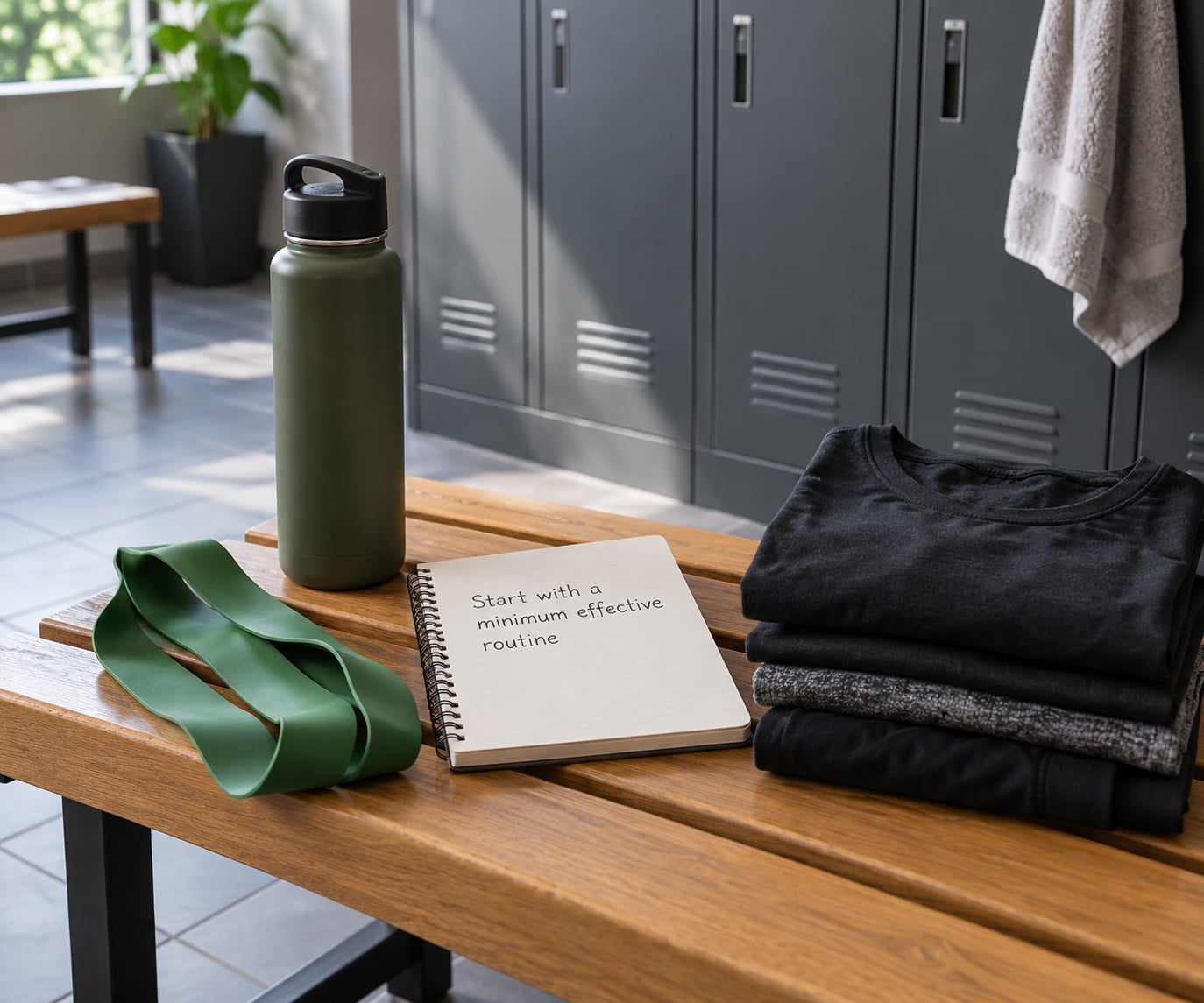
Two or three short sessions a week is a real program, not a placeholder. Each one covers the big movement patterns: squat or hinge, push, pull, and some carry or core work. Three sets of five or eight reps is plenty at the start.
| Workout type | Minimum target | Ideal target |
|---|---|---|
| Strength | 2 sets, 15-20 minutes | 4-5 exercises, 45 minutes |
| Cardio | 15-minute walk | 40 minutes, some intervals |
| Mixed | 2 strength blocks plus one walk | 3 strength blocks plus 2 cardio |
The minimum is the point of the whole system. On a bad Tuesday, doing the minimum keeps the streak intact and the habit loop alive. Doing nothing breaks both, and restarting from zero is where most people quit for good.
Public health guidance in the US is roughly 150 minutes of moderate activity a week, plus two days of muscle strengthening. That is a ceiling to grow toward, not a starting quota. Hit the minimum, add time slowly over weeks.
You know it is working when four weeks pass and you have not missed more than one planned session in a week.
4. Make the first step easy
Friction is anything standing between you and the workout: the drive, the parking, deciding what to do, finding your shoes. You cannot remove all of it, but you can remove the parts that live inside your house, where you control them.
Lay out your clothes the night before. Pack the bag by the door, or fill a water bottle the night before and leave it next to your keys. Pick the gym before you pick the day, so the location is already decided when motivation is low.
Write the workout down in advance, three to five exercises with sets and reps. Every decision you make in the first five minutes is a chance to quit. Deciding in advance is free.
On the worst days, give yourself the five-minute version: change, walk to the building, do one exercise set. Most sessions that start get finished. Starting is the whole battle.
You know it is working when the gap between deciding to go and physically leaving the house has shrunk to a few minutes.
5. Track attendance and adjust gradually
Attendance first, performance second. Mark the days you showed up, the length of the session and one thing you noticed. That is enough. A simple calendar with a mark per session works as well as any app and asks nothing of you.
Once attendance is steady, log the work itself: exercise, sets, reps and load. That log is how progressive overload becomes real rather than theoretical. Progressive overload just means gradually asking your body to do a little more than last time, and you cannot manage it if you cannot see what last time actually was.
Progress in the first month is almost always records. A session you finished. A weight that moved. Same numbers, better control. Change something small every week or two, not every session.
You know it is working when you can point to a specific number in your log that is higher than it was eight weeks ago.
6. Protect recovery and return after missed days
Rest is part of the program, not a failure of it. Sleep, food and water decide how the session feels, and a session that feels terrible is the one you skip next week. Eight weeks of sleep debt will undo more consistency than one missed workout ever could.
Plan rest days into the week rather than earning them by collapse. If a lift feels like a second job, take a day. Light walking counts as active recovery on those days.
Use the no-guilt return rule: miss a session, miss two, and you restart at the minimum target on your next scheduled day. No doubling up, no making up for lost time, no punishment. The rule that matters most for how to stick with a gym routine is that a lapse is a scheduling problem, not a character problem.
Two weeks off costs you some conditioning and some strength. It does not erase months of work, and the honest number most people find when they restart is that the first two sessions feel terrible and the third feels fine.
Talk to a doctor before starting if you have a heart condition, joint problems, are pregnant, or have been inactive for a long time and want to start with something demanding. Physiotherapists and exercise specialists can also help you build a plan around an old injury.
Common Mistakes
All-or-nothing thinking. Two missed sessions becomes two weeks off becomes a cancelled membership. The correction is a defined minimum you have already decided counts, so a bad day never zeroes the week.
A schedule built for an ideal week. Plans built around perfect sleep and empty calendars collapse in the third week. The correction is to design for your worst normal week, then treat better weeks as surplus.
Chasing fast results. Big early changes invite comparison and cause people to crank intensity until something hurts, then stop. Progress built slowly is the kind that survives a bad month.
Skipping meals or sleep to train harder. Under-fueling shows up as low energy and stalled progress. Eat regularly, especially on training days, and protect your sleep window.
Treating a missed day as failure. Guilt is the fastest way to end a routine. Correct it the same way every time: log it, adjust the week, come back at the minimum.
Ignoring gym anxiety. If the room is the problem, start with the quietest hours, a familiar piece of equipment, and layers you feel comfortable in. Walk in, train for the minimum, leave. Repeat. Most self-consciousness fades after a handful of sessions when nothing dramatic happens in any of them. A small home set or a walk outdoors removes the issue entirely, and the routine matters more than the venue.
Some smaller habits keep motivation alive: swap one exercise every few weeks so boredom never has a reason to grow, keep a photo or a note from a week you felt strong, and tell one person your schedule so someone notices when you disappear.
Frequently Asked Questions
How long does it take to build a gym habit?
Most people need six to twelve weeks of regular sessions before a workout stops requiring a decision. Habit research generally points to a range of about two weeks for simple behaviors and up to six months for anything demanding, and exercise falls nearer the difficult end because it takes real time out of your week. The variable that moves this fastest is not effort but volume of repetitions, so a small routine you repeat beats an ambitious one you abandon in month two.
What should I do after missing workouts?
Return at your minimum target on your next scheduled day and log what happened. Do not double up sessions, make up lost minutes, or start a punishing program to catch up. A single missed session changes almost nothing physically. Two to three weeks away costs some strength and endurance, mainly cardio fitness, and it comes back faster than beginners expect once regular sessions resume.
How often should I change my gym routine?
Change small details often and the overall plan rarely. Swapping one exercise every few weeks keeps boredom away and reduces repetitive strain, while your weekly structure should stay stable for months so scheduling is predictable. If motivation drops sharply, changing the format temporarily, for example moving from barbell work to machines or group classes, often works better than simply pushing harder on the same plan.
Does walking count if I am not doing a gym routine?
Yes, and brisk walking is a legitimate part of most activity guidelines. Research on weekly volume shows benefits appear across a range of intensities, and walking builds the aerobic base, mood and daily movement habit that make harder sessions later possible. If walking is what you will actually do consistently, it is a better foundation than an impressive gym plan you follow for six weeks and then abandon.
How do I stay motivated when results plateau?
Plateaus usually mean the demand has stopped rising, not that effort is pointless. Return to your log and add a small amount of load, reps or distance, then give it three to four weeks. If a direction stops producing changes after that, change variables: volume, exercise selection, or rest. Also check sleep and food, because under-recovery stalls progress far more often than the workout itself.
When should I talk to a doctor before working out?
Speak with a doctor or exercise specialist before starting if you have a heart condition, high blood pressure, a recent injury, diabetes, are pregnant, or have been inactive for years and want to begin with demanding work. They can also help if you take medication that affects heart rate during exercise. For ordinary aches and fatigue in healthy adults, slowing down and adjusting usually works without a medical visit.
Conclusion
Today, write down one measurable goal, block two or three short sessions into times you are genuinely free, and decide what your minimum session looks like on a bad day. Then prep tomorrow night: clothes out, bag packed, workout written down.
Record each session, raise the demand slowly, and treat every missed day as a scheduling change rather than a verdict. That is the whole method behind how to stick with a gym routine, and none of it depends on how motivated you feel on a given morning.