
A chosen family is a group of people you deliberately choose and build mutual, ongoing support with, outside of biological or legal ties. You build one the way any deep relationship is built: start with whoever is already in your orbit, keep showing up, create shared rituals, reciprocate, set boundaries, and let it deepen over months and years. Nobody is born into this. It gets made.
That last part matters if you are searching a phrase like how to build a chosen family with an empty contact list. There is a persistent myth that chosen family is a consolation prize, something you settle for when the real version is unavailable. It isn’t. It is a different structure with different rules, and the rules are learnable.
The honest version: this takes longer than most advice implies, and it is not automatic. The people who describe it well — queer community members, adult adoptees, childfree adults, people rebuilding after estrangement — tend to talk about the slow middle, the part where you are not yet friends and not yet family, and nobody knows which way it goes. Guideposts help more than pep talks.
For Chicago readers specifically, the local infrastructure matters more than it does almost anywhere else in the country. You have centers, choirs, leagues, book groups, mutual aid networks, and neighborhood spaces where the same faces recur. That recurrence is the raw material. The rest is attention.
Table of Contents
- Chosen Family vs. Family of Origin: What Actually Changes
- What You Need
- Step-by-Step: How to Build a Chosen Family
- Common Mistakes
- Frequently Asked Questions
- How long does it take to build a chosen family?
- Can chosen family replace biological relatives?
- How do I know if someone is safe to include in my chosen family?
- How do I set boundaries with people I consider family?
- What if my chosen family lives in another city?
- When should I seek support from a therapist or LGBTQ+ counselor?
- Start With One Reliable Connection
Chosen Family vs. Family of Origin: What Actually Changes
Family of origin is the household you grew up in. A chosen family, sometimes called a family of choice or fictive kin, is assembled deliberately. The difference is not warmth, and it is not effort. It is authorship. Placed side by side, the contrasts show up fast.
- How it forms. Family of origin is assigned at birth or adoption. A chosen family is chosen, deliberately and repeatedly.
- Who decides closeness. Family of origin runs on genetics and household rules. A chosen family runs on you, renegotiated over time.
- Expectations. Often unspoken and inherited in family of origin, and stated out loud by the people in a chosen family.
- Boundaries. Hard to name in family of origin without consequence, and part of the definition from day one in a chosen family.
- Roles. Fixed by birth order and custom in family of origin, and invented in a chosen family, including chosen parents and chosen siblings.
- Where conflict comes from. Old wounds and old patterns in family of origin, and new friction that is actually repairable in a chosen family.
- Exit. Complicated and rarely clean in family of origin, and possible in a chosen family, though most people never want it.
The one I would underline is expectations. Chosen family works partly because you get to say the quiet part out loud. Someone can be your chosen brother and also be someone you do not want to discuss your dating life with. Naming that early prevents the kind of slow erosion that family of origin often hides.
One more thing worth saying plainly. The skeptical position you will meet — that chosen family is a fantasy people use to avoid harder work — comes from a real observation. Some chosen-family arrangements do recreate the same dynamic, and some do function as a way of refusing to process grief. Both are worth watching for. Neither invalidates the structure.
What You Need

You do not need confidence, charisma, or a big personality. You need a little clarity about what you want, a few hours a month, and a willingness to be the person who initiates more often than feels natural.
Readiness. Building a chosen family only works once you are willing to be a participant rather than an auditor. Auditing keeps everyone at arm’s length while you wait for certainty that will not arrive. A rough self-check: can you tolerate being known, and can you tolerate someone else needing something on a day you are already tired?
Communication basics. You need to be able to name a need, ask for help, and hear a no without treating it as a verdict on you. Those three skills do most of the work in this guide, and none of them require a particular personality type.
Time. Realistic math: one or two new people, one meaningful contact each, plus maintenance on what already works. Adults who say they have no time usually mean no unstructured time. Chosen family is built out of structured time, which is far easier to protect.
Tools. A contacts list you actually maintain, a shared calendar, one group chat for the people who are close, and a note on your phone with the practical information your people would need in an emergency — who is your doctor, who is your backup, who should be called. That last one is worth doing this week rather than someday.
And a five-item starting list, if you want somewhere to begin:
- List three people you already feel safe around, however briefly.
- Send one of them a message you have been sitting on for more than a month.
- Choose one recurring place you go, and go back to it twice.
- Put one standing event on a calendar — dinner, a walk, a call — even before anyone says yes.
- Ask one person a question about their life that is not about you or your work.
Step-by-Step: How to Build a Chosen Family
Chosen family does not arrive in a moment. It accumulates through repeated contact, small tests passed, mutual support exchanged, and shared experiences that nobody would have planned deliberately. Seven steps describe how that accumulation usually goes, and the order is less important than the repetition.
1. Define What Support Looks Like to You
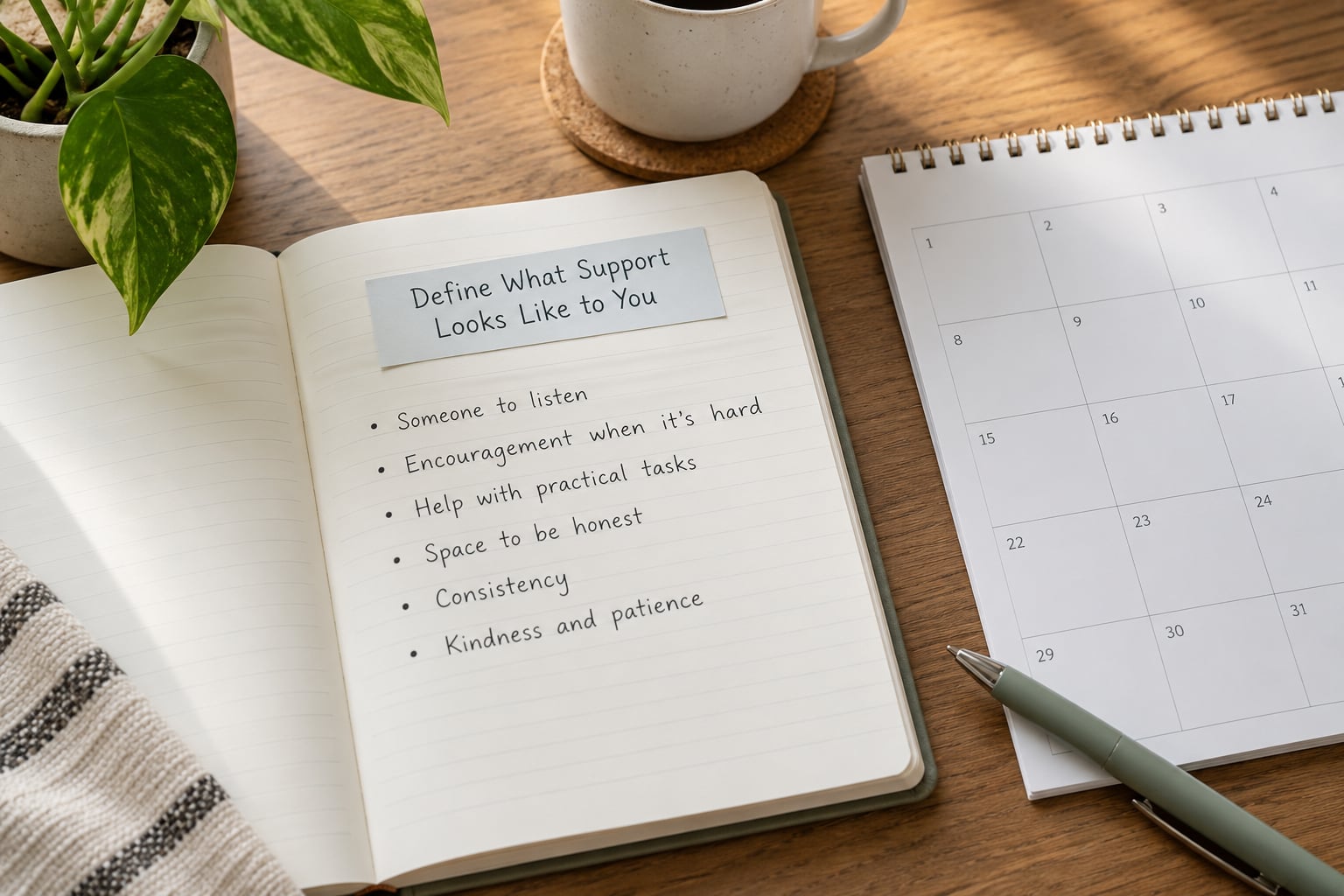
Most people who struggle with this are trying to find one person who fills every gap. That person does not exist, and the search for them is exhausting. Separate the categories first.
Emotional support is someone you can call at 2am. Practical support is someone who will drive you to an appointment or feed you when you are sick. Social support is company — a dinner, a wedding, a birthday where you are not the guest of someone else. Community support is a group, a center, a congregation, a team, a place where you are known without having to explain yourself.
Then add the durable layer, which is where the real family role lives. Who is authorized to make a medical decision if you cannot? Who gets your spare key? Who will tell you the truth about your marriage, your hair, your new job? Write it down. A simple list of support needs beside your calendar is more useful than a year of vague longing.
2. Look for Shared Values and Safety
Safety in a chosen family has a specific meaning: how does this person behave when your identity is inconvenient to them? Watch the small tell. A person who misgenders you once and corrects themselves, and one who hears it and does not, are not the same kind of tired.
Five things to check, in rough order of importance:
- Identity respect. They use your name and pronouns, and keep using them when you are not in the room.
- Privacy. What you share in confidence stays with them. Test this gently, because it is a real and common failure.
- Boundaries. They can hear a no. Watch what they do after one.
- Difference tolerance. Non-monogamy, gender nonconformity, chosen childfreeness, religion you do not share, a political view that annoys you — can they hold your life without requiring you to defend it?
- Queer safety. Would they stand with you in a hostile space, or would they get quiet?
Red flags are easier to spot in the first three months than later. Someone who moves very fast, wants to be the only person you lean on, dislikes your existing friends, or asks for details about your family before offering much of themselves is telling you something.
3. Build Connections Through Repeated Low-Pressure Contact
Chosen family candidates come from places where the same people return repeatedly. That repetition is the whole mechanism, and it is why one great night out rarely changes anything.
The places that work best are the ones with a built-in third activity: a community center, a recreation league, a class with a final, a choir, a book club, a volunteer shift, a mutual aid network, a creative meetup, a workplace group that continues after hours. Everything is easier when you are doing something, because doing something together removes the pressure to perform intimacy.
In Chicago specifically, the options are unusually dense. Look at the community centers and their queer and trans programming, the LGBTQ+ adult swim teams and recreational leagues, the arts organizations with regular open studios and volunteer nights, and the mutual aid and harm reduction groups that circulate on social platforms and meet in person every week. Add the ones doing free or low-cost public programming: libraries, park districts, and neighborhood arts bodies host recurring groups that most people never search for because they assume they require membership or a particular identity document.
If you are not in Chicago, the same logic applies with one adjustment. In a small town or a rural area, your recurrence may be online, and that is legitimate. A server, a discords-style group, an online craft circle, or a game community can be your in-person substitute for a year or two. Combine it with a monthly trip to the nearest city with real queer infrastructure, and you are not lonely by accident.
For migrants and transplants, the first three months are the danger zone, when you are working hard to meet people and nothing has caught yet. That is when most people quit. The ones who end up with a chosen family are usually the ones who keep showing up in the same low-key places long after it stops being fun.
4. Show Up Consistently
Showing up consistently is the least glamorous and most reliable thing you can do. Reliability is the trait people mean when they say someone feels like family. Charm gets you invited back; reliability gets you called at 3am.
Concretely, and weekly: reply to the group chat. Remember the small detail someone mentioned three weeks ago. Bring the thing they were looking for. Ask about their mother’s surgery. Be the person who suggests the activity rather than waiting to be invited to one you proposed. Learn the name of the friend they mentioned twice.
This is also the honest answer to how to build a chosen family when you have nobody to start from. You are not waiting for a person to appear. You are becoming the person who appears, and the reliability is what makes the first contact safe for someone else to make.
A caveat worth honoring: consistency is not volume. One good hour a week with one real person beats three busy group memberships you never really enter.
5. Create Mutual Rituals and Shared Experiences
Rituals are what convert affection into a structure. Without them, a chosen family depends on everyone being in a good mood at the same time, which is not a plan. Rituals cost almost nothing and do most of the durability work.
Some that work, roughly cheapest to most ambitious: a standing Sunday dinner where the host rotates and whoever cannot cook brings bread; a weekly voice note instead of a group chat when the chat is dead; a monthly museum or botanical garden outing, because a walk is easier to sustain than a conversation and gives you something to talk about for a week; a book or film club; a shared tradition for the holidays that you actually want to celebrate; and a mutual aid check-in, even informal, where everyone reports whether they are eating, sleeping, and managing to get to appointments.
Give rituals names. Sounds ridiculous; works anyway. A recurring dinner with a name attached gets defended in someone’s calendar the way a vague standing offer does not.
Also plan for the big days. Birthdays, a coming-out anniversary, a funeral, a breakup, a surgery, a promotion. These are the moments that decide what a relationship is, and they are the moments people most often spend alone because nobody planned for them.
6. Set Boundaries and Repair Misunderstandings
Boundaries in a chosen family feel disloyal, because you opted into closeness on purpose. Here is the reframe that helps: a boundary is not a withdrawal, it is a maintenance schedule. It keeps the relationship from failing, which is the actual risk.
Some scripts that work in plain language:
- “I love you and I have this Friday. Can we do Saturday morning instead?”
- “I am not comfortable with you telling people about that. Please keep it between us.”
- “I would rather talk about this in a couple of days than right now.”
- “I care about you, and I am not the right person for that particular problem.”
Distinguish availability from reliability, which is a recurring source of quiet resentment. Some people are always delighted to see you and cancel often. Others are not free every weekend but will absolutely show up when you are in a hospital corridor. The second person is usually the real family. Say so, out loud, before you resent them.
Expect a specific, uncomfortable problem: someone in your chosen family disapproves of your partner, your new job, your move, or your decision not to have children. Chosen family can absolutely reproduce family-of-origin conflict, and the only real difference is that you get to talk about it directly. The tell is whether the person can hold your decision without withdrawing affection. If they cannot, you have learned something important, and it is better to know at year two than at year ten.
Then make the practical parts durable. List your chosen family as emergency contacts where it counts, because next of kin is often a parent you have not spoken to in a decade. Put the wishes in writing. Designate a health care proxy if that is not already sorted. In Illinois, the Health Care Proxy Act allows you to name an adult you trust to make medical decisions for you when you cannot, and it is far simpler to complete than people assume — the form is short, and you do not need a lawyer for a straightforward one. Do the same with a will or a durable power of attorney, and keep the copies where someone in your chosen family can find them. If you have ever been through a hospitalization or a caregiving situation, you already know why.
Conflict repair matters as much as boundary setting. When friction happens, aim for: name the specific behavior, skip the diagnosis of their character, say what you need, and leave room for a different outcome. “You told three people about my diagnosis” is a sentence a relationship can survive. “You are selfish” usually ends one.
7. Give Support Without Losing Yourself
Reciprocity is the mechanism, and the common failure is imbalance. One person ends up doing most of the emotional labor, notices the imbalance, resents it quietly, and eventually leaves. The friendship did not fail on chemistry. It failed on accounting.
Three things keep it workable. Ask rather than assume — people often want to help and are waiting to be asked, and asking honors them more than a quiet rescue. Match capacity rather than intent, which means accepting that a person with a new baby or a bad stretch has less to give right now without treating it as a withdrawal of love. And let the needs change, because the people in your chosen family will change too, and the arrangement has to be renegotiated a few times or it calcifies into roles nobody chose.
Give support in forms that are easy to receive. A scheduled visit, a meal already in the freezer, a ride, a phone call on Sunday, sitting with someone while they say an ugly thing out loud. Unsolicited advice is rarely the gift people think it is.
Finally, watch for the version of closeness where one person is the emergency contact for everything, all the caregiving flows one way, and being cared for has quietly become impossible. A good chosen family can absorb a hard year in one direction. It cannot absorb ten.
Common Mistakes
Idealizing too fast. Confusing intensity with depth is the classic error, and it usually involves a third date and the word family. Fix: keep the label off for six months. Let the label arrive on its own. A friendship that survives a slow year is worth more than one that was declared on a Tuesday.
Reading availability as reliability. The person who is free every evening and cancels half the time is not more available than the one who shows up for the hard things. Fix: ask the quiet, practical question — who do you call when something goes wrong? — and find out within the first year.
Advising instead of listening. Most offers of help are actually a request to be told what to do. Fix: try “do you want ideas or just company?” It is a disarming question and it works nearly every time.
Treating boundaries as disloyalty. Pushing back on someone you chose yourself, then resenting them for being disappointed, is a pattern, not a bad day. Fix: state the boundary plainly, do not over-explain it, and let time do the rest. Someone who accepts it was only ever testing it.
Asking one person to be the whole family. A single relationship cannot supply emotional, practical, social, and community support, or emergency response on top of it. Fix: deliberately maintain at least four relationships of different kinds, including one that is not romantic, and notice if you have stopped making new contacts entirely.
And one thing none of the fixes address. You can be grateful for the family you chose and still be grieving the one you did not get. Those two feelings sit in the same person at the same time, and no amount of good dinner conversation resolves it. Queer community members describe this more plainly than most writers do: the chosen family does not substitute for the loss, it lives next to it. Letting both be true is the actual skill, and it takes longer than the rest of this guide.
One more reality worth stating. Not every friendship becomes family, and some relationships end. People move, partner up, have children, get exhausted, and drift. Chosen family has a mortality rate, and treating an ending as evidence that you did it wrong will keep you from starting again. The person you lost three years ago is not proof the next one will not work.
Frequently Asked Questions
How long does it take to build a chosen family?
For most people, one or two people in a few years, not a whole network. Acquaintance to regular contact takes a few months of showing up in the same place, regular to close usually takes a year of consistent effort, and inner circle arrives only after a hard thing has happened together. People who describe a fast chosen family usually had a built-in bridge, like a shared group or a mutual friend. Anyone promising faster than that is selling something.
Can chosen family replace biological relatives?
It can replace the functions that matter, but not the history. A chosen family can be your emergency contact, your celebration, your caregiving, and the people you call at 2am, and that is most of what family does. It cannot give you the childhood you had, and plenty of people carry grief for that alongside gratitude for the family they built. Many people keep both, with more distance and more honesty than blood usually allows.
How do I know if someone is safe to include in my chosen family?
Watch behavior over the first three months, when things are still being tested. Use the right name and pronouns even when you are not in the room, keep what you share in confidence, and hear a no without sulking or withdrawing. Watch what happens after a small disagreement. One mistake corrected is human; a pattern of needing you to be easy is information. People who are genuinely safe will let you keep other people in your life.
How do I set boundaries with people I consider family?
Say the boundary plainly and do not over-explain it, because explaining turns a limit into a debate. Try a short script: I love you, and I am not comfortable with that, or I am not the right person for that problem. The test is not how they feel, it is what they do next. Someone who accepts a no and stays warm is safe to be close to. Someone who punishes you for having a limit has just told you something important about the structure you are building.
What if my chosen family lives in another city?
Distance changes frequency, not definition. Move some of the rituals to a scheduled time, like Sunday dinner by video, and add asynchronous ones, like a shared photo album or a group chat for logistics. Travel becomes a planned visit rather than a hope. Be honest about the asymmetry, because one person doing all the organizing will eventually resent it. For your own support, build a small local layer too, even two or three people who can bring you a meal.
When should I seek support from a therapist or LGBTQ+ counselor?
Consider it when chosen family is the only place your distress gets handled, when you cannot accept or offer help without it becoming rescuing, or when estrangement, rejection, or grief from your family of origin is still running your decisions. A therapist, and specifically an LGBTQ+-affirming one, can help you separate what you inherited from what you chose. Community organizations such as the Ali Forney Center, The Trevor Project, and Point of Pride also offer free or low-cost peer and counseling support.
Start With One Reliable Connection
Do not plan the whole network this week. Pick one person who already makes you feel slightly safer than you did a year ago, and send them one message you have been avoiding. Then put a recurring thing on a calendar and keep it, twice, three times, past the point where it feels exciting.
That is genuinely the method. Chosen family is not a decision you make once, it is a set of habits you keep until a relationship has been tested enough times to call it family. The people who have it did not find it. They kept showing up in the same rooms until the rooms became a kitchen and the acquaintances became someone you would call at 2am.
Anyone who asks how to build a chosen family wants it to happen in 2026. It usually takes longer than that, and the waiting is not a sign you did it wrong.