Why Stonewall still matters is easier to answer in the present tense than in the past one. The June 1969 uprising at the Stonewall Inn in Greenwich Village is not a relic we politely remember each June. It is the last time a whole group of people decided that being policed, robbed and publicly humiliated was a routine to be ended rather than endured, and it is the working example that queer people still point to when a new law, a new raid, or a new headline makes the machinery look brand new.
Ask most people for the Stonewall story and you will get the date, the police, and the six nights. That part is easy. The harder part, and the one worth reading for, is what happened next: who was actually standing on Christopher Street, which parts of the standard version came out of a specific group’s interests, and why a 57-year-old bar fight still decides how millions of people live in 2026.
This is a magazine for queer readers in Chicago, so we are not going to write another national recap that stops at Manhattan. We will cover the uprising honestly, including the parts that are argued over, then stay with the consequences all the way into the current year.
Table of Contents
- What happened at Stonewall?
- How did Stonewall change LGBTQ+ life?
- Why Stonewall still matters today
- What lessons does Stonewall offer now?
- How is Stonewall connected to Pride?
- What work remains after Stonewall?
- How can people honor Stonewall responsibly?
- Frequently Asked Questions
- What is the main reason Stonewall still matters?
- Was Stonewall the beginning of the LGBTQ+ rights movement?
- How did Stonewall influence Pride celebrations?
- Why is Stonewall important for LGBTQ+ people today?
- What can allies do to support the legacy of Stonewall?
- Is Stonewall only about LGBTQ+ history or also about current action?
- Conclusion: Why Stonewall still matters now
What happened at Stonewall?
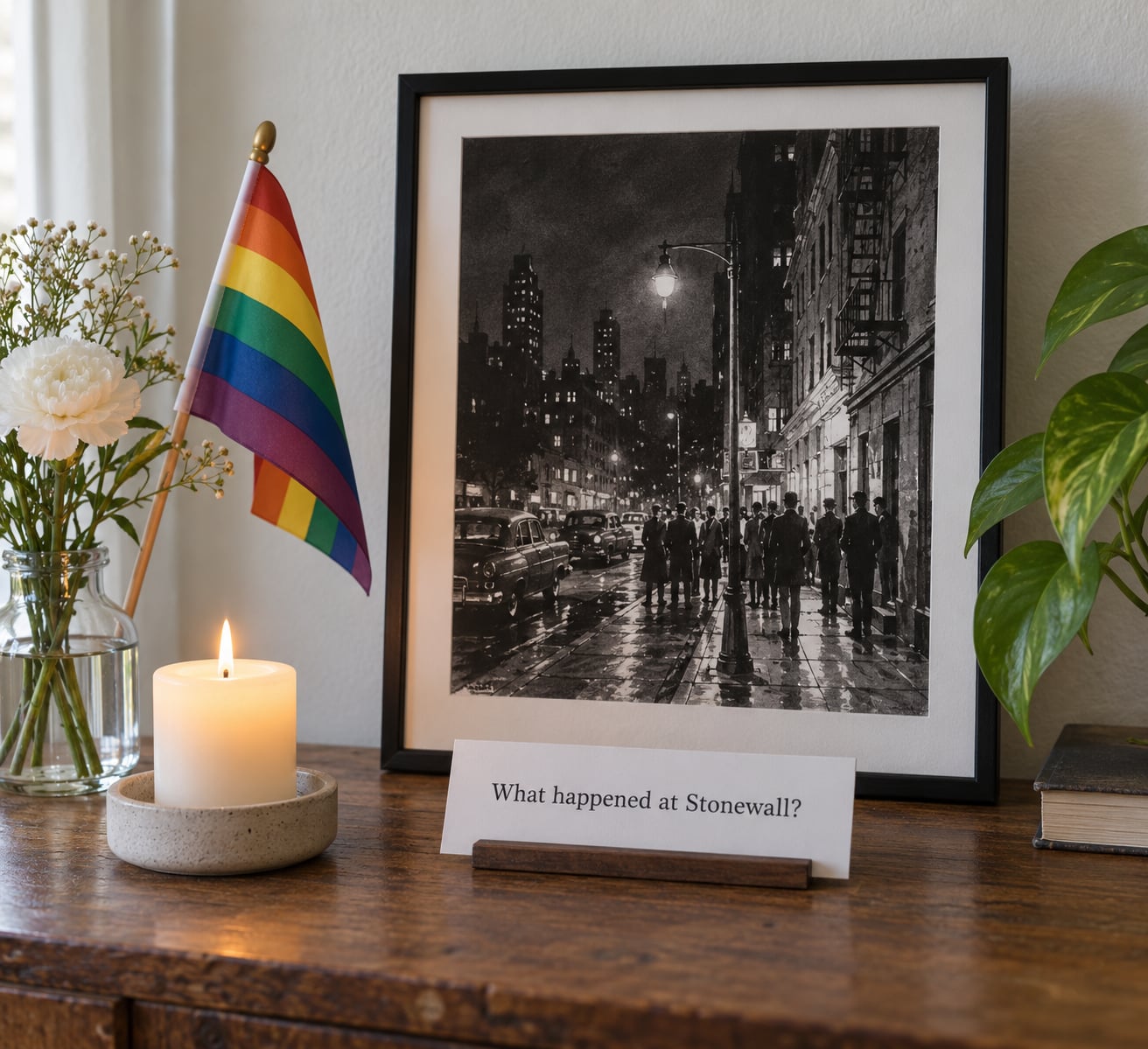
In the early hours of Saturday, June 28, 1969, plainclothes police and patrol officers entered the Stonewall Inn at 51 Christopher Street and began handcuffing patrons roughly two at a time. According to the National Park Service, most of the people taken outside were released without charges, which is the detail that matters most: the raid was built on the assumption that the arrest itself was the punishment.
What followed over the next several nights was resistance. The crowd outside grew on each pass, bottles were thrown, fire was set to the building, and the surrounding neighborhood joined in. By the time it settled, no small part of the anger came from that single weekend. It came from years of routine enforcement against a population with no legal standing to complain, including New York City’s 1962 liquor rules that let police close a bar on any technicality and the crossdressing statutes that made a person’s clothing a police matter.
Two things about the crowd are worth stating plainly, because they are the two facts the standard telling most often flattens. The first is that trans women, drag queens, and patrons of colour were central to what happened on those streets, not incidental to it. The second is that the building was a bar with a working population: hustlers, students, housewives, bus drivers, people just released from prison, people just off a six-month stretch in the Village.
On casualties, the honest answer is that we do not have clean numbers. The National Park Service and the Library of Congress both frame it as one or two people believed to have killed during the events, with the record disputed and incomplete. The Howard University law library puts the reason bluntly: few contemporaneous records of the raid and the nights after it exist, so much of what we know comes from oral history taken from the people who were there.
The terminology is contested too. Riot, rebellion, protest, uprising. Gay and lesbian organizations have generally preferred resistance language, and many historians use the word uprising as a neutral middle. It is worth noticing that the argument about the word tracks the argument about the story.
Almost nobody involved described what happened as a triumph that night. It was a bar that burned and a few nights of people standing in a street being told the rules applied to them. The consequences came later, and they came from organizing.
How did Stonewall change LGBTQ+ life?
Before 1969 there was no gay rights movement in the United States in the sense most people mean by that. There were people, largely, in small numbers, mostly closeted, and the main institutional responses were criminalization and pathology. Within a year of Stonewall, the Gay Liberation Front existed, the Gay Activists Alliance existed, and the next year’s march drew a crowd large enough that police had to plan traffic control for it.
The shift was less about a mood change than a structural one. Gay organizing had existed for decades through the Mattachine Society, the Daughters of Bilitis, and local groups, and most of it was cautious, respectable, and aimed at convincing decent people that gay people deserved basic decency. The generation that came out of Christopher Street pushed toward confrontation, visibility and liberation instead, and that choice had consequences that are still being argued over fifty-seven years later.
Marsha P. Johnson and Sylvia Rivera were leaders of the uprising, not commentators on it. Johnson was a veteran street activist who had already organised against the sanitation department over the treatment of homeless trans youth, and Rivera came to New York after years in Puerto Rico. Together they co-founded STAR, the Street Transvestite Action Revolutionaries, which worked on the street rather than on policy. They were frequently treated as marginal by the more respectable white gay organizations of the early 1970s, a split that is the single most important thing to understand about how the movement’s history has been narrated since.
Here is the shorthand timeline most references agree on:
| Year | What changed | Why it happened |
|---|---|---|
| 1969 | The Stonewall uprising and the birth of gay liberation organizing | Police raid on the Stonewall Inn, followed by six nights of resistance |
| 1970 | First Christopher Street Liberation Day march | Organized by the Gay Liberation Front and the Gay Activists Alliance; crowd estimates range from a few hundred to a couple of thousand |
| 1973 | American Psychiatric Association removed homosexuality from the DSM | Years of activism by gay psychiatrists, with the association’s own members voting the change in |
| 1973 | The first national liberation march on Washington | Organized largely by trans and gender-nonconforming activists including Johnson and Rivera, who had been pushed to the back by earlier planners |
| 1978 | Gilbert Baker’s rainbow flag first flown in San Francisco | A deliberate design with no commercial use and limited formal symbolism, later modified as the community grew |
| 2015 | Obergefell v. Hodges | The Supreme Court ruled that same-sex couples have a constitutional right to marry |
| 2016 | Stonewall Inn designated a National Historic Landmark and a national monument | Federal recognition of the site as significant in American history |
| 2020 | Bostock v. Clayton County | The Supreme Court held that Title VII’s workplace protections cover sexual orientation and gender identity |
Read that table end to end and one pattern shows up: nothing in it was given. Each line is the residue of people who organized, marched, sued, testified, and got arrested for it. That is the actual answer to how Stonewall changed LGBTQ+ life. It did not change laws by itself. It changed who was willing to demand them.
Why Stonewall still matters today
If the history is familiar and the argument is not, here is the argument in five parts.
It proved that refusal is a collective act, not an individual one
The most quoted thing about Stonewall is that a small crowd refused to go quietly. The part that matters for 2026 is what followed. A bar full of people can be dispersed. A network of people who already know each other, who have somewhere to meet, and who agree on a next step cannot be dispersed the same way. Every queer institution that survives locally today, whether it is a bar, a health clinic, a youth program or a political action committee, is that pattern repeated.
It corrected the record about who was actually there
For decades the popular version of Stonewall was a story about white gay men who had been somewhat oppressed too. The archival work, much of it driven by trans historians and by the Stonewall Veterans’ Association itself, has established that trans women and drag queens fought in the front lines and then had their role written down small. Anyone who tells the story now should have to explain why the credits look the way they do.
It built institutions, not just memories
The Gay Liberation Front raised rent for members, marched, ran a newspaper and insisted that liberation was the goal rather than assimilation. Groups like the Anti-Violence Project and the Stonewall Inn’s own youth work program came out of the same conviction that a movement needs places, services and people who will do the boring parts. Pride events in most American cities now run on that institutional base.
It is the reason Pride is a protest and not only a party
Stonewall gives the parade its argument. When a corporate float wants the look of solidarity without the politics of it, the reference point available to critics is a June night in 1969 when a community got its rights by confronting the people withholding them. The comparison is unfair to most Pride events, and it is still the sharpest tool anyone has.
It is a working script for the fights happening now
As of 2026, the legal pressure on queer people in the United States is not subtle: state laws restricting local anti-discrimination protections, restrictions on gender-affirming healthcare, school and library content limits, and federal pressure on research and health funding. The mechanism is uncomfortably familiar to anyone who has read about 1969. A minority is defined by something, made visible by someone else, and regulated in public. The script that comes out of Stonewall is the answer to that shape of attack: get visible on your own terms, gather, refuse, organize, and make the cost of enforcement impossible to ignore.
What lessons does Stonewall offer now?
The first lesson is that policy follows pressure, not goodwill. Nothing in the timeline above was conceded out of decency. Marriage equality came after roughly two decades of court cases, ballot measures, and marriages performed in defiance of the law. Anyone counting on the current climate to be kinder on its own is betting on the wrong variable.
The second is to be suspicious of any history that makes one group the whole protagonist. The erasure of trans women from the Stonewall story did not happen by accident; it happened because a louder set of organizations found it convenient. If a retelling flatters the version of the movement your community does not want to admit was there, that is a reason to check the sources.
The third is that a moment of visibility and the daily work of change are different jobs, and the second one is where people actually get hurt. The Inn did not become an organizing engine because people sang outside it once. The Street Transvestite Action Revolutionaries did not help people because they were charismatic. They built the specific, unglamorous infrastructure that turns a good night into a lasting condition.
The fourth is that a safe space has to be built and defended by the people who need it. That is not a slogan, it is a funding line and a staffing plan, and most of it is raised locally by small organizations with very little overhead.
How is Stonewall connected to Pride?
The link runs through a single date. In October 1970, organizers planned a march down Christopher Street and into Washington Square Park under the banner of Christopher Street Liberation Day. That first Pride was a protest about police harassment and was deliberately timed against the anniversary of the raid. Nothing about it was designed to look like a parade.
By 1978, Gilbert Baker had designed the rainbow flag as a symbol of hope, with colors chosen for their presence and not their meaning so the design could be adapted by whoever used it. He made versions of it for different sizes and occasions, and later said he would have dropped the stripes entirely if the community had wanted.
That transformation is the honest version of the story. Pride became a celebration, and it also became an annual demonstration that a group which once could not hold hands in public now takes up city blocks, hires security, and forces institutions to say out loud whether they will stand with it. Both things are true at once, and arguing about which one is the real Pride has been a useful fight for fifty-six years.
It is also worth saying that Pride is bigger than one New York street. Marches in Chicago, Los Angeles, Mexico City, Cape Town, Mumbai and Manchester draw on local histories as much as on 1969, and treating American anniversary culture as the source of all queer visibility is its own kind of erasure. If you want the American version told honestly, it still has to be told next to the rest of the world, not instead of it.
What work remains after Stonewall?
Start with the present-tense legal picture. In 2026, the pattern that worries most advocates is state preemption, where a legislature overrides protections that individual cities and counties had adopted. It matters in Illinois and across the Great Lakes in a very concrete way: a local non-discrimination ordinance that a city passed can be wiped out at the state level, and local elected officials who fought for it lose the ability to act.
Healthcare is the second front. Rules around gender-affirming care for both minors and adults continue to move through statehouses, and the people most affected are the same people Stonewallers fought for. Access also depends on insurance and on which clinicians are willing to treat whom, and both of those have shifted since 2020.
Schools and libraries are the third. Content restrictions for age-appropriate material, challenges to books in school curricula, and policies governing what clubs can exist have expanded considerably since 2019. In practice this affects young queer people most, who have the least power to appeal a decision made about them by adults.
Money and safety make the fourth. Federal attention to LGBTQ health research and to community health funding has become inconsistent and at times hostile, and community organizations have had to absorb cuts that were never matched by new revenue. Meanwhile, harassment and violence against queer people, including violence that targets trans people specifically and violence against people who do physical or sex work, remain a documented and persistent feature of life in American cities.
Nobody should need a Wikipedia page to know that these trackers are public and updated continuously. Organizations publishing legislation trackers and annual violence reports are the right place to get current numbers rather than a statistic quoted from a few years ago in an article that never gets updated.
Then there is the erasure problem, which is harder to photograph. Queer history pages, health resources, and community archives are now maintained largely by volunteers, and a lot of that material has been removed from major platforms in recent years. Losing a link is not losing a fact, but losing the search result is a real practical loss for a teenager looking for language that fits.
How can people honor Stonewall responsibly?
Start with sources rather than summaries. The National Park Service pages on the Stonewall National Monument and the Library of Congress LGBTQ studies guide are free, current, and written for exactly this. A ninety-minute read there will correct more myths than a season of commemorative social media.
Put money where the history is made. The work still happening is not commemorative: youth programs, health clinics, legal aid, HIV and long-term care services, and the community centers that let a seventeen-year-old have a safe place on a Friday. Local LGBTQ+ organizations are the least glamorous and most effective way to honor this.
Go to a commemoration as a witness, not a costume. The mood at most major Pride events is joy, which is legitimate and also a deliberate refusal of the shame the old world preferred. Treating it as a spectacle to consume misses the point of people showing up to be counted and seen.
Get the history right when you repeat it, especially the parts that are inconvenient. Trans women led at Stonewall. The 1970 march and the 1973 Washington march were not the same event. Stonewall did not end discrimination, did not stop an epidemic, and did not fix anything by itself. Saying all three is not cynicism. It is the difference between commemoration and history.
And when someone asks you in 2026 why any of this still matters, resist the answer that sounds most polite. Rights in this country have gone one direction for about half a century, and every step of that direction came from people who were told to be satisfied with less. Stonewall matters because it is the proof, recorded in public, that they were not.
Frequently Asked Questions
What is the main reason Stonewall still matters?
Stonewall still matters because the rights queer people use every day were taken rather than granted. It is the reference point that proves a persecuted group can organize, resist publicly, and change the law. It also keeps a present-tense question honest: if the gains since 1969 came from pressure rather than goodwill, then any new attack on those gains can be met the same way.
Was Stonewall the beginning of the LGBTQ+ rights movement?
No, and the claim is worth arguing carefully rather than repeating. Queer organizing existed for decades before 1969, and so did uprisings, including Compton’s Cafeteria in San Francisco in 1966. What Stonewall began was the modern liberation phase: a named movement, permanent organizations, a radical stated goal. It was a turning point for the United States, not the world’s first queer resistance or its global beginning.
How did Stonewall influence Pride celebrations?
Organizers deliberately chose the first Christopher Street Liberation Day march in October 1970 to fall on the anniversary of the raid, which made Pride a demonstration against police harassment rather than a neutral celebration. Gilbert Baker’s rainbow flag followed in 1978. Since then, Pride has split into celebration and protest at the same time, which is why modern Pride events can carry corporate sponsorship and anti-police signage without contradiction.
Why is Stonewall important for LGBTQ+ people today?
Mostly for people who did not grow up in 1969 and are being asked to defend gains they never saw anyone fight for. As of 2026, the pressure has shifted to state preemption of local protections, healthcare restrictions, school and library content limits, and funding pressure. The underlying mechanism is the one the Stonewall crowd faced: a minority defined by someone else, regulated in public, and told to accept it.
What can allies do to support the legacy of Stonewall?
Fund local LGBTQ+ organizations, which mostly run youth programs, health services and legal aid on small budgets. Show up at Pride as labor, not as an audience. Use correct names and correct history in ordinary conversation. And where you work, check whether your own city has anti-discrimination protections, since local ordinances remain the first thing state preemption laws target.
Is Stonewall only about LGBTQ+ history or also about current action?
Both, and separating them weakens both halves. The history matters because it establishes that progress here was extracted through organized public resistance, and that trans women led at Stonewall rather than watching from the sidelines. The present matters because the same playbook still applies. Any account of Stonewall that stops in 1969 turns a live example into a parade float.
Conclusion: Why Stonewall still matters now
Start with the next thing that is true: a local organization taking money, a name used correctly, a chapter read from the National Park Service. Stonewall matters for 2026 because the generation that inherited its gains did not win them, and a generation that cannot name where something came from tends to assume it cannot be lost either.