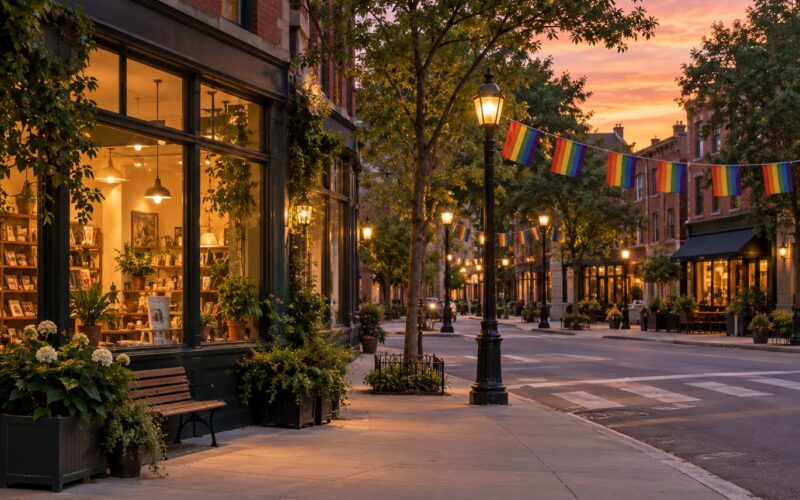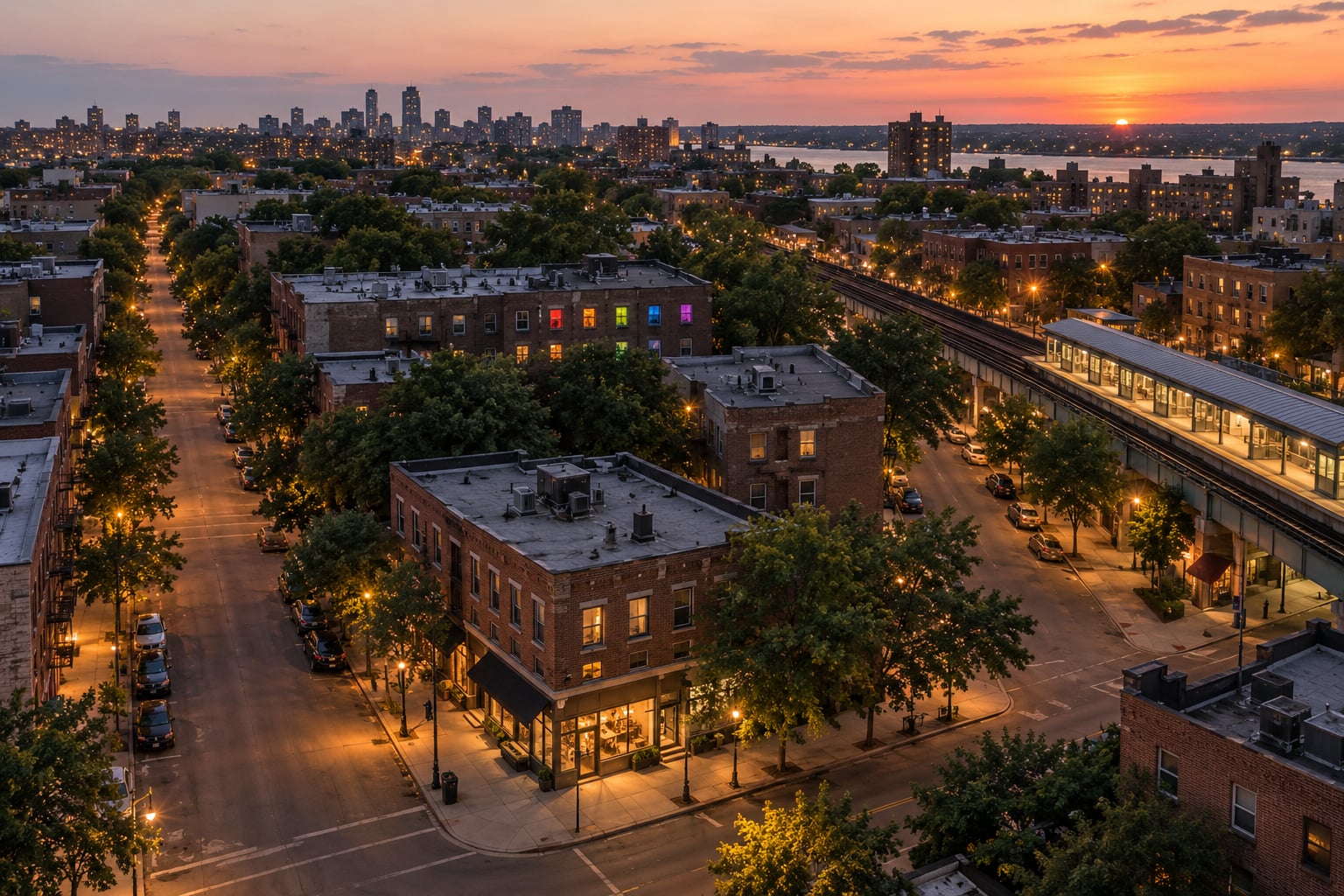
Gay neighborhoods formed the way most urban enclaves do: people who were pushed toward the same few blocks settled there, opened businesses, and made the area legible to each other. Understanding how gay neighborhoods formed in American cities means looking at migration, housing, policing, and organizing together, because no single cause explains any one of them.
That question is worth taking seriously. The answers explain a lot about who could afford to live where, who got left behind during redevelopment, and why some legendary queer streets now feel like polished entertainment corridors.
Table of Contents
- How gay neighborhoods formed in American cities
- What counts as a gay neighborhood?
- Why LGBTQ+ people clustered in certain city neighborhoods
- How housing, policing, and city policy shaped queer districts
- How nightlife and community institutions created hubs
- How migration and identity shaped different local histories
- What happened in major US queer neighborhoods?
- How did activism and resistance change these neighborhoods?
- Why are some queer neighborhoods declining or disappearing?
- What do queer neighborhoods look like today?
- What lessons do these neighborhood histories offer?
- Frequently Asked Questions
- What is the first gay neighborhood in America?
- Are there definitive founding dates for American gay neighborhoods?
- Why did gay people live in the same neighborhoods?
- How did immigration and race shape gay neighborhoods?
- Is gentrification erasing gay neighborhoods?
- Are there gay neighborhoods outside large cities?
- Start with the local history
How gay neighborhoods formed in American cities
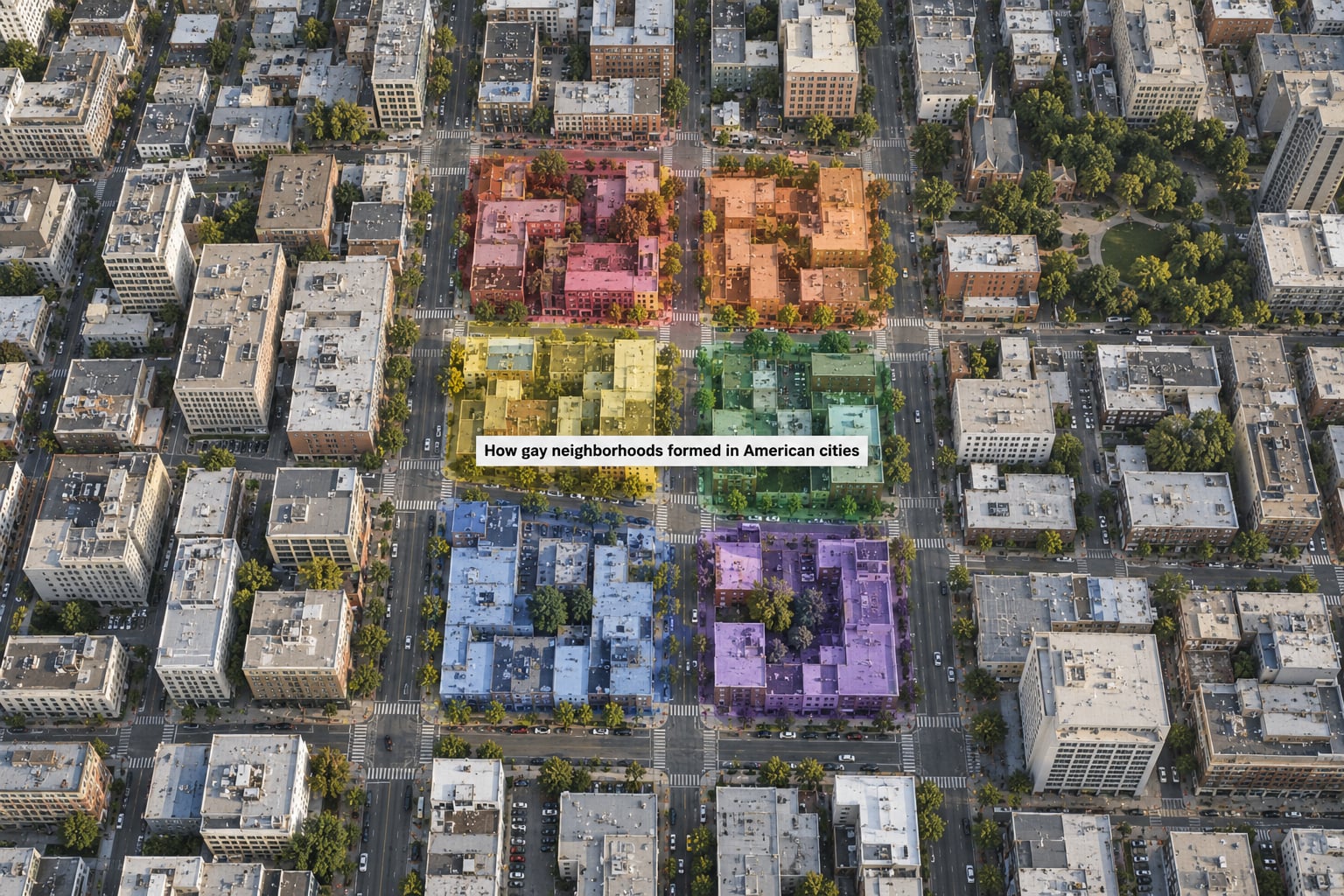
The short answer: gay neighborhoods formed through the compounding of six forces. Post-war migration brought people to cities, housing rules decided which blocks they could afford, bars and businesses provided infrastructure, policing shaped what happened after dark, community institutions did the care work, and activists turned neighborhoods into political leverage.
None of these forces were unique to queer people. What made the result distinct was the combination. Black migrants in the 1920s, Italian and Irish immigrants in the 1950s, and young renters in the 1980s all formed neighborhoods with comparable density and mutual aid. The difference is that gay neighborhoods grew under a specific legal apparatus that treated their residents as criminals in many cities, which made the gathering places both more urgent and more fragile.
The useful frame is a layered one. Take the housing market, the nightlife economy, the criminal code, and the migration stream of a given city, and where they overlap you will usually find something that looks like a gayborhood.
What counts as a gay neighborhood?
A gay neighborhood, also called a gayborhood or gay village, is a recognizable area with a high concentration of LGBTQ residents, businesses, and institutions. It has fuzzy edges rather than official borders, and different people will draw the boundary differently.
Scholars who study queer urbanism have pushed back on treating the gayborhood as a fixed stage of progress. Amin Ghaziani’s work on cultural archipelagos argues that queer life in most cities now spreads across scattered, changeable clusters rather than one district, which is why long-time residents talk about their neighborhoods disappearing even when the rainbow flags are still up.
Several markers overlap to create a real center of queer life:
- Institutions people rely on, such as health clinics, community centers, and social service organizations.
- A cluster of businesses, historically bars, bookshops, restaurants, and record shops.
- Visibility and public recognition, from Pride parades to municipal rainbow signage.
- A housing pattern where queer renters and owners find each other and landlord discrimination is low.
- Political and cultural activity, including clubs, performance spaces, and organizing.
- Mobility and social networks, including the word-of-mouth referrals that moved people across the country.
Plenty of neighborhoods have many LGBTQ residents without being gay neighborhoods. Concentration plus infrastructure is the difference.
Why LGBTQ+ people clustered in certain city neighborhoods
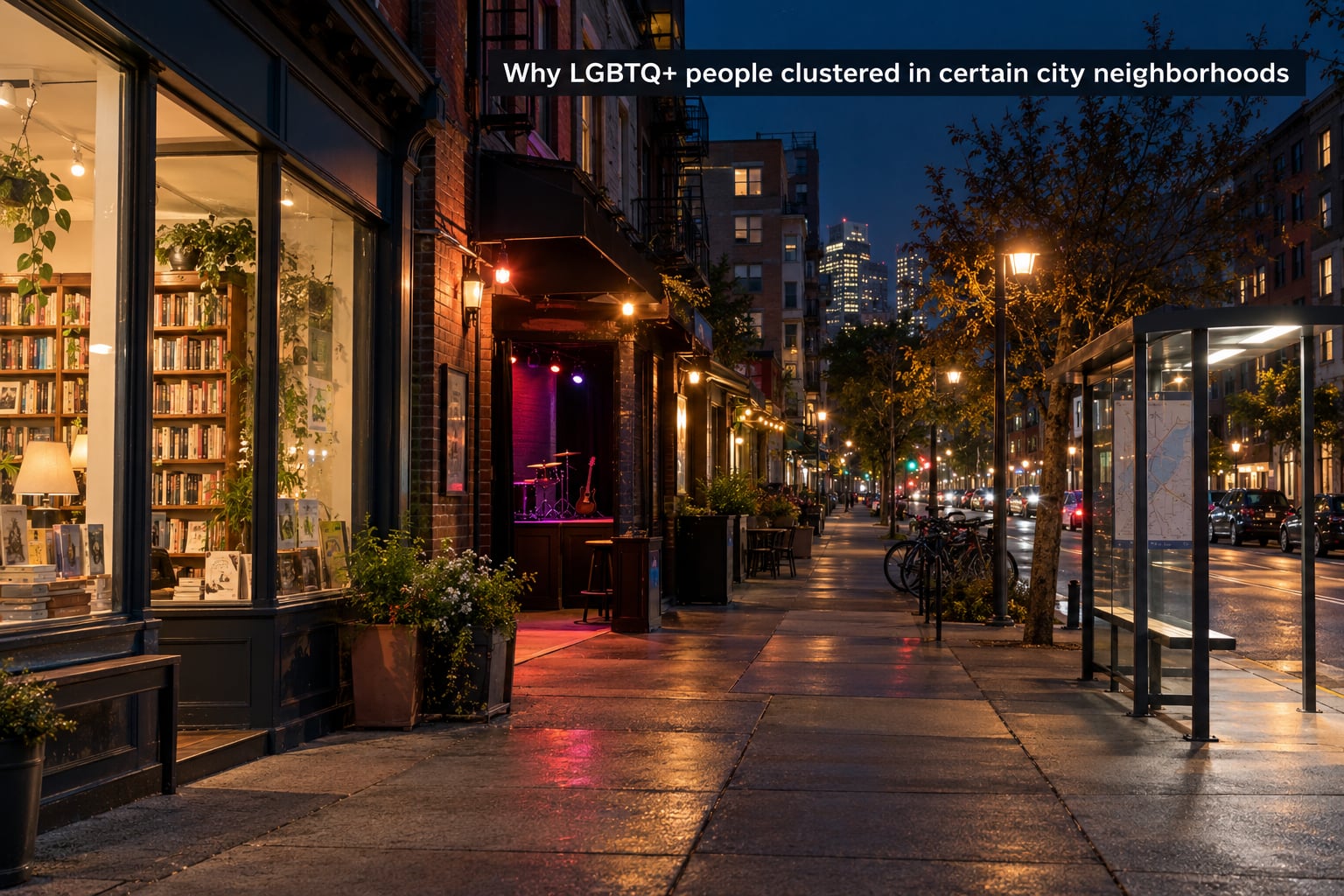
People cluster because clustering solves problems. Seven pressures do most of the work, and they vary a lot from city to city.
Safety in numbers
Before 1969 and for decades after, being gay in public could mean arrest under sodomy laws, loss of employment, or physical violence. A block where you were known lowered the daily cost of being yourself, even when nobody there was safe.
Housing that was actually available
This is the part most origin stories skip. Gay people were largely shut out of the mortgage market. Veterans’ loan programs favored married homeowners, lenders steered single applicants toward older buildings, and unmarried people faced a punitive tax system that charged spinsters more than married couples without children. Renting an old apartment on a tired block was often the only door left open.
Proximity to work and to other arrivals
Port cities and industrial cities attracted single workers. San Francisco, New York, Los Angeles, Boston, Baltimore, and Philadelphia all drew men who intended to earn and leave, which made cheap housing and anonymity available at the same time.
Venues as infrastructure
A bar was not only drinking. It was a meeting hall, a hiring board, a bulletin board, a place to hear about a doctor or a lawyer, and often the only room where a person was fully recognized. One Chicago organizer put it plainly: coming into a bar was really the only moment you were home.
Chosen family
Queer people were frequently cut off from biological kinship. Dense neighborhoods made substitute families possible because relatives and lovers lived within walking distance and could share a meal, a phone, or a spare key.
Shared culture
Music, dress, language, and performance gave a district a character people could recognize from a block away. That cultural distinctiveness is what later makes these places attractive to newcomers and to investors, sometimes in that order.
Ability to organize
Numbers become political weight. Once a community has a critical mass of residents and businesses, it can push for ordinances, defend members in court, and eventually name itself in city documents.
Voluntary choice matters here, but it sat on top of exclusion. People chose the Castro or Halsted Street. Banks, employers, landlords, and police made sure the choice was not wider than it needed to be.
How housing, policing, and city policy shaped queer districts
Free choice explains very little on its own. The table below tracks the policy forces that consistently decided where queer residents could land, and what happened once they had.
| Policy force | How it operated | Effect on queer residents |
|---|---|---|
| Redlining and mortgage discrimination | Racial risk maps and lender practice steered capital away from older, working-class districts and toward suburbs, with queer tenants caught in the same map | Pushed renters toward blocks with cheap, neglected housing and high turnover |
| Veterans’ loan eligibility | Home loan programs rewarded marriage, dependents, and stable employment, leaving many gay veterans without a viable purchase path | Concentrated men in the rental stock of central neighborhoods |
| The unmarried tax penalty | Unmarried people paid higher federal income tax than married couples without children | Made independent housing in the city harder to afford |
| Urban renewal and demolition | Highway construction, slum clearance, and later transit projects tore through districts such as San Francisco’s Tenderloin and Los Angeles’s east side | Dispersed or erased businesses, including bars and boarding houses |
| Zoning, licensing, and nuisance law | Municipal codes restricted adult businesses and let police revoke or refuse bar licenses on morality grounds | Made venues fragile, expensive, and easy to weaponize politically |
| Police enforcement of sodomy laws | Entrapment, raids, and bar checks shaped where people could gather and how public a venue could be | Created a chronic demand for informal, private, or careful spaces |
| Later housing law | The 1968 Fair Housing Act barred racial discrimination but did not reliably protect single adults or queer households, and federal statutes still leave marital status unprotected | Legally sanctioned the clustering that residents had already created by necessity |
The pattern repeats: housing rules that were written for married nuclear households produced a rental population concentrated in central neighborhoods, and police power over bars made those blocks simultaneously the social center and the most exposed.
How nightlife and community institutions created hubs
Bars get the attention because they are visible and, after dark, public. They were not the important part. The important part was what else arrived alongside them.
Take the growth of Chicago’s Boystown in the 1980s. Bar culture made Halsted Street legible, and organizers turned it into a political district. Tracy Baim and his partner opened Sidetrack in 1980, and within a few years the street supported a shop, a cafe, and an association that could lobby. WBEZ’s oral histories with people like Art Johnston describe that period as a moment when a set of blocks became a community rather than a destination.
Across cities, the same supporting cast shows up: lesbian bars such as Chloe’s in Chicago, which opened in 1997, lasted only three months as a lesbian bar before changing names and eventually becoming a ramen shop, and a small commercial frontage that does not survive that well. Bookstores such as Women & Children First anchored Andersonville on Chicago’s North Side, drawing a lesbian community that gave the stretch its own identity. Gay health clinics and community centers turned a district into a place you could receive care, not just meet a date.
Transgender and gender-nonconforming people have been present in these spaces from the start, often earning their keep as performers, waitstaff, and patrons before anyone built a space for them. Compton’s Cafeteria in San Francisco became known in the 1960s as a gathering place for transgender women and drag performers, and the 1966 disturbance there is often cited as one of the earliest recorded public confrontations involving transgender patrons.
Institutional infrastructure is what separates a district from a nightlife cluster. A bar district can empty out when the leases change. A neighborhood with a clinic, a housing organization, a food program, and a paper survives its own landlords.
How migration and identity shaped different local histories
No city shares one origin story, because the forces arrive in a different order and combination in each place. Reading a national map onto a local history gets it wrong more often than not.
Race has been the sharpest dividing line in these narratives, and the usual telling is backwards. Black queer communities existed and organized in Harlem, Philadelphia, Chicago, and Los Angeles before any white gayborhood was recognizable as one. William Dorsey Swann is described in Washington’s Black and Blue Madhouse as the first drag queen in United States history, and Alice Dunbar Nelson and the female blues and club women of Harlem built social worlds in the 1920s that the later gay economy did not produce.
The mid-century white gay migration story is real, but it happened in the gaps left by Black residents who were pushed out by redlining and urban renewal. The Federal Housing Administration’s underwriting maps shaped where investment went after World War II, and Black and queer residents were sorted into the same declining housing stock by different mechanisms.
Lesbian communities formed on different terms. Women who could not afford to follow men into the bar scene built their own apartment networks, book clubs, and cafes. Andersonville’s stretch was nicknamed Girlstown before that bookstore moved in. Legal cases in the 1970s made this visible: some women simply lost their apartments, their jobs, or their children once they came out publicly.
What happened in major US queer neighborhoods?
How gay neighborhoods formed in American cities, city by city
Six snapshots, none of them a template for the others.
San Francisco: the Castro and the Tenderloin
The Tenderloin became known as the city’s first queer district before the Castro did, serving sailors, soldiers, and contract workers who had nowhere else to stay. When developers pushed the military out of the neighborhood in the 1960s, residents and small businesses, including drag performers, held off bulldozers for years. The Castro followed through the Eureka Valley’s own displacement story, and Compton’s Cafeteria gave it a lasting transgender presence.
New York City: Greenwich Village and Chelsea
The Village’s density and its large population of single renters made it the natural landing place for men discharged from military service under rules that treated homosexuality as a disqualifying condition. Stonewall Inn, at 53 Christopher Street, became the target of a police raid on June 28, 1969, and the uprising that followed over several nights is the episode most Americans know. Christopher Street Liberation Day marches began the following June.
Los Angeles: a corridor erased by redevelopment
Los Angeles had early queer institutions, including the Black Cat Tavern, founded in 1927 by Les K. Wright and widely described as one of the oldest surviving gay bars in America. What later broke down was geography. Redevelopment of the eastern downtown corridor demolished many of the venues that had made it a destination, and queer life dispersed to Silver Lake, Koreatown, and West Hollywood.
Chicago: Boystown, the Levee District, and Andersonville
Before Halsted Street there were the Levee District, Tower Town, and hotel rooms where men could meet without being arrested. Bar culture in the 1980s made Boystown legible, and the city responded with symbolic infrastructure including rainbow pylons installed in 1997. Chicago voters passed a Human Rights Ordinance in 2010. At the same time, long-time residents have argued publicly that the district is whiter and safer and therefore less theirs, a tension visible in the 2011 campaign that pushed back on perceptions of the neighborhood.
Boston: the South End
Boston’s South End combined cheap nineteenth-century housing with a nearby university population and a service economy, the same formation pattern as the Village but with a smaller scale. Its queer presence became tied to lesbian community life, community centers, and later a residential conversion and reinvestment wave that raised values sharply.
Philadelphia: a cluster on and around Christopher Street
Philadelphia’s gayborhood took shape in the blocks around Christopher Street, linked to a nearby medical school and teaching hospitals. It has always been more a set of overlapping residential and commercial pockets than a single district, and long-time residents in local forums describe the same squeeze the rest of the country sees: rising rents, fewer bars, and residents pushed to the edges.
How did activism and resistance change these neighborhoods?
Organizing is what converted a settlement pattern into a neighborhood with a political identity. Residents fought liquor license revocations, police harassment, zoning enforcement, employment discrimination, and closed health clinics, and each fight turned a group of renters into a constituency.
Three outcomes came out of it. Bars became safer and more durable once their owners organized against raids. Residents built service infrastructure, including clinics, hotlines, and food programs, that no government supplied. And in a few cities, that organization produced municipal recognition, through human rights ordinances, designated cultural districts, Pride parade routes, and street signage.
Activism also defined identity more sharply, sometimes too sharply. Districts marketed as welcoming could resist the presence of trans patrons, unhoused people, or young queers, and residents who did not match the district’s image were treated as outsiders. That tension runs straight through the 2011 debate in Chicago, where organizers pushed back on the idea that the neighborhood’s problems came from queer youth of color.
Outward, activism delivered legal change: marriage equality brought a wave of couples seeking these neighborhoods as a destination, which is one reason rents in some districts rose for reasons that had nothing to do with new residents moving in.
Why are some queer neighborhoods declining or disappearing?
The commercial district is the fragile part. The community itself is usually still there, dispersed a few miles away.
- Rents and redevelopment. Once a district is known as welcoming, landlords and developers price in the reputation. Residential conversion of older buildings in the South End, Boston and along the Village’s edges follows this logic.
- Nightlife economics. The venues that built the districts depended on cheap rooms and lenient codes. That combination is vanishing in the highest-value neighborhoods, and lesbian bars, which were already scarce nationally, have closed at a much higher rate than bars serving men.
- Dating apps. People meet before they travel, which reduces the need to go somewhere to be found. One of the recurring phrases from younger queers is community as opposed to a building, and that is not nostalgia, it is a reasonable accounting of how things work now.
- Commercialization. A parade route, a branded crosswalk, and a month of themed marketing can substitute for the year-round infrastructure that made a neighborhood able to care for its own members.
- Scattered living. Couples buying homes, remote work, and family formation pull residents outward. The population may grow while the district empties out.
The term for the process of a neighborhood losing its queer character while keeping its queer reputation is straightening. The term for a district gaining money and losing its residents is gaytrification. Both are used loosely, but both describe something real and measurable in rents and in who is still there.
What do queer neighborhoods look like today?
The single-district model is now one pattern among several. Most large cities have a downtown corridor of bars and clubs, often mixed into a wider nightlife strip rather than standing apart from it. Alongside that sit smaller residential enclaves with a grocery store, a center, and no bar at all. Suburbs and midsize cities have developed their own corridors, in many cases around a college town, a military presence, or a specific street.
Pride events increasingly function as the temporary district. A city without a permanent queer center may host a large festival, a march, and a week of events that draw people from across the region, then go quiet. That model gives people a community without giving them a place to live.
Hybrid organization blurs the line further. A group chat can organize a dinner, a volunteer shift, and a night out in three different neighborhoods. If that works, the district was never the point. But people living in towns where nobody else is out still describe the value of a visible local scene, however small.
What lessons do these neighborhood histories offer?
Read across the cities, four things repeat.
Housing policy is the whole story in miniature. Every neighborhood that formed cheaply did so because someone could not buy. Any policy that restores access to housing will move people, and the question is only whether they choose to.
Institutions survive longer than aesthetics. A rainbow crosswalk costs very little. A free health clinic does the actual work of keeping a community alive through a crisis, and those are the parts a redevelopment plan tends to value least.
Visibility cuts both ways. Being known brings safety and community and also brings landlords, consultants, and marketing. Neighborhoods that kept some obscurity survived longer.
Neutral owners are never neutral. Every decision about density, code enforcement, and tenant protections in a queer district is a decision about that community, whether or not anyone says so out loud.
How communities can respond to current redevelopment pressures
Organize around housing rather than around identity, since housing is what determines who is still there a decade later. Track code enforcement and license revocations, which are routine and easy to ignore, and pair preservation efforts with legal protections that outlast any one campaign.
Support the unglamorous infrastructure: the food program, the clinic, the tenant hotline, the school. Protect lesbian and trans venues specifically, since those are the businesses that already close first and attract the least support.
And keep building somewhere. The queer districts that survived the last cycle are the ones where somebody kept a room, a phone line, or a meeting space through the lean years.
Frequently Asked Questions
What is the first gay neighborhood in America?
There is no agreed first. Black and Blue Madhouse, a Black drag house in Washington DC run by William Dorsey Swann around 1890, predates every neighborhood claim, and Black queer communities in Harlem formed before any white district was recognized. San Francisco’s Tenderloin is often called the first recognized queer district, and Los Angeles’ Black Cat Tavern opened in 1927.
Are there definitive founding dates for American gay neighborhoods?
No. Districts assembled over decades through overlapping waves of migration, venue openings, and policy shifts, and the boundaries shifted the whole time. Dates that appear in city histories usually mark one event, such as a bar opening or a municipal designation, rather than a founding. Any single year flattens a process that took a generation.
Why did gay people live in the same neighborhoods?
Mostly because the housing system left them few choices. Lending favored married buyers, the federal tax code penalized single adults, and many employers barred gay workers, so large numbers of people rented older apartments in central districts. Living near other queer people made that constrained choice livable by supplying friendship, services, and venues.
How did immigration and race shape gay neighborhoods?
Early queer social worlds grew inside Black, Latino, and working-class immigrant districts such as Harlem and the Levee District, often in drag and social club forms. When white gay men migrated to cities after World War II, they settled in the neighborhoods those communities were being pushed out of by redlining and urban renewal. The two histories overlap more than the standard telling allows.
Is gentrification erasing gay neighborhoods?
In many cities, yes, though the mechanism is usually rising rents rather than outright eviction. When a district becomes desirable, older landlords sell, buildings convert, and residents who depended on cheap rent move to cheaper blocks nearby. The rainbow flags often stay. The community organizations and lesbian bars that were there first are much likelier to disappear.
Are there gay neighborhoods outside large cities?
They exist, though they rarely call themselves that. Midsize cities, college towns, and suburbs tend to have a street, a bar, or a community center rather than a district. Formation follows the same logic at a smaller scale: cheap housing near a source of arrivals, plus one or two venues that made it possible to be visible. Without a venue, the network usually stays private.
Start with the local history
If you want to understand how gay neighborhoods formed in American cities, pick one city and read its migration, housing, venue, and activism history in that order. The order matters, because each layer sits on the one before it.
Skip the founding-date hunt. A date will make the story tidy and the story wrong. These were never finished districts waiting to be discovered, and they are not fixed districts now, either. They are living, changing, and mostly made out of people deciding to be somewhere together.