
A budget that actually works comes down to three moves: build it from your real after-tax income, give every dollar a specific job, and review what actually happened once a month instead of guessing. That is the whole system, and it takes one evening to set up plus about thirty minutes a month to keep alive.
Most budgets do not fail because of discipline. They fail because they were guessed instead of tracked, were too tight to survive a bad week, left out the costs that only land twice a year, or were never revised after life changed.
This guide covers how to make a budget that actually works from the first number to the monthly review: gathering records you can trust, choosing a method that fits your income, funding the irregular stuff without a scramble, and what to do in the first thirty days. I have used the same zero-based setup with a spreadsheet for years and I still revise it every quarter, which tells you something about how this works in practice.
Table of Contents
- What You Need Before You Start: Five Things, and None of Them Are Perfect Numbers
- Step-by-Step: How to Build, Use, and Fix Your Budget
- Gather Reliable Numbers Before You Plan Anything
- Choose a Zero-Based Method to Make a Budget That Actually Works
- Separate Needs, Wants, and Future Costs Without Judgment
- Fund Savings and Irregular Expenses Before They Hit
- Automate the Plan and Add Spending Checks
- Review and Adjust the Budget on a Set Schedule
- Give Every Dollar a Job With a Worked Example
- Common Mistakes That Break Budgets, and the Fix for Each
- Frequently Asked Questions
- How do I budget when my income changes every month?
- Should I build a budget around take-home or gross income?
- How much should I put aside for expenses that happen only once a year?
- What is the fastest way to start an emergency fund?
- How should couples or chosen-family members handle different spending habits?
- What should I do with money still in the account at the end of the month?
- Start With This Month’s Fixed Costs
What You Need Before You Start: Five Things, and None of Them Are Perfect Numbers
You need much less than most budgeting guides imply. Here is the full list.
- Thirty to ninety days of records. Bank statements, a card export, or a photo of every receipt for the last month.
- A calendar you actually look at. Phone or paper, it does not matter. You are checking it for due dates, not tracking daily life in it.
- A method. A spreadsheet, a note-taking app with a table, or a dedicated budgeting app. Pick one and stay in it for a full quarter.
- Your known future bills. Rent renewal, insurance renewal, a car payment, quarterly dues, anything with a date attached.
- One evening, about two hours. That is the real time investment.
What you do not need: perfect numbers, a large emergency fund, a partner on board, or a particular app. Start with what you have this week and fix the gaps as they show up.
Step-by-Step: How to Build, Use, and Fix Your Budget
Gather Reliable Numbers Before You Plan Anything
Start with what actually landed in your account, not what you earned. Take your gross pay and subtract taxes, benefits, retirement contributions, and deductions. What remains is your net income, or take-home pay, and that is the only number a budget can be built on.
Pull three months of statements if you can. Three months catches the annual bill hiding in the background: the dental cleaning, the car registration, the quarterly insurance premium. One month misses it, which is exactly how people end up broke in March after a smooth January.
If you do not have three months of history, use your bank and card statements for whatever period you do have and mark the gaps. Extrapolate carefully. A gap in the record means the figure is an estimate, so leave a small buffer rather than pretending it is exact.
While you are in there, sort every line into two buckets: recurring and one-time. Recurring means rent, utilities, subscriptions, loan payments, and the medication you refill every month. One-time means the concert ticket, the broken car window, the gift. One-time spending still matters, but it does not get a monthly category.
Your verification point is simple. When you finish, you can point to a number that represents your monthly take-home, and a list where every recurring expense has a dollar figure attached.
Choose a Zero-Based Method to Make a Budget That Actually Works
Zero-based budgeting means you assign your expected take-home income to specific purposes until nothing is left unassigned. Not spending every dollar, just deciding where each one goes before it disappears.
The alternative is percentage-based planning, where you aim for a split such as half on needs, thirty percent on wants, twenty percent on savings and debt. Plenty of people use 60/30/10 or a 70/10/10/10 variant when housing eats the budget, and that is fine. The percentages are a starting template, not a grade.
| Method | How it works | Best for | Effort |
|---|---|---|---|
| Zero-based (every dollar gets a job) | Assign each dollar of expected income to a purpose until the total is used up | People with irregular costs who want total visibility | Medium to high |
| 50/30/20 (or 60/30/10) | Split net income into fixed percentages across needs, wants, and savings | Steady pay, simple setup, low tracking appetite | Low |
| Envelope system or cash stuffing | Set aside a fixed amount per category and stop when the envelope is empty | People overspending on small daily purchases | Medium |
| Reverse budgeting (pay yourself first) | Move savings out on payday, then budget whatever remains | Anyone with a history of saving nothing at month end | Low |
The honest trade-off: zero-based asks more of you weekly, and a lot of people find that micromanaging. Community consensus on budgeting forums leans toward bank-linked tracking plus a monthly category review over daily micro-logging. If you know you will abandon a rigid system by week three, take the percentage split and automate what you can.
Either way, base your plan only on money you actually receive. A budget built on gross income fails immediately, because money you never received cannot pay a bill.
Separate Needs, Wants, and Future Costs Without Judgment
Sort your recurring list into needs, wants, and future costs. Needs cover housing, utilities, groceries, transportation, minimum debt payments, health basics, and insurance you are contractually committed to. Wants cover dining out, nightlife, subscriptions, hobbies, travel, and events with friends.
Some wants are non-negotiable for your mental health, and that is a real budgeting input, not an excuse. Concerts, dance class, a subscription you genuinely watch, a trip with chosen family. Protect those deliberately rather than pretending they are needs and then resenting every grocery receipt.
Future costs are the ones that scare people: annual premiums, quarterly dues, deductible contributions, gifts, registration renewals, the every-few-years expense that never seems to arrive until it arrives.
The verification point: for every category, you can say whether it is fixed or variable. Fixed means it barely changes month to month. Variable means it swings with your choices or the season. Both need a number, and variable ones need a realistic one rather than your best-ever month.
Fund Savings and Irregular Expenses Before They Hit
Give the irregular costs their own accounts. A sinking fund is simply a named pile of money set aside for something predictable but infrequent, and it removes the annual scramble.
The math is straightforward. A 600 annual insurance bill spread over six months of premiums is 100 a month. A 900 holiday and birthday budget spread over twelve months is 75 a month. Divide by the number of months until the cost lands, not by twelve every time. A bill due in two months needs half the amount now, not a twelfth.
For the emergency fund, most mainstream guidance starts with a small starter target: one month of essential expenses, or roughly one to two thousand dollars for a single renter living somewhere expensive. Small and consistent beats big and delayed. Once the starter exists, aim for three to six months of essential costs, and more if your income swings.
Consumers Financial Protection Bureau and university-extension financial education programs both frame the order the same way: a small buffer, then employer retirement match, then high-interest debt, then everything else. Matching money is the closest thing to an instant return available to an ordinary household, so it comes early in the queue.
For irregular or freelance income, a conservative version of pay yourself first works well. On your smallest month in the last six, move a set amount to savings first, then live on what remains. That baseline becomes your spending plan in a good month and your floor in a bad one.
Automate the Plan and Add Spending Checks
Anything predictable should happen without you. Schedule rent, utilities, and loan payments for the day after payday, when the money is definitely there. Set standing transfers to your emergency fund, then to each sinking fund, then to retirement. Order matters more than size at the beginning.
A two-account setup does more work than any app. One account holds bills, sinking funds, and savings. The other holds the amount you actually spend from, transferred at the start of each period. When that second account runs low, you have a decision to make with real information instead of a vague feeling on the fifteenth.
Then check weekly, for ten minutes. Look at what has cleared since the last check, glance at upcoming bills for the next ten days, and confirm nothing has quietly eaten the grocery money. That is the whole ritual. Daily tracking rarely survives contact with a real life.
Use one question for every transaction: does this fit the plan as written, or does the plan need to change? Both answers are legitimate. The failure mode is deciding neither.
The verification point: your bills paid themselves, savings moved on payday without permission, and you know your next ten days of obligations at a glance.
Review and Adjust the Budget on a Set Schedule
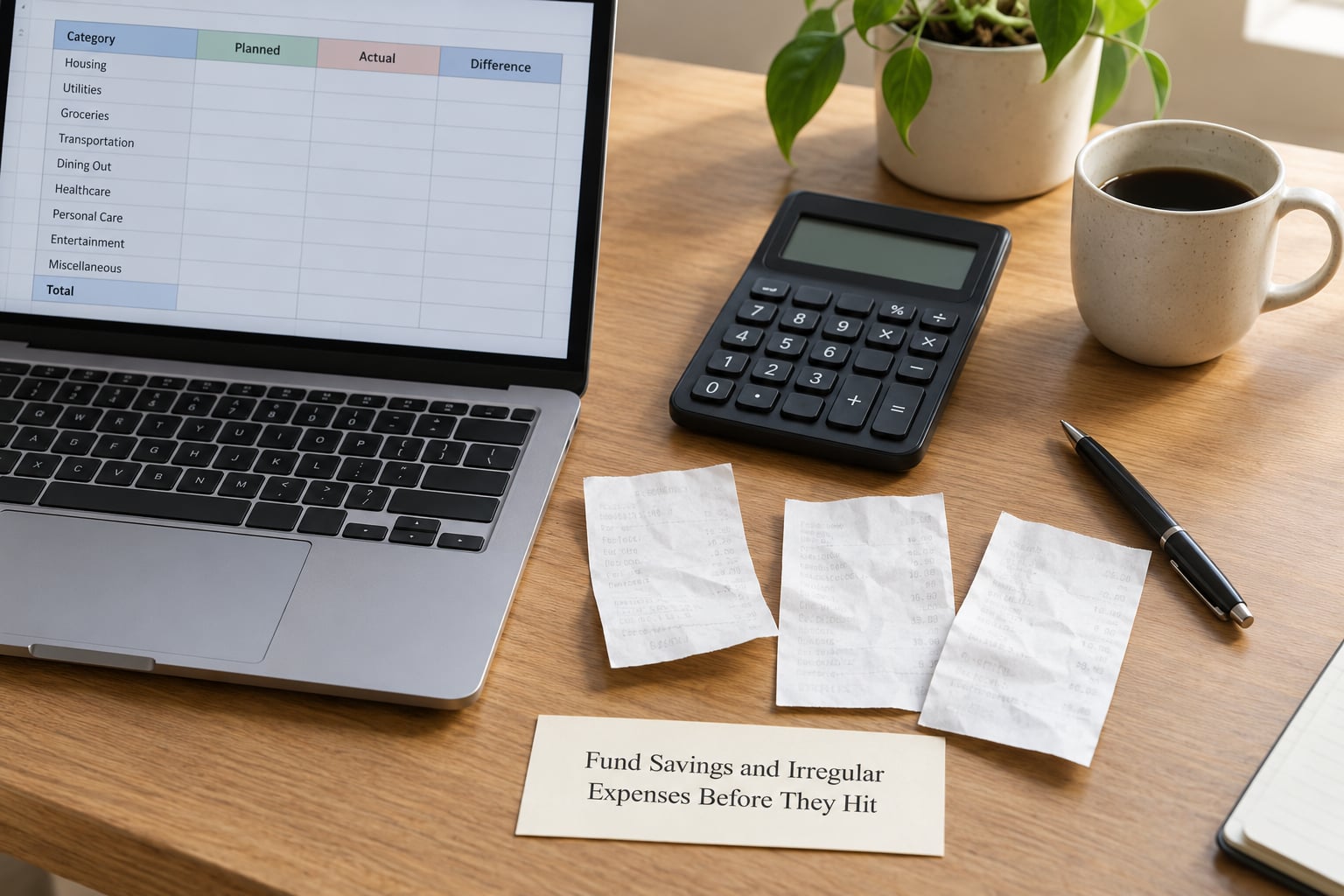
Once a month, spend thirty minutes comparing planned amounts with what actually happened. Three columns are enough: planned, actual, difference.
Work through every category with a difference. A negative number is not a disaster, it is information about either a one-time event or a recurring pattern, and those two require opposite responses. A single dinner out needs no plan change. Three months of dining out above plan means the planned number was unrealistic, not that you failed.
Check whether any big bill moved. Adjust sinking fund contributions so the amounts still land before the cost does. Look at next month’s calendar before you close the file.
Revise the budget whenever income changes, a fixed cost moves, or a goal changes. Switching methods is not a sign of failure either. It is your budget doing its job.
Your verification point: after each review you can name one change you made and why. A budget you never edit is a document, not a plan.
Give Every Dollar a Job With a Worked Example
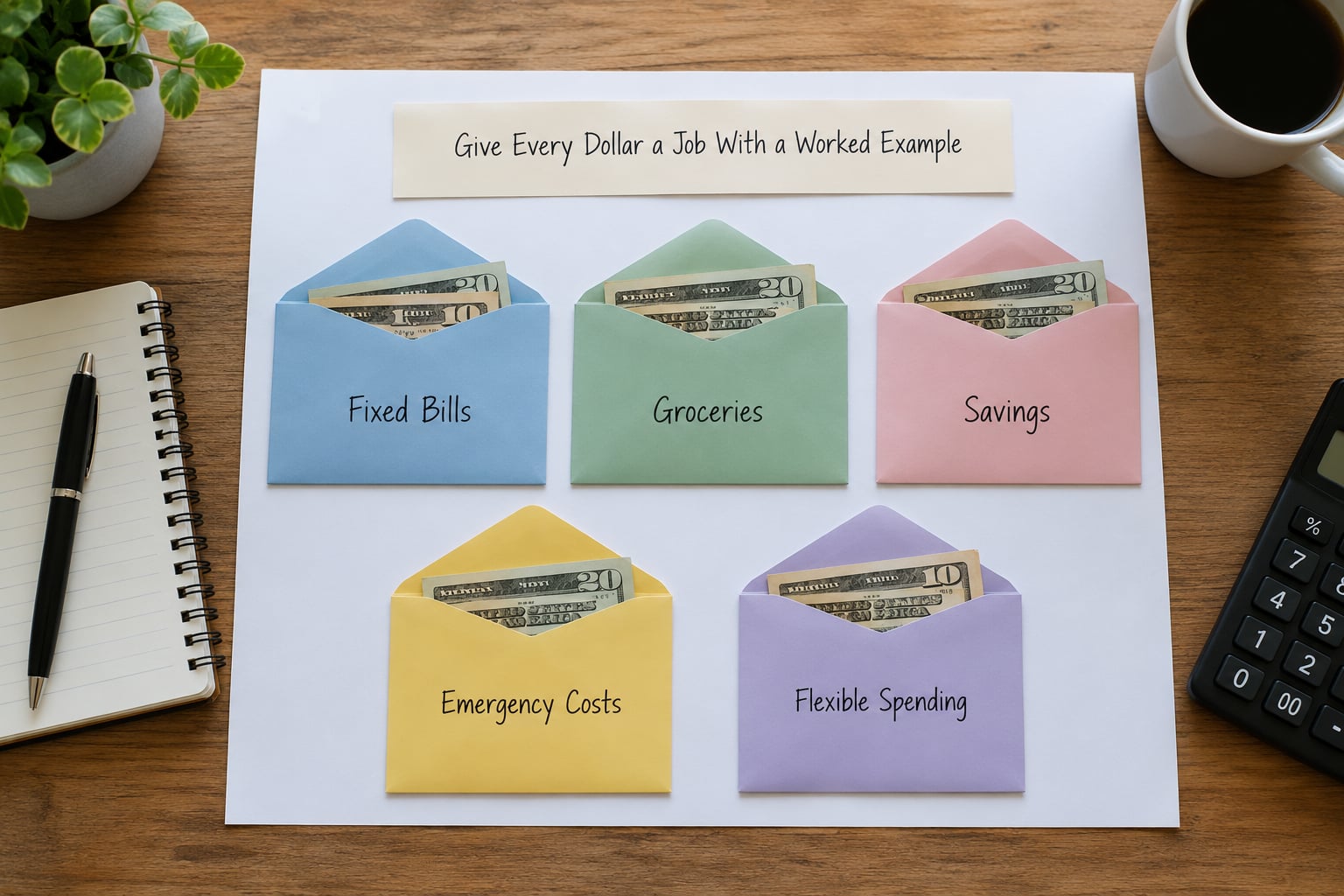
Here is a single take-home figure carried through every step. Take-home is 3,600 a month.
| Category | Monthly amount | Notes |
|---|---|---|
| Fixed: rent, utilities, transit pass, phone | 1,845 | Same every month, paid automatically |
| Variable: groceries, household, personal care, daily transit | 700 | About 175 a week for groceries |
| Debt: one student loan minimum | 210 | Extra goes to the highest rate |
| Savings: emergency, retirement match, brokerage | 466 | Transferred on payday |
| Sinking funds: insurance, deductible, quarterly dues, gifts | 243 | Annual costs divided by months until due |
| Fun and social: dining out, events, hobbies | 136 | Roughly 31 a week |
The total lands exactly on 3,600, which is the point of the exercise. Nothing is vague and nothing is undecided.
Check it against 50/30/20 and the fixed costs alone exceed half the take-home, which is ordinary in a high-cost city. Adjust the split rather than pretending: 60/30/10 fits this budget better, and no one is failing by choosing it.
Shared money needs a decision before the spreadsheet does. Couples and chosen-family households generally land in one of three setups: fully separate accounts, a fully merged account, or a hybrid where shared costs come out of a joint account and personal spending stays individual. The hybrid is the most common and the least argued-about. Agree on what counts as a shared cost, contribute the same amount each month, and keep the leftovers personal.
Where you are unmarried, put the shared-cost agreement in writing anyway. Renting together, splitting utilities, or covering each other during a rough month works fine without paperwork, and a short written note about who owes what avoids a very specific argument later.
Common Mistakes That Break Budgets, and the Fix for Each
Guessing instead of tracking. If you built the plan from what you think you spend, the first month is a surprise, and a bad surprise is how trust in a budget dies. Fix: track for thirty days before planning anything, then plan from the average of those three months, not the best one.
Budgeting gross income. Your paycheck total is not your money. Taxes and deductions were never yours to spend. Fix: take-home only.
Setting variable categories from your best month. Nobody shops for a sick week. Fix: use a slightly higher number than average so a normal month feels easy and a hard month is survivable.
Forgetting the irregulars. Annual premiums, quarterly bills, deductible money, gifts, and the occasional repair. Fix: one sinking fund per annual cost, divided by the months until it lands.
Funding savings last. By the time anything is left in the checking account, saving has already been spent. Fix: transfer first on payday, then budget the remainder.
Never adjusting. Prices change, habits change, and a budget built in January can be wrong by July. Fix: thirty minutes monthly, with at least one written change at the end of it.
Tracking daily. Day-by-day logging produces detailed records of ordinary purchases and no useful decisions. Fix: weekly ten-minute check, monthly thirty-minute review.
Abandoning the plan after one bad month. A budget is supposed to flex, and one month is data, not a verdict. Fix: define your restart date in advance and keep the same system after the bad month.
A few reusable rules close it out. Give every dollar a job, including the small ones. Keep a buffer in the plan so the month is not a test of willpower. If a category keeps getting blown, raise the number and move on. The plan should lower stress, not add a second job of bookkeeping.
Frequently Asked Questions
How do I budget when my income changes every month?
Budget from a conservative baseline rather than your best month. Look at the smallest amount you have received in the last six months and plan your spending around that, treating anything above it as extra that funds savings or a one-time goal. Pay yourself first from the baseline, and hold the surplus in a buffer account so a thin month never becomes a crisis.
Should I build a budget around take-home or gross income?
Take-home, always. Gross pay includes taxes, retirement contributions, and benefits that were never available to you, so budgeting against it guarantees a shortfall every month. Find your net figure on a recent pay stub or deposit, and if your income varies, use the smallest recent month as your working baseline.
How much should I put aside for expenses that happen only once a year?
Divide the annual cost by the number of months until it is due, not by twelve. A 600 premium coming due in six months needs 100 a month; the same bill due in two months needs 300 a month. Open one sinking fund per annual cost, label it with the amount and the date, and let the balance grow until the bill clears.
What is the fastest way to start an emergency fund?
Start small and automate it. Open a separate high-yield savings account and transfer a fixed amount on payday, even if that amount is small enough to feel almost pointless. Your first goal is one month of essential expenses, which is often reachable in a few months. Consistency matters more than the starting figure.
How should couples or chosen-family members handle different spending habits?
Split the difference between you and put it in writing. Decide together which costs are shared, like rent, utilities, groceries, and insurance, and set up one joint account funded with the same contribution from each person. Everything else stays personal. Review the arrangement quarterly, since habits change faster than most agreements do.
What should I do with money still in the account at the end of the month?
Decide the rule before the month ends so the money is not quietly spent. Most people do best by checking off pending bills first, then assigning what remains to emergency savings, next sinking fund, and only then guilt-free spending. A budget with nothing built into it for enjoyment tends to fail by week three.
Start With This Month’s Fixed Costs
Open your last bank statement tonight and write down two numbers: your monthly take-home and your total fixed costs. Subtract one from the other and you have a realistic number for flexible spending, which is where a budget actually lives or dies.
Put the result in a spreadsheet, automate one savings transfer, and run the system for thirty days without changing anything. That first month is diagnostic, not a grade. When the review comes, change one number, keep the rest, and do it again. That loop is how to make a budget that actually works, and it works on any income.
Budgeting rules, tax treatment, and savings programs vary by country and state, and they change. Check the details that apply to where you live and treat anything here as general education rather than personal financial advice.
Updated for 2026.