
Yes, you can buy a house with a partner you are not married to, and plenty of couples do it every year. Nothing about a mortgage or a deed requires you to be married. What you give up is the automatic legal framework that marriage supplies: division of assets on divorce, spousal inheritance rights, and homestead protections. So the practical answer to how to buy a home with a partner you are not married to is that the purchase itself is straightforward, and the protection comes from decisions you make before you sign anything.
This guide walks through those decisions in order, from the first money conversation to the recorded deed. Budget about four to eight weeks of prep work plus however long the search takes, and expect the legal piece to cost a few hundred to a couple thousand dollars depending on your state. A word on scope: this is general education, not individual legal or financial advice. Property, tax, lending and family-law rules differ by state and country and change over time, so run your specific situation past a local real-estate attorney.
Table of Contents
- What You Need
- Step-by-Step: Buy a Home With a Partner You Are Not Married To
- 1. Define What You Mean by Buying Together
- 2. Check Your Credit, Debt, Income, and Budget
- 3. Choose the Ownership Structure That Fits
- 4. Make a Down Payment and Get Preapproved
- 5. Find a Home and Complete Due Diligence
- 6. Negotiate the Purchase Contract and Protect Each Person’s Rights
- 7. Close the Purchase and Put Your Agreement in Place
- What Marriage Equality Changed and What It Did Not
- The Simpler Alternative: One Buyer, One Tenant
- Common Mistakes
- Frequently Asked Questions
- Can two unmarried partners buy a home together?
- Does buying a home with my unmarried partner make us married?
- Should my partner and I put both names on the mortgage?
- What happens to the house if an unmarried co-owner dies?
- Do we need a lawyer to buy a home together?
- How much should we have for a down payment and closing costs?
- Start With the Ownership Decision
What You Need
Four kinds of preparation have to be in place before you look at listings: money, documents, decisions, and professionals.
Money and credit
Both of you need a realistic number for the down payment and the closing costs, not just the monthly payment. You also need to know your own credit picture independently, before a lender tells you what you qualify for, because lenders often quote the better of the two applications.
Documents
Gather government photo ID, recent pay stubs or W-2s, two years of tax returns if you are self-employed or have variable income, bank statements for the last 60 to 90 days, and existing loan statements for anything you owe. Pull your own credit reports from all three bureaus and read them line by line. Collect any collections accounts and old debts you intend to pay off or settle before closing.
Decisions you have to make together
Ownership structure, how you split the down payment, whose name goes on the loan, and what happens if one of you exits. These are relationship decisions as much as financial ones, and they are much cheaper to make before closing than afterward.
Property groundwork
Once a home is under contract, you will need inspection and disclosure documents, a title report or public-record search, flood zone and insurance checks, and any HOA documents that apply.
Estate documents
This is the one people skip, and it is the one that hurts. Unmarried partners generally have no automatic right to inherit from each other. Each of you should have a will naming the other, plus a durable power of attorney. If the home is bought in one person’s name, that person should also name the other as beneficiary on the title.
People, and what each one actually does
These roles get confused constantly, and mixing them up is how buyers end up with a contract nobody reviewed.
- Notary witnesses signatures and administers oaths. They give no legal advice.
- Real-estate agent finds property, negotiates price, and coordinates the transaction on your behalf.
- Title company or title attorney searches public records, issues the title policy, and prepares the deed and closing documents.
- Real-estate attorney advises on ownership structure, reviews your contract, and drafts the co-purchase or buyout agreement. This is the person whose job protects your individual rights.
The agent and the title company work for the transaction. The attorney works for you. That distinction matters more when two unmarried buyers are involved, because nothing in the transaction will stop the other person from taking a position that happens to be wrong for you.
Step-by-Step: Buy a Home With a Partner You Are Not Married To
1. Define What You Mean by Buying Together
Co-buying works when both people want the same house on the same timeline. It fails when one person is buying a home and the other is buying a relationship.
Sit down with a list and answer out loud. Are you buying to live in for five years or twenty? What happens to the plan if either job moves? Do you both want to live there, or does one person plan to renovate and resell? What about children or pets? Who handles repairs, and at what dollar threshold does a repair need both signatures?
Then talk about the exit. If you break up in year two, who is allowed to buy out the other, and how do you decide the price? What happens to a house neither of you can afford alone? These conversations feel morbid at a kitchen table. They are far cheaper than the alternative.
Forum threads on this topic repeat the same warning: couples who co-buy without agreeing on exit terms are the ones who end up in a dispute. The written agreement is not distrust. It is the thing that lets two people buy a house together and stay functional when things get hard.
2. Check Your Credit, Debt, Income, and Budget
Both partners should run their own numbers, separately, before you apply anywhere.
Lenders underwriting an unmarried couple generally use the lower middle score of the two applicants. Fannie Mae allows an exception when both applicants have scores above a specified threshold, commonly described as an average of 620 or better, which can rescue a joint application when one score is weak. Ask any lender you talk to exactly which rule they are applying, because the answer changes whether you qualify together at all.
Debt-to-income ratio is the other number. Lenders generally look for total monthly debt payments at or below roughly 36% of gross monthly income, and qualified-mortgage rules cap the ratio in that neighborhood. Credit card balances, student loans and car payments all count. Someone with $60,000 of student debt and a $4,200 payment can fail on income that looks plenty on paper.
Here is a worked affordability example. Assume a $450,000 home with 20% down, a 30-year fixed loan at a mid-range rate:
- Principal and interest on a $360,000 loan: roughly $2,000 to $2,100 a month
- Property taxes: $550 to $750 a month in a mid-cost county, and they rise with assessments
- Homeowners insurance: $120 to $250 a month depending on the home and your location
- Utilities, internet, and cable: $200 to $350 a month
- HOA dues, if applicable: $0 to $400 a month
- Maintenance and repairs reserve: at least $100 to $200 a month even in a new home
That lands near $3,000 to $3,700 a month before a single repair. Keep an emergency reserve of three to six months of total housing costs in a separate account, separate from your down payment money.
One more point that catches people: unmarried partners are not automatically treated as one household for underwriting. Each application stands on its own income, credit and debts. Some lenders ask about child support, alimony or obligations to other relatives, and they count them against the borrower who pays them.
3. Choose the Ownership Structure That Fits
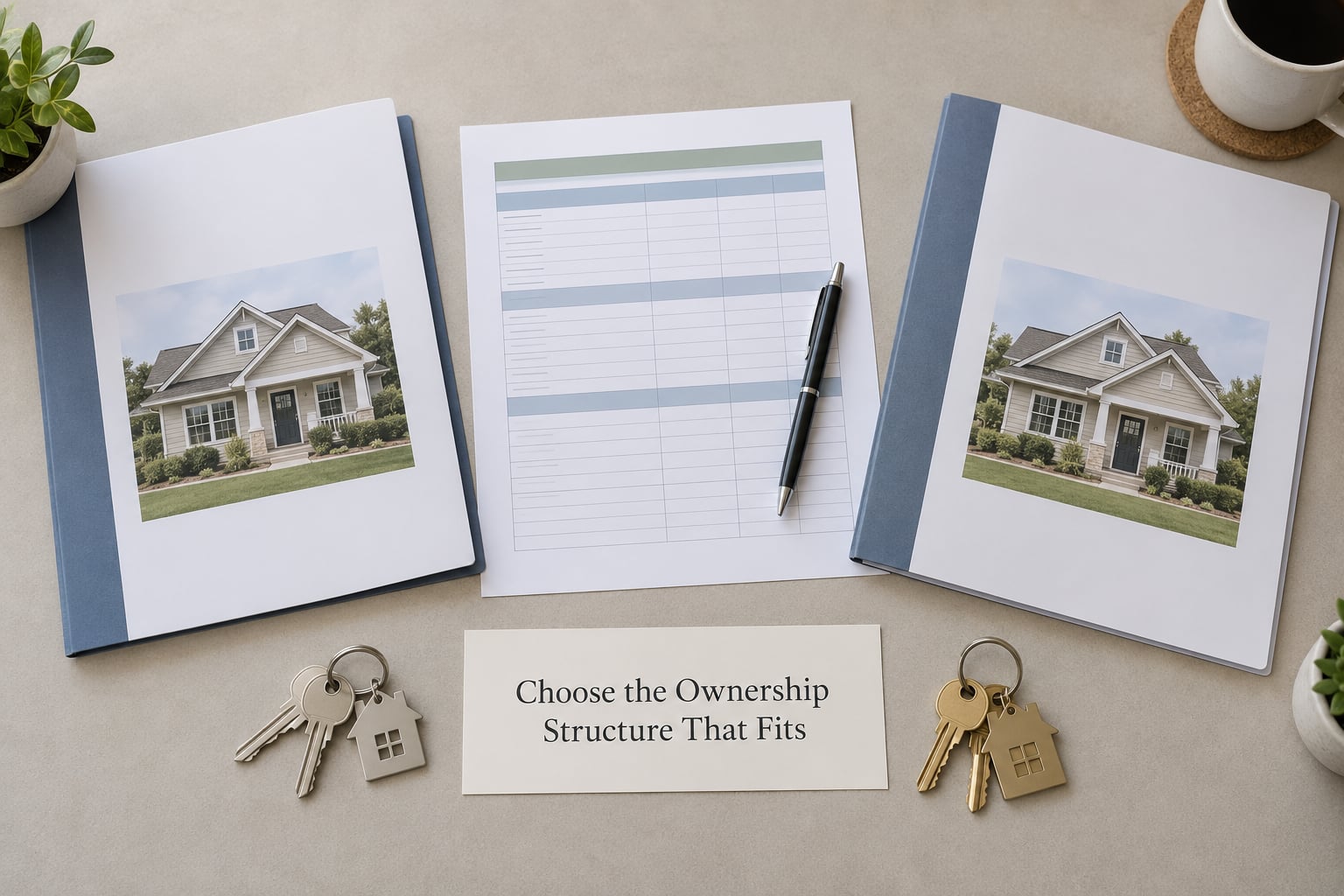
Tenancy in common means each co-owner holds a defined, separate share, and that share can be sold, inherited or attached by that person’s creditors without the other’s involvement. Joint tenancy with right of survivorship means the surviving owner automatically takes the entire property. That single difference decides what happens when one of you dies.
| Structure | How ownership is held | If one owner dies | Can one owner sell alone | Creditor exposure | Best for |
|---|---|---|---|---|---|
| Sole ownership | One person holds title entirely | Passes under that person’s will or intestacy rules | Yes, fully | Only the title holder’s creditors reach it | One partner buying for both, with a lease |
| Tenancy in common | Separate shares, often 50/50 but not required | Only that share enters the estate | Yes, usually, which is the risk | Each owner’s creditors can reach that owner’s share | Couples who want to keep exit options open |
| Joint tenancy with right of survivorship | One indivisible interest, equal by default | Survivor takes full ownership automatically | Harder to do unilaterally; requires the other to sign | Both owners’ creditors may reach the property | Couples who want the simplest survivorship result |
| Trust or beneficiary deed | Title held by a trust with named beneficiaries | Handled by trust terms rather than probate delays | Depends on trust language | Varies widely | Higher-value purchases, blended families, second marriages |
Domestic partnership and unmarried status do not create joint ownership on their own. Registering as domestic partners, in states that offer it, may carry a few state-level benefits, but it is not a substitute for a deed, and it is not marriage. Ask a local real-estate attorney or title company which of these your state actually permits and how each is recorded, because a title defect discovered at closing is expensive to unwind.
Tenants in common is the default in many states when you are unmarried, which surprises people. Ask for the choice explicitly rather than accepting whatever the closing paperwork says.
4. Make a Down Payment and Get Preapproved
Prequalification is a quick estimate. Formal preapproval is an underwriting decision with a letter you can show sellers, and only that one carries weight in a competitive market.
Loan programs differ in how they treat two unmarried co-borrowers:
- Conventional loans follow the lower-middle-score rule unless the Fannie Mae averaging exception applies, and many conventional loans with less than 20% down require private mortgage insurance.
- FHA loans have historically allowed down payments as low as 3.5% for borrowers with qualifying scores, but require both applicants to qualify on their own income and credit.
- VA loans require eligibility, generally through military service, and involve lender and property eligibility checks.
- State housing programs vary widely and often serve first-time buyers or specific income bands.
Compare lenders using the Loan Estimate, which every lender must give you within three business days of application. Look at the rate, the loan type, the points, the estimated closing costs, and the cash to close. No program is universally best, and the right answer depends on both of your credit files plus the property.
For closing costs, ask for a written estimate of your actual cash to close rather than assuming a percentage. Property taxes, insurance rates, HOA dues and local transfer costs all vary by location and change over time.
5. Find a Home and Complete Due Diligence
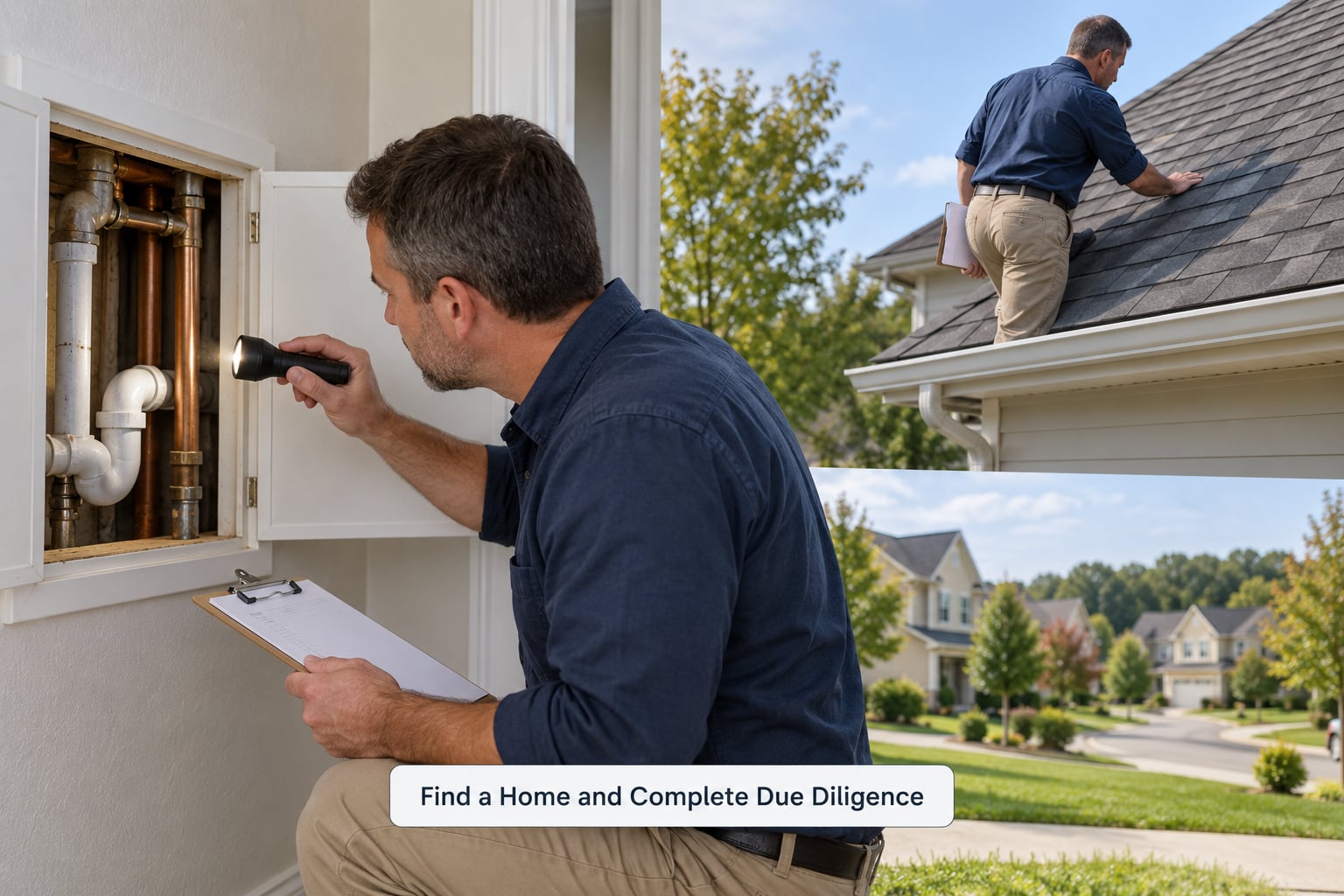
Both of you should walk through the property together and answer the same questions. What are the monthly carrying costs once everything is added? How long would a commute take in real traffic at 8am? What does the resale picture look like if you are there in seven years? Would you both be equally happy living here, or is one of you being talked into it?
Then work through the paperwork. Inspections, seller disclosures, a title or public-record search, flood zone and insurance checks, and HOA review where an HOA exists. An attorney can flag title defects, liens, boundary questions, and contract language that does not match what you agreed privately.
Which inspections and disclosures apply is governed by state law and by the contract, and requirements differ meaningfully across states. Do not assume your friend’s disclosures cover your purchase.
6. Negotiate the Purchase Contract and Protect Each Person’s Rights
The contract is where your private agreement either becomes binding or does not. Earnest money, offer price, financing and appraisal contingencies, inspection and disclosure deadlines, which improvements come with the house, closing date, occupancy rights, and what each of you can do if the deal falls through all belong in writing.
Ask the title company or your attorney to confirm, on the record, both purchasers’ full legal names, the ownership shares as recorded, how the deed treats marital or domestic-partnership status, and whether title insurance is available and worth the cost in your situation. Names must match your loan documents exactly. A middle name discrepancy or a name change that was never recorded can stop a closing.
Then get individualized legal review. Generic online purchase templates are not built for two unmarried buyers with different credit, different cash, and different long-term plans. If your agreement is going to be reviewed by anyone besides a template site, make it your attorney.
7. Close the Purchase and Put Your Agreement in Place
Closing day runs in a fixed order. The lender does a final review and issues your final Loan Estimate, typically at least three business days before closing. You compare that final document to your earlier estimate and can raise concerns about changed terms.
Verify wiring instructions by calling a number you look up independently. Never use contact details that arrive only by email, and treat any last-minute change to payment instructions as a reason to stop and confirm.
You sign the note, the mortgage, and the deed. The title company records the deed, funds disburse, insurance goes into effect, and you get the keys. Your first-month expenses usually include the first payment, property taxes, and any escrow deposit the lender requires.
Then put the agreement in place. A written co-purchase, ownership, expense, maintenance, sale, dispute and breakup agreement can fill the gaps that title law leaves open. It should address how contributions are documented and reimbursed, who pays for what, who decides on repairs, what happens on a sale, and what happens if one of you exits early. Have an attorney draft it rather than writing it yourselves; forum readers are nearly unanimous that a self-written agreement comes back to cause problems.
Finally, store the deed, mortgage, closing statement, insurance policy and signed agreement together, and start a shared record of major repairs, receipts and contributions. A dated spreadsheet resolves more disputes than a memory does.
What Marriage Equality Changed and What It Did Not
Marriage equality fixed who can marry. It did not rewrite the property framework for unmarried couples. Two people who are unmarried still have no automatic marital division of property, no default spousal inheritance rights, and no spousal privilege in a dispute, regardless of gender or sexual orientation.
A few things still vary by state. Common-law marriage is recognized in a small number of states and, where it exists, can change property treatment substantially. Some states extend homestead protections to unmarried partners. Domestic partnership registration exists in some jurisdictions and adds limited state benefits, but it is not a deed and it is not recognized uniformly across the country.
The practical takeaway for a queer couple buying a home together is simple: treat your arrangement as the unmarried purchase it legally is, and build the protections in writing. If you are in Illinois, the title company and the attorney handling your closing can tell you exactly which state-law features are available to you, and local practice is more useful than anything generic you find online.
The Simpler Alternative: One Buyer, One Tenant
The most-recommended approach in homeowner finance forums is also the least complicated: buy the home in the name of whoever can qualify on their own, and have the other partner pay rent rather than share legal ownership.
You lose the equity split, which is the real cost. You gain a single clear owner, one signature on every decision, no shared-debt exposure if the relationship ends, and no second person’s credit standing between you and a mortgage. Some couples handle the split by crediting part of the rent toward future equity, spelled out in a written agreement.
| Question | Buying together | One buyer, one tenant |
|---|---|---|
| Legal complexity | Title structure, agreement, exit terms | Standard purchase plus a lease |
| Breakup risk | Requires a buyout the lender will approve | Tenant moves out |
| Equity building | Shared | All to the buyer |
| Flexibility to sell | Depends on the structure you choose | Full |
If you cannot agree on the ownership structure, that itself is useful information. It is far better to learn that now than after the inspection fee is spent.
Common Mistakes
The first mistake is assuming a joint mortgage creates equal ownership. The note and the deed are separate documents. Being on the mortgage makes you liable for the whole debt. Being on the deed is what gives you an ownership interest. People end up on one without the other in both directions. Decide each separately and check both after closing.
The second is skipping a written breakup or sale plan. Without one, a separation turns into a legal dispute over who lives there, who pays the mortgage, and how the equity is divided. The fix is an attorney-drafted agreement covering contribution reimbursement, exit timing, valuation method, and a buyout mechanism.
The third is looking only at the principal and interest payment. That number is the smallest part of what you will spend. Build your budget around PITI plus HOA dues, utilities and a repair reserve, as in the example above.
The fourth is making a large down payment without documenting where the money came from and what it bought. If one partner puts down 70% of the cash and both names go on the deed 50/50, that partner has no automatic claim for the difference. Document contributions at the time, and either reflect them in the ownership shares or in a written reimbursement promise.
The fifth is waiving due diligence for speed. In a competitive market it is tempting to skip the inspection or shorten the contingency window to win the offer. A missed deadline is exactly how a buyer ends up in contract dispute as well as an ownership dispute.
The sixth is assuming domestic partnership status or a registered relationship conveys property rights by itself. It usually does not. Confirm what your state provides, and do not rely on it as a substitute for title and a written agreement.
A few habits help more than anything else: keep one shared folder for documents so neither of you has to ask the other for a copy, put every deadline on a single calendar with reminders, budget monthly for irregular repairs so a $1,800 HVAC issue does not become a debt, and revisit the ownership arrangement whenever a major life change happens, including a marriage, a new child or a job in another state.
Frequently Asked Questions
Can two unmarried partners buy a home together?
Yes. There is no legal requirement that buyers be married. Two people can apply together for a joint mortgage, both can be named on the deed, and the property can be titled as sole ownership by one buyer, as tenancy in common, or as joint tenancy with right of survivorship. You will each still qualify on your own credit, income and debts, and you will both sign the note. What you lack is the automatic divorce, inheritance and homestead protections that marriage provides.
Does buying a home with my unmarried partner make us married?
No. Buying a property together creates a financial and legal relationship, not a marital one. Title, the mortgage and any co-purchase agreement have nothing to do with your marital status. Note that a handful of states recognize common-law marriage, which in those states can arise from living together in a way that resembles marriage. If you want certainty, ask a local attorney whether anything about your relationship would be treated that way in your state.
Should my partner and I put both names on the mortgage?
Only if both of you want full liability for the whole debt. A joint application usually means a better rate and access to more loan programs, and the lender generally uses the lower middle credit score unless the Fannie Mae averaging exception applies. Putting both names on the loan does not force both names on the deed, and the reverse is also true. Compare a joint application against a solo one using Loan Estimates from at least three lenders before you decide.
What happens to the house if an unmarried co-owner dies?
It depends entirely on how the title is held. With joint tenancy with right of survivorship, the surviving owner receives full ownership automatically. With tenancy in common, only the deceased owner’s share enters the estate, and the survivor would typically need a will naming them or they may inherit nothing from that share. Dying without a will means intestacy rules apply, which can send the share to relatives instead. Ask about beneficiary designations and estate planning before closing, not after.
Do we need a lawyer to buy a home together?
It is strongly recommended, and it is the cheapest protection available to you. A real-estate attorney can explain which ownership structures your state permits, review your contract, confirm how both names are recorded, and draft a co-purchase or buyout agreement covering contributions, expenses, repairs and a sale. Agents and title companies facilitate the transaction but do not advise you on your individual position. Homeowner forums are nearly unanimous that an attorney-drafted agreement is worth the fee.
How much should we have for a down payment and closing costs?
It depends on the loan program, both credit files, the price and your location. FHA loans have historically allowed down payments as low as 3.5 percent for qualifying borrowers, conventional loans commonly start around 3 percent with private mortgage insurance, and some state programs assist first-time buyers. Closing costs typically run a few percent of the purchase price but vary by county and transfer taxes. Ask each lender for the estimated cash to close so you can plan the exact figure.
Start With the Ownership Decision
Start with the decision that costs nothing: how you will hold title. Talk through your shared and separate goals, look at both credit and debt pictures independently, then get local advice on which structures your state actually permits and how each is recorded. Once that is settled, get formally preapproved, write down how contributions and expenses will be handled, and only then start looking at homes.
Property, tax, lending and family-law rules vary by state and country and change over time. Nothing here is individual financial or legal advice, so treat it as a framework for the conversation with your attorney, lender and title company, and get the specifics confirmed where you live.