
How to split bills when incomes differ comes down to one idea: split shared costs by percentage of income so both people give up the same share of what they earn. Add both incomes together, divide each by the total, and multiply that share by the bill. The higher earner pays more dollars and the same percentage of their pay.
That answer takes about fifteen minutes to work out on paper, and about thirty minutes of conversation to agree on. The math is the easy part. The harder part is agreeing on which income number to use, and deciding how to talk about it without one person feeling like a guest in their own home.
This guide works for married couples, unmarried partners, roommates, and friends sharing a place. It also covers the situations most guides skip: freelance income that swings month to month, one partner on leave, one partner who owns the home, and the one partner whose income dropped for reasons neither of you chose.
Table of Contents
What You Need
Before you talk numbers, gather five things. Without them, the conversation turns into a debate about whose numbers are right, and that is the version that goes badly.
- Each person’s take-home income for the last full month, or a reliable monthly average.
- Your fixed expenses that exist regardless of this arrangement: student loans, car payments, subscriptions, existing credit card balances.
- The full list of shared bills with real amounts and due dates: rent, utilities, internet, groceries, insurance, phone plans.
- Which payment methods you both use, and whether a joint account is realistic for your situation.
- A fairness standard you are willing to argue for, stated in one sentence before the arguing starts.
Privacy is a fair concern, and a good one. Nobody owes you their bank login or a screenshot of every statement. Rounded bands work fine: low five figures, mid five figures, six figures, or a monthly range rather than an exact figure. Most people will share a number once they understand what it gets used for.
Decide the income definition now, because it is the single most common reason couples stall. Take-home pay is the honest option. Gross pay is easier to verify on a payslip and is common in the UK, but it can skew the ratio badly when one person’s tax situation differs. Both partners must use the same one, and both must decide whether side income, freelance work, bonuses, and benefits are included.
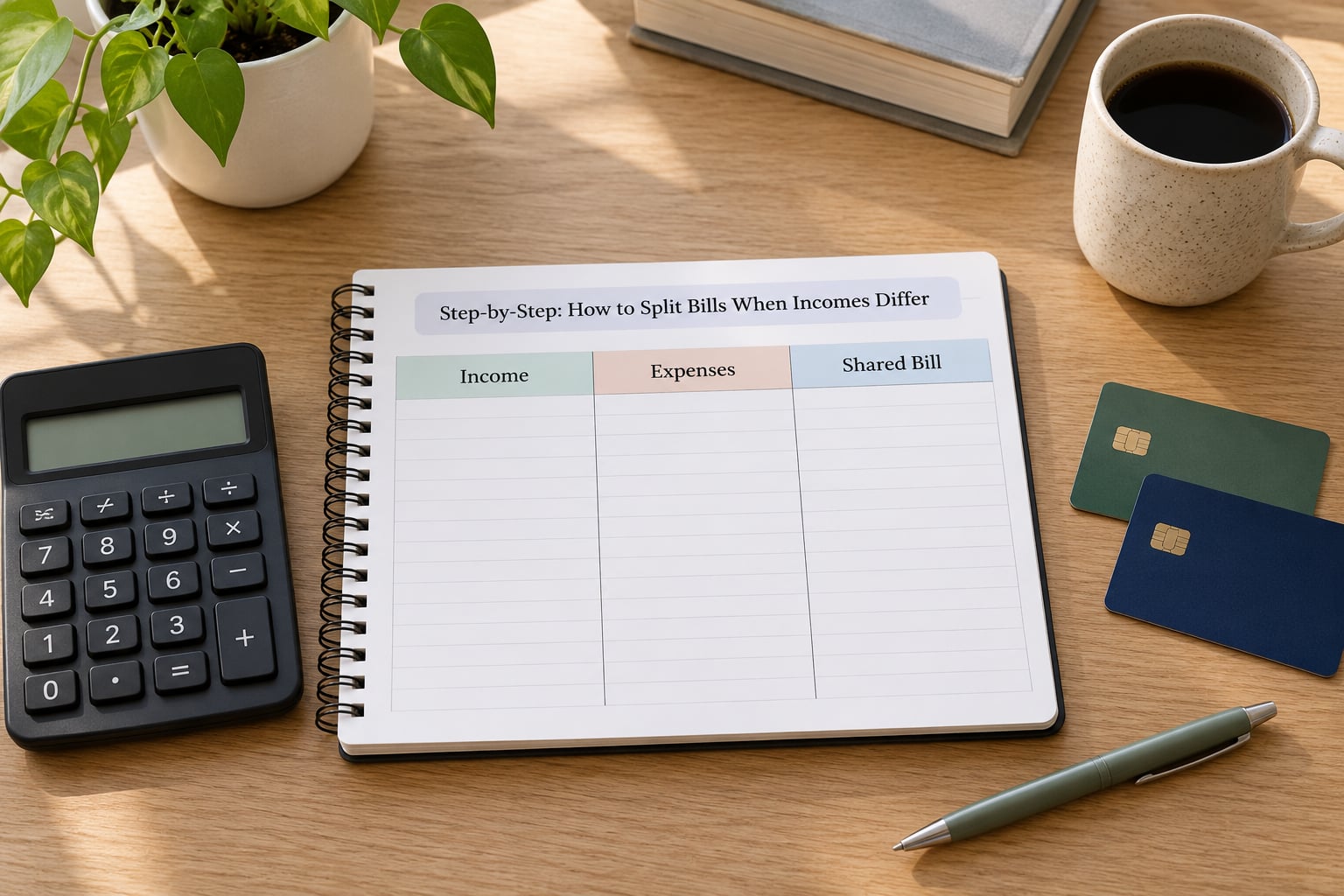
Step-by-Step: How to Split Bills When Incomes Differ
1. Define What Fair Means to You
There are four common definitions of fair, and you need to pick one before you pick a number. Equality means everyone pays the same dollars. Proportionality means everyone pays the same percentage of their own income. Ability to pay means the person with more resources covers more, with a floor so nobody contributes nothing. A hybrid blends those.
Proportionality is the one most households land on, and it is the fairest default when incomes differ. Equality is defensible when the gap is small, and the common threshold people use is roughly 20 to 30 percent. Below that, the split barely matters. Above it, a flat fifty-fifty asks the lower earner to hand over a visible slice of their paycheck while the higher earner barely notices the deduction.
Proportionality also has a built-in fairness property worth knowing: each person gives up an identical share of their own income, so neither person’s standard of living collapses to fund the household.
None of these is the correct answer. Ask which one you would sign without resentment six months from now, then say it out loud in those words.
2. Separate Shared and Personal Costs
Rent, utilities, internet, and groceries are shared by definition. Subscriptions belong in a gray zone, and usage is usually the deciding factor rather than whether both people technically use them. Travel and dates are usually personal, unless you both agree otherwise for a specific trip.
Make three columns: shared fixed, shared variable, and personal. Shared fixed covers rent and power. Shared variable covers groceries and household supplies, which move month to month. Personal covers clothing, hobbies, and individual subscriptions.
| Cost | Type | How to split it |
|---|---|---|
| Rent | Shared fixed | Proportional to income |
| Power and heat | Shared fixed | Proportional, adjust in winter if one person works from home more |
| Internet and phone | Shared fixed | Proportional, or by line count if plans differ |
| Groceries and household supplies | Shared variable | Proportional, reviewed quarterly |
| Streaming and subscriptions | Mixed | Whoever watches pays; equal if you both use them equally |
| Travel, gifts, dates | Personal | Each pays their own, or split in advance for a specific trip |
| Student loans, old card debt | Personal | Each pays their own, always |
Keeping old debt out of the shared pile is the rule people break most often. Debt that existed before you pooled your lives is personal, and blending it in quietly converts a fair arrangement into a subsidy.
3. Choose a Transparent Method
Four methods do nearly all the work. The one most functioning households use is an equal personal allowance plus proportional shares of the fixed costs, and it is worth understanding before you commit to anything simpler.
- Equal split. Every shared bill divided in two. Best when the gap is under about 20 to 30 percent and the lower earner has real disposable income. Watch out for it when the gap is three to one or wider.
- Percentage of income. Each person’s income divided by combined household income, applied to every shared fixed cost. Best as the default for a real gap. Watch out for using it on personal spending, which is where the resentment usually starts.
- Custom per-bill split. A different rule for each category, chosen from the table above. Best when usage genuinely differs, like one person working from home three days a week and blowing up the power bill. Watch out for spending more time negotiating each bill than the bill is worth.
- Equal allowance plus proportional top-up. Both people receive the same amount of personal spending money each month, and shared fixed costs are split proportionally. Best when the gap is large, because it protects the lower earner’s independence without ignoring the gap.
Worked difference between the last two: with one person taking home 4,000 a month and the other 1,200, equal spending money might be 600 each. Proportional rent on a 3,600 rent works out to 2,769 and 831. Combined with 600 of personal spending each, neither person can accuse the other of controlling the money.
Do not turn income percentages into an automatic rule. If one person controls the shared space, or a room is far larger, or one person’s income is higher because they work two jobs while the other does unpaid care, an identical percentage can still be unfair. Adjust the rule, not the person.
When the gap is very large, set a minimum contribution. If proportional math leaves someone paying almost nothing, set a floor they can always cover, and set the remainder as an equal allowance both people receive. This is common advice in personal finance forums, and it exists for a reason: paying zero toward the household does not feel like partnership.
4. Calculate Each Person’s Share
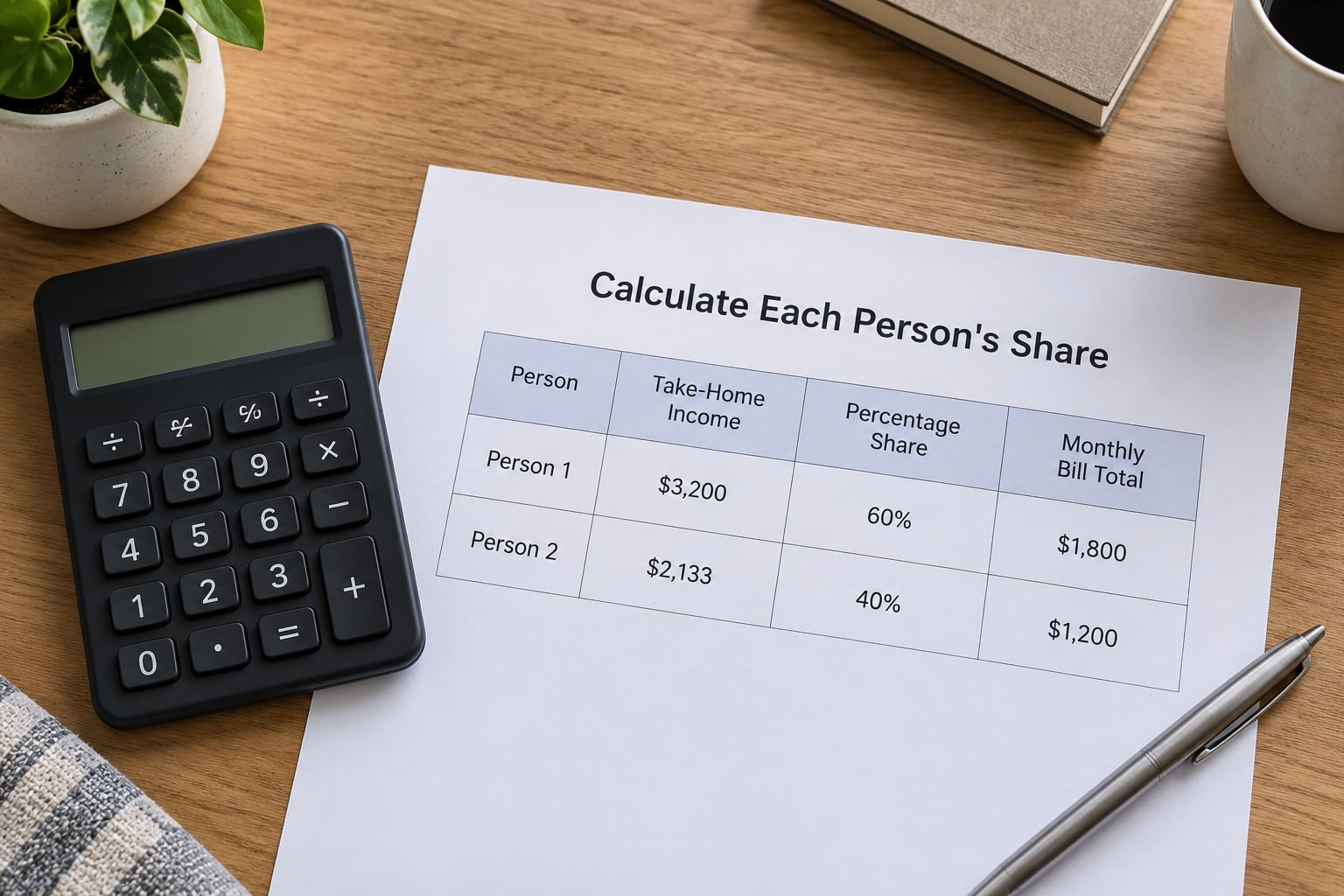
Use this formula, and keep it on one line somewhere both people can see:
Your share = (your take-home income / total household take-home income) x the bill
Here is the arithmetic for a household with a three to one gap, sharing 1,800 rent, 320 in utilities, and 400 in groceries.
| Person | Take-home income | Income share | Rent 1,800 | Utilities 320 | Groceries 400 | Total |
|---|---|---|---|---|---|---|
| Alex | 4,000 | 76.9% | 1,385 | 246 | 308 | 1,939 |
| Sam | 1,200 | 23.1% | 415 | 74 | 92 | 581 |
Read the last column against each person’s income and you see the point. Sam hands over 1,939 against 1,200 of take-home pay, which is not a number that works, and a fifty-fifty split would have asked Sam for the same 1,260. In this case, the proportional method on its own fails too, which is exactly when the equal-allowance-plus-top-up structure earns its place: proportional for the fixed bills, equal personal spending money, and the rest toward savings in whatever ratio you both pick.
Round to the nearest whole unit and let the rounding difference land on the higher earner, or on whoever asks. Do not let a 40-cent discrepancy become a conversation. A spreadsheet with one row per bill and a running balance settles this in seconds once the rule exists.
Treat every income figure as an estimate. Pay changes, bonuses land, freelance months vary, and a percentage written in January is wrong by June. Update the inputs when pay or expenses move materially, not every time a bill changes by a few units.
5. Write Down the Agreement and Payment Plan
The people who report the fewest arguments are the ones who wrote the split down. A shared finances agreement does not have to be formal or signed to be useful; a single shared note with these items is enough.
- The method you chose and the reason, in one sentence each.
- Which income figure is used, whether it is gross or take-home, and what counts: side income, bonuses, freelance payments, benefits.
- Each bill, its amount, its due date, and its split method.
- The transfer date, so money moves on the same day each month instead of whenever someone remembers.
- Rounding rules and what happens when a payment is late.
- The review date, three or six months out, written down at the top.
Keep the tone administrative. This document describes a payment arrangement, not a judgment about anyone’s worth, and writing it that way keeps it from turning into a scoreboard later.
For couples who are not married, this written agreement carries more weight, because there is no spousal default to fall back on. Unmarried partners often have no automatic legal claim to shared property or assets, and domestic partnerships can leave one person exposed if the arrangement ends badly. A co-habitation or domestic partnership agreement handles the parts money cannot: ownership, what happens to the home, and who is included on accounts and insurance. If your situation involves property you both paid into, that is a conversation for a family law attorney in your state, not something to settle with a spreadsheet.
6. Review the Arrangement Regularly
Set a review, not a series of one-off arguments. Quarterly works for most households; every six months is fine if nothing is changing. Put the date in your calendar when you set the agreement, and treat it like any other appointment.
At each review, check four things: whether the income figures still match reality, whether the shared cost list is accurate, whether either person’s fixed personal expenses changed in a way that affects their disposable income, and whether the split still feels right rather than merely still be right.
You have a conversation when income changed, when a job ended or started, when someone went on parental or medical leave, when the home situation changed, or when one of you says something during a normal week that hints at friction. The last one is the early warning, and treating it as a signal rather than an accusation is most of the skill.
Write down any change, with the date it takes effect, and note the reason. Agreements decay silently, and the person who agreed to something six months ago and now resents it usually had no idea the other person felt fine with it.
Common Mistakes
Mixing gross pay with take-home pay. If one of you uses gross and the other uses net, the ratio is wrong and nobody notices. Pick one, write it down, and apply it to both people.
Using a percentage from a year ago. Income shares drift with promotions, layoffs, and new side income. Re-run the numbers at your review, not when the resentment shows up.
Splitting every expense equally. Flat fifty-fifty on a wide gap asks the lower earner to subsidize the household. The correction is proportional for fixed shared costs, equal for personal spending.
Ignoring who actually uses more. One person at home five days a week uses more power and more hot water. A usage adjustment is fair and takes about two minutes to calculate.
Leaving it unwritten. Every couple in a finance forum agrees on the split verbally, forgets the details within a month, and re-litigates them. The fix is one shared note, not a legal document.
Applying the proportional rule to personal spending. Dining out, clothes, and hobbies are not household costs. The higher earner paying for both of them starts to feel like a parent, and it ends badly.
Treating a temporary payment plan as permanent. During a layoff or a leave, the lower earner may contribute a floor amount or nothing. Say out loud when the arrangement returns to normal, and put the date in the note.
Tips for Fair, Repeatable Bill Splitting
A few habits keep the arrangement working after the first month, when the novelty is gone.
- Use one shared spreadsheet or a bill-splitting app, with a single row per bill and a running balance. Abandoned spreadsheets are the top complaint in personal finance forums, so keep it to one page.
- Round to the nearest whole unit and give the leftover to the higher earner automatically.
- Set a fixed transfer date, ideally the day after payday, so both payments clear before bills are due.
- Review subscriptions quarterly. Small recurring charges are the easiest place to find a genuine difference in usage.
- Talk about irregular expenses early: holidays, a car repair, a friend’s wedding. Agreeing in advance beats reconciling after.
- For an unusually high bill, agree a temporary adjustment rather than rewriting the whole method. Treat it as a short-term patch with an end date.
- Name the non-money contributions too. Housework, care work, and earnings given up for a family are real contributions, and a split that only counts cash will eventually feel wrong to the person doing the care work.
- Keep each person’s own discretionary account. Shared money for shared costs, personal money for personal spending, and nobody has to ask to buy a coffee.
Frequently Asked Questions
Should rent be split 50/50 when incomes differ?
Usually not, unless your incomes are close, within roughly 20 to 30 percent of each other. When the gap is wider, split rent proportionally so each person’s rent equals the same percentage of their own take-home pay. A useful check: after paying rent, can the lower earner still cover their own fixed costs and have real discretionary money left? If not, a fifty-fifty split is not workable regardless of how fair it looks on paper.
What is the fairest way to split bills?
The fairest method when incomes differ is a proportional split by percentage of household income, combined with equal personal spending money for each person. Proportional shares mean both partners give up the same share of their own income. Equal personal allowances then protect the lower earner’s independence, so the arrangement does not turn into one person controlling the household money. Write the method down and review it every three to six months.
What income percentage should each partner pay?
Each partner pays their own take-home income divided by total household take-home income, applied to shared fixed bills. If one person takes home 4,000 and the other 1,200, the shares are roughly 77 percent and 23 percent. Use the same income definition for both people, and decide explicitly whether side income, freelance payments, bonuses, and benefits are included. When the gap is very large, set a minimum contribution so the lower earner is not paying nothing.
What happens if one partner has no income right now?
Treat it as a temporary arrangement with a written end date. Set a fixed monthly contribution the person can manage, even a small one, so they are contributing rather than depending entirely, and agree on when the normal proportional split resumes. Put the end date in your shared note. Unpaid care work, a job loss, and a health leave are all reasons to pause the formula, not reasons to abandon the shared finances structure.
Do we need a spreadsheet, or is an app better?
Either works, and the tool matters far less than the rule it records. A single shared spreadsheet with one row per bill, a split method column, and a running balance handles most households with fewer than ten shared bills. A bill-splitting app is easier when you want automatic reminders and fewer manual entries. The common failure is not the tool, it is abandoning the record after six weeks, so pick the simplest option you will actually keep updated.
Should we split discretionary spending the same way as bills?
No, and this is where most arrangements break down. Shared fixed costs get split proportionally by income. Personal spending, including dining out, hobbies, clothing, and gifts, works better as an equal allowance for each person, or by turns. Applying the proportional rule to personal spending makes the higher earner feel like a bankroll, which is the fastest route to resentment over time.
Conclusion
Start with the list. Write down every shared bill, choose whether fair means equal, proportional, ability to pay, or a hybrid, run the numbers, and put the whole thing in a shared note with a review date three months out. The arithmetic takes fifteen minutes and settles most of the argument on its own, because the argument is rarely about money. It is about whether the arrangement will still feel fair when something changes, and only a written, dated agreement answers that.
This is general guidance for organizing shared household costs. It is not individualized financial advice, and rules about property, taxes, and domestic partnerships vary by state and country, so talk to a qualified professional about anything involving legal or ownership decisions.