
How to set up a power of attorney takes about one afternoon: pick the type, name someone you trust, fill out your state’s form, sign it in front of a notary and any witnesses your state requires, then store the original safely and give copies to your agent. The mechanics are simple, but the rules change from state to state and no one — not a partner, not a parent — has automatic authority to act for you without paperwork.
This guide is written for people who are putting a POA in place for themselves, and for LGBTQ+ couples and chosen families in particular. People in r/Marriage and r/AskLawyers repeat the same warning over and over: without a document, courts default to biological next of kin, and a partner can be frozen out of decisions about money, medical care, and a shared home.
Everything here is general information, not legal advice. Requirements vary by state and by the type of document, and situations involving real property, a business, a blended family, or a contested guardianship are worth a conversation with a licensed attorney in your state.
Table of Contents
- What You Need to Set Up a Power of Attorney
- Step-by-Step: How to Set Up a Power of Attorney in 7 Steps
- 1. Decide What Decisions You Want to Delegate
- 2. Choose the Type of Power of Attorney
- 3. Use a Valid State Form or an Attorney-Drafted Power of Attorney
- 4. Identify the Agent and Principal Clearly
- 5. Follow Document Signing and Notarization Rules
- 6. Store the Document Safely
- 7. Review and Activate the Document
- Common Mistakes That Invalidate a Power of Attorney
- Frequently Asked Questions
- Conclusion
What You Need to Set Up a Power of Attorney

Gather these before you start. Having the paper in one place keeps the signing session short, which matters more than it sounds — a document signed in a rush is where blanks get left behind.
- Your state’s statutory form or an attorney-drafted document. Every state publishes a short statutory form, and those forms carry the exact execution language courts and banks expect.
- Your agent’s full legal name and address. A nickname, an old name, or a PO box is a common reason an institution refuses to accept the paperwork.
- A successor agent. Naming a backup prevents a deadlock if your first choice dies, moves away, or simply stops answering the phone.
- Government-issued photo ID for yourself and, if they are signing as witnesses, for your witnesses.
- One or two disinterested witnesses, depending on your state. A witness who is named in the document or who benefits from it may be disqualified.
- A notary within reach. Banks, UPS stores, libraries, and courthouse service counters commonly host one for a small fee.
- A list of institutions where the document will eventually be used: your bank, your hospital, your attorney, your landlord.
- A secure place for the original and a plan for copies.
Step-by-Step: How to Set Up a Power of Attorney in 7 Steps
1. Decide What Decisions You Want to Delegate
Start with a plain-language list of what you want handled if you cannot handle it yourself: paying the mortgage, filing taxes, managing a brokerage account, hearing information from doctors, selling the condo. That list becomes the authority you actually grant, and nothing beyond it.
The failure mode here is granting more than you intended. Broad wording gives your agent the power to gift, borrow, or sell assets you never imagined handing over, so it is worth deciding line by line rather than accepting a template’s blanket clause. Users on r/legaladvice describe the classic regret as an agent who could not say no to a relative asking for money.
Think about who the decisions will actually be made with. If it is an unmarried partner or a friend, name them plainly — a chosen family member is a perfectly valid agent, and the document is often the only reason anyone outside your bloodline has a say.
2. Choose the Type of Power of Attorney
There is no single “power of attorney form.” The type determines how much authority your agent has and when that authority starts.
| Type | Scope | When it activates | Typical use |
|---|---|---|---|
| Durable | Broad, listed powers | Immediately, and survives incapacity | Long-term planning for a spouse, partner, or parent |
| Springing | Broad or narrow | Only when a written determination of incapacity is attached | People who dislike handing over control while healthy |
| Limited (special) | One transaction or asset | On signing, ends when the task is done | Selling a house, managing a rental, a short trip abroad |
| Health care proxy | Medical decisions only | When a clinician determines you cannot decide | Hospitals, treatment choices, end-of-life wishes |
| Non-durable | Whatever is listed | Ends the moment you are incapacitated | Short-term errands, rarely used for planning |
The single most damaging choice is a non-durable document for someone planning ahead. It works perfectly well right up to the moment it stops working, which is exactly the moment you signed it to handle — and r/rainbow and r/transgender threads run long with people who discovered that too late.
Most people want two documents, not one: a durable financial POA plus a separate health care proxy. Keeping medical decisions separate means your agent for finances never has to weigh a treatment question, and many states treat them under different statutes.
3. Use a Valid State Form or an Attorney-Drafted Power of Attorney
Free statutory forms come from your state’s secretary of state, county clerk, or legal help website. Search your state name plus “power of attorney statutory form” and download the current version — agencies revise them, and an outdated revision is a needless headache.
In Illinois, the governing law is the Power of Attorney Act, 755 ILCS 11/, and the statutory short form is published through the Secretary of State and the Illinois Legal Aid Online resources. Health care decisions are handled separately under the Illinois Health Care Proxy Act, 755 ILCS 5/2, which adds its own witnessing and notarization steps. If you live anywhere else, the same search gets you the equivalent rules for your state.
Generic online templates from unrelated states are the problem, not the format. A Texas form signed in Chicago will not do you any favors in an Illinois probate court, and institutions frequently reject a document that does not include the language their own statute requires.
An attorney earns their fee when the picture is complicated: real property in more than one state, a closely held business, blended families with competing claims, a partner whose legal name differs from the name on other records, or a plan that depends on specific medical decisions. A straightforward financial and health care POA for one person is rarely that complicated.
4. Identify the Agent and Principal Clearly
Name the principal with the exact name on your government ID, then name the agent, often called the attorney-in-fact, with the same care. “Attorney-in-fact” is a term of art and has nothing to do with your agent being a lawyer.
Fill in the address and contact details for both of you, and name a successor agent in the order you would want them to step in. If your partner and your closest friend are both named, the second one usually activates only if the first cannot serve.
Attach a plain-language identification sheet listing the accounts, policies, and providers you want covered, and note the legal name and any former name that appears on those records. For a transgender loved one, aligning the name and pronouns across the POA, the health care proxy, and the underlying accounts prevents exactly the kind of mismatch that stalls a hospital desk.
You also decide what happens to the authority when you die. A durable POA ends at death, and probate takes over — a will and a POA do different jobs, so having one is not a substitute for the other.
5. Follow Document Signing and Notarization Rules
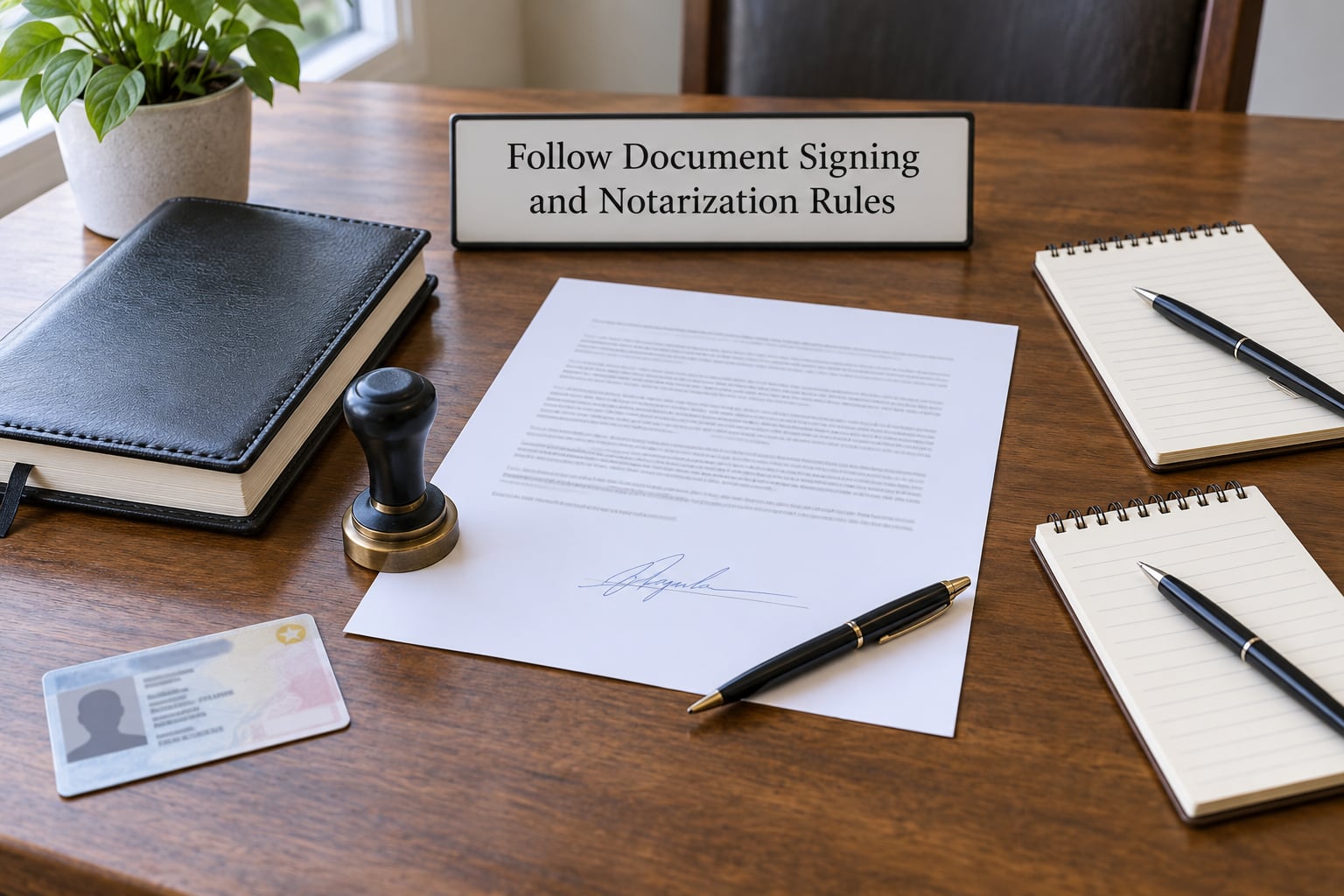
Signing must happen while you are an adult, competent, and acting of your own free will. A document signed by someone who already lacks legal capacity cannot be fixed by a notary, and a document signed under pressure invites a challenge later.
Two formalities do most of the work. Notarization means you sign in front of a notary, or acknowledge your signature, and the notary verifies your identity and willingness. Witnesses mean disinterested people observe the signing and sign the document themselves.
Which of the two you need depends entirely on your state and on the document. Many require notarization; some accept notarization or two witnesses as alternatives; the Illinois health care proxy has its own stricter execution rules. Read the instructions printed on the form itself, because the statute, the form, and the institution’s checklist occasionally differ, and it is much cheaper to comply with all three than to redo the document.
Sign every page where a signature line appears, fill every blank with “N/A” rather than leaving it empty, and date the document. Then make copies immediately, before the original leaves your hands.
6. Store the Document Safely
The original goes somewhere secure and findable: a fire-resistant home safe, a safe deposit box, or with your attorney. Scans and photocopies belong in a password manager or a locked cloud folder, and your agent should know exactly where both the original and the copies are.
Do not treat a file in an email inbox as your only record, and do not hand the only copy to a bank that will not promise to return it. Banks and hospitals are supposed to return originals, but the practice varies and a lost original can mean a second signing.
Give your agent a copy before you need one, not during an emergency. A copy in the drawer when a hospital asks is the difference between being heard and standing there while someone explains who is authorized to speak.
7. Review and Activate the Document
Reread the finished document against your list from step one. Confirm the effective date, the named powers, the agent and successor details, and the execution formalities actually required by your state.
Then tell the people who need to know. Walk your agent through the accounts, the providers, and the passwords, and ask your bank and primary doctor what documentation they want on file. A bank that has seen the document once is far easier to deal with than one hearing about it during a crisis.
Revisit the POA every few years. A move to another state, a new agent, a marriage, a change in who handles your care, or a change in the accounts you care about all make an old version worse than no version.
Common Mistakes That Invalidate a Power of Attorney
Using another state’s form. Courts and banks work from the statute that applies where you live, and a foreign form can be rejected outright. Fix: download the current statutory form from your own state’s legal help site or clerk’s office.
Leaving blanks on the page. An unfilled space can leave room for an amendment later, which is exactly what someone else would want. Fix: complete every field, writing “N/A” where something does not apply.
Confusing your agent with an attorney. Calling your agent “my lawyer” in conversation invites assumptions. Fix: use “agent” or “attorney-in-fact,” the terms the document itself uses.
Skipping a witness or the notary. A missing formality can invalidate the document at the worst possible moment. Fix: check the execution requirements printed on the form for your state and document type before anyone signs.
Granting unlimited authority by habit. Boilerplate that lets an agent sell, gift, or encumber your home may not be what you want. Fix: read the authority section and strike or limit what you do not want delegated.
No successor agent. If your agent dies, moves abroad, or stops answering, the authority ends with them. Fix: name one or two backups in a defined order.
Using a non-durable POA for long-term planning. It ends the day you lose capacity, which defeats the purpose. Fix: choose a durable document if you want it to survive incapacity.
Not telling anyone where it is. A perfectly valid document in a filing cabinet nobody opens is useless. Fix: give your agent a copy and the location of the original today.
Two more habits close most of the remaining gaps. Revoke old documents in writing and destroy every copy when you replace one, so nobody is relying on a stale POA. And pair the POA with a will, a health care proxy, and a HIPAA release so the paperwork does not contradict itself.
Frequently Asked Questions
What’s the easiest way to do a power of attorney?
The easiest route is your state’s free statutory form, filled out with the specific powers you want, signed in front of a notary and any witnesses your state requires, then stored safely with copies given to your agent and your bank or hospital. Most people finish in an afternoon. The hard part is deciding the scope of authority, not the paperwork.
What is the best way to set up a power of attorney?
The best approach is to start from your state’s current statutory form, pick the narrowest type that covers your situation, and name a successor agent. A durable power of attorney for finances plus a separate health care proxy is a solid baseline for a couple. If real property, a business, or family conflict is involved, have a local attorney draft it instead.
How much does it usually cost for a power of attorney?
State statutory forms are free to download. Flat-fee online services charge a one-time fee, usually in the low hundreds of dollars, and attorney-drafted documents commonly run several hundred dollars or more depending on how much custom drafting you need. Notarization and witness costs are small, and some banks offer the service free to account holders.
Can I draw up a power of attorney myself?
Yes. You can write and sign your own power of attorney as long as you are an adult of sound mind acting voluntarily, the document covers your state’s execution requirements, and the wording is unambiguous. What you cannot do is do it for someone who is already incapacitated. Once capacity is gone, the only court route is guardianship or conservatorship, which is slower and costlier.
Do you need a lawyer to get a power of attorney?
You usually do not need one for a straightforward financial and health care POA. A lawyer is worth paying for when real estate sits in more than one state, a business is involved, relatives are likely to contest the agent, or your legal name does not match other records. Some employers also offer free legal consultations through a benefit plan.
Can I revoke a power of attorney?
Yes, as long as you still have capacity. Revoke it in writing, date it, deliver the notice to your agent, and destroy every copy you have so nobody is acting on revoked authority. Tell your bank and doctor too, since they may have the old version on file. A POA also ends automatically at your death, when probate authority begins.
Conclusion
Start with the first action that actually matters: write down the decisions you want delegated, then pick the narrowest document type that covers them. Download your state’s current statutory form, check its signing and notarization rules, and confirm the agent’s legal name matches their ID before anyone signs.
Once it is executed, give your agent a copy, tell your bank and doctor it exists, and store the original somewhere both of you can find. Revisit it every few years, and get a lawyer involved before signing if your situation involves property in more than one state, a business, or family members likely to disagree.