
Caring for an aging parent from far away is mostly coordination, not caregiving. You secure the right permissions, put the information in one place, build a small local team, and set a check-in rhythm you can keep for years. That plan takes a few focused hours to set up and gives you something solid to fall back on.
Updated for 2026. This is general guidance, not medical, legal, or financial advice. For anything involving medications, a diagnosis, or signing documents, talk with your parent’s own clinicians and an attorney in your parent’s state.
Most people who search this are adult children in their forties and fifties with a parent who is still independent enough to live alone but visibly slowing down. They usually have some authority in the family, some money, and a job that will not bend. They also have a specific dread: the phone call where something sounds off and they cannot drive over to check.
That dread is worth naming, because it shapes everything else. Distance is the biggest reason families put off the paperwork and the paid help they already need. A missed fall, an empty refrigerator, and a medication that never got taken all look identical from 600 miles away, and by the time you find out, something has already broken.
Table of Contents
- What You Need
- Step-by-Step
- 1. Have a candid conversation about care needs
- 2. Build a written care and contact plan
- 3. Set up healthcare and medication management
- 4. Make the home safer and daily life manageable
- 5. Coordinate local help you can trust
- 6. Manage finances, benefits, and legal decisions
- 7. Create a routine for check-ins and emergencies
- Common Mistakes
- Frequently Asked Questions
- How often should I check on an aging parent who lives far away?
- What should I do if my aging parent will not answer my calls?
- Can I manage my parent’s healthcare from another state?
- How do I choose a home-care provider for my parent?
- What if my siblings disagree about how much care my parent needs?
- When is it time to consider assisted living or a nursing home?
- Conclusion: Start With One Conversation and One Reliable Local Contact
What You Need
Before arranging anything, gather the pieces below. Doing it in one sitting saves weeks, and the act of collecting it usually tells you more about your parent’s situation than a phone conversation will.
The basics you should collect first
- Your parent’s own wishes, in their own words. Where they want to live, whether they would accept help in the house, what a good day looks like for them. Write these down and date them, because they will change and you will need to know what they said when.
- Health records and a current medication list. Include prescriptions, over-the-counter drugs, supplements, allergies, pharmacy phone number, primary care office, specialists, and recent test results. Ask the office for copies rather than screenshots you will lose.
- Emergency contacts. At least two people, one local and one who can be reached from anywhere, plus the parent’s doctor and the local hospital’s emergency department.
- Insurance and benefit details. Card numbers, plan type, pharmacy benefit, and who to call about coverage questions. Note that Medicare Advantage and employer retiree plans work differently from original Medicare.
- The legal stack. A will, a health care proxy (sometimes called a health care power of attorney), a durable power of attorney for finances, and a HIPAA authorization. Ask for these before anything changes, while your parent can sign them and understand what they mean.
- A financial snapshot. Monthly income, recurring bills, property, accounts, and who bills whom. Include where documents live.
- Local resources. The Area Agency on Aging for your county, the county office on aging, the local 211 line, the parent’s primary care office, and the pharmacy that actually delivers.
- One dependable local person. A neighbor, a relative, a longtime friend, or a hired aide who can check in and pick up the phone. Not someone who might. Someone who does.
- One shared place for everything. A physical binder in the home plus a cloud folder or a private group chat. Physical matters more than people expect when the power goes out.
The National Institute on Aging generally describes long-distance caregiving as living an hour or more away from a parent who needs help. It is common enough that there is language for it, and naming it helps when you ask family members for help or look up resources.
Step-by-Step
Seven steps, in this order. Each one makes the next one easier, and skipping ahead usually means starting over later.
1. Have a candid conversation about care needs
Start with a conversation, not a plan. The goal is to hear what your parent thinks is going on and what they want, not to present yours. Parents notice the difference immediately, and the difference decides whether the next six months go well.
Ask about specific days rather than general health. What was Tuesday actually like? Did they get out for a walk? Was there a meal? Did anyone come by? Where does the laundry sit? Who drives them now? Concrete questions get honest answers, and vague ones get reassurance you cannot use.
Watch for the changes people report most often in caregiver forums: meals shrinking to crackers, laundry piling up, appointments skipped because rides fell through, bills arriving late, less interest in things they used to enjoy, and bruises with a story attached. A change in one of those is worth a follow-up, not a lecture.
The 40/70 rule is a useful frame here. It suggests that if 70 percent of your parent’s assets would go to you, you can probably start making decisions for them, even if they are still alive and talking. It is not a law, but it does open a conversation that is otherwise hard to start.
Close the conversation by writing down their goals. If they want to stay in their house, write that. If they want the dog to be the last thing they give up, write that too. Those sentences are what you will read at two in the morning during a bad week.
2. Build a written care and contact plan
Now build the document. One page for the daily plan, one page for emergencies, and a list of everyone who has a copy.
The daily plan covers medications with names and times, appointments, meals, mobility and fall precautions, home maintenance, what the parent can safely do alone, and who checks on them. The emergency page covers warning signs, what to do first, the local hospital, the parent’s doctor, the two emergency contacts, and any legal documents the hospital will want.
Include the boring administrative lines too: the power company, the landlord, the pest guy, the neighbor who has a spare key, and which mailbox holds the important paper. Crises happen at two in the morning on a holiday, and the person handling them cannot hunt for a phone number.
Store it in two places. One copy lives in a drawer in the kitchen, not a shoebox on a high shelf. The other lives in a shared folder that your local contact and any paid helper can actually open. Give everyone a copy rather than telling them where to find one.
3. Set up healthcare and medication management
Get the paperwork side right first, or you will spend months locked out. A health care proxy lets you speak for your parent in medical decisions, and a HIPAA authorization lets providers discuss records with you. Without both, a receptionist can legally refuse to tell you what is going on, and that refusal is not malice.
Build one medication list. Every prescription, over-the-counter drug, and supplement, with dose, time, and who fills it. Bring it to appointments, even the ones you join by phone. Ask the pharmacist to run a review for interactions; that service is usually free and catches more than people expect.
Set up telehealth before you need it. Test the camera, the audio, and the connection at the same time of day your parent would use it. Sit in with them on the first visit so you know where the notes go and who follows up.
You can sit in on appointments remotely once the paperwork allows it. Send three questions in advance by message so the visit does not become the only chance to raise them, and ask permission to record your own notes afterward.
Do not change doses, guess at symptoms, or interpret test results yourself. Ask the parent’s clinicians directly, and treat a sudden change in appetite, alertness, balance, or swelling as a call to the doctor’s office rather than a puzzle to solve.
4. Make the home safer and daily life manageable
Most falls happen in ordinary places: the bathroom, the stairs, the path between bed and chair. Walk the house with fresh eyes on your next visit, even if you have been there a hundred times. Look at the lighting, the rugs, the cords, the thresholds, and the bathroom floor.
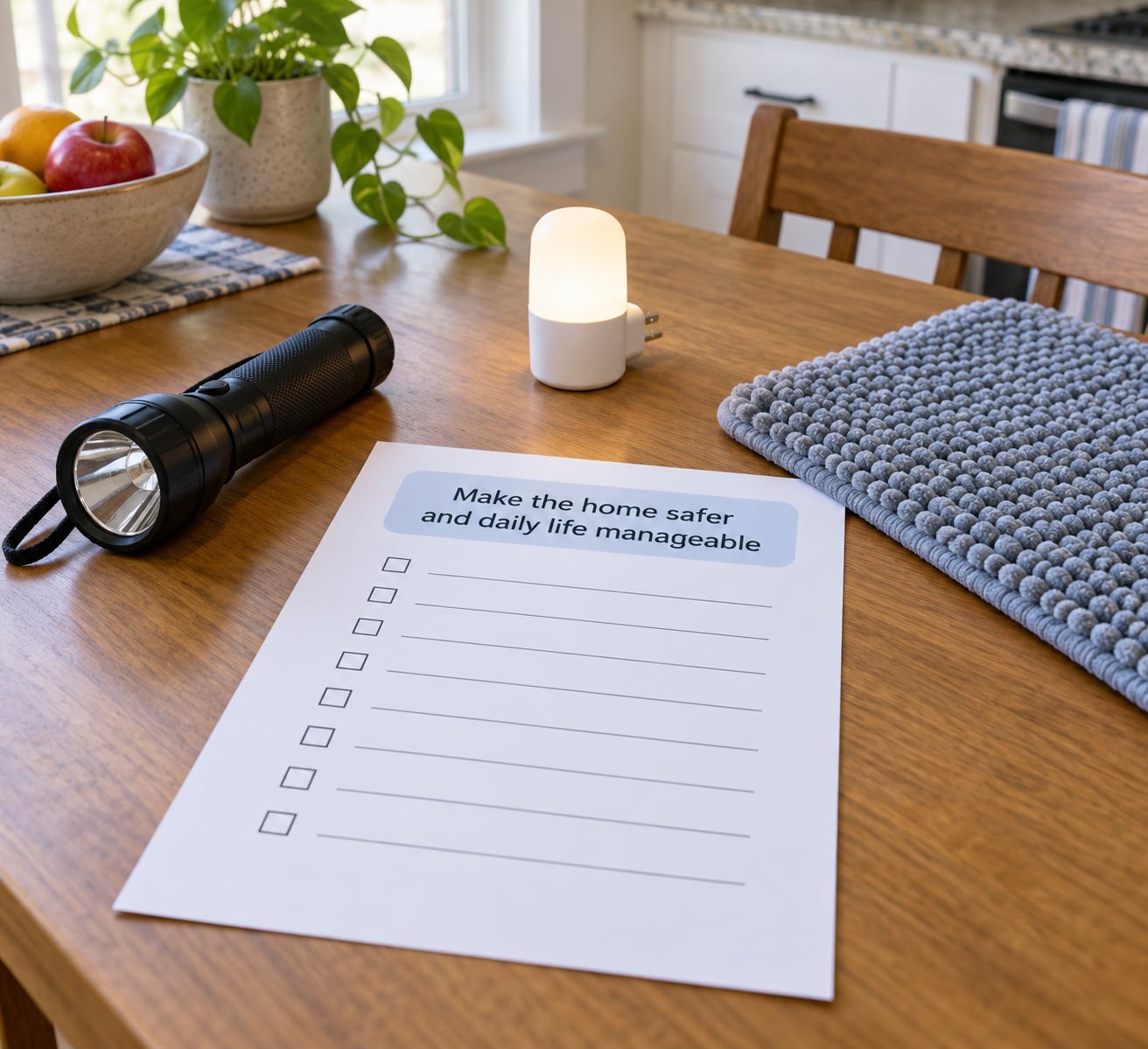
Here is the short checklist I would walk through with you:
- Lighting. Hallways, stairs, the route to the bathroom at night, and inside the closet. Overhead and bedside switches so nobody has to walk across a dark room.
- Bathroom. A non-slip mat, grab bars installed properly, a raised toilet seat if needed, and a shower chair. Bars screwed into studs, not drywall anchors.
- Rugs and cords. Remove loose rugs, secure cords along walls, keep the path to exits clear.
- Medication storage. One location, ideally one container, kept away from grandchildren and pets.
- Meals. Does the parent cook, or are they eating standing at the counter? Meals on Wheels and similar programs exist in most counties through the Area Agency on Aging.
- Utilities and maintenance. Someone changes filters, runs the dishwasher, and notices when the water bill doubles.
- Door and window security. A doorbell camera or similar, plus a spare key with a trusted neighbor.
Fall risk deserves its own conversation with the clinician, because falls are often the first visible sign of a larger change. Ask whether an occupational therapist visit would help. That single referral often produces a written list of the exact grab bars, railings, and equipment that house.
For physical work, use licensed or insured contractors. Grab bars that wobble create more risk than they remove, and a handyman shortcut is not worth the saving.
5. Coordinate local help you can trust
Learning how to care for an aging parent from far away mostly means finding one good local person and making sure they are not alone. Neighbors, relatives, church or community friends, adult day programs, home care agencies, and home health aides all have a place, and most families end up using more than one.
When you assess anyone, ask four questions. Are they willing to be on the emergency card? What can they actually do, and what can they not? How much do they charge, and how is payment handled? What happens when they are unavailable?
Set service boundaries early. A paid caregiver who is also a friend or relative usually costs more and does less than you expect, because nobody wants to fire a person they see every week. Paid help from an agency brings background checks, a replacement plan, and someone to call when things go sideways.
If a sibling lives nearby and does the hands-on work, the most useful thing you can do is stop offering opinions and start doing legwork. Build a shortlist of agencies, confirm costs, and ask the Area Agency on Aging for free or low-cost options before that sibling burns out. That advice lands differently when it comes with the phone numbers already gathered.
Caregivers in forums say the same thing over and over: do not try to fix the person who is doing the care from a distance, and do not criticize them. Even when the idea is right, an idea delivered as a correction reads as a complaint about their effort.
Caregiver burnout is real, and it comes for the local helper hardest. Respite care, meaning temporary care so the primary caregiver can rest, is worth arranging before anyone asks for it out loud. Most people will not ask.
6. Manage finances, benefits, and legal decisions
Money is where distance creates real risk, and it is also where families rarely talk. Start by reviewing recurring bills together on a call. You can watch the screen over video, which makes it a shared task instead of an audit.
Know what each program covers before you count on it. Medicare covers a limited home health benefit when care is medically necessary and prescribed by a clinician. It does not pay for custodial daily care, a geriatric care manager, a medical alert system, or most in-home support services. Medicaid has waiver programs that can pay for home- and community-based services for people who qualify, and rules differ by state.
Costs vary enormously by region, so get local quotes rather than trusting a national number. Hourly rates for private home care swing widely between a metro area and a rural county, and a geriatric care manager usually bills by the hour for a defined block of work. Both are out of pocket for most families, so ask about sliding-scale programs, veteran benefits if applicable, and long-term care insurance before assuming the full amount.
On legal documents: ask for a durable power of attorney for finances and a health care proxy for medical decisions, both with the specific authority you need and specific people named as backup agents. Do not assume a signed document exists because someone remembers discussing it. File the originals where the parent’s lawyer or the local office on aging tells you to keep them.
Never share passwords for banking or email, even with family you trust. Set up authorized users or proper access instead. And do not sign, move money, or make a decision on your parent’s behalf without legal authority, because without it most of it can be challenged later.
This is the section to bring in a professional. An elder-law attorney in your parent’s state, a financial planner, a benefits counselor, or an accountant can each handle the piece that fits. Many elder-law offices do a one-time consult and then hand you a checklist you can follow yourself.
7. Create a routine for check-ins and emergencies
Pick a schedule you can hold for a decade, not a month. For most families two calls a week plus one longer video visit works, with more contact after a hospital discharge or a change in medication. Put the calls on a shared calendar so siblings see them and nobody feels checked up on.
Vary what you ask. Ask what they ate, who they saw, what they were up to before the phone rang. A parent who is alert and connected on the first call and unreachable on the third is a signal worth acting on, not a busy evening.
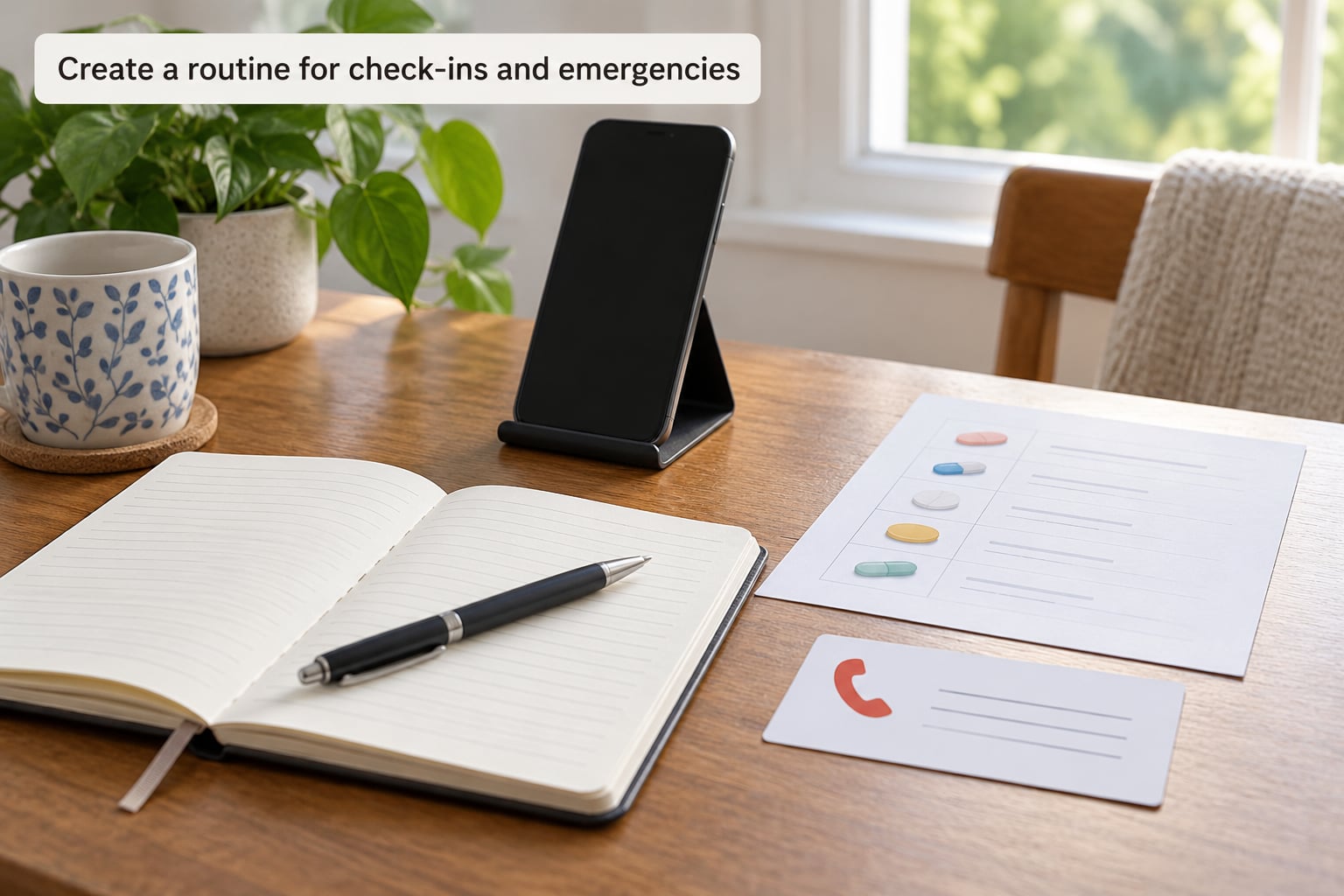
Decide in advance what happens if they do not answer. Most families agree on a sequence: call again, then text, then call the local contact, then the local emergency number. Write that sequence down, because at midnight you will not design it fresh.
Keep a running log of what you learn on each call. One line is enough. Searchable notes beat memory when a doctor asks when the dizziness started.
A medical alert system with fall detection is worth discussing, especially after a first fall. It is an out-of-pocket monthly cost, and it is not a substitute for checking in.
Common Mistakes
Making promises before the conversation. Saying “I will handle it” from a thousand miles away creates a promise nobody asked you to make. The correction is simple: say what you can actually do this week, then do it.
Relying on one informal helper. One unpaid person is one sick day away from a crisis. Every person in the plan needs a backup, and the backup needs to know the backup’s phone number.
Sharing passwords and sensitive records too widely. Logins and medical records travel badly. Use authorized users, secure folders, and named permissions instead.
Micromanaging daily details. A call that turns into a review of the parent’s fridge and social calendar teaches everyone that the calls are surveillance. Ask about the week, then let it go.
Ignoring warning signs because you do not want to make a big decision. Skipped appointments, unpaid bills, weight loss, bruises, and withdrawal are reasons to escalate a little, not to wait and see.
Saving the paperwork for a crisis. Documents signed after a fall or a diagnosis are signed under pressure. Getting them now takes one afternoon.
Remote care tips that pay off
- Send the plan and the contacts in writing at the start of every visit, even if nothing changed.
- Use a private group chat for scheduling, not for opinions about the parent’s care.
- Book the next flight or visit before you leave the current one.
- Make each in-person visit a working trip: appointments, the care binder, a home walk-through, and time with the local helper.
- Put your own name on the local caregiver support group roster so someone can reach you.
- Ask your parent directly who they would call at two in the morning. The answer is often not you.
- Give yourself permission to be the person who coordinates, researches, and funds the care without being the person who does it.
Families split across state lines or an international border add time zones and immigration and licensing questions to the same list. In that case, a local care manager or an agency that handles the paperwork is worth the fee, and you should ask about cross-border document recognition before you assume anything will transfer.
Frequently Asked Questions
How often should I check on an aging parent who lives far away?
Two calls a week plus one longer video visit is a good baseline for a parent living alone. Increase it after a hospitalization, a new medication, or a fall. What matters more than frequency is that the schedule is written down and shared with siblings, so expectations stay clear and nobody treats a missed call as a personal failure.
What should I do if my aging parent will not answer my calls?
Call again after an hour, then send a short text saying you are trying to reach them, then call your local contact and ask them to check in person. If nobody can reach your parent and you have reason to believe they are unwell, call the local emergency number. Agree on this sequence with your family in advance so nobody has to think it through during a crisis.
Can I manage my parent’s healthcare from another state?
Usually yes, but only with the right paperwork. A health care proxy lets you make medical decisions for your parent and a HIPAA authorization lets providers share records with you. Without those signed and current, offices are permitted to refuse to discuss your parent’s care with you. Ask the parent’s attorney or a local elder-law office to set both up while your parent can still sign them.
How do I choose a home-care provider for my parent?
Start with your state or county office on aging for vetted local referrals, then ask each agency about background checks, training, minimum shift length, and what happens when the usual caregiver is sick. Ask for a written rate schedule and a clear cancellation policy. Trial one shift before committing to a long block, and check in with your parent afterward without criticizing the agency first.
What if my siblings disagree about how much care my parent needs?
Do not settle it over phone calls. Ask for one family meeting, in person when you can, and bring the written care plan rather than opinions. Assign duties by strength and by distance, name one person who holds the medical information, and agree on who pays for what. If the disagreement stalls, bring in a geriatric care manager or social worker as a neutral party.
When is it time to consider assisted living or a nursing home?
When safety has failed more than once, when medications are regularly missed, when the home has become unsuitable, or when the local caregiver is exhausted. Those are practical triggers rather than moral ones. Start the conversation before a fall forces it, tour several places together, and involve your parent in the decision for as long as they can take part in it.
Conclusion: Start With One Conversation and One Reliable Local Contact
You do not have to solve long-distance caregiving this week. Start with your parent’s goals in their own words, write down the two or three concerns that worry you most, identify one dependable local person, and schedule the next call before you close the tab.
Everything else, the documents, the home safety pass, the sibling conversation, the paid helper, the difficult decision about a bigger change, can come after that. And if the relationship with your parent is already broken or you have gone no-contact, the same first steps still work. You can gather information, plan for safety, and support local help without pretending the relationship is something it is not.