Learning how to plan a commitment ceremony comes down to about seven decisions: what the ceremony means, who is there, where it happens, who leads it, what you say, what you celebrate, and how the day runs. A commitment ceremony is a personal promise made in front of the people you choose, with no marriage license, no government filing, and no legal status attached. That freedom is exactly why it needs more intention, not less.
Couples plan these ceremonies for all kinds of reasons. Some have married already for immigration, tax or insurance paperwork and never got the real celebration. Some want to mark a relationship in a country that will not recognize it. Some are marking a second beginning after a divorce. Others simply want a wedding-shaped day with none of the legal strings.
Budget for the whole thing in one or two evenings of work, then spread the planning over three to six months. Here is the sequence that works.
Table of Contents
- What You Need to Plan a Commitment Ceremony
- Step-by-Step: How to Plan a Commitment Ceremony
- 1. Decide What the Commitment Ceremony Means to You
- 2. Set Your Date, Guest List, Size, and Budget
- 3. Choose an Inclusive Venue and Celebrant
- 4. Build the Ceremony: How to Plan a Commitment Ceremony Vows and Script
- 5. Add Readings, Music, and Meaningful Traditions
- 6. Plan the Celebration and Guest Experience
- 7. Rehearse, Confirm, and Enjoy the Day
- Common Commitment Ceremony Planning Mistakes
- Frequently Asked Questions
- Start With the Meaning, Not the Template
What You Need to Plan a Commitment Ceremony
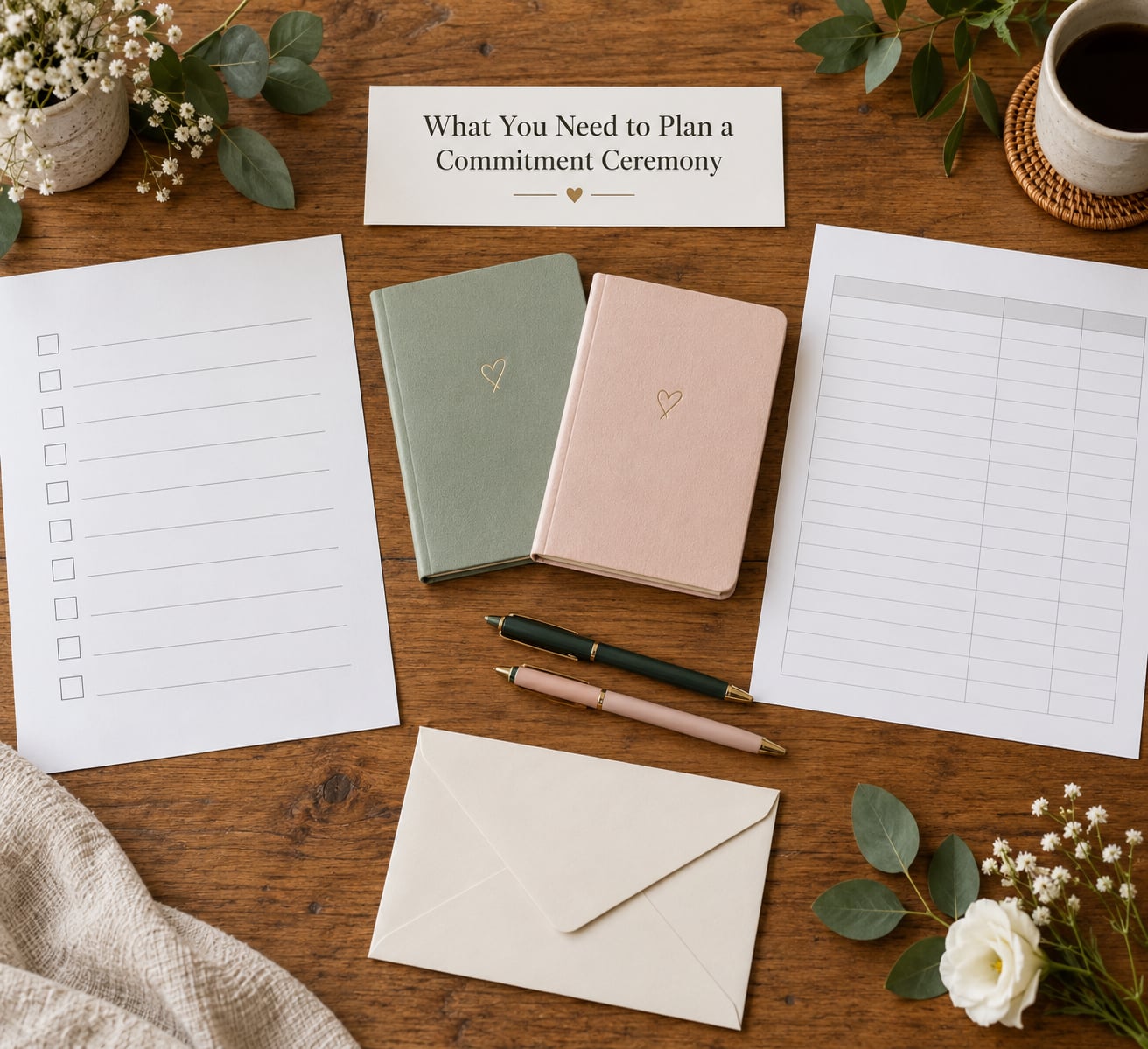
Six things do the heavy lifting, and nothing else on the list is essential.
A shared vision. One sentence that tells you what the ceremony is for. Couples who skip this step end up arguing about music in week nine.
Date and location parameters. Three candidate dates, a rough headcount, an indoor or outdoor preference, and a travel radius for guests.
An officiant or celebrant. For a non-legal ceremony this can be any willing person, including a friend, a family member, or the couple themselves.
Ceremony elements. Vows, a ring or symbol exchange, one or two readings, and a closing statement. Everything else is decoration on top.
Support roles. Someone who handles the run of show, someone who greets guests, and someone who holds the emergency contacts.
A budget with a ceiling. See step 2.
What you do not need: a marriage license, a certified celebrant, a witness, a registrar, a signed certificate to be valid, or any document at all. The ceremony is not legally binding, and it does not create marital status. Couples who want the paperwork side handled separately can run a legal marriage on another date and treat this as their real celebration, which is a common arrangement.
A warning about language: a commitment ceremony does not create a common-law marriage in most US states, and it does not trigger name changes, benefits, or tax status. Anyone who tells you otherwise is guessing.
Step-by-Step: How to Plan a Commitment Ceremony
1. Decide What the Commitment Ceremony Means to You
Before logistics, write the purpose. Five formats cover almost everything: a private promise between you, a family celebration, a spiritual observance, a public declaration, or a hybrid. Pick one and the rest of the planning gets easier, because every later decision gets measured against it.
A purpose statement looks like this: “We are gathering the people who raised us to say out loud that we are building a life together, without turning it into a legal document.” Or: “This is our wedding in every way that matters to us, and we are choosing that on purpose.”
Keep it to one sentence. If it runs past two, you are writing a program, not a purpose. Couples who wrote this line first report far fewer late revisions than couples who booked a venue first.
2. Set Your Date, Guest List, Size, and Budget
Compare three dates against three things: guest availability, venue availability, and your own stamina. A Thursday evening or a Sunday afternoon often gives you the whole venue for a lower rate and lets working guests actually show up.
Then estimate attendance. Take your must-have list, add the people who would be hurt not to be invited, and assume about 15 percent of RSVPs will drop. Plan the space for the number you hope for, not the number you invited, so nobody ends up standing.
Divide the costs. Venue and food move the budget the most; attire, stationery and music usually do not. A workable worksheet has nine rows:
- Venue and any permit or site fee
- Food and drink, including service fees
- Officiant or celebrant honorarium
- Attire and alterations
- Music, sound or a playlist
- Photography or videography
- Rentals: chairs, linens, lighting, glassware
- Accessibility: ramps, seating, captioning, accessible restrooms
- A contingency line of about 10 percent
Split the total by the number of people in the room, then round up and give each household a number they can actually pay. Couples who skip the contingency line end up improvising on the day.
3. Choose an Inclusive Venue and Celebrant
Ask the venue directly and specifically. Whether LGBTQ+ couples celebrate there, whether they have hosted one before, and whether staff have been trained in chosen names and pronouns. A confident answer beats a vague one.
Also ask about indoor and outdoor options, noise curfews, alcohol rules, whether you can bring your own food or alcohol, what happens if it rains, how accessible the entrance and restrooms are, and whether vendors must be chosen from a preferred list. Write the answers down. Verbal yeses evaporate.
For the celebrant, know the distinction. A legally authorized officiant can perform a marriage in a given jurisdiction. A ceremonial leader is anyone chosen to hold a non-legal ceremony, which for this purpose is every person who is willing and able to do it well.
Ask candidates to describe a ceremony they have led that was not a wedding. That question surfaces the real answer fast. Couples in smaller cities often find the affirming celebrant pool thin, so start early and consider someone traveling in or leading remotely.
4. Build the Ceremony: How to Plan a Commitment Ceremony Vows and Script
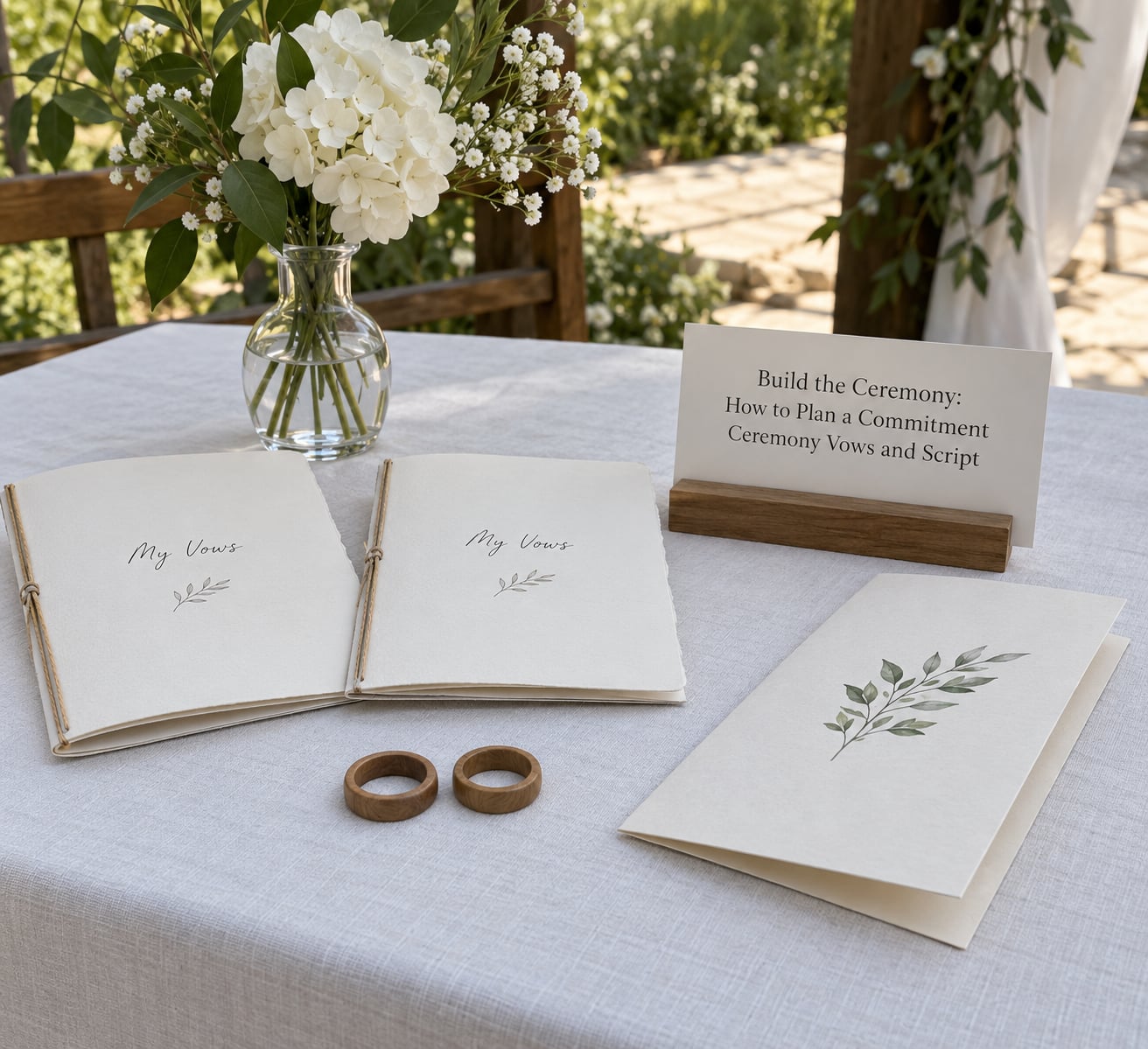
The working order is short and it works: welcome, a reading, a statement of purpose, the promises or vows, the ring or symbol exchange, a closing declaration, and a kiss or a hug. Six to ten minutes total. If it runs past fifteen, something needs cutting.
Writing vows works better with prompts than with a blank page. Ask each of you:
- What did you notice first about the other person?
- What ordinary Tuesday do you want to keep?
- What do you need from each other when things get hard?
- What are you building toward in the next five years?
- What do you want to say that you have never said out loud?
Two to three minutes each is plenty. Write them, then read them aloud to someone who will not be gentle about it, and cut every sentence that does not survive that test.
A full script is worth writing for three reasons: it lets you rehearse, it gives the celebrant exact wording, and it means a guest who cannot hear clearly can follow along on paper or on a shared screen. Print it large, and give a copy to the person running sound.
5. Add Readings, Music, and Meaningful Traditions
One or two readings, no more. A poem, a short essay passage, or something a friend wrote for you. Read it twice as long as you think it needs and cut a quarter. Couples who schedule four readings end up with guests checking their phones by minute twelve.
Build a music timeline instead of one long playlist: something for guests arriving, something for the processional, one clear piece for the vows, and something for the celebration afterward. Note the exact track and the moment it starts on the run sheet.
Traditions work best when they come from your actual lives rather than a template. A unity candle, handfasting, unity sand, warming rings together over a flame, planting a tree, cooking a shared meal, or writing letters to each other to open in ten years. Trans and non-binary couples often build the ring exchange around whichever symbol actually fits, rather than defaulting to two wedding bands.
If you want a tradition that carries a history, do it deliberately. Couples have found that borrowed rituals land poorly when they are copied without context, while adapted ones, explained briefly to the room, tend to be the part guests remember.
6. Plan the Celebration and Guest Experience
A dinner, a picnic, a community gathering, a dance floor, or a quiet hour alone after the ceremony all count. Match the celebration to the purpose from step 1 rather than to what you assume a ceremony requires.
Write invitations that answer the question guests actually have, which is what is happening here. Say something like: “We are having a commitment ceremony, a celebration of our promise to each other. It is not a legal marriage, and no paperwork is involved. We would love to have you there.” One sentence of explanation prevents the most common awkwardness at the door, which is guests arriving with wedding gifts and no idea what to say.
Include the practical details people need: date, time, location, whether to bring a plus-one, parking and transit, dress guidance in one phrase rather than a paragraph, and whether there will be alcohol. Ask about food allergies on the RSVP and put a real deadline on it.
Get names and pronouns right. Put both of your chosen names on the program, tell the celebrant and the caterer how to pronounce them, and check that any printed signage uses the same version everyone else is using. A printed program is a commitment, and it is easier to get right than a memory. Getting names right is one of the quieter wins when you plan a commitment ceremony, because it removes a whole class of awkward moments for guests.
Decide what happens with gifts. Say plainly on the invitation whether you are registering anywhere, and if not, name the thing you would rather receive, such as a contribution to a trip or a charity. Unclear gift guidance gets mentioned later in r/LGBTWeddings threads more than almost any other planning snag.
7. Rehearse, Confirm, and Enjoy the Day
In the final week, run the whole ceremony once, standing, with the actual script, the actual music, and the actual people. Ten minutes of rehearsal prevents the ten-minute delay that usually eats the photo window.
Then confirm: the run of show with times, cue sheets for music and readings, final payments, one named contact per vendor, every accessibility need the guests told you about, transportation and parking details, the weather backup, and what happens if a phone dies.
Assign one owner per task. Not a shared list, not a group chat where nobody acts. Names on tasks, so the person holding the rings knows it is them.
On the day, hand off the logistics early. Two people who are not getting married should run the event so you can actually be present for it.
Common Commitment Ceremony Planning Mistakes
Copying a conventional wedding without checking the fit. The fix: go back to your purpose sentence and cut anything that only exists because a wedding planner article told you to.
Spending without a cap. The fix: decide the per-person number before you book anything, and treat the first quote that exceeds it as a reason to change the plan rather than raise the number.
Choosing a celebrant before confirming values. The fix: have the conversation about tone and language before anyone signs a contract.
Leaving accessibility unplanned. The fix: ask every guest privately about access needs in the RSVP, and confirm the venue’s accessible restroom and entrance in writing.
Writing impractical vows. The fix: time them by reading aloud, then trim. Two minutes reads better than four.
Scheduling too many readings. The fix: cap it at two and let your own vows carry the weight.
Skipping a rain or technology backup. The fix: know where everyone moves to if the weather turns, and have the script saved on a phone and on a printed copy.
Two quick tips that pay off. Announce your chosen names and pronouns once at the start of the ceremony, which saves the celebrant the job and protects everyone in the room. And decide in advance whether you are announcing your anniversary date publicly, because after a ceremony date and a legal date, couples often end up with two and no agreed story about which one is the real one.
Frequently Asked Questions
Do you need a marriage license for a commitment ceremony?
No. A commitment ceremony has no legal component at all: no license, no registrar, no filing, and no signed certificate that anyone verifies. Nothing about it creates marital status or triggers benefits. Some couples file a legal marriage separately, on a different date, and celebrate it with this ceremony, which is a common way to get both. Others never file anything and simply hold the promise they say out loud.
What should we wear to a commitment ceremony?
Guests do not need matching attire or a dress code. Say one clear phrase on the invitation, such as semi-formal or cocktail casual, and let people interpret it. For the couple, wear what you will actually want on in six hours of photographs and dancing. Many couples choose suits or a suit and a shirt rather than a full tuxedo or a white dress, because the day is not a legal wedding and the outfit can say so without saying a word.
How do we celebrate our commitment ceremony with family?
Invite family first and let them help shape it. Ask one or two relatives to read, hold the rings, or say a short toast, which gives them a real role instead of a spectator seat. Set the tone in the invitation by explaining plainly that this is a ceremony of commitment rather than a legal marriage. If someone struggles with that framing, a short conversation before the day goes further than any explanation printed on paper.
How can we plan a commitment ceremony on a small budget?
Cut the vendor list before the guest list. A friend or family member can lead the ceremony, a public park or your own home removes the largest cost, and a playlist with a speaker handles the music. Food is usually the biggest remaining line, so consider a potluck, a picnic, or a restaurant dinner where the price is per person anyway. Keep the contingency line and skip the printed favors.
What are some LGBTQ+ affirming readings for a commitment ceremony?
Readings that honor the relationship without turning the room into a political statement work best: a poem about choosing and staying, a passage about building a home, or something a friend wrote for the two of you. Many couples read a public-domain piece by a queer writer or a poet whose work reflects their own life, then follow it with their own vows, which keeps the affirming part personal and quiet rather than performative.
Start With the Meaning, Not the Template
Planning a commitment ceremony well is mostly subtraction. Define the promise, choose the people, find a place and a leader who fit, write vows short enough to say out loud, and cut everything that was there only because it appeared on a wedding checklist.
So here is your first action, tonight: each of you writes one sentence describing what the ceremony should communicate to the room. Compare them. If they say the same thing, you have your purpose and the rest of the plan writes itself. If they do not, that disagreement is the most useful thing you will find all week.