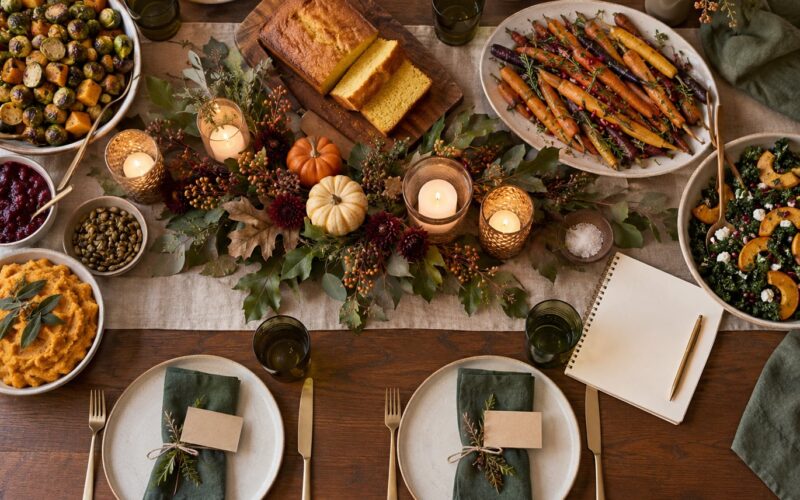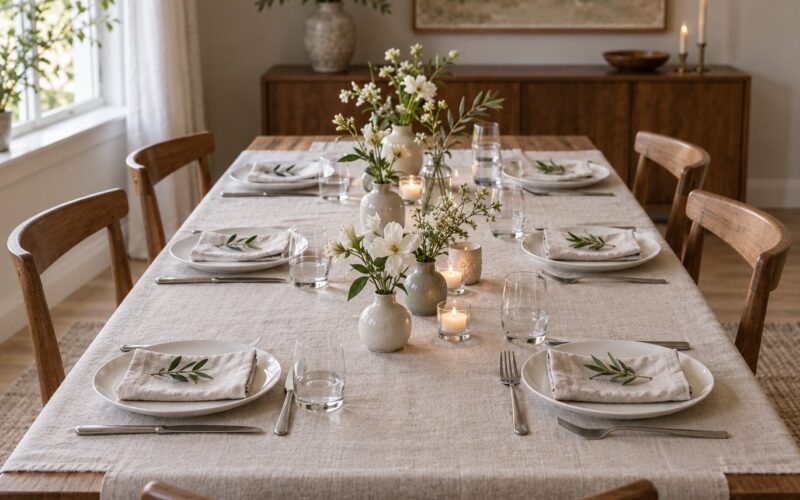
If you have ever wondered how to plan a dinner party menu so everything lands on the table at the same time, the answer is short: work backward from the hour you want everyone seated. Confirm your guest count and anyone’s dietary needs, pick one main dish, add two or three sides and a dessert that contrast with it, then schedule every dish around your oven space, burners, and refrigerator. Most of that work takes about an hour and happens days before the evening.
The hosting disasters I hear about almost always trace back to menus chosen by inspiration rather than by logistics. Three dishes that all need the oven at 400 degrees at the same moment. A nut allergy discovered at the door. A main that needs ninety minutes of attention after the salad is already on the table.
None of that is a cooking problem. It is a planning one, and the fix is a process you can run once and reuse every time you host.
Table of Contents
- What You Need
- Step-by-Step: How to Plan a Dinner Party Menu
- Define the Occasion, Guests, and Service Style
- Set a Budget and Choose a Menu Structure
- Pick a Main Dish and Build Supporting Sides
- Account for Dietary Needs Without Complicating the Menu
- Test the Menu and Create a Cooking Timeline
- Set the Final Menu and Shopping List
- Prepare Ahead and Serve Food Safely
- Common Mistakes and How to Fix Them
- Frequently Asked Questions
- Conclusion: Start With the Main Dish
What You Need
Gather these eight things before you choose a single dish. Ten minutes of setup here saves the hour of dithering that comes with an empty page.
- The occasion and the format. A Tuesday catch-up with four people calls for a different plan than a seated dinner for ten. Write down which one you are hosting.
- A confirmed guest count. Plan for the people who said yes, then add one extra for every ten guests. Somebody always remembers at the last minute.
- A budget limit. A per-guest ceiling keeps dessert from quietly eating the whole grocery bill.
- Dietary notes. Allergies, vegetarian or vegan guests, religious restrictions, and foods a guest simply dislikes.
- Serving equipment. Count your platters, bowls, and big spoons. Family-style service for eight needs about three serving dishes, not eight individual plates.
- Your cooking schedule. When you are actually free to cook, and how long you can stand at the stove without losing track of the oven behind you.
- Fridge and freezer room. Most home refrigerators hold roughly a week of food for a small household. Check yours before committing to three make-ahead dishes.
- An instant-read thermometer. Dinner-party timing depends on knowing when food is truly done, not when a timer says it ought to be.
Step-by-Step: How to Plan a Dinner Party Menu
Work through these seven steps in order. Each one narrows the next, so you will not end up buying an appetizer that fights with the main you pick later.
Define the Occasion, Guests, and Service Style
Start with the shape of the evening rather than the food. Decide whether the meal is casual and eaten from the coffee table, family-style down the center of a dining table, or a plated course at a table with a real start time.
Then write down what you know about the room. How many people fit comfortably, whether you have dining chairs or only a sideboard, and whether anyone will arrive late. That last detail changes your plan more than any recipe choice.
Finally, send a message to guests about food. Ask three questions: any allergies, any dietary restrictions, and anything you would rather not eat. A short message gets better answers than a long form, and it gives guests a private moment to mention something they would otherwise skip quietly.
Set a Budget and Choose a Menu Structure
Set a per-guest limit, then choose a structure. The structure matters more than the individual dishes, because it decides how many things you buy and how many things you cook.
Four structures cover nearly every situation:
- One main plus two sides. The workhorse. Cheapest to shop for, the easiest to scale, and the least likely to fail.
- Soup and salad with bread. Good for cold months and light appetites, and almost nothing needs the oven.
- Shared small plates. Three or four dishes placed in the middle and passed around. Especially good for mixed diets, since everyone can take what works.
- Casual buffet. Food held warm and served at your own pace. Requires the least plating and the most containers.
A worked example: six people, a modest per-guest budget, one main plus two sides. That means one braised or roasted main, one starchy side, one green side, a salad, bread, and a make-ahead dessert. Six dishes, two of them cooked the day before, and an evening free for company instead of the stove.
Pick a Main Dish and Build Supporting Sides
Choose the main first, because it dictates nearly everything else. A braise, a roast, a sheet-pan meal, and a stovetop pasta behave very differently when you try to time them together.
Aim for contrast across the plate. If the main is rich and soft, such as a beef stew or a lasagna, add something crisp and acidic: a bitter green salad, roasted vegetables dressed with vinegar, crusty bread. If the main is grilled and bright, add something creamy and slow to balance it.
Consider this three-course shape for a Saturday dinner: a chilled soup or a plate of raw vegetables with good olive oil to start; braised beef or a mushroom and lentil loaf as the main; roasted root vegetables and a green salad alongside, with bread and butter on the table; and a fruit-based dessert served cool. One protein, two cooked vegetables, one raw salad, one dessert, and only one dish that uses the oven.
The menu works when every plate supports the main rather than competing with it. Too many rich dishes in a row is the most common imbalance, and it leaves everyone full and unimpressed.
Account for Dietary Needs Without Complicating the Menu
The kindest way to handle dietary restrictions is to design one menu that most guests can eat together, rather than running a separate kitchen for one person.
Begin with the most restrictive guest. Look for a main that satisfies the largest number of needs at once: a lentil or mushroom loaf, a bean-based chili, or a roasted vegetable dish that happens to be vegan, dairy-free, and gluten-free without special effort.
Adjust the sides rather than the centerpiece. Use olive oil instead of butter, broth instead of cream, and pick a dessert built on fruit or dark chocolate. For a genuine allergy, cook that dish first, use separate utensils and a separate cutting board, and keep it covered on its own plate rather than in the serving line.
Ask directly when the answer matters. “Are you avoiding nuts, or just avoiding dishes with nuts in them?” is a question you can ask without making a guest explain their health in front of six people.
Test the Menu and Create a Cooking Timeline
Only cook dishes you have made before, unless you have time to test them a week early. A new recipe is a research project, and a research project does not belong in a dinner-party plan.
If a dish is unfamiliar, make it once at an ordinary Tuesday dinner. If it fails there, replace it. If the whole menu feels heavy, cut one item rather than simplifying everything, and cut the second starch first.
Then write the timeline backward from your serving time. For each dish, work out when it must start, how long it takes, how long it needs to rest, and how long it can sit before it suffers. Confirm that no two dishes need the oven at conflicting temperatures at the same moment and that your burners are not oversubscribed.
The test is simple: when guests sit down, everything should be ready or safely held, and you should not be holding a knife.
Set the Final Menu and Shopping List
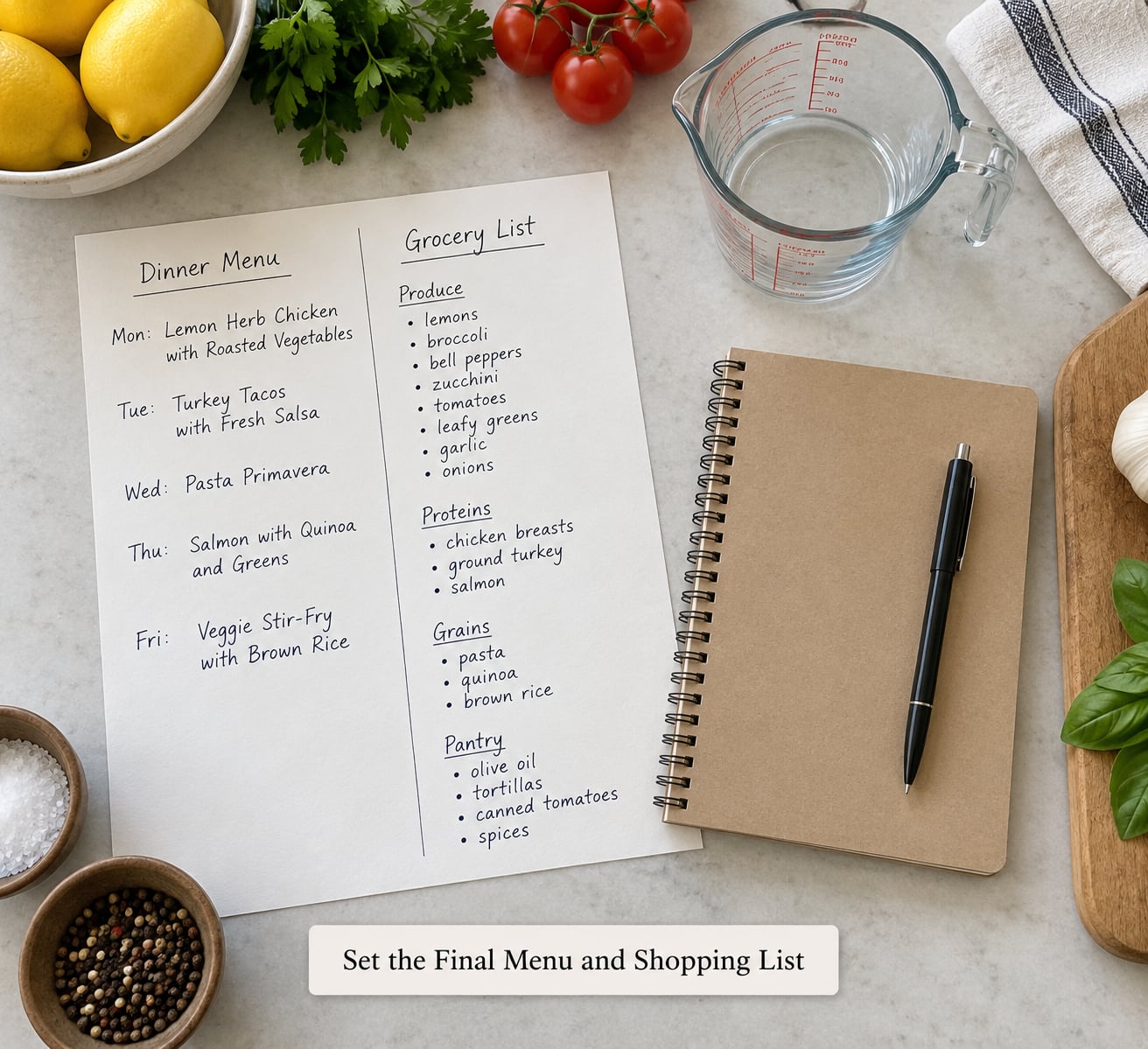
Write the final menu down as courses rather than recipes, then turn it into quantities. For eight guests, a solid three-course plan looks like this:
| Course | What to buy for eight guests |
|---|---|
| To drink | One bottle of wine per two guests, plus non-alcoholic options and one extra bottle if the main is red |
| Starter | About two bites per person, so 16 small portions total |
| Main | One generous portion per person plus two extra; roughly 4 to 5 pounds boneless or 6 pounds bone-in |
| Starchy side | About 1 cup cooked per person, so 8 cups |
| Vegetable side | About 1 cup per person, so one full sheet pan plus a small dish |
| Salad | Enough for a first helping and a second |
| Bread | One loaf per four guests, so two loaves |
| Dessert | A small slice per person plus two extra portions |
Then sort the list by grocery aisle and add what people forget: olive oil, butter, broth, salt, paper towels, serving spoons, cocktail napkins, and a bag of ice if anything is being held on ice.
A final pass should answer one question: can I carry all of this in one trip? If not, plan two runs or drop a dish.
Prepare Ahead and Serve Food Safely
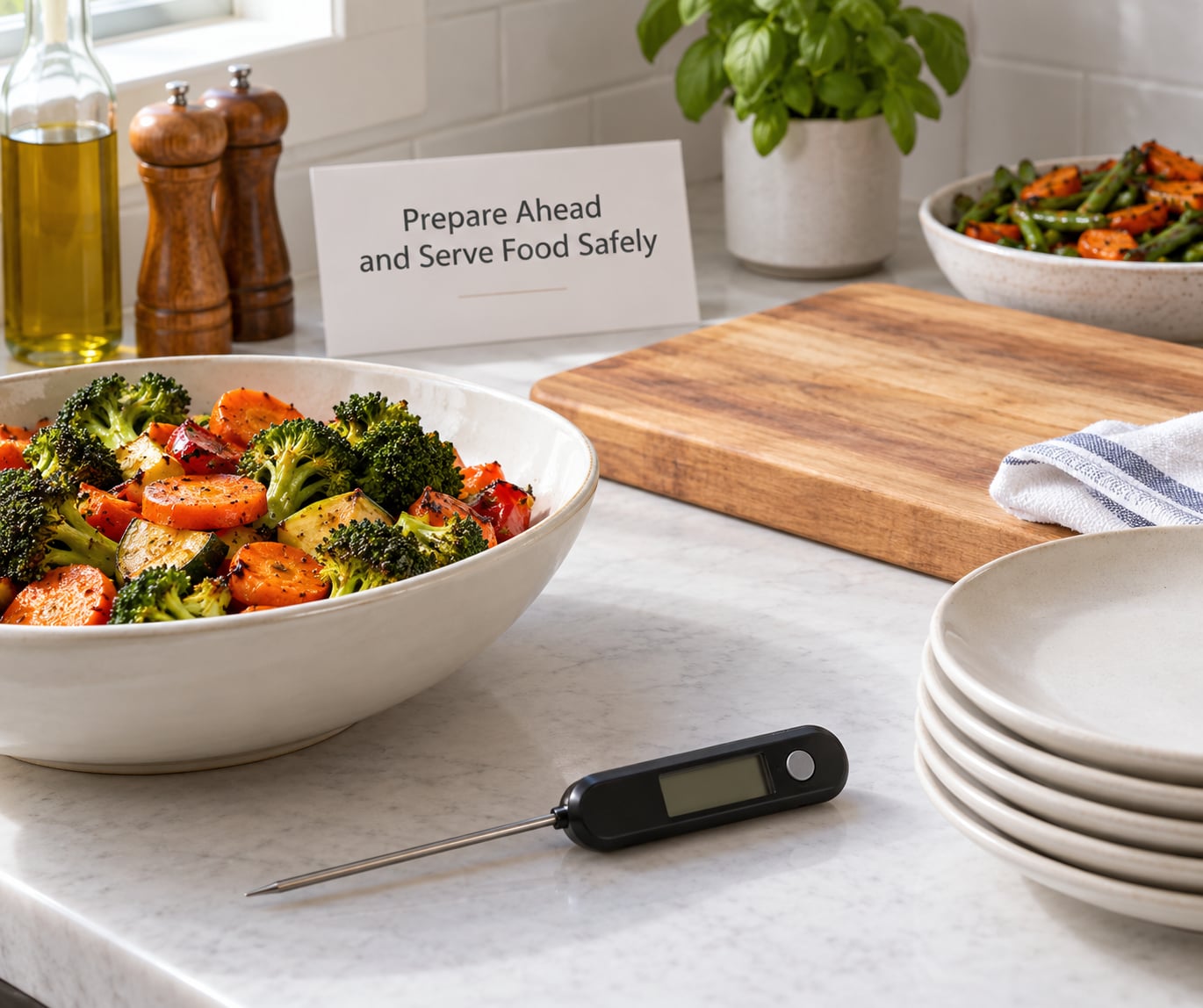
Most of a dinner party menu can be built in the two days before the evening. Soups, braises, roasts, casseroles, marinated proteins, salad dressings, and most desserts are better the next day anyway.
Chill cooked food quickly and refrigerate it promptly rather than leaving it out to cool. Keep raw meat on the lowest shelf or in a separate container so nothing drips onto the produce below it.
| Food | Minimum internal temperature |
|---|---|
| Poultry, whole or ground | 165 degrees F (74 C) |
| Ground beef, pork, or lamb | 160 degrees F (71 C) |
| Whole cuts of beef, pork, lamb, or veal | 145 degrees F (63 C) |
| Fish | 145 degrees F (63 C) |
Perishable food should not sit out longer than two hours, and only one hour when the room is hotter than 90 degrees F. That rule covers the whole evening, including the stretch before guests arrive when dishes are out early.
Reheated leftovers need to reach 165 degrees F (74 C) all the way through. A microwave works for single portions, but a covered pan on the stove heats a larger dish more evenly and keeps it from drying at the edges.
Plan a fifteen-minute service window. Warm the serving platters in the low oven while you finish, bring out the first course, clear it, then bring the main. Roasted vegetables and potatoes hold fine in a low oven; a dressed green salad should go out last so the leaves stay crisp.
Refrigerate leftovers within two hours and eat them within three to four days. If guests want to take some, make it easy for them to pack a container before the evening gets late, rather than sorting through dishes at midnight.
Common Mistakes and How to Fix Them
Almost every hosting failure fits into one of these:
- Planning too many dishes. Three finished properly beats six finished badly. Cut the second starch and nobody misses it.
- Ignoring oven temperature conflicts. List each dish’s oven temperature and cook time, then look for the overlap. Two dishes at different temperatures need a delay, not a compromise.
- Shopping without a list. Write the list by course rather than by recipe, so you notice what you are about to buy twice.
- Asking about dietary needs too late. Message guests one to two weeks ahead and ask about allergies specifically.
- Scaling a home menu to fifteen or twenty people. Past about ten guests, a grazing table or buffet beats a plated menu from a single kitchen.
- Leaving food out too long. Set a timer for two hours from the moment the first dish hits the table.
- Losing the host. Choose dishes that assemble in under ten minutes, and put yourself at the table instead of in the kitchen.
One habit pays off every time: write the final menu and the cooking order on a card, and tape it inside a cabinet door. When something beeps mid-conversation, you will not have to reconstruct your own plan from memory while six people wait.
Frequently Asked Questions
How far in advance should I plan a dinner party menu?
Two to three weeks is comfortable, and one week is enough for an informal meal. Menu planning itself needs about an hour; the real lead time is shopping and testing anything unfamiliar. Send your dietary questions a week or two ahead so nobody has to raise an allergy at the table, then shop for non-perishables up to three days before. Cookable dishes can go in the freezer at that point and thaw in the refrigerator overnight.
How much food should I plan for each guest?
For a meal with a starter and dessert, plan one generous main portion per guest plus two extra, roughly 4 to 5 pounds of a boneless main for eight people. Sides run about one cup cooked per person, and a starter needs only two or three bites each. If you skip the starter and the dessert is rich, cut the main back by a quarter. Hosting more than ten people? Increase the sides and bread rather than the main.
Should I prepare dinner-party food the day before?
For most menus, yes. Soups, braises, roasts, casseroles, salad dressings, and make-ahead desserts are all better after resting overnight, and they remove hours from the evening itself. Cook and chill food promptly rather than leaving it to cool on the counter, then refrigerate it covered. Keep crunch and fresh herbs for the last step, and add any salad dressing right before serving so nothing wilts.
What is an easy menu for a dinner party?
Use one main plus two sides and a make-ahead dessert. A braised or roasted main, a starchy side such as potatoes or rice, a green vegetable or salad, and a fruit-based dessert served cool needs only one dish in the oven at a time. It scales easily, travels well if you ever need to shift locations, and leaves you free to sit down with your guests instead of monitoring six pots.
How do I keep food warm without drying it out?
Warm dishes hold far better than hot dishes do. Put covered serving platters in a low oven around 200 degrees F, add a splash of broth or water to the pan for roasts and braises, and cover everything loosely with foil. Keep fried and crisp items out of the oven entirely and serve them last. A slow cooker on low works for the same purpose and frees your oven for the main course.
Conclusion: Start With the Main Dish
Most of menu planning collapses into four decisions, in this order: how many guests are coming and what they cannot eat, what you are willing to spend, how the food will be served, and what the main dish is. Everything after that is arithmetic.
Once the main is chosen, the sides fall into place on their own, the timeline writes itself backward from serving time, and the shopping list is a two-minute job. Make two dishes ahead, keep the oven to one temperature at a time, and put yourself at the table. That is the whole plan.