Long-distance relationships do not fall apart because of distance. They fall apart because nobody builds a structure around the distance.
Most couples try to survive on spontaneous texts and whatever calls happen to fit between work and dinner. Knowing how to keep a long distance relationship strong comes down to something simpler: a communication rhythm both people can keep, honest expectations about what connection looks like, small rituals that create continuity, and a real timeline for the future.
Eight things move the needle, and they stack on each other. If you fix only one this week, make it the first one.
Table of Contents
- What You Need
- Step-by-Step: How to Keep a Long Distance Relationship Strong
- 1. Set a Communication Rhythm You Can Both Keep
- 2. Be Specific About What Connection Looks Like
- 3. Build Trust Through Predictable Follow-Through
- 4. Make Emotional Check-Ins a Regular Practice
- 5. Create Rituals That Keep You Connected
- 6. Protect Intimacy and Honest Vulnerability
- 7. Make Future Plans Together
- 8. Keep Growing as Individuals
- Common Mistakes
- Frequently Asked Questions
- How often should a long-distance couple talk?
- What should I do if I feel jealous in a long-distance relationship?
- How do we stay intimate when we live far apart?
- What if my partner is always too busy to schedule calls?
- How can we make long-distance dating more affordable?
- How do we know if the distance is becoming a problem?
- Start With the Rhythm, Not the Grand Gesture
What You Need
A strong long-distance relationship does not need constant availability, expensive gifts or an unlimited data plan. It needs four things you can set up in a single evening.
A shared communication rhythm
One agreed schedule for calls, plus permission to text whenever. Without a rhythm, every missed message becomes evidence.
Honest expectations
A shared answer to the question of how much contact feels enough. Most fights in long-distance relationships are really fights about an assumption nobody said out loud.
Privacy
A place to talk where neither person is worried about who might walk in, especially if you are not out to family, roommates or coworkers.
A few cheap tools
Shared calendars, voice notes, a watch-party app, a two-person playlist. That is genuinely the whole shopping list.
Step-by-Step: How to Keep a Long Distance Relationship Strong
1. Set a Communication Rhythm You Can Both Keep
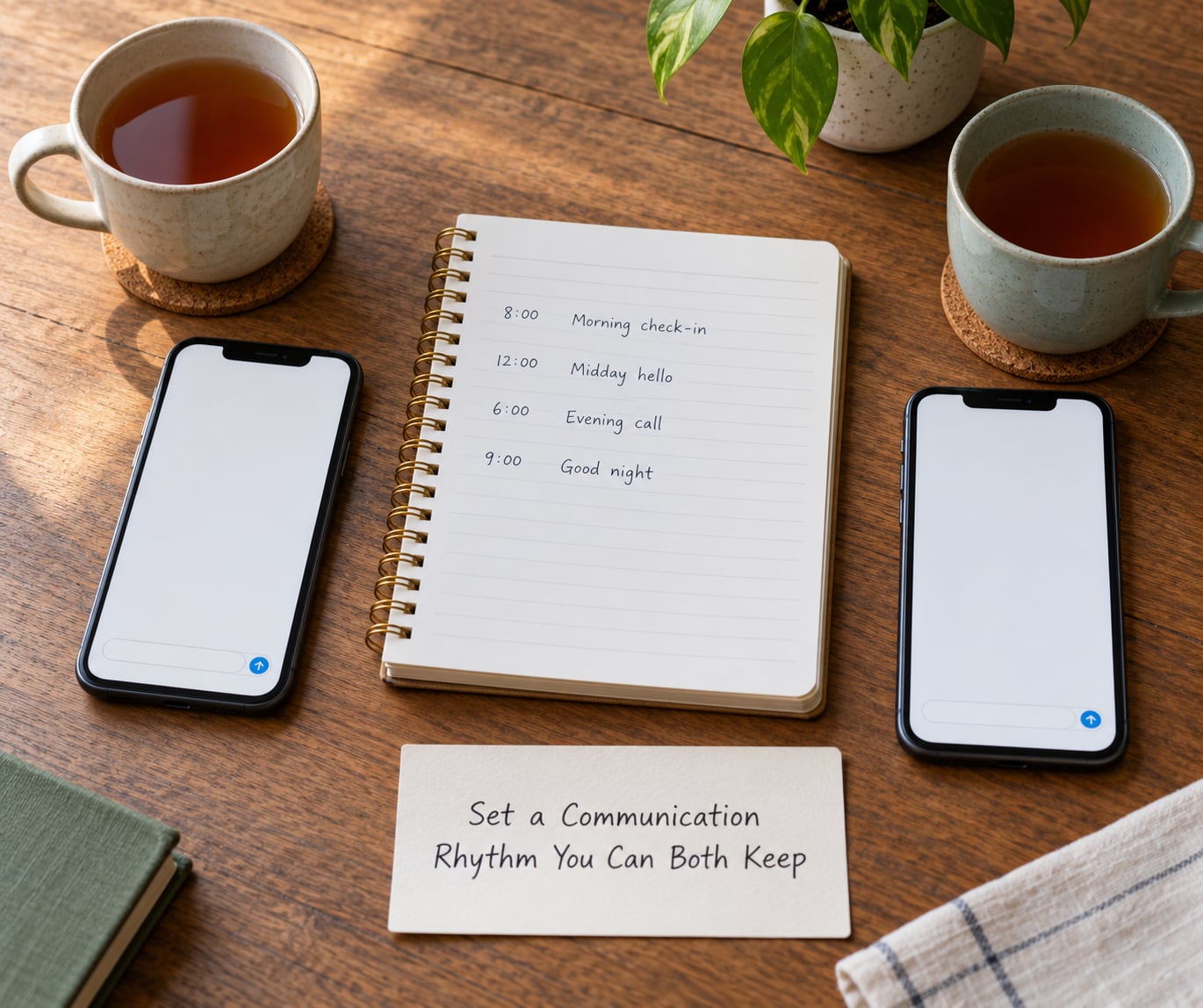
The best schedule is the one that survives a bad week. Agree on two or three dependable touchpoints instead of a vague promise to talk every day.
A common pattern is a short morning exchange, one real call in the evening, and one longer call or shared activity on the weekend. If your time zones are far apart, protect one overlapping hour and let the rest go.
Then build in slack. When someone has a deadline, a sick parent or a rough month, drop to the one anchor point and pick the rhythm back up afterward. Couples who over-schedule in the good months tend to go completely silent in the bad ones.
2. Be Specific About What Connection Looks Like
Vague hopes are the enemy. Staying close is not a behavior, so it can never be measured or improved.
Replace it with specifics: three calls a week, one honest conversation a month, voice notes whenever the day goes sideways, no phone calls during a movie or a shift. Write the list down if it helps. It sounds clinical and it works, because it turns an argument about effort into a question about the schedule.
Decide in advance what happens when one of you misses a night. A short note saying it slipped beats a silent morning.
3. Build Trust Through Predictable Follow-Through
Trust at a distance grows from small actions landing when you said they would, not from grand declarations.
Say you will call Saturday, then call Saturday. Say the trip is happening, then book it. Say you are fine, then actually be fine, or say you are not. People read the gap between words and behavior as data, and at a distance there is very little else to read.
Volunteering information also builds trust. Sharing where you are going, with whom, and when you will be back answers questions before they get asked, which takes a lot of pressure off the relationship.
4. Make Emotional Check-Ins a Regular Practice
Daily contact is often logistics. Logistics is how you coordinate, not how you know each other.
Set aside part of one call a week for the real stuff: what is stressing you out, what went well, what you are avoiding, whether you feel seen lately. Three questions work well: what took the most energy today, what are you proud of this week, what do you need from me?
For harder conversations, pick a neutral channel and a time when you are both awake. Say the hard thing early rather than letting it ferment in a text thread for three days.
5. Create Rituals That Keep You Connected

Rituals are the cheapest way to manufacture continuity. They matter more than grand gestures because they repeat.
- Parallel play. Be on a call while you both cook, clean, work out, game or study. No agenda. Couples on r/LongDistance talk about this one constantly, and it usually beats a planned date because it is ordinary.
- Shared meals. Order the same dish, plate it up and eat on a video call at the same hour.
- Two-person rituals. A show picked from the same list every week, a playlist you add to, a cooking recipe you both attempt and mess up.
- Voice notes. Longer than a text, less heavy than a call, and they carry tone. Most people say the notes are what they replay.
- Small physical gestures. Care packages, handwritten letters, a postcard, or something that smells like their apartment.
Pick two. A ritual you abandon in a month is worse than one you never started.
6. Protect Intimacy and Honest Vulnerability
Intimacy at a distance is mostly honest language. Say what you want, what you do not want and what has changed, and make room for the same in return.
Sexual connection can survive distance when both people are comfortable and nobody is performing. Remote-controlled devices and paired video sessions are options that plenty of couples use and plenty of couples skip, and either choice is fine as long as it is discussed openly.
The rule I would keep simple: any kind of intimate sharing happens because both people want it that night. Consent applies to a webcam exactly as it applies anywhere else, and privacy matters more than excitement. If one partner is not out or not comfortable being seen, keep cameras off and use imagination instead.
7. Make Future Plans Together
An open-ended distance has a way of shrinking into a permanent condition. A timeline gives the relationship an actual shape.
Start with the visits you can see in the next six months and put them on a shared calendar. Then have the harder conversation: is there a realistic way to close the distance, and what would it take?
Be specific about money, visas, work timelines and who moves. Couples who survive years of distance usually did the boring adult math early. If closing the distance is genuinely not possible right now, say so out loud and agree on a review date instead of leaving the question open.
8. Keep Growing as Individuals
Two people with full lives make a better relationship than two people waiting for it to start.
Keep the friendships, hobbies, classes and career moves going. Tell your partner about them, because reporting the good parts of your week is part of staying close. Couples who maintain separate social lives usually report feeling less lonely and less possessive.
Watch for the drift where everything gets put on hold until you are in the same place again. A life on pause is hard to restart, and your partner deserves to be someone you are building with rather than someone you are waiting for.
Common Mistakes
Long-distance relationships rarely fail from one dramatic event. They fail from six small habits that quietly wear the connection down.
Fixing the schedule too rigidly
A timetable with no flexibility turns one missed call into a moral failure. Keep the anchors, drop the extras without comment.
Reading meaning into reply times
A two-hour gap usually means a shift, a meeting or a bad day, not something you did. Ask before you build a story.
Relying only on screens
If every interaction is a call, the relationship gets heavy and people start avoiding it. Mix in text, voice notes, shared activities and real visits.
Avoiding the hard conversation
The thing you keep not discussing is the thing you argue about every month instead. Put it on the calendar and talk while you are both calm and awake.
Treating your partner’s local life as a rival
They have a life there and so do you. Asking them to shrink it to make you feel secure rarely works and eventually reads as control.
Making promises with no details
Someday we will close the distance is a feeling, not a plan. Attach a date, a budget and a first step, or the promise will quietly expire.
Frequently Asked Questions
How often should a long-distance couple talk?
Aim for consistency rather than volume: one real call most days, one longer conversation each week, and messages throughout the day when you want to. Agree on that pattern together and adjust it during busy weeks rather than letting it collapse. Couples who fix the same anchor points tend to stay steady through hectic months, because the expectation is clear on both sides.
What should I do if I feel jealous in a long-distance relationship?
Say it plainly and early, before it turns into a silent fight. Jealousy at a distance usually comes from missing information rather than from evidence, so ask your partner about their plans and let them volunteer more detail. Agree on a level of transparency that feels normal to both of you. If it keeps circling back, an individual therapist can help you find the trigger underneath it.
How do we stay intimate when we live far apart?
Talk about it directly, including what each of you wants and what you would rather skip. Emotional intimacy comes first: honest check-ins, affection through voice notes and regular talks about how you are really doing. Physical intimacy can work through shared private video, remote-controlled devices or simply being creative together, as long as both people are comfortable and nothing is being recorded or shared without consent.
What if my partner is always too busy to schedule calls?
Look at the pattern rather than the last busy week. If calls get skipped repeatedly while quick replies keep coming, the relationship is not under-committed, it is deprioritized. Say that without accusation, ask what scheduling actually looks like for them this month, and pick one anchor time you can both protect. If nothing changes after a direct conversation, that tells you something important.
How can we make long-distance dating more affordable?
Travel is usually the biggest line item, and the cheapest fix is frequency. Several short trips in a year often cost less than two long ones and give you more shared routines to talk about. Meeting halfway splits fares fairly, and alternating who travels spreads the cost. Free or low-cost rituals, like a synced watch party, a shared meal and a real letter, replace the expensive gestures without leaving a gap.
How do we know if the distance is becoming a problem?
Watch for a few signs together: every conversation turns into planning or logistics, you avoid hard topics, one of you stops sharing their daily life, or the relationship feels like a holding pattern with no end date. Feeling lonely in a good long-distance relationship is normal, so loneliness alone is not the signal. The signal is when closeness stops happening and nobody wants to fix it.
Start With the Rhythm, Not the Grand Gesture
Most couples try to fix distance with a huge surprise. It helps for about a week. The pairs who last build the boring layer first: agreed touchpoints, specific expectations, follow-through, and a calendar with real dates on it.
If you do one thing tonight, agree on two dependable touchpoints and write them down. Everything else in this guide builds on that.