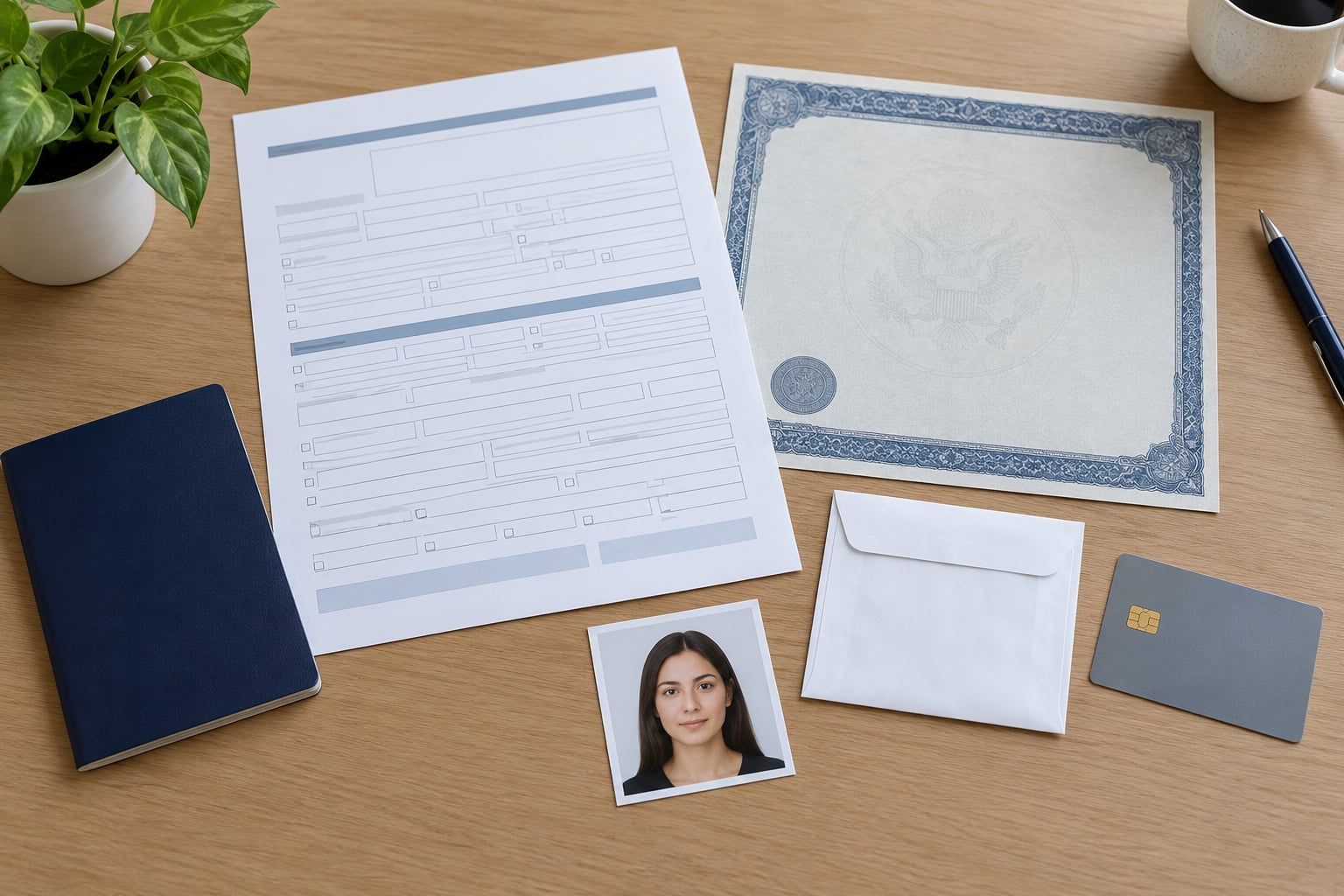
How to get a passport for the first time comes down to one in-person appointment: you fill out Form DS-11 by hand, leave it unsigned, and bring it with proof of U.S. citizenship, a photo ID, a 2×2 inch photo and two separate payments to a passport acceptance facility. The appointment itself is usually short. The slow part is printing and mailing, so start several weeks before you plan to fly.
The single detail that catches almost everyone is the signature. You do not sign Form DS-11 at your kitchen table. An acceptance agent has to watch you sign it, because that signature and the oath attached to it are part of the legal declaration that you are who you say you are.
Fees and processing times in this guide are current as of October 2026. They change, so confirm the amounts and turnaround estimates on travel.state.gov before your appointment.
Table of Contents
What You Need Before You Start
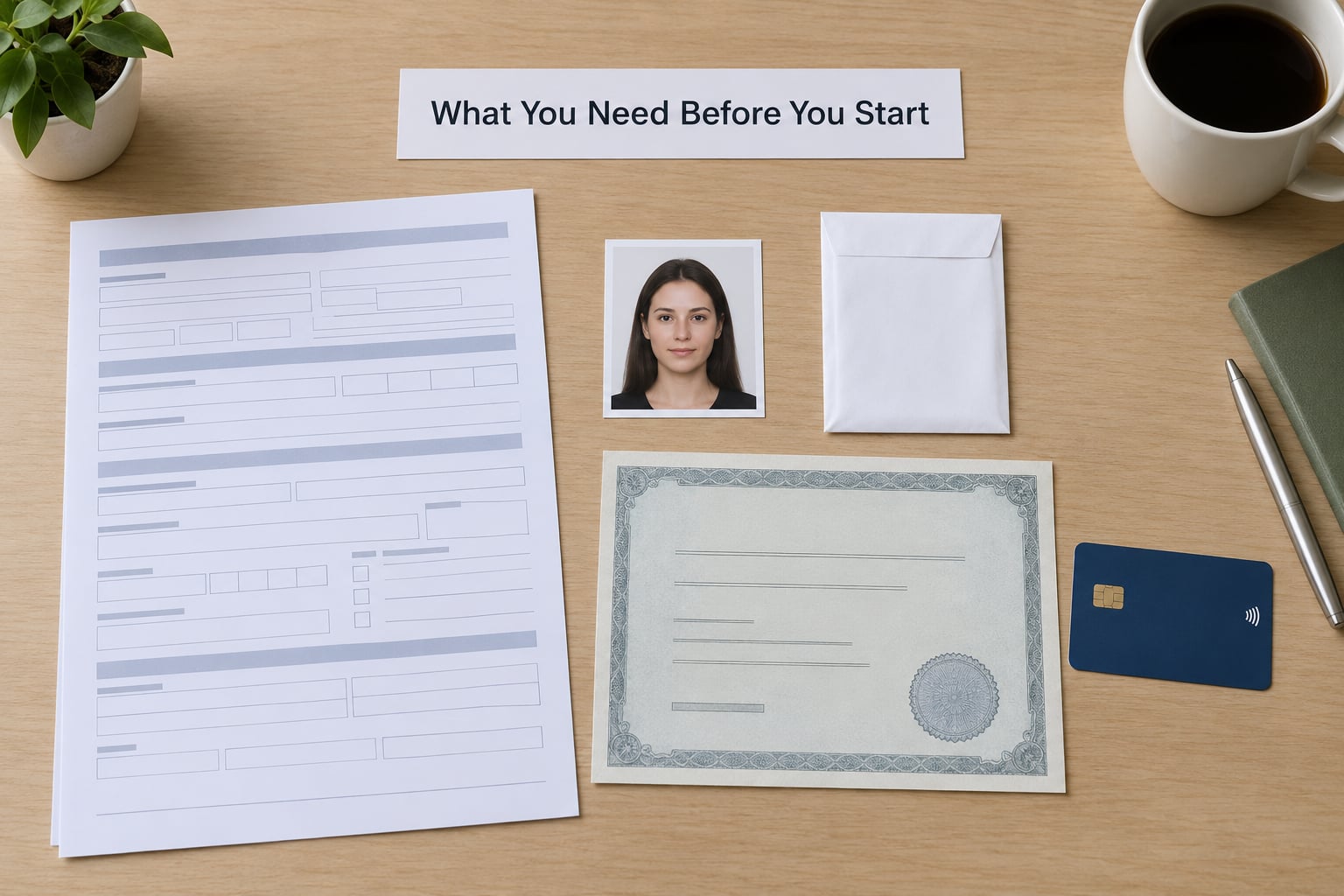
Five things have to be in your hand when you walk in, and three of them are documents you have to bring twice.
- Evidence of U.S. citizenship. An original or certified, full-form U.S. birth certificate issued by a state or local vital records office is the document most first-time applicants use. A previous passport issued after you turned 16, a Consular Report of Birth Abroad, a Certificate of Naturalization, or a Certificate of Citizenship also work.
- A photocopy of that citizenship evidence. Make it on plain white 8.5 by 11 inch paper, single-sided. A photocopy of a photocopy does not count, and a notarized copy is not citizenship evidence.
- Valid photo identification. A state-issued driver’s license or state ID, a government employee ID, a military ID, or a fully valid expired ID paired with a second form of ID. A student ID or library card on its own is not enough.
- A photocopy of your photo ID, front and back, on the same white paper.
- A compliant 2×2 inch photo and its receipt. Take the photo within the last six months. Most pharmacies and shipping stores will take it for a small fee and stamp or sign your photo receipt, which is the Form DS-71.
- Two payments, made separately. One to the U.S. Department of State for the application fee, one to the facility for its execution fee. More on that in step 5.
If you have no valid government photo ID, that is a problem but not a dead end. Reporters on r/Passports describe people getting through with a Social Security card plus a secondary document when their only state ID had expired. Bring everything with your name on it, and be prepared to explain the situation to the agent rather than hoping it is not noticed.
One more thing to sort out first: does your legal name match your birth certificate? A first passport has to use your legal name as it appears on your citizenship evidence. If you changed your name after marriage, through court order, or through a state process, bring the certified marriage certificate, the court order, or the updated birth certificate that documents the change. A Social Security record that lags behind your birth certificate is the other version of this problem, and the fix is to update it with the Social Security Administration before you apply.
For travelers whose legal name and presentation do not line up, a first passport follows the same rule as everyone else: the photo shows you, the name fields show your legal name at the time of application, and the two must be a match for border officials. If you have changed your name and your documents are current, nothing extra is required on the form. If they are not in order yet, the application will be rejected, not delayed politely.
How to Get a Passport for the First Time, Step by Step
1. Confirm that you can actually apply
First-time applicants and anyone not eligible for renewal use Form DS-11, and they must apply in person. That includes people who have never held a passport, whose passport was issued before they turned 16, whose passport was issued more than 15 years ago, and whose passport was lost, stolen, or damaged beyond repair. You will know you are on the right path if the State Department site sends you toward the first-time application page rather than a renewal form.
2. Gather your citizenship and identity documents
Start with the original citizenship document, then make the photocopy, then confirm your photo ID and its photocopy. Check that the birth certificate is the long-form certified copy with a registrar signature, not a hospital souvenir certificate, and that it lists your full name, date and place of birth, and both parents. Reports of rejected applications cluster around uncertified birth certificates, which look official and are not.
3. Get a compliant photo
Take the photo in the last six months, in person, sized 2×2 inches with a white or off-white background, head between 1 and 1 3/8 inches, taken in normal street clothes with no glasses and no head covering unless you never wear one for religious reasons. Avoid selfies, filters, shadows on the background, and a second person in frame. The agent will check it, and a rejected photo usually costs you a return trip.
4. Complete Form DS-11 without signing it
Print the form single-sided on letter-size paper, or fill it out online and print the result, but do both before your appointment rather than in the car outside. Fill in your name exactly as it appears on your birth certificate, your date and place of birth, your parents’ names, and your contact details. Leave the signature line, the date line and the oath blank. Bring the whole page; a half-empty or folded form slows you down at the counter.
5. Work out the fee and bring accepted payment
A first-time adult application involves two separate payments plus optional extras. The application fee goes to the U.S. Department of State; the execution fee goes to the acceptance facility, and that amount is set by the facility, which is why the same application costs more in one county than another. Expedited processing and faster delivery are separate line items you can add. You can verify the current amounts at travel.state.gov, and you can pay most facilities by check, money order, card or cash, so check your facility’s page before you go.
6. Attend the passport acceptance appointment
No, you cannot simply walk into a post office, so plan ahead. Most locations, including nearly all USPS locations, require an appointment, and the official facility locator is the right place to find one. Bring everything from the checklist plus your appointment confirmation. The agent will check your photo, compare your face to your ID, take custody of your citizenship document, ask you to raise your right hand and swear the oath, and then watch you sign. You leave with a receipt showing a date and a tracking number, and that receipt is the only proof you have that the application entered the system.
7. Follow the application until it arrives
Use the tracking number on your receipt, and expect a letter or card if the department needs more evidence or a clarification. If weeks pass with no movement, the National Passport Information Center at 1-877-487-2778 is the number to call, and the department also has an online application status tool. If the passport arrives damaged or unusable, report it before you travel rather than at the counter on departure day.
Common Mistakes That Get Applications Rejected
Almost every rejection traces back to something that took ten minutes to do correctly the first time.
- Signing the DS-11 before the appointment. The most repeated mistake in the r/Passports and immigration forum threads, and the one that can cost you a new form and a second trip. Bring it unsigned.
- Using the wrong form. Form DS-82 is for renewals by mail. A first-time applicant who arrives with DS-82 has to start over.
- Submitting a photo that fails spec. Wrong dimensions, a grey or colored background, a shadow, a selfie, a filter, or glasses are the usual reasons photos bounce.
- Leaving out citizenship evidence, or bringing only a copy. Originals or certified documents only, plus a photocopy. A notarized copy is not accepted.
- Letting names drift apart. A birth certificate, a photo ID and the DS-11 that say three different things will be sent back. Fix the mismatch, or bring the legal document that explains it.
- Making one payment when two are required. The facility cannot take a single check for both, and it cannot give change on the federal fee.
- Booking the wrong kind of facility. An acceptance facility handles routine first-time applications. A regional passport agency is for urgent travel, requires proof of travel within a short window, and usually needs an appointment arranged by phone.
- Leaving without reading the receipt. Check the date, the fee, and the tracking number before you walk out. It takes thirty seconds and it is the only way to catch a mistake while it is still fixable.
Two more things worth knowing. First, a passport is not a visa. A few folks on the travel forums ask about Vietnam or other destinations in the same breath as the passport, and the answer is that a passport is only the first layer; some countries require an additional visa or an electronic travel authorization on top of it. Check your destination’s entry rules separately. Second, give yourself a buffer. If your trip is under two or three weeks away, call a regional agency rather than paying for expedited processing and hoping.
Frequently Asked Questions
How long does it take to get a passport for the first time?
Routine first-time applications are printed and mailed after your paperwork reaches the department, and the current estimate runs several weeks from the day the facility forwards it. Expedited processing shortens that but still adds mailing time and costs extra. Check the live processing times on travel.state.gov, then count backward from your departure date and leave a couple of weeks of slack.
Can I apply for my first U.S. passport online?
No. Anyone applying for a first U.S. passport must appear in person at a passport acceptance facility, because an acceptance agent verifies your identity and citizenship evidence, administers the oath, and watches you sign the form. Online and mail renewal is a separate path, and it is only open to people holding a previous passport issued after age 16 and within the renewal window.
How much does a first-time U.S. passport cost?
It is not one charge. You pay the federal application fee to the U.S. Department of State plus a separate execution fee to the acceptance facility, and the facility sets its own fee, so the same application costs more in some counties than others. Expedited processing and faster delivery are optional add-ons. Check the current amounts on travel.state.gov before your appointment and bring both payments.
What documents do I need to apply for a first passport?
Bring original or certified evidence of U.S. citizenship, usually a full-form certified U.S. birth certificate, plus a photocopy of it. Also bring a valid government-issued photo ID and a photocopy, one compliant 2×2 inch passport photo taken in the last six months, the photo receipt, your appointment confirmation, and two separate payments. A notarized copy of a birth certificate is not citizenship evidence.
Can a child get a passport without both parents present?
Sometimes. A child under 16 generally needs both parents or guardians present, or a signed and notarized consent from the absent parent, or documentation of sole legal authority. For applicants 16 and 17, parental awareness is required and one parent’s awareness is usually enough. Either way, bring the full-form certified birth certificate and your proof of the parent-child relationship.
Conclusion
Start by checking whether you are a first-time applicant at all, because that decides everything downstream. Then gather your citizenship evidence and its photocopy, sort out any name mismatch before you touch the form, get the photo taken, work out both payments, and book the appointment. Bring the unsigned DS-11, attend, sign in front of the agent, and keep the receipt until the passport is in your hand.