Yes, you can learn to dance without a partner. Almost every beginner dance has a rhythm, a step pattern, and a frame you can drill alone in a living room, and doing it solo often teaches those basics faster than bouncing around a dance floor with someone who is also guessing. The only things you genuinely cannot learn alone are the ones that need a second body: pressure, resistance, and reading a partner’s lead. Here is a pressure-free plan that gets you from standing in front of a mirror to dancing socially in a few months of short, regular sessions.
Ask yourself one question first, and answer it honestly: do you want to learn a partner dance like salsa, swing, or ballroom, or do you just want to move well at weddings and in clubs? The answer changes your plan. Either way, the six steps below work, and the first session only needs twenty minutes.
Table of Contents
- What You Need
- Step-by-Step: How to Learn to Dance Without a Partner
- How to Learn to Dance Without a Partner: Set Up Your Practice Space
- 1. Choose One Dance Style and One Simple Routine
- 2. Find Your Beat and Practice Basic Timing
- 3. Build a Repeatable Solo Movement Drill
- 4. Practice the Skill Without Looking at Instructions
- 5. Add Technique Without Losing the Basics
- 6. Simulate Real Dancing and Build Confidence
- Common Mistakes
- Frequently Asked Questions
- Can I really learn to dance without a partner?
- How should I practice a partner dance routine by myself?
- Is a mirror useful when learning to dance alone?
- Should I record myself while practicing dance?
- What is the easiest dance style for someone with no experience?
- How long does it take to feel comfortable dancing socially?
- Conclusion
What You Need
Less than most people expect. You do not need a partner, a dance studio, a mirror mounted in a spare room, or a paid course to start this week.
A clear patch of floor is the main thing. Carpet is fine for most social styles, but it kills the smooth sliding footwork used in swing and quickstep, so carpet sessions should focus on rhythm, frame, and step patterns instead. If you are practicing on hard flooring, wear shoes with a flat, non-marking sole and keep the space clear of tables and cables.
Clothing matters less than people think. Anything you can move in and raise your arms above your head without hitting a ceiling works. If you live in a small apartment, check your ceiling height before you attempt turns or lifts of any kind, and dance away from walls so you can catch yourself.
For learning resources, free video is genuinely enough for your first two months. Search for a beginner lesson in your chosen style, pick one that counts the beats out loud, and stick with that single instructor until the basics stop feeling foreign. Free apps built around short daily routines work well too, since the value is in the daily habit rather than any single lesson. Paid structured courses become worth it later, once you know which style you are actually keeping.
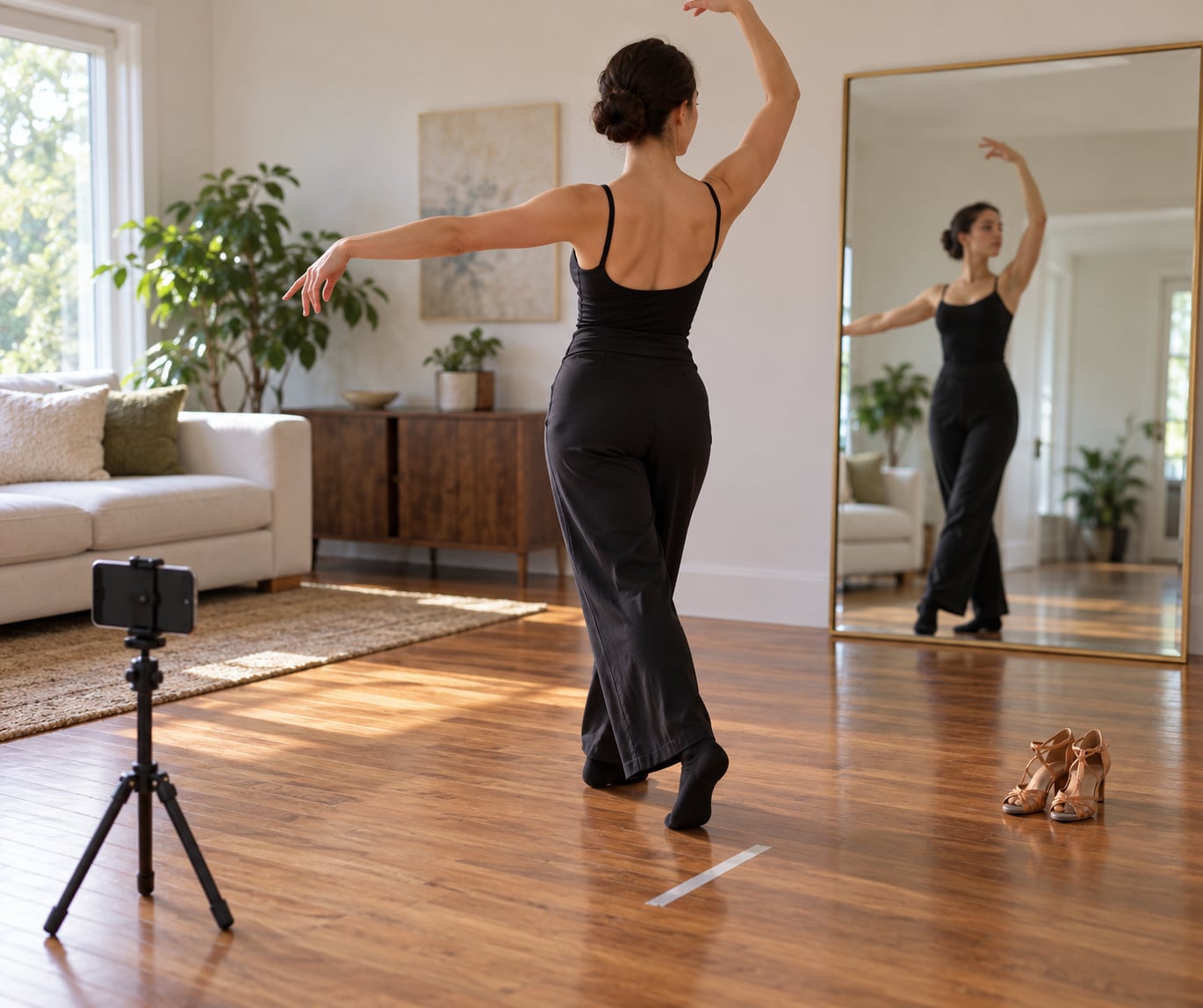
The most underrated tool is your phone, propped where you can see the full length of your body during a run-through. A cheap portable speaker matters more than expensive shoes. That is the whole equipment list.
Step-by-Step: How to Learn to Dance Without a Partner
How to Learn to Dance Without a Partner: Set Up Your Practice Space
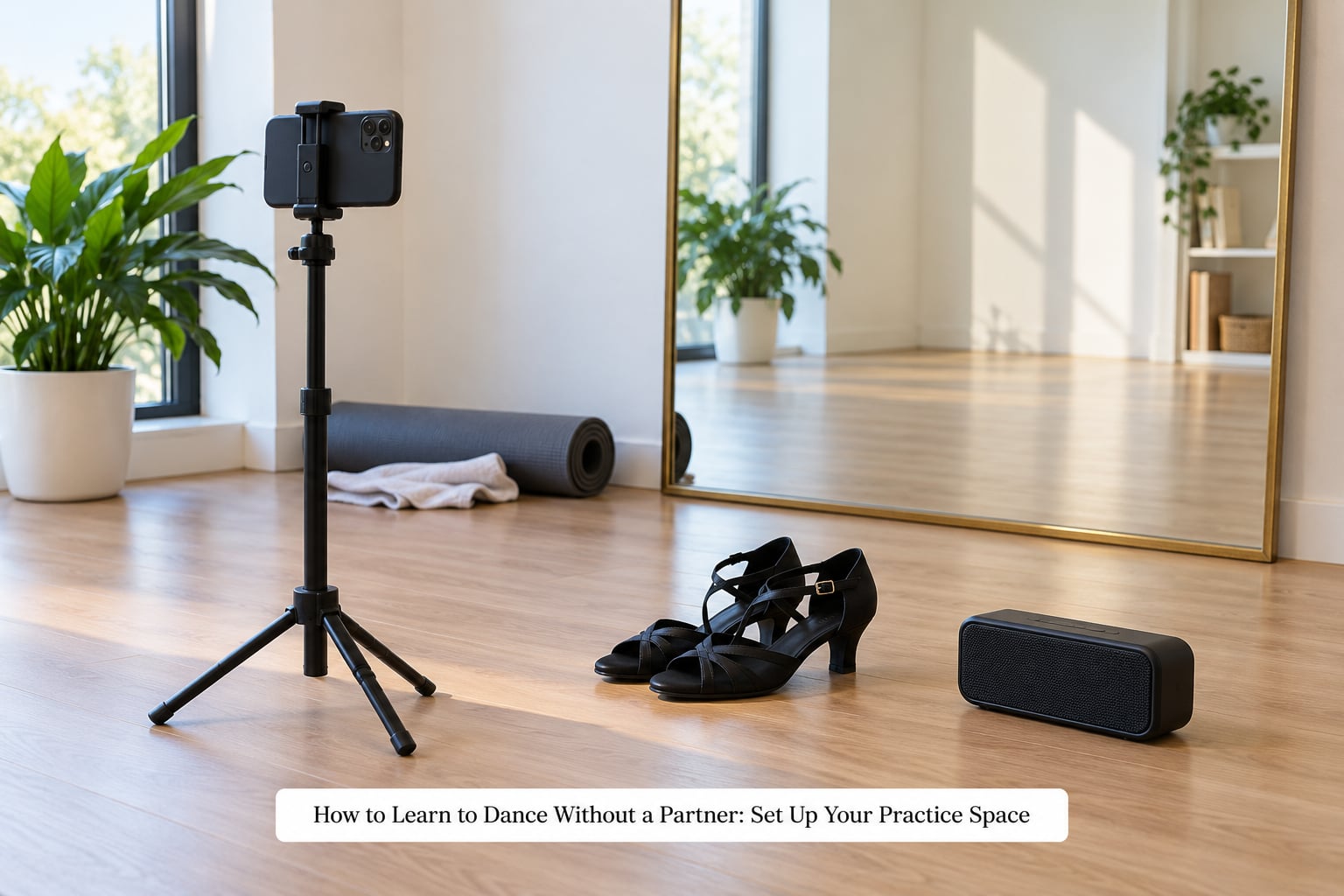
Stand in the middle of your cleared floor and check three things before you turn the music on.
First, can you see your whole body? A full-length mirror is ideal, but if you do not have one, your phone propped horizontally on a shelf at waist height works just as well. Second, can you move two steps in every direction without touching furniture? That is your travel radius, and staying inside it keeps solo practice safe. Third, is the speaker close enough that you hear the kick drum clearly? Bass is where the beat lives, and a phone speaker across the room will not give you the low end you need for timing work.
Lighting matters more than people expect. A dim room hides your feet, and feet are where mistakes hide. If you are only working on upper body frame, dim light is fine. If you are learning footwork, light the floor.
Play your track once from the start before you move. Find the first downbeat, count it out loud, and start there. Beginning on beat one rather than drifting into the song is the difference between practice and just moving around.
1. Choose One Dance Style and One Simple Routine
Pick one style and one routine. Not two, not a playlist of favorites, one.
Beginners often lose months by watching six different instructors and never finishing anything. The mechanics differ between styles: salsa has a forward-and-back weight pattern, swing has a rock-and-swing rhythm with a different base, ballroom slow dances count in a steady pulse, hip-hop and contemporary lean on phrasing rather than a strict count. Mixing them means your hips and feet get contradictory instructions.
Choose a routine under two minutes long. Something with a repeated basic step you can run ten times without losing count. Salsa and bachata basic steps, a basic swing or Charleston, a slow Waltz or Foxtrot box, or a line dance you can learn entirely alone are all reasonable starting points. If you are unsure which style suits solo practice best, start with the one whose rhythm is simplest to hear, and switch styles only after three solid months.
Write the routine down in four or eight short phrases so you can remember the order. Memory matters later, and a routine written as four phrases is far easier to recall than one written as a single sentence.
2. Find Your Beat and Practice Basic Timing
Counting beats is the single most useful solo skill, and it is the one people skip. Dance music is organized into sets of eight, sometimes called an 8-count, and almost every step pattern fits inside those eight beats.
Tap your foot through one 8-count out loud: one, two, three, four, five, six, seven, eight. Then tap only the strong beats, one, two, three, four. Those are the downbeats, the places where the movement naturally starts and where the bass drum usually lands. If your foot hesitates on one and two, that is the downbeat. If it is steady through the whole count, you are likely a beat or two off from the music.
Once you can find the downbeat, mark two rhythms in place without moving across the floor. A single rhythm is step, hold, step, hold, and a double rhythm is step, step, hold, hold. Partner dances use both constantly, and the difference is easier to feel than to explain. You do not need to talk about lead and follow or frame at this stage. You need your weight to change cleanly on the beat, every time, with no dragging.
You can check yourself honestly: play the same track, mark the rhythm, and film thirty seconds of it. If your weight change does not land on the beat, slow the track down and do it again. Nobody sees this footage but you.
3. Build a Repeatable Solo Movement Drill
Break the routine into sections, no longer than eight beats each. A two-minute routine usually splits into four or five small pieces.
Practice one piece at quarter speed. Slow practice is not a compromise; it is the only way your body learns a new pattern rather than guessing at it. Move slowly enough that you could stop mid-move and hold the position without falling over, and check the basics every time: feet apart, knees soft, weight centered rather than leaning back, shoulders down.
Then add repetitions. Ten slow repetitions of one section, then five at half speed, then five at full speed with the music. This progression matters more than session length, and it is why a ten-minute daily practice beats one hour on Sunday.
Use the phone to check your work. Film a run-through, watch it once at normal speed, and write down exactly one thing to fix in the next round. Filming fifteen repetitions of the same error teaches you nothing. One correction per session is plenty.
Shortcuts and half-speed playback tools in most apps and video platforms make this much faster. Ten seconds of footage at half speed is worth twenty minutes of guessing.
4. Practice the Skill Without Looking at Instructions
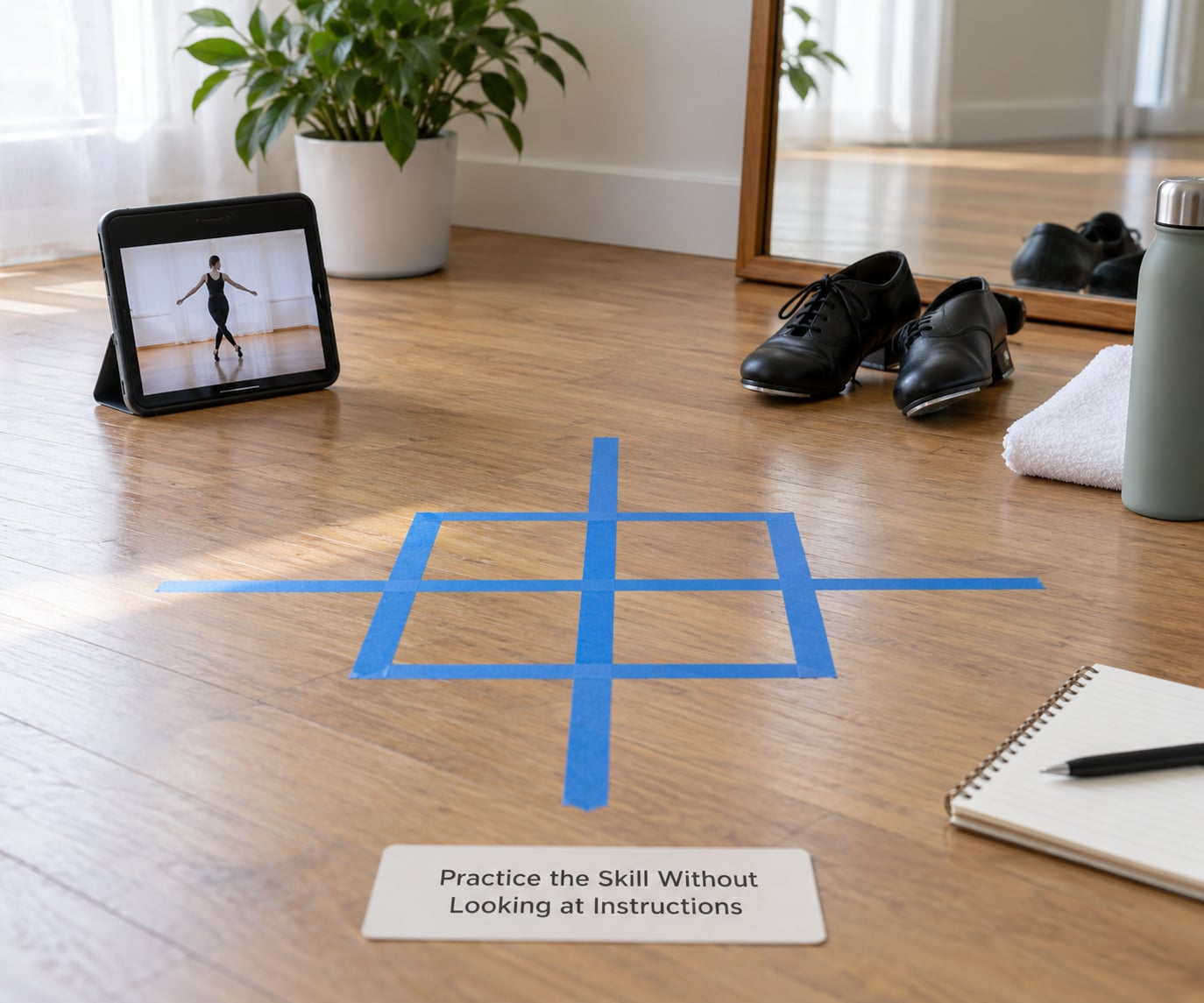
Copying a demonstration is not the same as learning it. The real test is whether you can perform the routine without pausing the video, with the tutorial closed.
Put the phone face down and run the sequence from memory. Where you stall, that is the section to work on, not the whole routine. Mark the spot with a piece of tape on the floor so you can place your foot in the same position every time, which makes any drift in timing obvious. Some people tape the whole sequence onto the floor, one strip per phrase, and step through the routine like a diagram.
Then record a full run-through and watch it end to end. Count how many clean repetitions you managed. Most beginners manage one or two before the counting slips, and that number climbing to five is the single clearest sign of progress you will get without a teacher.
Change songs once you can do the routine three times cleanly. Practicing only to one track is a trap, because you end up learning the song rather than the dance. Any song in the same style at the same tempo will expose timing habits that one familiar track hides.
5. Add Technique Without Losing the Basics
Only once the basics are automatic should you add style-specific technique. Stacking new detail onto shaky foundations just creates a more advanced version of a beginner mistake.
Weight transfer is the first thing to sharpen. In partner styles, the energy goes through the floor and into the partner rather than through the arms. Practicing your basic step while consciously pushing the floor away on each step builds the habit early. It is a small correction with a large effect on how you feel to hold.
Frame and posture come next. Frame is how you hold your arms in a partner dance, usually a rounded or slightly rounded shape in front of the body, and it is worth practicing alone because you can check it in a mirror. Elbows soft, shoulders relaxed, ribs stacked over hips, chin level. Practicing the hold without a partner means you arrive at your first class already knowing where your arms belong, instead of spending the first ten minutes awkwardly being positioned.
You can also drill the ideas behind leading and following alone, even without learning the actual connection. Learn to signal a change of direction with a clear hand or head cue, then perform that cue to an imaginary partner. It is shadow dancing, and it is the standard solo substitute for partnered practice. Marking a turn in the air, walking a pattern forward and back as if someone were in front of you, and rehearsing how you ask for a change of level all prepare you for the floor.
Hold off on advanced footwork and syncopation for now. Nobody at a first social needs them, and chasing them early pulls your attention off the beat.
6. Simulate Real Dancing and Build Confidence
Solo practice has a natural end point, and reaching it is easier if you plan for it early. The goal is not perfect technique, it is being able to move through a full combination without stopping to think.
Practice transitions. Dance the routine, then pause mid-phrase and restart from the previous phrase. Repeat until the link between sections feels automatic. Then try it faster than you think you can, which is closer to what a real dance floor actually demands.
Perform for someone when you can. A friend, a partner, a family member, even just the camera. The nerves you feel in front of a lens are small compared to the ones you will feel on a crowded floor, and repeating the experience is the only way to shrink them.
Then take it to people. Look for beginner group classes, where the instructor demonstrates and everyone rotates partners, which is the practical middle ground when you have no practice partner of your own. Look for drop-in socials, which usually have no teaching at all, so go after you have a few weeks of basics. Arrive early, tell the host or instructor that you are new, and ask whether anyone is free to dance a slow one with you. Almost everyone is warmer about that request than beginners expect.
If you have been away from dancing for years, expect the first social to be more work than fun. Pick the quietest corner, dance with people who are also moving slowly, and leave after an hour. Go back the next week. That is the entire transition, and it takes far less courage than it sounds like it does in advance.
Common Mistakes
Practicing too fast. If you cannot do it slowly, you cannot do it. Drop the speed until the movement is unbreakable, then raise it in steps rather than jumping to full tempo.
Changing styles constantly. Every switch restarts your timing and your frame habits. Commit to one style for three months before you decide it is wrong for you.
Copying choreography without understanding the rhythm. A routine you cannot count is a routine you cannot fix. Build the beat first, then layer the movement on top of it.
Cramming a long routine in. A two-minute combination you own is worth more than a five-minute one you fumble. Add length only after short combinations feel easy.
Judging your footage too harshly. Everyone looks strange on video. Review for one specific thing, such as whether your weight change lands on beat one, rather than watching the whole take and deciding you are bad at dancing.
Skipping the warmup. Five minutes of marching, shoulder rolls, and small weight shifts does more for your practice than an extra ten minutes of dancing stiff. Loose joints learn faster.
Never dancing with people. Solo drills are training, not the goal. Book a class or a social in your second month, and treat it as part of the practice rather than a reward for finishing the practice.
Two smaller habits help more than expected. Keep a one-line log of what you worked on each session, because progress in dance is invisible week to week and obvious in a two-month review. And keep your practice time short and regular. Most solo learners quit in month two from doing too much in month one.
Frequently Asked Questions
Can I really learn to dance without a partner?
Yes. Rhythm, timing, footwork, posture, frame, and step patterns can all be learned alone, and beginners often progress faster solo because nobody else’s mistakes interfere. What you cannot learn alone is anything that needs a second body: pressure, resistance, shared timing, and reading a partner’s lead. Those arrive in your first class or social.
How should I practice a partner dance routine by myself?
Break the routine into sections of eight beats or less, drill each one at quarter speed, then raise the tempo in three or four steps. Mark the rhythm in place with weight changes before you add travel across the floor. Film a run-through and correct one thing per session. Practise with an imaginary partner, rehearsing your arm position and turn cues.
Is a mirror useful when learning to dance alone?
Yes, mainly for posture, arm position, and spotting whether your shoulders are level. Turn toward the mirror only for short checks rather than practising sideways for whole sessions, since you lose the sense of facing a partner. A phone propped up at waist height works almost as well if you have no full-length mirror, and it also lets you review your timing from the side.
Should I record myself while practicing dance?
It is the only feedback loop available when you practise alone, and it is more useful than it sounds. Film short clips rather than whole sessions, watch for one specific issue such as late weight changes or a rounded shoulder, and write down what to fix next time. Avoid filming every repetition, because a fixed mistake repeated on tape just teaches you the error.
What is the easiest dance style for someone with no experience?
For learning completely alone, styles with a simple repeatable count are easiest, which points to line dance, salsa or bachata basics, and basic swing. Ballroom slow dances like the Waltz or Foxtrot are also very learnable solo because the tempo is steady and predictable. Pick the one whose music you actually enjoy, because you will practise the same track dozens of times.
How long does it take to feel comfortable dancing socially?
Most self-taught beginners can follow along in a beginner group class after six to eight weeks of regular practice, and can hold a short conversation while dancing on a social floor after three to four months. Those numbers assume short, frequent sessions rather than occasional long ones. Confidence tends to arrive on the tenth visit, not the first, so expect the early socials to feel awkward and keep going anyway.
Conclusion
Most people who ask how to learn to dance without a partner want a plan they can start tonight, not a syllabus. So here is your first session, in order. Pick one style and one routine under two minutes long. Clear a safe patch of floor and prop your phone where you can see your whole body. Count one 8-count out loud until the downbeat is obvious, mark the rhythm with weight changes in place, then drill the first eight beats of your routine ten times slowly.
That is it. No partner, no class, no equipment worth mentioning. Ten minutes of that, most days, is how people who thought they could not dance end up dancing at a wedding, on a club floor, or anywhere else they want to be.