To find a barber who gets your hair right, work in three layers: gather evidence (their own before-and-after photos, recent detailed reviews, recommendations from people whose hair you actually admire), check fit (do they cut your hair type and the specific style you want), then get proof (a consultation or a cheap first service before you commit to a full cut).
That whole process takes maybe an hour of scrolling and one short phone call. Most people skip it, then spend six weeks hiding a cut they paid for twice.
The advice below is shaped for readers who are done being handed the same haircut every time, particularly queer and trans adults who have run into shops that clearly were not built with them in mind. Nothing here requires you to explain your identity to prove you deserve good work. You are allowed to just be a client who wants a specific cut.
Table of Contents
What You Need
You need less than you think, and none of it takes more than an evening. Here is the list that makes the rest of the process much faster.
- Two or three reference photos. One of a cut you like, one of a cut you absolutely do not want. Screenshots are fine.
- A sense of your hair type. Curl pattern, how thick it is, whether it shrinks, whether it holds a cut on its own, whether it goes grey or thins out.
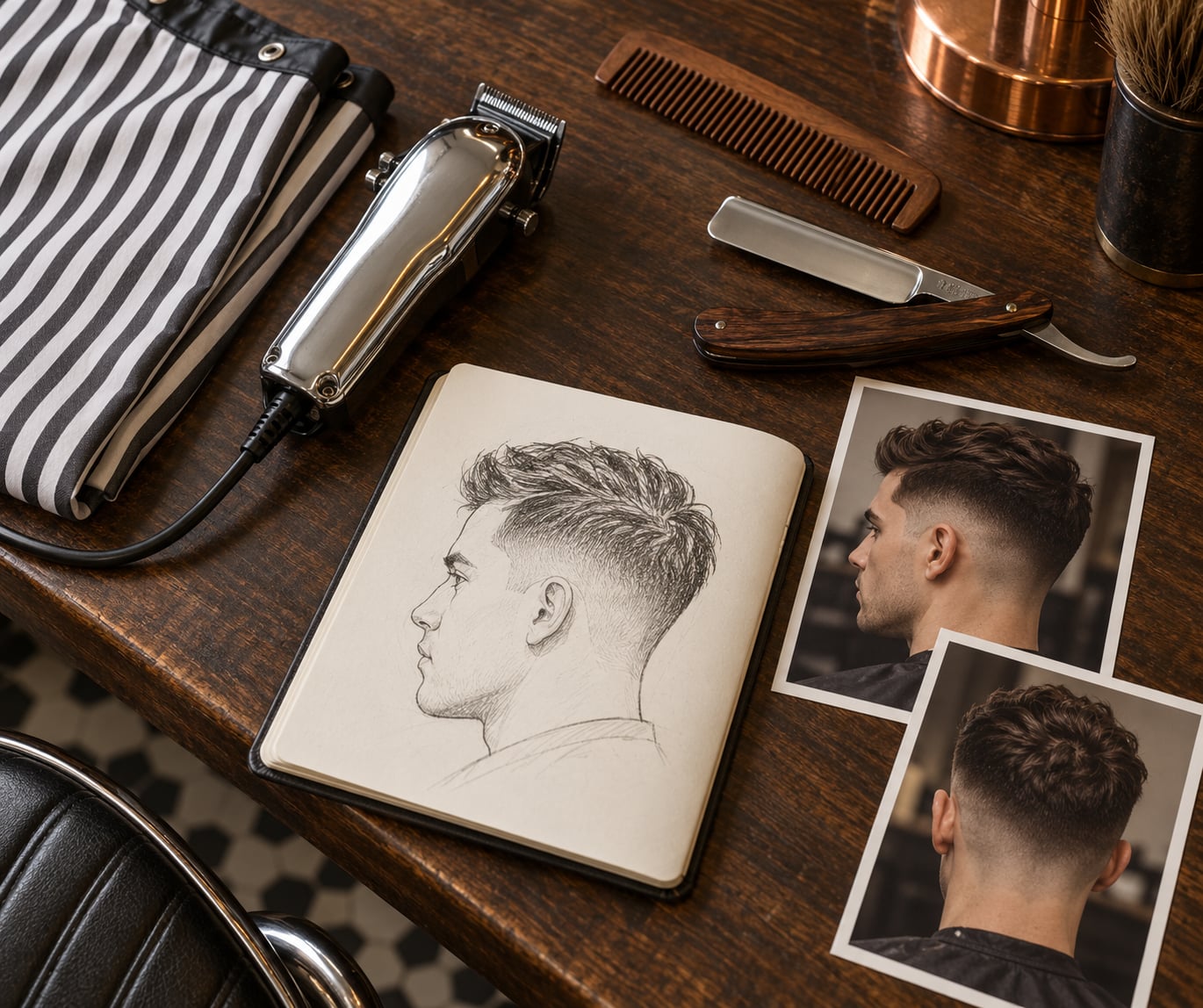
- A short description of the cut in plain words: how much length stays on top, how short the sides go, what happens at the neckline.
- Your real maintenance window. Some people want a shape that still looks intentional after three weeks. Others want a sharp line for an event next Saturday.
- Budget and setting preferences. What you are comfortable paying, whether you want a chair in a walk-in shop or a booked chair with a named barber.
- Comfort and accessibility needs. Noise level, how long you can sit still, whether you need a quiet first appointment, whether body hair or scalp sensitivity is part of the service.
- Names to start with. A friend who always looks sharp, a barber you have had before, a queer business directory for your city.
Two items on that list do most of the work: reference photos and an honest description of your hair. Skip them and you are asking a stranger to guess.
How to Find a Barber Who Gets Your Hair, Step by Step
Define the hair and style you want
A vague request produces a vague haircut. Turn “I just need a refresh” into four numbers or names you can say out loud: how short on the sides, how short on top, where the blend starts, and what shape you want at the neckline.
Clipper guards are numbered in eighths of an inch. When a barber asks how short you want it, this is the vocabulary they are hearing:
| Guard | Length | Millimetres | Usually looks like |
|---|---|---|---|
| No guard / bare blade | 0 in | 0 mm | Skin, or nearly |
| #1 | 1/8 in | 3 mm | Very short, stubbly |
| #2 | 1/4 in | 6 mm | Short military cut |
| #3 | 3/8 in | 9 mm | Classic crew, still shows scalp |
| #4 | 1/2 in | 13 mm | Even short cut, tidy |
| #5 | 5/8 in | 16 mm | Visible texture, casual |
| #6 | 3/4 in | 19 mm | Longer short cut, soft |
| #8 | 1 in | 25 mm | Full inch, scissor territory |
A fade and a taper are not the same request, and mixing them up is one of the most common reasons a cut misses. A taper leaves a hard line where the short hair meets the longer hair. A fade blends that line away gradually.
- Low fade starts the blend just above the ear, near the bottom of the head.
- Mid fade starts around the temple and ear line.
- High fade starts much higher, around the temple to crown.
- Skin fade takes the sides down to bare skin with no guard at the bottom.
Say which one you mean, or pull up a photo. Nobody sensible will mind.
Search local barbers and read recent reviews
Start with a map search for barbershops near you, then narrow to an individual barber rather than a shop. Shop-level stars tell you about the room and the wait; they rarely tell you who will actually be holding the clippers.
Each channel is good at something different, and most readers use one source for five different questions it cannot answer:
| Channel | What it can tell you | What it cannot tell you |
|---|---|---|
| A person whose hair you admire | Who they trust with a specific texture and style | Whether that person is taking new clients right now |
| Google reviews | Recent consistency, cleanliness, whether complaints get fixed | Which barber inside the shop was responsible |
| Yelp | Same, often with more written detail | Who cut the reviewer’s hair |
| The barber’s own feed | Real before-and-after photos, hair types handled, current style work | How they handle clients who ask questions |
| Booking apps | Availability, service length, per-barber portfolios | Anything about atmosphere or how you will be treated |
| A walk-in visit | The room, the music, the sanitation routine | Whether this specific barber is good |
Reading reviews like an editor beats reading them like a fan. Look for reviews written in the last six months. Prefer ones that describe a specific service: how long it took, what the client asked for, what the barber suggested instead, and whether the client came back.
A bare five stars with no detail tells you almost nothing. A three-star review that says the fade was perfect but the wait ran an hour tells you a great deal. Watch for a wall of identical short reviews posted in the same week, a five-star review for a service the shop does not offer, and feedback that only ever praises the vibe.
Searching by neighbourhood in Chicago works well because most of the good shops here are neighbourhood shops rather than chains. Pick the areas you can realistically get to, then filter by the barber’s own name so you are comparing people, not storefronts.
Look for evidence of experience with your hair type
This is the step that gets skipped, and it is the one that decides whether you come back. Texture expertise is genuinely scarce. Barbers themselves say in trade forums how hard it is to find clients who can cut all hair types well, so treat a portfolio full of straight, thick hair as information rather than proof.
Look specifically for clients whose curl pattern, density and length resemble yours. Coily hair needs a barber who plans the cut dry and understands shrinkage, because a wet cut can shrink two sizes after it dries. Fine hair needs someone who will not over-blend and flatten it. Thinning hair needs a barber who knows how to take weight off the sides without making the top look worse.
Also check the service menu. If they list textured hair, grey blending, or shaping around a hairline as a named service rather than a favour, that is a good sign. Ask directly what they have done with hair like yours, and see whether the answer includes specific examples or goes vague.
Ask about consultation, pricing, and booking
Before you book anything, one message or phone call gets you most of the information you need. Ask whether they offer a consultation, how long the service runs, what happens if you need a touch-up inside a week or two, whether you can book a specific barber rather than any chair, and whether they take walk-ins.
Ask about price plainly. Shops vary widely by city and by service, and the only way to get a real number is to ask. If a barber hesitates or deflects on pricing, that tells you something too.
On tipping, treat it as a percentage of what you actually paid for the haircut, not a fixed amount, and add more when someone spends real time on a beard shape or a difficult blend. Mobile and roaming barbers come to your home, garage or office, and they charge more for the travel because they are running a one-person business out of a van.
Some shops use a client note system where your preferences get saved for next time. That is worth asking about directly, because it is the single best protection against your instructions quietly disappearing between visits.
Book a trial or first appointment
Your first visit should be designed to reveal technique and communication, not to be the cut you care most about. A beard shape, a tidy-up or a fringe trim on a familiar cut tells you plenty and costs less than gambling on a full change.
Walk in with your photos open on your phone and say what you liked and what you did not like about your last cut, specifically. Barbers who listen to that sentence tend to be careful. Barbers who interrupt it are telling you something.
Some literal phrases that work well in the chair:
- “Here is the cut I want. Here is the one I hated last time, so I know what to avoid.”
- “Can I see the mirror before you start on the back?”
- “How much are you taking off the top, in guard numbers?”
- “Is that blend going to show a line in about a week?”
- “Can we go a shade shorter than you think?”
- “I would rather stop now than make it shorter than I can live with.”
Speak up while the cut is happening, not after. A sentence like “that edge looks higher than the other side” costs nothing and saves two weeks. If you are anxious, first-time, or somewhere on the autism spectrum, book the quietest slot, bring headphones for the wait, and tell the barber at the start that you will be giving quiet feedback. Most of them have heard something like it before and will adjust.
One more thing to watch in year one: chain shops rotate staff constantly, and the barber you liked can be gone in three months. If consistency matters to you, book a named independent barber rather than a chair at a rotating shop.
Evaluate the result and decide whether to return
Do not make your decision in the shop under bright lights while someone is watching your reaction. Wait two or three days, wash it, style it the way you actually style it, and look at it in daylight.
Judge four things: the shape when it settles, the blend after a week of growth, how you were treated during the cut, and whether your instructions were followed rather than reinterpreted. A barber who talked you into a slightly different length because your hair cannot hold what you asked for is doing good work, not ignoring you.
If the result is wrong, say so plainly and soon, and keep it factual: “the back is shorter than the sides and I would like it matched.” Most barbers will fix it within a few days at no charge, because their name is on the work. Give a specific request about what you want changed rather than saying the whole thing failed.
If you would rather not go back, that is a normal outcome and nobody is owed anything. Leave a review that describes your experience accurately, thank them if the room was pleasant, and stop booking. Trying to “train” a barber into a look they do not do is the thing that costs readers months.
Common Mistakes
Most bad cuts trace back to one of seven avoidable mistakes.
- Choosing from one viral photo. A single beautiful result proves nothing about consistency. Look at a dozen posts spanning several months.
- Using vague language. “Just a little off the top” means something different every time. Give guard numbers, or a photo.
- Ignoring texture. Skipping this is how you end up with a cut that shrinks out of shape in a week. Name your curl pattern before you name the style.
- Skipping price and timing questions. Ask what the service costs, how long it takes, and what their touch-up policy is, before you sit down.
- Assuming inclusivity from appearance. A rainbow sticker is not a service policy. Ask about the specific thing you care about, such as a gender-neutral booking or a neckline you cannot ask for elsewhere.
- Going silent during the cut. You have about ten minutes to redirect the work. Use them.
- Treating visit one as a long-term match. Nothing is settled until you have had a second appointment with the same person.
A few short habits that help more than anything else: book the earliest morning slot when you are not in a rush, take a photo of the finished cut on day one so you can compare later, and tell your barber what you liked about your last haircut somewhere else. That last one does more for consistency than any app.
Frequently Asked Questions
How do I know if a barber understands my hair type?
Look for before-and-after photos of clients whose curl pattern, density and length match yours, not just the style you want. For coily hair, a barber who plans the cut dry understands shrinkage. For fine or thinning hair, look for someone who blends down without flattening. If you ask what they have done with hair like yours and get a specific answer, that is a good sign. A vague answer is information too.
What should I bring to my first haircut appointment?
Bring two or three reference photos on your phone, one of a cut you like and one of a cut you disliked, plus a short description of your hair type and how much length you want left. If your hair is unusual in any way, say so at the start rather than hoping they notice. Booking a low-stakes service for the first visit, like a beard shape or a tidy-up, is the cheapest way to test the fit.
How do I ask for a haircut without sounding unsure?
Confidence comes from specificity, not from knowing barber jargon. Say the length in guard numbers, name where the blend should start, and describe the neckline shape. You can say ‘I am not sure this suits my face, does it’ and still sound clear. A good barber will give an honest answer and tell you when a request will not work with your hair, which is a compliment to their skill, not a challenge to their ego.
How can I find an LGBTQ+-friendly barber?
Start with queer business directories for your city, then check whether the shop takes gender-neutral bookings and how the booking form asks about your name and pronouns. Read reviews from other LGBTQ+ clients where you can find them, and pay attention to whether staff use the names clients give them. You can also ask directly on the phone before booking. Nobody minds a clear question, and a shop that cannot answer it is telling you something useful.
Should I book a consultation before getting a haircut?
Yes, if the cut matters to you, if you are changing styles, or if you have never been to this barber before. A consultation is usually short and sometimes free, and it lets you talk through length, texture and upkeep before anyone touches your hair. If the shop does not offer one, book a low-stakes service instead so you learn about their technique and communication without committing to the look you most want.
What should I do if I do not like the result?
Wait two or three days, wash and style it normally, then decide. If you still dislike it, contact the shop quickly and describe the specific problem, such as the back being shorter than the sides, and ask for a matching correction. Most barbers fix recent work at no charge because their name is on it. If you would rather move on, thank them, leave an accurate review, and book someone else without feeling awkward about it.
Start This Week
Pick two or three barbers in your area and look at nothing but their own before-and-after photos for ten minutes. Choose the one whose work looks closest to your hair, send one message asking about consultation and booking, and take the lowest-stakes service on your list. Judge them at home three days later, and keep going back only if the shape holds up.