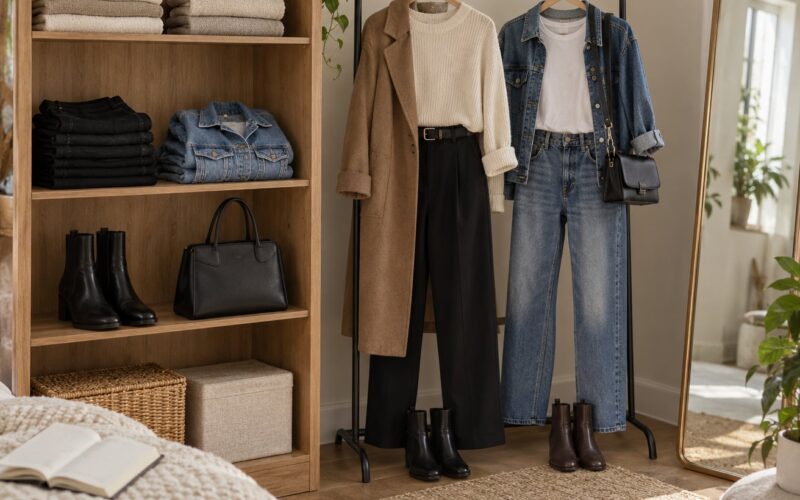
A capsule wardrobe is a small set of pieces that mix and match into far more outfits than the count suggests, and learning how to start a capsule wardrobe takes about 30 days and two or three focused sessions. The method is simple: pull out what you already wear, group it into repeatable outfits, and only then decide what to buy.
Most people get this backwards. They empty the closet, donate half of it, then go shopping to replace it. Three months later they are back to staring at a full closet with nothing to wear, which is exactly where I was twice before this stuck.
So here is the plan that worked: no total purge, no shopping list written from someone else’s saved outfit folder, and no purchases until the last five days. You will finish with a working wardrobe, a short shopping list, and a plan for what comes after.
Table of Contents
- What You Need
- Step-by-Step: How to Start a Capsule Wardrobe in 30 Days
- Step 1: How to Start a Capsule Wardrobe With What You Already Own (Days 1-4)
- Step 2: Choose Your Capsule Size and Lifestyle Categories (Days 5-8)
- Step 3: Build a Cohesive Color and Style Palette (Days 9-13)
- Step 4: Choose Foundation Pieces That Make the Rest Work (Days 14-20)
- Step 5: Add Outfit-Specific and Personal-Expression Pieces (Days 21-24)
- Step 6: Shop, Organize, and Test the Capsule (Days 25-30)
- Common Mistakes
- Frequently Asked Questions
- How many pieces should I have in a capsule wardrobe?
- Do I have to declutter my whole closet first?
- How much should I spend on a first capsule wardrobe?
- How do I build a capsule that fits my body and my style?
- What if my closet is small or shared?
- How do I keep a capsule wardrobe working after the first month?
- Conclusion
What You Need
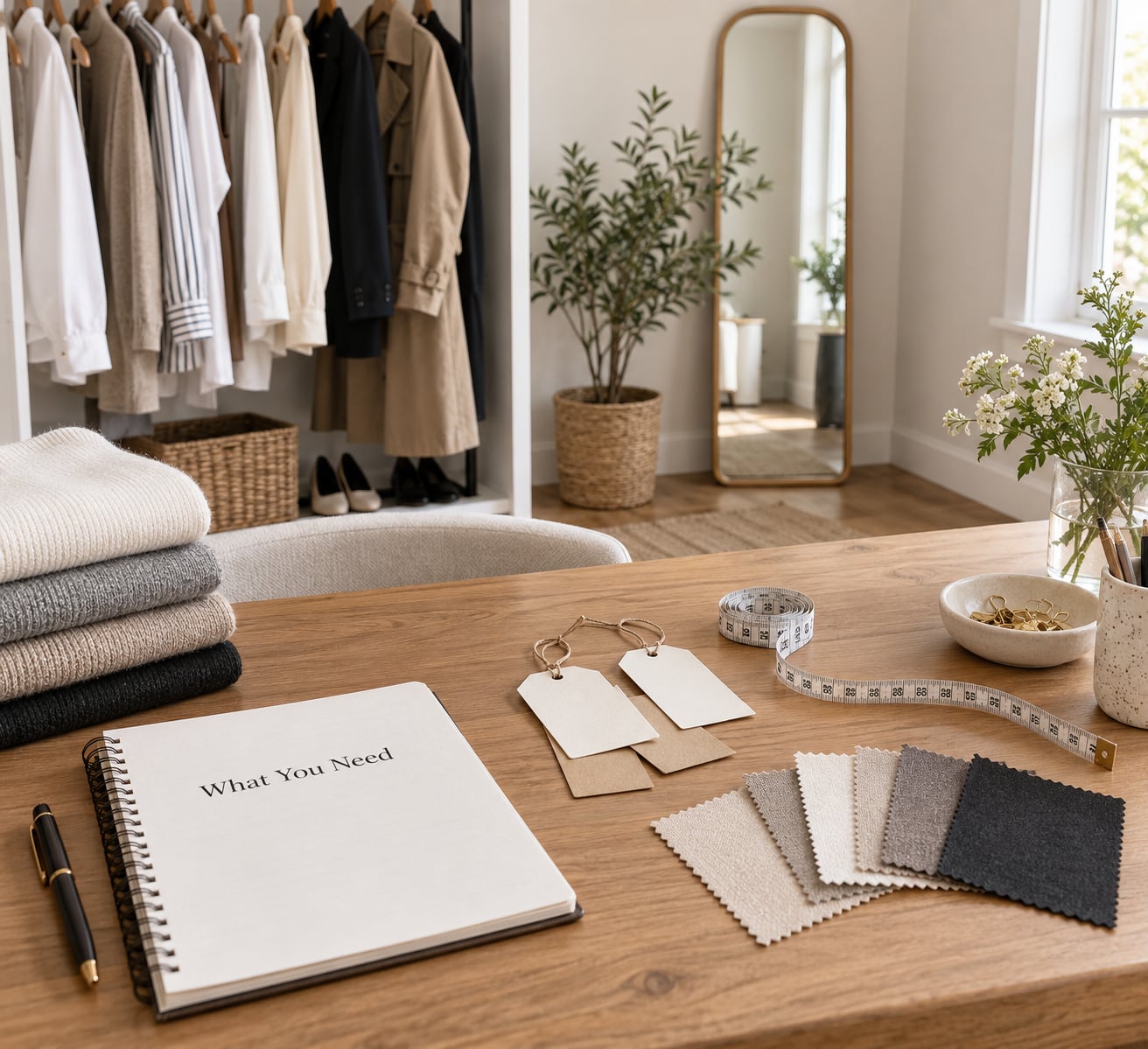
You need almost nothing to start: a notebook, whatever you track your spending in, a measuring tape, and about three hours spread across a month. Everything else is already hanging in your closet.
A written goal. One sentence. Mine was “I want to get dressed in under five minutes on weekday mornings without standing in front of the closet.” A goal about getting dressed is testable; a goal about being minimalist is not.
An honest inventory. Count what you actually own, not what you wish you owned. Write the number down. Most people find the real number is smaller than they assumed and larger than they hoped.
Your lifestyle categories. List the contexts you dress for and roughly how often each one happens. Mine: work three days a week, going out two evenings, hosting friends monthly, and a lot of days spent working from home.
A palette. Pick your neutrals and your accents before you look at a single shop. This is the part most people skip and then spend a year undoing.
A way to hold doubt. One clear storage box. Anything you cannot decide about goes in it for six months. If you do not reach for it, it leaves without a second conversation.
Step-by-Step: How to Start a Capsule Wardrobe in 30 Days
Step 1: How to Start a Capsule Wardrobe With What You Already Own (Days 1-4)
Start with what you wore, not what you own. Pull the last month of outfits from your photos, notes, or memory and list the pieces that appeared more than twice.
Everything else goes into one of three piles: worn often, worn sometimes, worn never. Photo piles two and three before you do anything else. A dress that looks like nothing in a drawer looks different in a photo.
How you will know it worked: you have a list of your twenty to thirty highest-wear pieces, and at least a third of your closet has already been ruled out with evidence rather than vibes.
Step 2: Choose Your Capsule Size and Lifestyle Categories (Days 5-8)
A workable first capsule is 30 to 40 pieces, including shoes and outerwear, with underwear, socks, activewear, and sleepwear living outside the count. For most adults that is roughly two weeks of outfits before repeats.
Adjust for your actual life. Add pieces if you do laundry less than twice a week, if your climate swings hard between seasons, or if your closet is shared or split across two homes. Subtract pieces if you travel often or wash daily.
Weight each lifestyle category by frequency. If you are out four nights a week, “going out” is not a special-occasion category, it is a foundation category and it needs real depth.
For LGBTQ+ readers planning around gender expression: build the count by outfit context rather than by garment type, and count any piece that gets worn in multiple contexts once. A structured layer that reads formal in the office and casual after work is doing two jobs and deserves the slot.
Step 3: Build a Cohesive Color and Style Palette (Days 9-13)
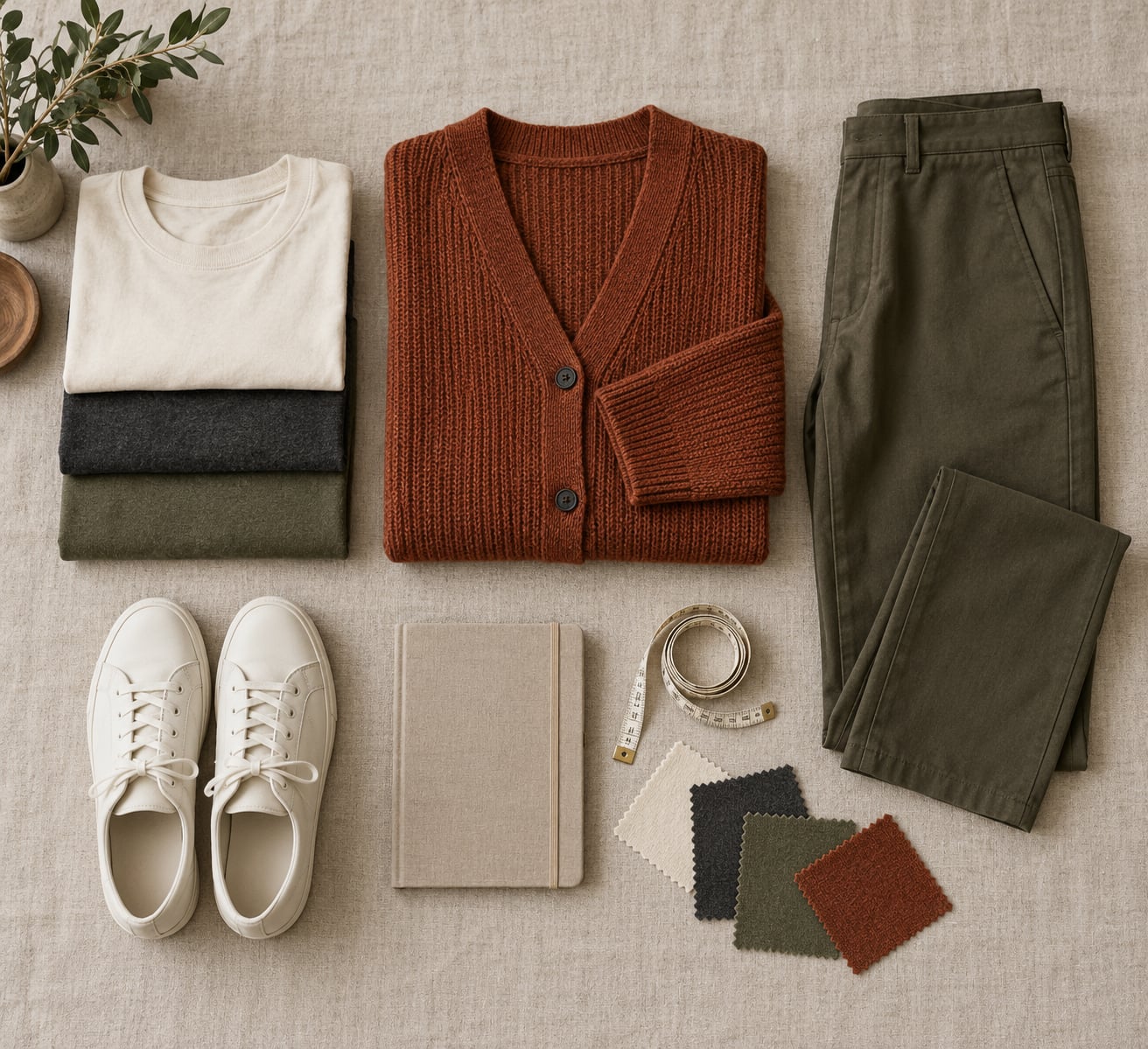
A capsule needs one neutral base, two or three supporting neutrals, and one or two accent colors you actually like wearing. Wearing a color rarely because it is popular is the fastest way to end up with a wardrobe that looks coherent and feels foreign.
Check your step-one photos: the colors you already reach for are your palette. If everything you own is cool-toned, do not buy warm pieces just because a list says beige is timeless.
About the two-colors-you-should-never-wear-together question: there is no real rule. What looks off is usually a clash of undertones, like a cool pink next to a warm beige, or a high-contrast pairing next to a washed-out one in the same outfit. Pick a contrast level you like and repeat it.
Set a rule for the whole capsule: every accent piece has to be able to sit next to every neutral, and every neutral has to work alone. If an item breaks that rule, it is an occasion piece, not a capsule piece.
Step 4: Choose Foundation Pieces That Make the Rest Work (Days 14-20)
Foundation pieces are the ones that show up in most outfits: tops, bottoms, layers, outerwear, and shoes. Judge each one by how many other pieces it can pair with, not by how much you like it on its own.
- Tops (7 to 9): a fitted tee, a relaxed tee, two or three shirts, one sweater, one layer that works under a jacket.
- Bottoms (4 to 5): at least one pair you can wear three days in a row, one dressier option, one that suits your climate.
- Layers (2 to 3): a cardigan or mid-weight sweater that bridges work and weekend.
- Outerwear (2 to 3): a truly wearable coat or jacket plus one lighter layer for shoulder seasons.
- Shoes (3 to 4): everyday shoes, work-appropriate shoes, something for nights out.
Add adaptive or mobility-friendly pieces here if they help. Easy closures, side zippers, and cut that does not catch on a wheelchair frame count as foundation pieces, not as special purchases.
How you will know it worked: every piece on your list pairs with at least six others on the list. Anything pairing with fewer gets moved to a secondary pile.
Step 5: Add Outfit-Specific and Personal-Expression Pieces (Days 21-24)
A capsule that is only neutrals is a uniform, not a wardrobe. This is the step where gender expression, nightlife, culture, and joy get budgeted for in writing.
- Nightlife (2 to 3 pieces): something with a different silhouette from your daytime clothes.
- Cultural or ceremonial pieces: these are expression, not accessories. Count them and plan around them.
- One statement piece: bold color, unusual texture, or a cut nothing else in the capsule has.
- Athleisure and loungewear: count these separately if you want them outside the capsule number, and keep them deliberately minimal.
The most upvoted advice I read in the biggest capsule wardrobe community while researching this was blunt: buy the cheap version first. Test the style in a less expensive fabric, wear it for two months, then replace it if you actually still reach for it.
Step 6: Shop, Organize, and Test the Capsule (Days 25-30)
Shop from a written list, one category at a time, and only for gaps you confirmed in step one. If a category is already covered, nothing new gets bought in it. Set a shopping ban for the rest of the 30 days.
Before buying, check secondhand first. A capsule built from what you own plus a few well-chosen thrift finds beats a capsule assembled entirely from new purchases, both for your budget and for the volume of new production it avoids.
Organize so everything is visible: hang what hangs, fold stacks vertically, and keep one section for the pieces currently in rotation. If a piece is buried, it is not in your capsule.
Then run the two-week wear test. Every morning, note in one line what you wore and how it felt, and log every piece you reached for but could not find. Any gap you hit twice goes on next month’s list.
How you will know it worked: two weeks in, you got dressed without standing in front of the closet, and your no-buy list is shorter than your shopping list. That is a working capsule.
Common Mistakes
Starting with a total closet purge. The empty-closet method feels dramatic and leaves you with nothing to wear for months. Skip it; the storage box test does the same job without the risk.
Buying an aspirational version of your life. That wrap dress kept for the wedding you never got invited to is dead weight. Every piece should have a real occasion on the calendar or a real week in front of it.
Ignoring fit and comfort to hit a number. Standard sizing charts describe very few actual bodies. Owning the same item twice in two different fits is not duplication, it is how real wardrobes work for a lot of people.
Making everything match too perfectly. A capsule where nothing clashes also has nothing to say. Leave one or two pieces that break your palette on purpose.
Skipping occasion and nightlife clothing. If the whole capsule is daytime-neutral, the nights out get solved by panic-buying, and the spending you were trying to control comes back.
Chasing a rigid number. Thirty-three sounds precise and mostly is not. Treat 30 to 40 as a working range and let laundry schedule, climate, and closet size move it.
Skipping maintenance. Plan one review a quarter: check what got worn, donate what did not, and replace only what actually broke. A capsule without a review date quietly becomes a regular closet again.
Frequently Asked Questions
How many pieces should I have in a capsule wardrobe?
Most people land on 30 to 40 pieces for one season, including shoes and outerwear. Underwear, socks, activewear, and sleepwear usually sit outside that number because they are replaced on a different schedule. Add pieces if you wash clothes less than twice a week or live somewhere with hard seasonal swings.
Do I have to declutter my whole closet first?
No, and most people should not. Clearing everything leaves you rebuilding from nothing, and rebuilding from nothing means spending. Instead, sort by wear history, move anything uncertain into a storage box for six months, and take only what you do not reach for out of your life. That is slower and it works.
How much should I spend on a first capsule wardrobe?
Less than you expect, because a first capsule is mostly a reorganization of clothes you already own. Budget what you are replacing rather than what you are adding, and spread it over months. Secondhand stores, resale platforms, and hand-me-downs cover a surprising share of a starter capsule once you know your gaps.
How do I build a capsule that fits my body and my style?
Count by outfit context instead of garment type, and check your own photos to find the colors and silhouettes you already favor. For petite, tall, plus-size, trans, or nonbinary readers, buy from brands that actually grade your proportions and repeat that. Duplicates in different fits are legitimate when nothing fits cleanly.
What if my closet is small or shared?
A capsule is a minimum, not a maximum, so a small closet is easier, not harder. Keep the 30 to 40 rotating in one place and store the rest out of sight in a lidded bin. If the closet is shared, give each person a dedicated drawer or section so no category gets blended by accident.
How do I keep a capsule wardrobe working after the first month?
Review it once a quarter. Look at what you actually wore, donate what sat untouched, and replace only what wore out. Keep a running wishlist so purchases happen on a schedule instead of on a bad day, and use a one-in-one-out rule for anything non-essential that comes in.
Conclusion
Start tonight with one small thing: pick a notebook, write down the five outfits you wore most in the last month, and list every piece in them. That list is the beginning of how to start a capsule wardrobe, and it costs nothing but an evening.
Give the 30 days a real run. Audit first, palette second, shopping last, and let the two-week wear test tell you what is actually missing instead of guessing. Most people end up buying fewer things than they planned and wearing them far more often than they expected.