No plant thrives in darkness, but a surprising number of houseplants will live for years in a room with no direct sun. The trick is that in low light you water less, not more, you pick tolerant species, and you give the plant drainage it can actually breathe through. That is the whole method: seven steps, one careful pass per week, and most plants that are currently yellowing in your dark apartment will pull through.
This matters because the diagnosis is usually backwards. People move a plant into a dim room and keep the watering schedule they learned for a bright windowsill. Less light means slower growth and far less evaporation, so the soil stays saturated for weeks, the roots suffocate, and root rot finishes the job. On the Gardeners Corner forum, one poster put it plainly: allow the soil to dry longer between watering in a poorly lit room, or add perlite so the mix drains freely. That one change solves most of the failures people ask about.
Table of Contents
- What You Need
- Step-by-Step
- 1. Assess the darkest part of your apartment
- 2. Choose plants that tolerate low light
- 3. Use the right pot and drainage
- 4. Place plants where they receive the most available light
- 5. Water according to soil moisture, not a fixed schedule
- 6. Add a grow light when darkness is constant
- 7. Build a simple ongoing care routine
- Common Mistakes
- Frequently Asked Questions
- Conclusion
What You Need
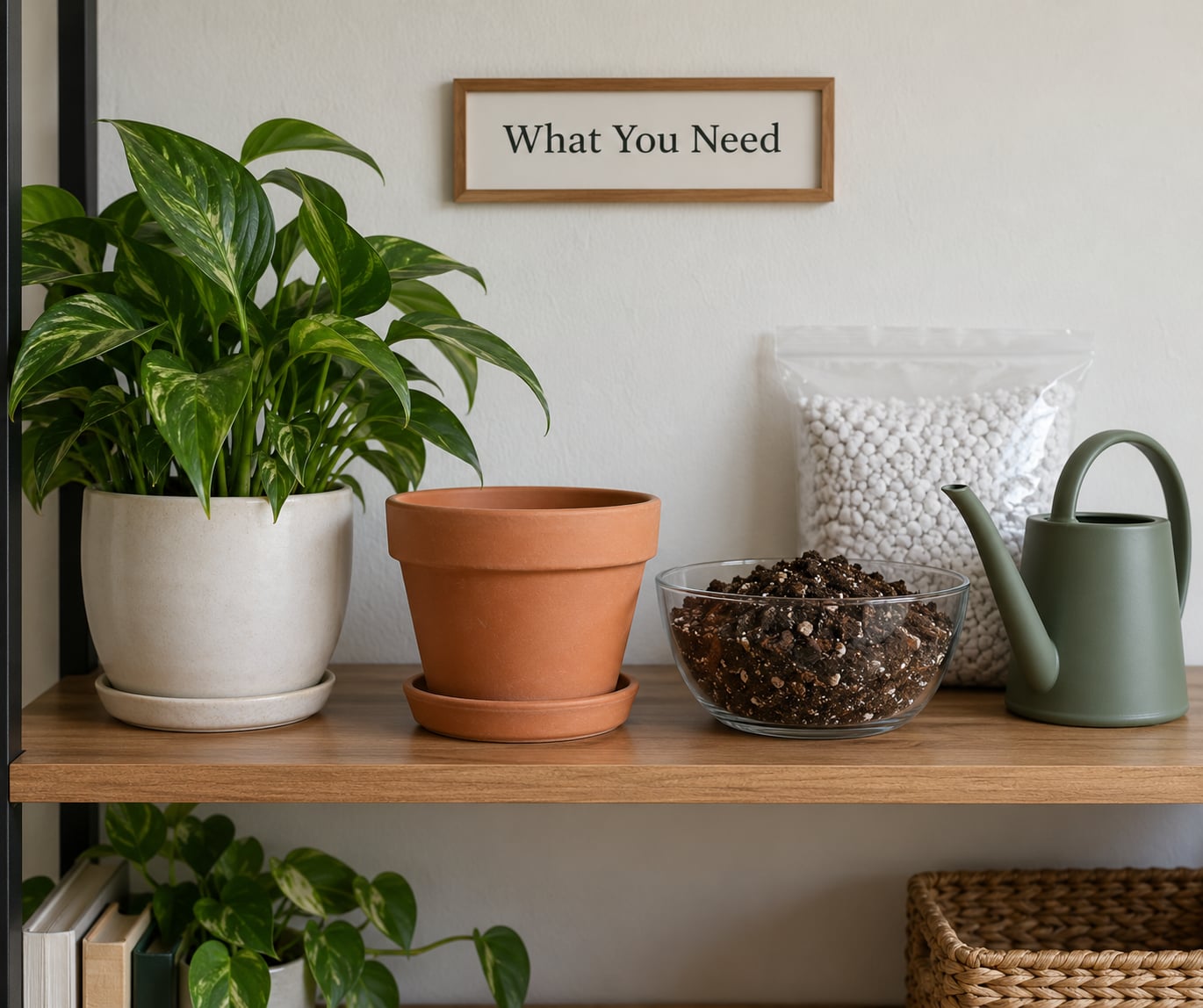
You need surprisingly little. Five things, most of which you probably already own.
Low-light plants that match your darkest spot
Snake plant (Dracaena trifasciata), ZZ plant (Zamioculcas zamiifolia), pothos (Epipremnum aureum) and cast iron plant (Aspidistra elatior) survive conditions that would kill a fiddle leaf fig in a month. Pick species based on how dark the spot really is, which is step one.
Pots with drainage holes
A decorative cachepot with no hole traps water against the rootball. That single missing hole is the most common reason a plant dies slowly in a room where light was never really the problem. Use a terracotta or thin plastic pot inside the pretty outer one, and empty the outer one after every watering.
Well-draining potting mix
Standard indoor mix holds water too long in a dim room. Mix in one part perlite per two or three parts of mix, or use a cactus and succulent blend for the drought-tolerant species. The extra air space keeps oxygen around the roots, and oxygen is what stops rot.
A finger or a moisture meter
You need a reliable way to check moisture instead of guessing. Your finger pushed two inches into the soil is enough. A moisture meter is better if you own ten plants or more, but it does not replace the habit of checking.
A watering can you can pour slowly
Water the soil, not the leaves. A fine-spout can lets you soak the rootball evenly instead of blasting the surface and letting it run down the sides.
Optional: a full-spectrum LED grow light and a timer
A lamp matters only when darkness is constant, which is common in a windowless living room, a basement unit or a north-facing bedroom. A clip lamp with a full-spectrum LED bulb does most of the work. The timer matters more than the fixture, because plants need a predictable schedule and eight uninterrupted hours of darkness.
Step-by-Step
Work through these seven steps in order. Each one depends on the one before it, and the order is not arbitrary.
1. Assess the darkest part of your apartment
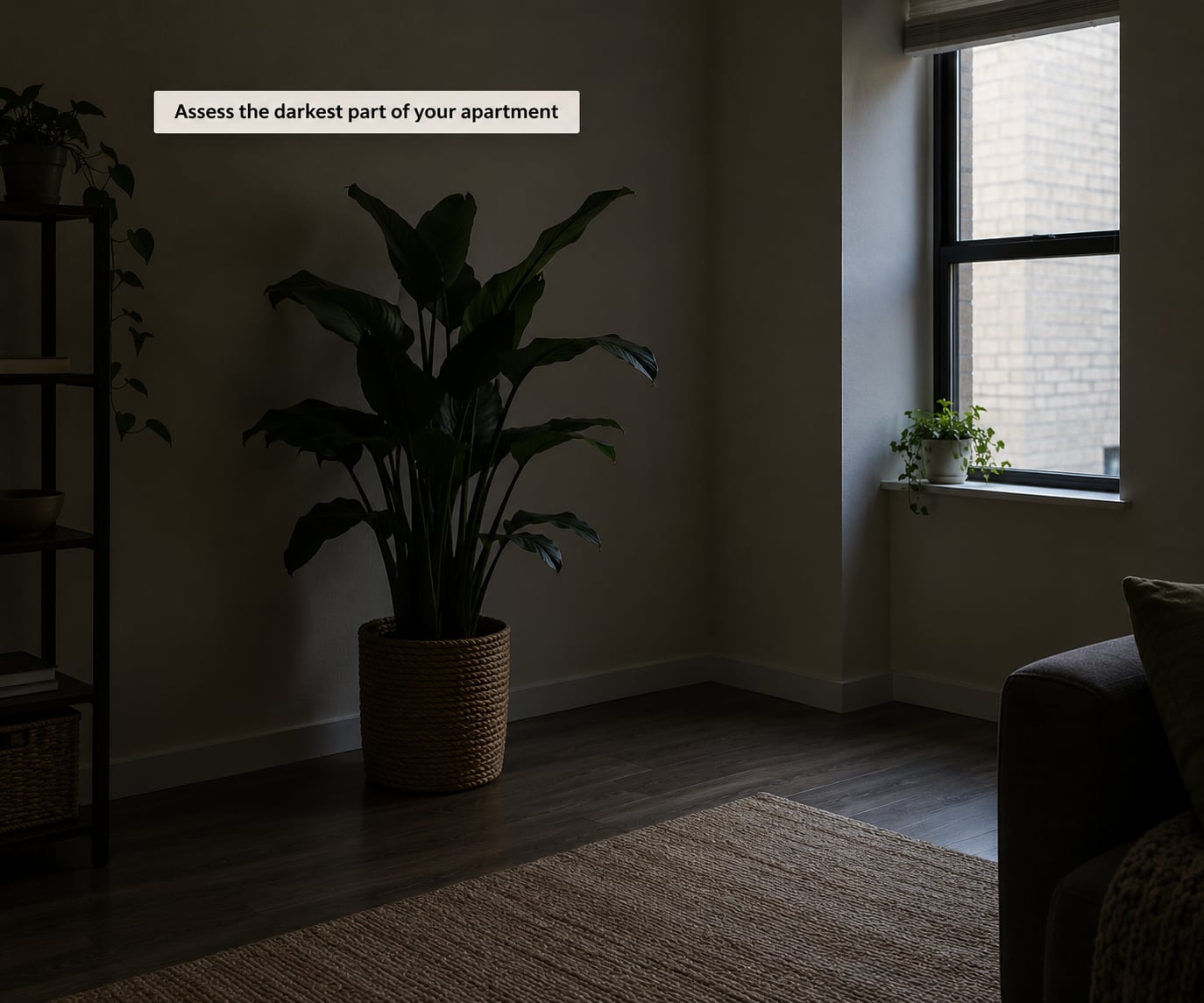
Stand in the spot where you want the plant and find out what you are dealing with. The old test still works: if you can comfortably read small print there at midday without turning on a lamp, you have enough light for most houseplants. If you can read the headline but squint at the body text, that is low light, and only the tolerant list survives. If the newspaper is unreadable, you are in true darkness and nothing lives there without a grow light.
A second check tells you how much the room changes through the day and the year. Note whether the window is north-facing, which gives soft, cool light and never direct sun, or blocked by an awning or a neighbouring building. Then watch for winter. A room with a usable window in June can drop to very low light in December, and a plant that shrugged off the summer may struggle by February.
How you know it worked: you can state your light level in one of three phrases, and you know which plants belong there.
2. Choose plants that tolerate low light
Match the species to the assessment. Snake plant and ZZ plant store water in thick leaves and rhizomes, so they tolerate both dimness and missed waterings, and they will sit in a hallway corner for years. Pothos and heartleaf philodendron (Philodendron hederaceum) trail happily from a shelf and grow fast in medium indirect light. Cast iron plant handles a north-facing window and cool rooms better than anything else. Chinese evergreen (Aglaonema) holds its colour in shade, and parlor palm (Chamaedorea elegans) wants filtered light rather than none.
Two honest expectations before you buy. A low-light plant grows slowly, which is fine, and it rarely flowers, which is not. Peace lily (Spathiphyllum) survives low light and will tell you clearly when it is thirsty through its drooping leaves, but it will not flower in a room this dim and may go dormant for weeks at a time.
Set expectations on pet safety before you shop, not after. Pothos, peace lily, spider plant and philodendron all cause irritation if a cat or dog chews the leaves. If pets share the room, peperomia (Peperomia obtusifolia), most calatheas, spider plants and prayer plants are the safer choices.
How you know it worked: your plant’s needs match your room, and nobody expects growth you cannot get.
3. Use the right pot and drainage
Choose a container one to two inches wider than the rootball, no more. An oversized pot holds a large volume of wet soil around a small root system, and the roots cannot use all that water, so the excess sits there and rots them.
Confirm three things before you fill it. The pot has a hole in the base. There is a saucer, and you empty it ten minutes after watering. The mix contains perlite, bark or another coarse ingredient for air. Then water thoroughly until it runs out of the hole, and empty the saucer. That drains-and-empty cycle is what keeps oxygen flowing in.
How you know it worked: the soil surface dries out within days rather than staying damp for a week, and the pot feels noticeably lighter when it is time to water.
4. Place plants where they receive the most available light
Even in a dark apartment you can usually improve the light by a few steps. Push plants as close to the window as the glass allows, because light falls off fast with distance. Clear anything blocking the lower part of the window, and hang a sheer curtain to diffuse harsh direct sun on south-facing glass so leaves do not scorch.
Rotate plants a quarter turn every week or two so growth stays even instead of leaning toward the glass. Clean the leaves monthly; a dusty surface reflects light back out of the room. Group plants near a mirror, since the mirror doubles the perceived light and the reflection reaches the darker side of the plant.
Skip the heating vent, the radiator and the top of the refrigerator. Warm, dry air pulls moisture out of leaves faster than a dim room can replace it.
How you know it worked: new leaves emerge at the same size as the old ones instead of coming in smaller and paler.
5. Water according to soil moisture, not a fixed schedule
This is the step that decides whether the rest works. A plant in a dim room photosynthesizes less, transpires less and uses water more slowly, so its water needs drop sharply. Someone moving a pothos from a sunny living room to a windowless bedroom and keeping to a weekly schedule is drowning it.
Check every five or six days in winter and every three or four in summer, always with the finger test. Learn the weight too: a pot that feels heavy is still damp, and a pot that feels light needs water.
Reduce frequency in three specific cases. Cooler rooms dry out slowly, so a north-facing room in winter may stretch to three weeks. Small terracotta pots dry faster than large plastic ones. And an unlit, cold-water-soaked mix can stay wet for weeks without any smell, so never assume a schedule transfers between rooms.
How you know it worked: soil is moist after watering, air-dry within a week in a warm room or two in a cool one, and the plant is neither limp nor yellowing.
Move your finger two inches into the soil before you pick up the can. If it feels damp, wait. If it feels dry and the pot is light, water. That check takes ten seconds and it outperforms any calendar.
Water the soil thoroughly when you do water, not a little splash. A small amount wets the top layer and leaves the rootball dry, which encourages shallow roots that dry out fast. Then empty the saucer.
Shorten your interval against instinct, but do not go endless. In low light, a snake plant might go three weeks between waterings while a calathea might need one week. When you are unsure, wait the extra few days. Roots recover from dryness. They rarely recover from rot.
6. Add a grow light when darkness is constant
A grow light makes a dark apartment workable. The term is marketing half the time, but the physics behind it is real: spectrum, intensity, duration and an uninterrupted dark period. For leafy houseplants you want blue-weighted light, since that drives leaf and stem growth.
Use a full-spectrum LED bulb in a clip lamp or a single-bulb fixture for one or two plants. Multi-bulb bar fixtures only make sense once you are growing a dozen plants under one unit. Higher-wattage fixtures also generate more heat, which is the main safety issue indoors.
Three numbers to hold onto. Run the lamp 12 to 14 hours a day, and give it eight hours of darkness without interruption. Keep it 6 to 12 inches above the highest leaves. Never let foliage touch a bulb; heat from an incandescent lamp is a known way to scorch leaves, and even LED fixtures get warm enough to stress a plant at close range.
Put it on a timer rather than remembering to switch it. A timer that runs 8 a.m. to 8 p.m. gives the plant consistency, which is what encourages steady growth.
How you know it worked: within a few weeks you see compact new leaves instead of long bare stems, and the plant stops leaning.
7. Build a simple ongoing care routine
A weekly ten-minute round beats an hour of fussing once a month. Check every pot with the finger test and water only what needs it. Wipe the leaves. Turn each plant a quarter turn.
On a monthly schedule, check for pests under the leaves and along stems, and pull off dead foliage at the base. Skip fertilizer for the first two months after repotting and never fertilize a plant that is dormant, cold, wilted or root-damaged. Feed only during active growth, and use a diluted balanced fertilizer at a quarter strength, because a dim room cannot process a heavy feeding.
Know the two moments a plant needs a new home. Repot when roots circle the bottom, water runs straight through, or growth has stalled for months despite steady care. Move when leaves burn on the window side, or when new leaves keep coming in smaller and paler.
How you know it worked: nothing dramatic. Steady leaves, no new yellowing, and no soil that stays wet for days.
Common Mistakes
Overwatering because the schedule never changed
The single most common killer in a dark apartment. Fix it by removing the calendar and checking soil moisture instead. If roots are already dark and mushy, repot into fresh dry mix and trim them back.
Placing plants in true darkness
A corner with no window at all cannot support a plant without a lamp. Fix it by moving the plant to the brightest available spot and adding a grow light on a timer.
Using an oversized pot
Extra soil means extra water, and a small root system cannot drink it. Fix it by sizing the pot to the rootball, one to two inches wider, and no more.
Using a decorative pot with no drainage hole
Water collects at the bottom with nowhere to go. Fix it by using a plain pot with a hole inside the cachepot and emptying the outer pot after every watering.
Misting instead of managing humidity
Misting leaves wet briefly and does almost nothing for the room. It also promotes fungal spots on soft leaves. Fix it by grouping plants together, keeping them off the heating vent, and leaving them alone otherwise.
Fertilizing a dark, dormant or stressed plant
Fertilizer feeds growth, and a plant in low light is barely growing. Fix it by waiting until you see active new leaves, then feeding lightly in spring and summer.
A few habits that matter more than anything else in this list: check before you water, water less than you think, and keep the leaves clean. If you only manage one thing, make it the finger test.
Frequently Asked Questions
Can plants survive 3 days without light?
Yes. A healthy houseplant stored in a dark closet or covered box will coast through three days with no light at all, because its leaves hold energy reserves built up over weeks. Water before you store it, move it somewhere dim and cool, and return it to its normal spot after three days. Plants lose more light-tolerant tolerance than people expect, so repeated moves between full light and total darkness are harder on them than the dark period itself.
What plants are good for an apartment with no sunlight?
Snake plant, ZZ plant, pothos, cast iron plant, Chinese evergreen and heartleaf philodendron are the usual answers for rooms with no direct sun. All of them are selected for tolerating shade rather than thriving in it, and all of them grow slowly in that light. Expect foliage, not flowers. If your room has zero natural light of any kind, choose the two or three hardiest of these and run a grow light on a 12 to 14 hour timer.
How often do you water a plant in low light?
Only when the top two inches of soil feel dry, which in a dim cool room might be every two to three weeks. Low light means less evaporation and slower growth, so a plant uses far less water than it would by a bright window. Water thoroughly until it drains, then empty the saucer. Never extend the interval indefinitely, though; bone-dry roots damage fine feeder roots and the plant takes months to recover.
Can plants survive 2 weeks without water?
Some can. Snake plants and ZZ plants store water in thick leaves and rhizomes and routinely go a month without a drink. Calatheas, peace lilies and ferns usually show damage well before two weeks. Two weeks is also long enough for a weak plant in a dark room to fail, so water thoroughly the day you leave, move it away from any window, and group it with other plants to hold a little more humidity around it.
What are the signs a plant is not getting enough light?
Leggy stems with long gaps between leaves, new leaves that are smaller and paler than old ones, leaning toward a window, dropping of the lowest leaves, and a complete lack of new growth. That combination is called etiolation, and it is the plant stretching toward light it cannot reach. None of it is fixable on the existing stems, so move the plant closer to the window or add a grow light, then expect better-looking growth rather than a recovery of what is already there.
How do I increase light for indoor plants?
Work in this order: move the plant closer to the window, strip back blinds and remove anything blocking the glass, then add a full-spectrum LED bulb in a clip lamp or single-bulb fixture. Run it 12 to 14 hours a day on a timer and keep it 6 to 12 inches above the canopy, with eight hours of uninterrupted darkness. Clean the leaves, since dust reflects away useful light, and rotate the pot weekly for even growth.
Conclusion
Start with four things this week. Read the small print in your darkest corner to find out what light level you actually have. Pick one genuinely low-light species for that spot. Check that the pot drains and the mix contains perlite. Then put your finger in the soil before you water, and let the plant tell you when it is thirsty rather than the calendar.
After that, change very little. Add a grow light on a 12 to 14 hour timer only if the darkness is constant, keep leaves clean, and check soil moisture on a loose schedule. Small steady adjustments keep a plant alive in a dark apartment for years. Extra water and a plant in a truly dark corner is how most of them die.